 |
|
|
|
|
|
|
|
|
|
|
|
|
|
|
|
|
|
|
|
|
|
|
|
|
|
|
|
|
|
|
|
|
|
|
|
|
|
|
|
|
|
|
 |
|
 |
|
|
|
|
 |
|
|
|
|
|
Andy Warhol |
|
|
 |
|
|
|
|
|
|
|
8/6/1928- 2/22/1987 |
|
|
|
|
|
|
|
|
|
Andy Warhol has quite an extensive list of accomplishments that accompany his name wherever it is mentioned. He had a fulfilling yet short life, due to his premature death in 1987 because of an operation. His schooling began in 1945 where he studied at the Carnegie Institute of Technology, |
|
|
|
|
|
|
Andy Warhol |
|
|
|
|
|
 |
|
|
|
|
|
|
|
|
|
Exhibit Reviews |
|
|
|
|
|
 |
|
|
|
|
|
|
|
|
|
|
|
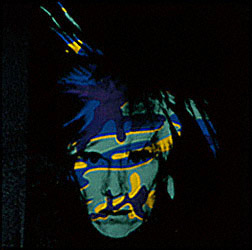
Andy Warhol, Self-Portrait, 1986 |
|
|
|
|
|
|
|
 |
|
|
|
|
|
|
|
|
|
now known as Carnegie Mellon. In 1949 he left for New York and worked for prestigious companies such as Vogue and Harper's Bazaar, and made window displays for Bonwit Teller. It was in 1952 that he had his own one-man exhibition at the Hugo Gallery, NY. In 1956, Madison Avenue housed his Golden Shoes and he traveled abroad. It was when he came back that his career took off full force. It was in 1962 that he began producing silkscreen prints of such things as the Campbell's Soup Cans, Dollar Bills, and Marilyn Monroe. Between the years of 1962-1964, he produced films, made over 2,000 pictures in his "Factory" and made his first sculptures. The Velvet Underground was first heard of in 1967 and he produced several films with them. Valerie Solanis, the one and only member of S.C.U.M. (The Society for Cutting Up Men) shot and seriously wounded him. 1970 brought him his own TV cable station, "Andy Warhol's TV". Throughout those years, numerous books were published by and about his life and work. Shows followed from the 1970's till the present day, representing a wide variety of his work. (Poich). These facts only represent Andy Warhol's accomplishments as an artist, but they do not describe him as a person. |
|
|
 |
|
|
|
|
Issues |
|
|
|
|
 |
|
|
|
|
 |
|
|
|
|
 |
|
|
|
|
 |
|
|
|
|
|
|
|
|
|
|
Andy Warhol at age of 31 was one of the most successful fashion illustrators, but was not satisfied with himself or his artwork. He began taking images from lower culture, magazines, newspapers, and incorporating them into his work. He knew this would cause a controversy because this imagery was not made for the exclusive, but for those in lower societal positions. Warhol began to experiment with his newfound medium and began working in repetition. At first he started by using rubber stamps, but found that the results were 'too homemade' and wanted something more commercialistic. It was then that he coined his technique of "photosilkscreening" that brought his so much acclaim and fame (Scherman). Warhol will probably always be remembered because of his silk-screening, not his books, not his photographs. He is seen as the father of Pop Art in America, and the silk-screens represent everything that it is. |
|
|
|
"I never fall apart because I never fall together" Andy Warhol, 1975-1979 |
|
|
|
 |
|
|
 |
|
|
|
|
|
|

|
|