Critics vs Public
    As a preface to this section, I must say this is not a very balanced opinion. I do not wish you to believe that everyone just loved this type of art, but it is very hard finding evidence that they hated it.  My theory is the art world feels inadequate for not understanding it at the time and does not with to rehash the subject of their dismissal.  That is only my opinion.
Andy Warhol
Exhibition Reviews
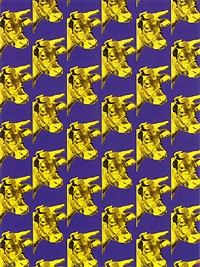
Warhol, Cow Wallpaper
    The debate is always the same, "Is this art?".  The question sparks many ideas and even more responses.  Art is such a personal, psychological, and physiological experience to a person, that all responses tend to be different.  It should be in the artist's missions that we can determine the validity of their art.  If they hold themselves true to their beliefs, it is riskier than conforming to society.  Art is an element that can cross cultural barriers and reach a wide variety of people.  Yes, it is true that they might have a different perspective due to their surroundings, but it still sparks an response.  For instance, critics in Germany, Italy, and European Continents thought that Warhol's work was not shallow and simplistic, but deep, complex, critical and rooted in art history.  Americans were just too uncultured to understand (Protzman).  Art is constant with the times, it is what the public yearns for, at least this is the case with Pop Art.
     The everyday public responded positively to this new type of art because it was refreshing and new.  It is speculated upon why they admired it, because it was familiar or for artistic values, but there is not an answer to the question.  The critics felt otherwise.  The New York Times in 1963 wrote that Lichtenstein was, "One of the worst artists in America... an academic draftsman retooled to blow up comic strips." (Scherman, 69).  Warhol was seen as capitalism's cheerleader through some of his comments.  He once said, "Making money is art and work is art and good business is the best art." (Fox). This art was embodied in what society was experiencing, what they were buying and the culture they were consuming.  It is the mass media that tended to be harsh on their work
Issues
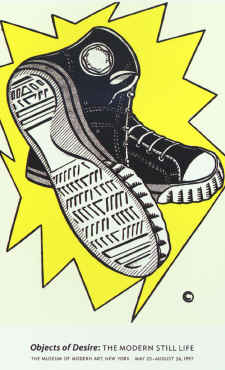
Lichtenstein, Keds
because Pop Art often criticized their role in this new society (Pioch).  The critics were generally disturbed by the familiarity or commercial character of the items depicted.  Responses to Oldenburg's cake and ice cream and Warhol's soup cans were sometimes seen as celebrating America's appetites or "criticizing its gluttony" (Fox).  In response to Andy Warhol in particular, critics often viewed his subjects as "victims" rather than active participants.  It is evident that there was some opposition to these artists, but when is there not?  Whenever an artist pushes new boundaries, they are thought as disruptive and ignorant.  We have this problem in the year 2001 and will continue to have this problem for some time to come.
     Nowadays, the work of Pop Artists from both the past and present are being cherished and admired by both critics and the public.  This is due to both our increasing understanding of the movement and to the people whom pushed the boundaries 40 years ago.
Hosted by www.Geocities.ws

1