 |
| Pampanga Philippine Festival Pinetensya Manila Cebu Davao Philippines geography Philippine Food Philippine national athem Baguio |
 |
 |
 |
 |
| Davao City is the capital of the Southern Mindanao Region. It is strategically located at the Southeastern part of Mindanao with latitude of 6*58�f to 7* 34�f North and a longitude of 125*14�f to 125*40�f East. Mt. Apo, a dormant volcano and the highest mountain the country, is favorite destiantion, treks may be arranged with tour agencies. The trek starts only after a bus ride to Kidapawan, 107 kilometers south of Davao City, a 12-kilometers south of Davao City, a 12-kilometer jeep ride to Barangay Ginatilan, and a five-kilometer jeepney ride to barrangay Ilomavis. From there, the climb begins. Trekkers will find on the slopes forest of exotic flora, steaming geyseres, rainwater lakes, swift-flowing rivers, and cascading waterfalls. After four days of leisurely trek, you are bound to see the Agko Blue Lake, a steaming lake with some parts that are icy cold and others that are boiling hot; Lake Venado, an iregularly shaped expanse bordered by a think carpet of bermuda grass; and the Mt. Apo Crater. Mt. Apo is home to theendangered Philippine Eagle, the world's tallest eagle species at one ane meter high and, with a wing span of about 2.5 meters, the largest. The eagle preys on mokeys, flying lemurs, flying squirrels and, occasionally, pigs nd goats. The mountain is also a sanctuary for some rare birds such as the flycatcher, fairy blue birds, flower catchers, coltos, doves, sunbirds, and racket-tailed parrots. On the base of the mountain is the Mt. Apo Science Foundation, an agrucultural foundation where you can bird watching, the Philippines Eagle Nature Center, which provides temporary shelter to 10 eagles in captivity and numerous birds, animals, and tropical plant.I ts boundary line passes through the top of the country�fs highest peak, the Mt. Apo. On the north, Davao del Norte bound it, while on the east, partly by Davao del Norte and the Davao Gulf. The city�fs strategic location makes it the center of trade not only in the Southern Mindanao region or the whole of Mindanao but also in the East ASEAN Growth Area (EAGA). Total land area of Davao City is 2,440 square kilometers. In terms of land area, it is the largest city in the world. It is divided into 3 congressional districts and further into 11 administrative districts and 180 barangays. Almost 50% of its total land area is classified as timberland or forested area. Agriculture utilizes about 43%. This is reflective of the fact that agriculture is still the largest economic sector. Big plantations that produce banana, pineapple, coffee, and coconut eat up a large chunk of total land area. Presently, built-up areas used for residential, institutional, commercial, and industrial purposes represent about 10% of the total land area. Climate Davao City is typhoon-free. The city enjoys a weather that remains balmy all year round. It is characterized by a uniform distribution of rainfall, temperature, humidity, and air pressure. It has no pronounced wet or dry season. Weather predictability makes it highly conducive to agro-crop production. Temperature ranges from 20 to 32 degrees Celsius and average rainfall is up to 2,000 mm yearly. Dialect/Language Cebuano is the most widely spoken dialect. The Filipino language comes a close second. English is the medium of instruction in schools and is widely understood and spoken especially in the business community. Religion The most dominant group is the Roman Catholic at 77.2% of the total population. While various Baptists, Pentecostal, and other born-again Christian groups comprise 15.3% of Davaoenos. Islam is at 2.3% and Iglesia ni Cristo at 2.2%. In still smaller percentages are the Seventh-day Adventists, Jehovah�fs Witnesses, Mormons, Aglipayans, Buddhists, and Taoists. Physical Infrastructure The presence of basic infrastructure within the City such as airport, seaports, roads, bridges, and telecommunications has sustained the economic growth in the last 10 years. Due to the City�fs unprecedented growth, a clamor for higher capacity infrastructures resulted to a number of modernization projects now ongoing to meet the demands of the new millennium. |
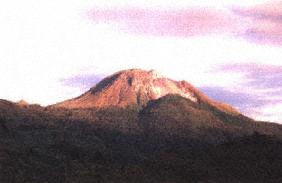 |
| Mt. Apo |
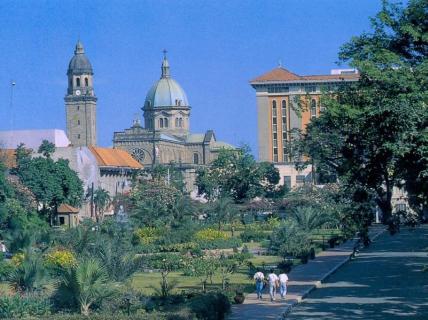 |
| Davao City |
 |
| Davao Eagle |