| More than grandiose
vision papers and long lists of achievements, the Diliman
chancellor must be weighed according to his/her principles
and track record, not as the supposed ruler of the Diliman
republic, but as the humble servant of his/her constituents.
The university during the past decades has been administered
through sheer complicity to iniquitous state agendas.
In Diliman, particularly, UP’s constituents, composed
of the students and faculty as well as members of the
community, have been gradually alienated because of
various policies implemented in line with the said prescriptions.
Administrators, as such, instead of reaffirming the
role of UP as the university of the people, merely serve
as conduits to the realignment of UP from a state to
a private institution.
Dr. Sergio Cao’s term did not result in any tangible
measures that would assert the welfare of the UP community.
It is disheartening to note that his vision paper –
revolving around the thrust towards an “excellent”
university – student rights and welfare appeared
merely as a footnote with motherhood prescriptions.
Excellence, indeed, is an ideal that must be constantly
recalled. The question that must be addressed, however,
is towards what end and to whose benefit? And through
what measures shall we pursue such ideal?
A glimpse of Cao’s term will reveal his failures
in working as a servant of the UP community. During
the campaign for the tuition increase, he merely served
as the mouthpiece of the Roman administration, unmindful
of the opposition from the ranks of the students and
faculty. It was as if he was Diliman’s sovereign,
adopting any policy that rendered expedient the agenda
to commercialize UP education.
Cao’s term as chancellor also oversaw the displacement
of UP communities, which he even regarded as an achievement
in the paper he submitted during his campaign for another
term. During the course of his chancellorship, around
200 janitors lost their jobs due to the hiring of a
private agency. During the campaign for the tuition
increase, meanwhile, the Collegian itself experienced
its longest hiatus because of skewed provisions in a
new procurement law. Cao did not defend the publication,
but instead emerged as the vanguard of twisted interpretations
of the said law. It was during his term, moreover, that
the “no ID, no entry” policy as well as
the 10 pm curfew was adopted.
Diliman, during Cao’s term, has indeed undergone
major changes. These changes, however, prove to be mere
masks concealing the regression of Diliman into an enclosed
campus, alienating the community and the people the
unversity is purported to serve.
The alternative to Cao, however, is equally subservient
to lopsided government agendas. Dr. Maria Serena Diokno,
another candidate for the chancellorship, was behind
the implementation of the Revitalized General Education
Program which transformed the university’s curriculum
to simulate the dynamics of the market, pushing core
subjects such as Philippine history to the peripheries
of the students’ imagination.
She, however, would be the least likely to become the
next chancellor after submitting a counter proposal
to the Socialized Tuition and Financial Assistance Program
adopted by the Roman administration. Diokno, as such,
only has one advantage: the benefit of the doubt.
The selection of the next Diliman chancellor is certainly
not in our hands right now because of the elitist structure
of the administration. It will be up to the Board of
Regents to decide next week. But let us define our position.
We do not need an apologist of the state as Diliman
chancellor. What we need is someone subservient only
to one principle – service to the people. It is
under such principle that we must attune the capacity
of the university towards excellence and integrity.
Marked Silence
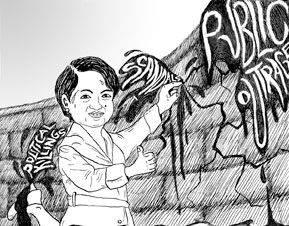
The renewed calls for Gloria Arroyo’s resignation
has possibly reached the most intense volume. UP, however,
has remained silent.
Universities such as La Salle, Ateneo, and Miriam have
already drawn the line in light of Jun Lozada’s
exposes on the ZTE scandal. Civil society groups and
Church institutions have also bannered the call. Everytime,
when we tune in on the news, we always half expect UP
as an institution to engage the tumult.
Thus, this is a challenge posed to the Roman administration.
We call on the administration to define its stand.
Students and various institutions in the university
such as the College of Law have already registered their
disgust and condemnation. The call for Arroyo to vacate
the presidency have already spanned years in the avenues
of the university. If anything, we should be leading
the call. Our clamor should be the loudest of all.
We must not be limited to the festivities surrounding
the UP centennial celebration. UP’s relevance
is based on its fearless forays into issues of national
significance. Currently, however, history seems to be
unfolding and we are not part of it.
This is a call for engagement. UP must come up with
its collective stand. Only then shall we affirm the
illustrious history of the university. It is not through
silence or compliance that we have defined it. It is
in the constant engagements that have changed the country
which rendered the history of UP as the history of the
Filipino people. # Philippine
Collegian
<< back to home |