
I returned to Pegasus within a few days after relocating her at Owl Harbor Marina in the California Delta. With me was a large assortment of cleaning supplies and a complete range of tools, manual and power. The bilge was my first priority and resulted in many hours of sometimes humorous and sometimes aggravating labor. How could such a small space require such a major effort? I should note here that although Pegasus is our fifth boat, she is only our second sailboat and the first one with a real bilge. I now understand why everyone speaks softly or mutters incoherently when discussing "cleaning their bilge."
I approached my new experience by removing
everything that was even close to the bilge except the portable ice chest
that contained the beer. 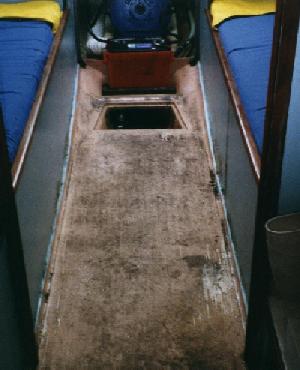 Water
pipes, hose's, electric and manual pumps, wiring, check valves, batteries,
etc. Next, I poured in a gallon of Simple Green then added a gallon
of water. I allowed this micro brew to stand undisturbed for about
2 hours while I worked elsewhere. Kind of like making your own beer;
you bottle it, cap it, then go out and get a hamburger and let it age before
conducting lengthily taste tests.
Water
pipes, hose's, electric and manual pumps, wiring, check valves, batteries,
etc. Next, I poured in a gallon of Simple Green then added a gallon
of water. I allowed this micro brew to stand undisturbed for about
2 hours while I worked elsewhere. Kind of like making your own beer;
you bottle it, cap it, then go out and get a hamburger and let it age before
conducting lengthily taste tests.
Before removing the Simple Green and water solution I scrubbed the bilge using an old Navy type stiff bristle brush. The solution laying 3 feet below me became very murky and about the consistency of cream. To remove the muck, I made a scooping container from a can no wider than the bottom of the bilge and attached it to a mop handle. This allowed me to reach to the aft most part of the bilge and pull the sweet smelling but bad looking muck toward me collecting solution and junk along the way.
What started as a chore however, soon became a game. My first treasure was a 9/16 inch open end wrench - Craftsman, excellent quality and still in good condition - good find. This was followed by another wrench of the same size and brand - Whoever was storing their tools in Pegasus's bilge knew quality. Next came 2 screw drivers (badly corroded and no longer usable - this was disappointing, I needed screw drivers more than 9/16" wrenches.
I continued to slowly drag my can along the bottom carefully pouring the contents into a large bucket while scanning the remains. I felt like an old gold minor searching for the prize nugget that would bring unlimited wealth and fame. However, in addition to the wrenches and screw drivers, my efforts produced nothing more than 2 one inch galvanized pipes - both 8 inches long - any guesses of their use? One 1/2 inch deep well socket - another Craftsman, a 1/4 inch dowel 12 inches long (could have been the fuel gauge I guess) and, of course my murky micro brew.
I repeated the above process, with less soaking each time, until the solution returned clean and I could clearly see the bottom of the bilge through a fresh water rinse. The bilge not only looked good, it smelled good. The remains, except for the wrenches and deep well socket, were hauled off to an appropriate dumping site.
With Pegasus's lower GI completed, I turned my attention to the pumps. I was most concerned with the electric pump which still sounded sick. I removed and cleaned the filter screen and all exposed parts that I could reach however, I could not assess internal damage. The pump was a "rule, Automatic Bilge Pump" whose role aboard Pegasus would be critical with California's wet season a short time away. So concerned was I, that I purchased another automatic pump (different manufacture) only to discover that it could not pump water from the bottom of the bilge (I got my money back with the explanation that it was probably designed for power boats).
Knowing little about automatic bilge pumps, I decided that I had better stick with the brand originally in the boat. Before returning to the parts house, I reassembled the sickly sounding rule pump and placed it into a bucket of 100% Simple Green and let it set for about an hour. I then connected it to a battery for about 10 minutes allowing it to operate in the cleaning solution. Today, many El Nino storms later, the original automatic rule pump still comes on every 2.5 minutes and looks for liquid (you can set your watch by it). If it finds water in its domain, it pumps with authority until it satisfies itself that all is dry then goes back to sleep for another 2.5 minutes. How simple can you get?
The manual pump is a Gusher 10 that once cleaned and lubricated, worked ok but what the manufacture advertises as a "die-cast, epoxy coated, anodized alloy body" shows major signs of internal corrosion. For now its adequate but it has been added to the list of items requiring future replacements.
My cleaning effort ended with the addition a 3M Bilge Pillow to minimize the possibility of dumping contaminants overboard. Needless to say, my experiences with Simple Green and rule automatic pumps has been very positive.
The next order of business was the cabin sole
(refer to the above photo). I would have preferred to save the sole
for last because of Pegasus's strange drain system however, 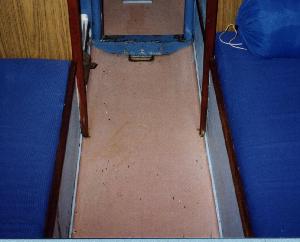 it
was so dirty that I was tracking muck everywhere I went. Again Simple
Green came to the rescue. I dammed up the sole at the point leading
into the bilge and added about a 1/2 inch of 50/50 Simple Green and water
and let it soak for an hour. A sponge wipe-up and a fresh water rinse
brought back a sole that showed her years but not her neglect. I guess
a little Simple Green every 40 years helps.
it
was so dirty that I was tracking muck everywhere I went. Again Simple
Green came to the rescue. I dammed up the sole at the point leading
into the bilge and added about a 1/2 inch of 50/50 Simple Green and water
and let it soak for an hour. A sponge wipe-up and a fresh water rinse
brought back a sole that showed her years but not her neglect. I guess
a little Simple Green every 40 years helps.
With the bulk of cleaning completed I finally felt that I could continue with my goal of renovating Pegasus to better meet our sailing life style; using the 4 decade her design to produce a safe and comfortable pocket cruiser for 2 to sail the California coast and Delta. Maybe even participate in some of those fun race's on occasion. Having no racing experience however, I will have to rely on the advise and instruction from other Triton owners that seem to have captured untold hours of enjoyment racing each other throughout the summer months. Plus, being the kind hearted folks that Triton owners are, I think they will give me some kind of an extra handicap for my inexperience, 1978 gray and brown sails, multi-patched genoa and a spinnaker that's held together by its launch bag. Why do I not see anyone standing in the sympathy line?
At this point in the Pegasus Project California's weather was turning very wet and the 1998 El Nino had arrived as predicted. Hunkered down under a blue plastic tarp draped over the boom, Jo and I dedicated our efforts on the interior; one compartment at a time starting in the forepeak and working aft.
The Pegasus Project
|
|
|
|
|
|
|
|
|
|
|
|
|