 |
2.5 consistency with quantum mechanics
1.) The subtle ambiguity in the function of c (identified in Section 2.3) is reflected in the rapprochement between discreteness and continuity in PM. A change in norm of c means that the 4-momentum of a lightlike null vector is ‘regauged’, not in spacetime but in a PM state space that we have called CN. We can visualise CN as a ‘hyperspacetime’. An electron recoil in R3 then represents a change in the hypermomentum of a photon track which, from a certain point of view, could be said to be continuous (Note 1). This hyperspacetime is then the N-dimensional phase space of all PM N-vectors.
Note 1. The stationary state in CN which is recovered when local scale-specific coupling is (notionally) removed is the Nth partial mode of an 'open' string which can be thought of as a time-reversal-invariant supersymmetric superposition of virtual photons and virtual electrons. The antinodes on this virtual string path are equivalent to anyons, quasi-particles with continuously-interpolated symmetric/antisymmetric wave functions, in the effective reduced 2-dimensionality of the PM hyperplane (due to the scale-free identity of 'lattice' separation and correlation length in CN. Of course because N is itself proportional to the self-interaction coupling in R3 then unravelling the string goes to the limit N = 1 in CN.
|
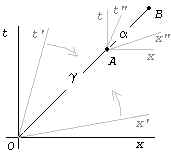
Fig.16
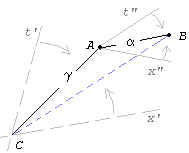
2.) Consider Fig.16. This can be looked at as an ordinary spacetime diagram which shows worldlines of g and a as collinear lightlike vectors with congruent spacetime axes illustrating the case where c is constant on OA and AB. Also shown are arbitrary Minkowski-orthogonal axes for frames moving with different <c velocities relative to both congruent rest frames x, t, to remind us that (as we saw earlier in relation to Fig.5, Section 2.3) a photon null vector collapses all axes like t’, x’ or t", x" onto itself and is considered to be self-orthogonal in its own frame. Accordingly one can say that c is equivalent to all values of itself.
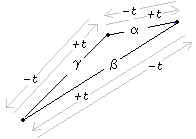
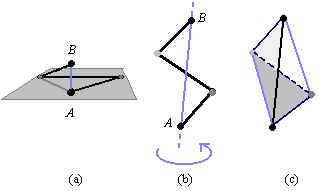
3.) Adopting this hyperspace vantage, we can bring out the idea that light is always at rest with respect to all hypervector orientations of itself. Because each such hyperworld-line is self-orthogonal in spacetime coordinates we are free to break the lightlike line into arbitrary discrete elements of unit speed, rotated to produce a non-differentiable acceleration in the hyperspeed of light. To do this we have to superimpose different sets of coordinate axes in a very unorthodox way which would be untenable if light were a spherical wave radiated to infinity in continuous space (Fig.17a). But PM confinement ensures that path a remains a properly null zero vector consistently with all diagrams, because we allow photon a to define the set of electrons with which it is in a lightlike relation as those which confine it (‘observe’ it), in this case only A or B at either end of path a.
|
|
(a) |
(b) |
Fig.17
4.) The break in the lightlike line automatically generates an elementary PM triad, where the spacetime origin is regauged at A, B and C. In Fig.17b the triad itself has now broken free from background coordinates and is self-referent. The interesting thing about this is the way that the pairs of antiparallel vectors each cancelled in the state of PM dynamical rest now find themselves transported nose to tail to give a counter-rotating ‘circulation’ of quantities like mi and mg. In the simplest case, that of a triad in isolated equilibrium, this has to be regarded as a virtual circulation where the quantities cancel to zero at all points of measurement.
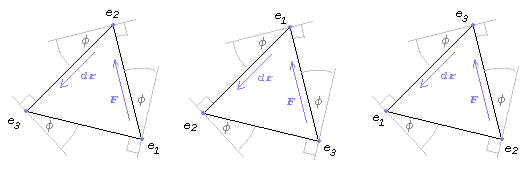
5.) In isolated equilibrium the transformation of unit scale around the triad maps like 1:1:1 giving an equilateral figure with 120o exterior ‘scattering’ angles, representing cos30o of negative work per vertex, summing to a total of cos90o around the triad. This means that (in this hyperspace representation) zero work of ‘displacement’ is done overall either in transporting a photon around the loop, beginning at any vertex, or in interchanging any pair of vertices (virtual electron positions). This gauge symmetry (see Fig.18) recapitulates the equilibrium of an isolated dyad inside a rudimentary triad that remains internally massless; in other words it is preserving a supersymmetric mode that realises c = constant in the form of unit time and unit scale. Here ‘c = constant’ means ‘c = unmeasurable’, in the sense that c/c = 1 is not contingent but is enforced for all possible measurements. The equi-angular triad enforces that the scaling algorithm for ‘physical measurements’ made by the system on itself recapitulates the degenerate identity of Fig.10, Section 2.3.
Fig.18. Triad symmetry. In one complete rotation each point exchanges labels with every other and each side is sequentially a force vector, F, a displacement vector, dr, and their scalar product F dr cos f. If this vector direction represents +t then the antiparallel direction (not shown) would be -t, and the cancellation on each side is reflected in the vanishing total (cos 90o) of negative work done in taking a photon cursor around the loop and back (in either direction) or in transposing any pair of virtual electron positions. |
But since isolation is impossible (this is a condition of the geometry of the complete graph in PM) this equilibrium configuration is in general not stable and ‘decays’ to another metrical state, in which state we say that the mass field is emergent from the radiation field (Note 2). In this new asymmetrical state we can still trace a gauge loop of zero summed work around the triad from any vertex; but the work done is now not the same at each vertex and may indeed be positive on one of them. It is in the breaking of the idealised boson symmetry to this dynamical equilibrium that the fermion symmetry appears and the virtual electron positions in Fig.18 become real. (As we will see presently this can easily be visualised in terms of the transition from the zero-mass invariant spin-1 polarisation of a symmetrical photon y function to a triad of non-zero-mass spin-1/2 electron y functions.)
Note 2. It is well known that a solid triangular lattice in a plane is the lowest energy state of a classical Coulomb system. From PM's point of view a triad in such a structure finds a cooperative equilibrium whose measurable energy DE is the rate and amplitude of its oscillation around a state of highest probability determined nonlocally over the whole hyperlattice, each triad acting as both driver and resonator. So mass is proportional to an average departure from static equilibrium and is a minimum condition with no unique instantaneous value.
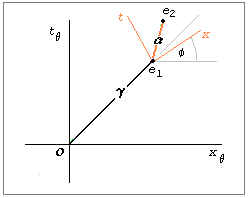
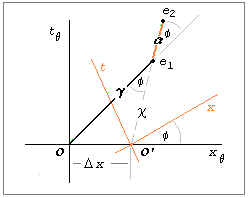
6.) Consider Fig.19, a schematic hyperspacetime diagram for a c of varying norm, in which the tail of a lightlike line a is transported to the head of the lightlike line g at a point which represents (say) an electron’s scattering region between two photon paths. Since all frames are rest frames with respect to light the start of every photon hyperworld-line will bisect (Fig.19a) a pair of identically orthogonal hyperspacetime axes at x = 0, t = 0. As Fig.19b shows, the projection of a on x defines an origin O’ which is simultaneous in the frame of O but hyperspacelike-displaced by the quantity Dx. The point O’ does not appear to have a physical significance in the hyperframe of g, or of a, but insofar as g is a ‘force’ applied to e1 in the rest frame of an electron hyperposition at O (f being fairly directly proportional to photon momentum in the case of scattering, probabilistically so in the case of resonance radiation) it might be permissible to think of Dx as a virtual hyperspace displacement vector proportional to a quantity of work that would have to be done to cancel the change in the norm of photon speed through the ‘hyperangle’ f from cg to ca. (The resemblance of this construction to the addition of complex phase angles in quantum theory is not accidental, as we will argue in detail later.)
Fig.19. Schematic hyperspacetime diagram for multi-phase c of varying norm. The black axes tq and xq signify the hyperframe of an electron arbitrarily taken as ‘at rest’ at the origin O of photon hyperworld-line g. Orange axes in (b) show the projection of the ‘scattered’ hyperworld-line a on xq. The displaced hyperposition O’ is ‘simultaneous with’ O. Simultaneity is here defined by, and only by, a terminus of any photon hyperworld-line from O on which 4-space interval s2 goes to zero, and so Dx not only must represent the distribution of an indeterminate position function for a ‘pair of electrons’, in fact it must represent this function for all such pairs. It is not a real distance on the hyperspacelike world-line of a particular electron, but rather the geometrical expression of PM unit scale, which is just the photon hyperworld-line connecting any electron position measurement with any other. We can see that what is significant about this geometry is not the absolute value of Dx (which varies arbitrarily with the hypercoordinates of e1) but its oscillation on xq which is a periodic function of the rotation of the phasor a. The text explains why this becomes a complex function. |
7.) The fact that f has a non-zero value at all is just what determines that g is no longer ‘observable’ at O (because of scattering or resonant re-radiation away from the lightlike hyperworld-line of O at e1), but its actual (complex) value is proportional to a displaced hyperposition on xq which is ‘seen’ by an electron at e2 as the hyperposition (simultaneous in the frame of O) from which a is emitted in the case that c is globally single-valued. If c is taken to be single-valued in a single-phase hyperspacetime continuum then e2 could say that O is actually a virtual position of O’ analogous to an optical refraction. In fact this is the point of view which, when ‘scattering’ by mass is considered in relativity, leads from the continuous flat manifold to the idea of a continuous curvature.
8.) This view corresponds to looking ‘back in time’ across a gradient of potential in a background space field that causes deflection of the lightlike line g,a proportional to a local mass at e1. (Note 3) But from our bird’s-eye point of view, where c acquires arbitrary values in a multi-phase hyperspacetime, a more natural point of view is that O’ is a virtual position of O, and instead of the curvature of a continuous medium due to a scalar mass at e1 this gives us an inverted picture of gravitational deflection, where what we call the local mass of e1 indexes a hyperspacetime ‘dispersion’ due to a discrete variation in the speed of light. We can call this a dispersion in the sense that c changes at e1 simultaneously for all space wavelengths and then again at e2 simultaneously for all space wavelengths, and so on. There is no dispersion between any pair of measurements, so it occurs not in spacetime but as a hyperspace phonon-like mode of the deflected lightlike string. The ‘reason’ for the deflection at e1 is then no longer to be sought at e1 itself, but in these phonon-like modes existing over larger hyperspacetime regions and quantising the ‘refractive index’ of the PM vacuum.
Note 3. In principle the electron's mass charge would deflect a light-speed graviton propagating on g and a in just the way that its electric charge deflects a photon. The description of the couplings in terms of the underlying PM geometry is the same.
9.) How does this perspective help us? The hyperangle f is proportional to a change in the hypermomentum of a photon, and more fundamentally that of any massless boson interaction - including therefore the gravitational interaction according to standard quantum treatments of GR. But how do we measure this? The ‘actual (complex) value’ of the hyperangle f is an emergent representation of the self-consistent network of translational and rotational transformations, and therefore just an index of c itself; so its ‘measurement’ consists in the familiar relativistic process of establishing dynamical consistency in systems (the pre-metrical character of Dx is the whole point of the conception of PM unit scale, after all) and on that account our construction might be thought to be a redundant level of description. But from the point of view of PM’s conception of a many-centred space the idea of a multi-phase c represents a generalisation of SR to a theory that ‘includes gravity’, via a type of complex vector construction that (as we will show in detail in Section 2.6) evokes and extends the formalism of quantum mechanics. It allows us to say that a ratio of phases represented by the hyperangle f acquires physical significance in terms of a projective superposition of ‘spacetimes’ that are not rotationally isotropic because their null-geodesic geometries differently, and privately, coordinatise the complex plane (every measurement triad defines a plane). This is the principle in terms of which we will be able to understand why mass is not a scalar particle property and does not ‘live’ at the point of its action (e1), but rather is a nonlocal property of the emergent planar ‘hyperfield’ containing O, O’ and e1, and exists as a superposition of values of the unit vector Dx on the simultaneous hyperplane of O in Fig.19.b.
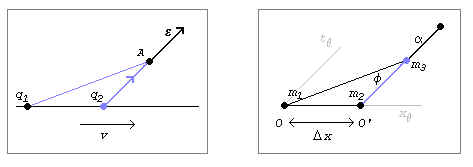
10.) We can visualise (Fig.20) how such a construction might be dual with a local field representation if we say that O is analogous to the so-called ‘retarded position’ (Note 4) of an electron e0 at O’ in respect of which the path a would remain a massless null radial component (mi - mg = 0) of the PM space field registered at O’. The hyperspace distance Dx travelling towards O can be regarded as the inverse of this mass/time-negating hyper-displacement. Therefore the complex hyperangle f is proportional to a non-zero positive mass/time gradient on xq, equivalent to the negative change in hypermomentum of the photon a due to renormalising c, and associated with a hyperspace-like interval containing two position states of ‘the same’ electron. This means that the shift Dx ‘takes place’ on the hyperplane of simultaneity containing both O and O’, and evidently represents the PM projective geometric identity of point and line being expressed in the transition between a spacetime view and the view from the PM state space.
Note 4. The analogy sees g and c in Fig.19.b as sequential force vectors in the PM hyperfield. The retarded position of e in an electric field refers to an advanced future position of e, whereas here we have a 'retardation' relative to a hyperspace 'position'. Again, we say that in terms of the underlying PM geometry the description is the same.
Fig.20. Schematic illustration of analogy between (a) retarded spacetime position of charge q in electric field e and (b) displaced simultaneous hyperpositions of mass m in PM space. In (a) the radial direction of e at a time t2 is associated with a moving charge at position q2. But if a local action due to q2 is limited by c then a test charge at A cannot instantaneously know the position of q2. Therefore if the radius vector of the force qe exerted at A is ‘caused by’ the moving point charge then it must be determined when the charge is still at q1, the so-called ‘retarded position’ of q2. In (b) a displacement m1 « m2 on a hyperplane of simultaneity is a doublet position state in the projective geometry of PM hyperspace. Dx represents the projection of unit scale as an arbitrary distance in any arbitrary spacetime frame, because in this hypergeometry of nonlocal couplings it is rotations, not scales, that have physical significance. The deflection proportional to Dx is a hyperangle which is thus a constant of all local geometries (Lorentzian frames). |
11.) PM’s geometry ensures that although the transition Dx is ‘instantaneous’ in the frame of O it does not violate momentum conservation, because it does not transport mass-energy. From the proper point of view of O (or of O’) in which Dx is radial, this is because of the cancellations +t -t = 0, mi - mg = 0 on xq. From the point of view of e1 (or of any other e for which OO’ is transverse) these cancellations are generally speaking not exact; but even so, Dx is an interval whose ‘centre of mass’ neither spontaneously ‘moves’ in spacetime, nor remains fixed. There is simply no scalar position state in the ‘middle’ of our Einstein’s-box that can be associated with a ‘centre of mass’, and what changes is a resultant of two opposed vectors, whilst a system of exhaustively interconnected self-orthogonal 1-dimensional spacetime ‘boxes’ (Note 5) undergoes evolution by re-scaling in PM hyperspace so as to define ‘rest’ as the dynamical equilibrium preserved in, and between, all boxes. And thus, as suggested in Section 2.2. para.10, it becomes impossible to support a distinction between ‘non-inertial’ unit vector accelerations due to an applied force and intrinsic or ‘inertial’ accelerations where there is no applied force, which satisfies the equivalence principle.
Note 5. This means one real dimension; each 'box' is a doublet state that is actually complex 2-dimensional in terms of its advanced (real) and retarded (imaginary) wave representations.
12.) So a non-zero mass and time (Note 6) on OO’ emerges proportional to the changing complex hyperangle Oe1O’ = f in a system where c becomes many-valued, and the properties of this geometry explain why these quantities are finite self-limiting. In general for most values of f in real systems, mi - mg ¹ 0 and +t -t ¹ 0, because the triads are scalene like Oe1O’ and because each side has a multiple role in the PM geometry, not only as both force vector and as displacement vector (Fig.14) but also as a resultant. Thus the ‘length’ of each side (its projection of unit scale Dx) is a superposition of three interdependent vector magnitudes each specifiable in three different ways, whose various combinations generate different internal angles. In these cases it is clear that the scalar product for work done on any side depends sensitively on the order in which the operator values of the remaining two sides are taken, and that the matrix of cyclic permutations of these logical orderings produces a periodic oscillation which is equivalent both to the permutations of position and momentum coordinates in the Heisenberg picture and to the differentiation of the wave function with respect to time in the Schrodinger picture. This results in the antisymmetric wave function where pq ¹ qp for almost all combinations of values of f, p and q (force » momentum, p; displacement » position, q).
Note 6. Important reminder: PM antiparallel-vector dyads mustn't be seen as simplified miniature facsimiles of the large scale cosmos, containing properties like 'time', 'mass' etc., neither individually nor even in systems that are numerically quite large compared to the schematic triads considered here. What we call a 'mass vector' or an 'advanced wave in the negative time direction' are concepts derived from theories of complicated systems. But the system properties we so label in the ensemble arise from a rudimentary dyadic PM symmetry which is itself a dimensionless quality.
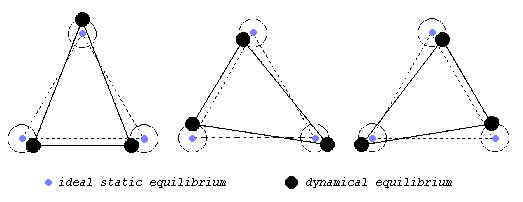
Fig.21. One cycle of ‘operator orderings’ in an equilibrating antisymmetric triad. 6 different arrangements of spin labels are possible for each of the 3 isosceles configurations. (Open circles are imaginary libration ‘orbits’ on which the vertices lie, but are not traced continuously by the vertices.) |
13.) If we assume a static condition without time evolution for simplicity, what can we say about the system for different values of f? Firstly, given p = q, when f = 60o we have the unique case of an equilateral triangle. This recapitulates the equilibrium condition illustrated in Fig.18, where the operator ordering is immaterial and therefore all three points of measurement lead to symmetric y functions. This is of course not generally a configuration available to fermion systems since the emergence of ‘points of measurement’ is cognate with transition to a dynamical equilibrium of antisymmetric y functions. If we characterise the static equilateral triangle as a continuous photon loop (equivalent to a counter-rotating anti-photon loop) containing virtual electron/positron position states, then we can see that comparison of the invariant photon polarisation vector with itself is always consistent because it rotates around the direction of the ‘world line’ to return with the same phase. On the other hand, the transition to a fermion representation destroys spin consistency around the loop because the spin components lie on directions Minkwoski-orthogonal to the world line, meaning that only two out of three possible comparisons of fermion spins can form opposite Pauli pairs with otherwise identical quantum numbers that are antisymmetrical under position exchange. One possible pairing must always be symmetrical in the two coordinates. This leads to an inevitable dynamical instability in the position states, which we interpret in terms of the cyclic permutation of operator orderings on a ‘rotating’ sequence of isosceles triangles where in general pq ¹ qp for two out of three operations (opposite orderings leading to different fermion vectors) but where pq = qp for the third. One possible cycle of dynamical equilibrium configurations is illustrated in Fig.21, where the two-fold degeneracy of the triangular symmetry group is that of the ‘E representation’ in group theory. (We can picture the complex dynamical equilibrium at each vertex - in terms of its real kinematic projection - as somewhat analogous to the libration of a mass around a stable Lagrange point in a gravitational three-body problem where the ‘dominant’ masses and the stable smaller mass at the ‘L4’ or ‘L5’ point are continually changing roles - i.e., mass is an emergent system property that can be considered to rotate around the triad. At every third ‘instant’ there is one mass-vector pairing which has a smaller magnitude in equilibrium with two equal vectors of larger magnitude. The mass of the system is a nonlocal property that cannot be rigorously isolated inside it.)
14.) Now we need to identify the special case of right-angled isosceles triangles. One way of looking at this is in terms of the schematic mapping of Fig.22. It is easy to see that as the angle f increases, and as c becomes parallel to xq, Dx grows towards infinity (or unit scale realises the ‘line at infinity’ in the projective PM geometry for the point e1; see also Fig.3, Section 2.1.). But we find that there is a sudden scale-free phase change whilst Dx is still finite, a discontinuity at f = 90o where the action (rate of work done, proportional to cosf) appears to go to a minimum on both g and c, regardless of the order in which the operators corresponding to force and displacement vectors are taken. If (continuing to assume an ideally static case for the moment) we take this minimum to be exactly zero for exactly cos90o, then this is obviously equivalent to saying that the radial force on both g and c vanishes, a condition which is mirrored in Fig.22 by the condition that +Dx=-Dt, or OO’ becomes self-orthogonal and causally null for the purposes of measurements at e1. So we deduce that a normal antisymmetric commutation relation for the transverse displacement vector must change at a phase of f = 90o to a symmetric relation, uniquely for ‘observers’ like e1, appropriate to a pseudo-boson where a ‘pair of electrons’ exhibits long-range correlation of the EPR type.
15.) The vital qualifier here is ‘uniquely’ because it reassures us that this pseudo-bosonic relation is not accessible singly at O or singly at O’, but only doubly at e1. This explains the preservation of SR locality inside a physics of nonlocal correlations: It is necessary that a correlated pair of states be cross-correlated through a third common state. That is to say, the correlations in Aspect-type experiments are between states that in terms of the geometry of Fig.22 are carefully prepared at e1 (for example a proton spin singlet, or a photon pair from an annihilation event) and transported to O and O’. The no-signalling condition therefore holds in PM between any given pair of vertices.
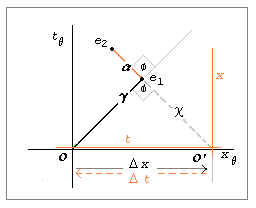
Fig.22
16.) As f
reaches 90o the t and x axes of the
simultaneous hyperframe containing O and O’ are
collapsed onto one another, becoming antiparallel and
interchangeable, so that +Dxq-Dtq º
-Dx
17.) Remember that OO’ stands for all self-orthogonal spacetime radius vectors at O (or O’) and represents a constant of phase in PM space for e1, not a constant of scale. This result is actually independent of the mapping convention in Fig.22, as we have seen; indeed the fact that a diagram like Fig.22 can be drawn for any set of lightlike-related points like e1 and e2 tells us that for all points like e, taken as the origin of a unique set of self-orthogonal null lightlike radius vectors like g, the real transformations (Dx) of all transverse intervals between radii g1 and g2 ‘seen’ by e encounter a phase change, independently of scale, at a hyperangle of 90o (to be formally represented as a rotation by i in the complex plane of the angle OeO’, as already indicated) where termini like O and O’ become hyperspacelike-simultaneous and recover an equivalence only otherwise expressed (in the form of a photon/anti-photon) as a degenerate identity at 0/180o. That is, we suggest that the commutation rule for position states q1 and q2 of any electrons e' and e" subtending f = 90o now changes from a wave function with an antisymmetric solution
ye'(q1)ye" (q2) - ye'(q2)ye" (q1)
(21)
to a symmetric solution
ye'(q1)ye" (q2) + ye'(q2)ye" (q1)
(22)
which describes supersymmetric opposite spin pairings of electrons with zero relative angular momentum generating a pseudo-bosonic integer-spin phase of the PM doublet.
18.) The question can be asked: What spacetime projection corresponds to this hyperangle f = 90o? To answer this we can interpret the phase transition in the following way: The hyperplane of simultaneity containing all transverse intervals obeying Eq.22 can be described as a critical-point phenomenon, a transition occurring in an n-dimensional system that behaves with reduced dimensionality where the correlation length becomes equal to the confinement ‘distance’. Consider an analogy with ferromagnetism: In a 3-space system of spins confined between parallel planes, the high temperature correlation length can be small compared to the distance between the planes and the system behaves 3-dimensionally. If the temperature is lowered through a critical region until the spin correlation length exceeds the distance between the planes then the system starts to behave 2-dimensionally. In our case the confinement distance and the correlation length are both just unit scale at a critical transition defined by the complex phase angle f = 90o measured at e1, which represents a rotation from the pure real plane to the pure imaginary plane. In other words, under a multiplication by i, the n-dimensional system behaves like a lattice of correlated spin pairs confined on the two dimensions of a hyperplane. This critical-phase transition occurs for any e. But - and this is the important point for our many-centred PM formalism - the meaning of the fact that f is complex is that e1, e2, e3 . . . en cannot live on the same hyperplane.
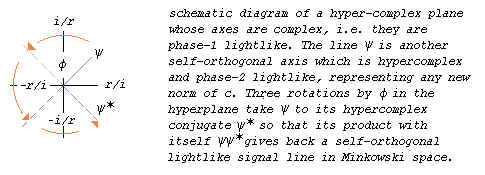
19.) We can see this as another statement of the PM exclusion principle. There is no single global operation applicable to every e; but instead, in going from e1 to e2 there is one well-defined rotation by f which takes us from a complex plane C1 with imaginary and real axes i1 and r1 to another, C2, orthogonal to it in the plane of i1, in which i1 and r1 (representing x and t on C1) are collapsed self-orthogonally on either i2 or r2. Each move from one point of measurement to another (one vertex to another) incurs this rotation through f and thereby exchanges one plane of complex coordinates for another orthogonal plane, in which the self-orthogonally collapsed axes of the former may now be specified either as a pure real or as a pure imaginary 1-axis for complex arguments in the new plane (see Fig.23). Thus every unit scale Dx has both real and imaginary roles in n-complex dimensional PM space, which is of indeterminate dimension yet is always (hyper)complex planar for any measurement. We can start to see here the way in which the factor f = i behaves as a renormalising factor for c, so that moving from vertex to vertex through multiple broken phases of the lightlike line takes us from one complex plane to another in a heirarchy of operations that generates a ‘hypercomplex’ matrix of nested quaternions, octonions and sedenions.
Fig.23. A rotation f taking r to i in the hyper-complex plane renorms c for a measurement at a new vertex. Three such rotations close a triad of unit vectors in equilibrium. |
20.) Returning to the plane of Fig.22, when we bring in the periodicity we are saying that the rate of change of the projection of unit scale Dx is proportional to a rate of work done equally on radial vectors g and c, which goes to a minimum when the value of f oscillates around a stationary value of 90o. This zero-point of work is a constant of all projections of this shift of complex phase, so it is independent of metrical distance. It is a lower bound on the work of transforming unit scale in n dimensions, superimposed on or ulterior to the relativistic composition of velocities taking place among 4-vectors in Minkowski spacetime, i.e. a constant underneath these local-real displacements which cannot itself appear as a dynamical variable of the Lorentz symmetry group. Nevertheless work is a dynamical quantity, which has the same dimensions (energy x time) as action. In other words the quantum condition originates in an emergent complex periodicity of the vector geometry of PM hyperspace.
21.) So we trace the quantum condition in general to the breaking of the direction of the hyper-lightlike line in PM space and infer that the condition f = 90o defines a plane of constant complex phase on which the rate of change of work goes to zero, meaning that time goes to unit time, because f is renormative indiscriminately, and there is no clock. The projection on spacetime of the quantum of complex work is a transformation factor i applied to the rate of change of an action that oscillates around a common zero-point condition which we guess to be equal to the Planck constant, h. This oscillation comes from a cyclic permutation of operator orderings, and in a non-equilibrium system with many phases it does generate a clock, so that relativistic spacetime emerges in the renormative calibration of all clocks for the condition c = const. But as we begin the primitive stages of assembling such a clock we encounter the lowest determinate energy state in an equilibrium triad where the rate of change of work sums to zero around a neutral gauge loop (Fig.18). This is a minimum condition equal to a zero rate of change of energy, but not an absolute zero condition for the triad because measurement is a register, not of E itself, but rather of DE. The physical significance of E here is only as the vacuum energy, a zero-point of an isolated equilibrium gauge for a 3-dimensional flat space. It is flat in the same sense that a surface is flat when transport of a parallel-displaced vector around a closed loop returns it to the start with no change of phase. The hyperplanes at e1, e2 and e3 are identically interchangeable. In more complicated asymmetrical systems, actual systems where real clock rates emerge, the space will (in general) no longer be flat in this sense because (in general) the hyperplanes en are not indiscernibly identical.
22.) To expand on the gauge symmetry: In PM the concept of the rate of change of phase of ‘a photon’ recedes to an abstraction and has no real physical meaning. On the PM network the physical quantity is a rate of change of phase determined over some sequence of photon states or pairs of measurements, A, B, C etc. We can compare photon phase at A with phase at B; but we cannot compare a photon with a future state of itself at ‘the same place’ because a photon can never be brought to rest for any observer. Hence, although we believe we can compare the phase of an electron with itself at the ‘same place’ - i.e., compare phases at A at different times (Note 7) - we can only ever compare photon phase at the same place A and at different times by comparing the phases of two photons. If we wish we can describe the situation where a sequence of such pairs forms a closed loop that returns phase to its original value as an extremum where the rate of change of photon phase goes to zero.
Note 7. It is actually more complicated because 'observing an electron' is interacting with a photon, so all observations in QED are ultimately 'observations of photons'.
23.) In an abstract sense, this is what happens because of complex time-reversal symmetry inside a single pair of vertices; but in an observable sense, in terms of local-real Lorentzian symmetry, it only happens on a closed loop of at least three such pairs - a triad. Either way the phase relation is anchored at a specified point in space (a vertex) because the photon only exists at emission or absorption. One way of saying this is that a photon phase ‘shift’ only occurs as a mutually-cancelling ‘comparison’ of phases of creation and annihilation, which are directly the Hamiltonian operators of one another, where the phase shift q - q’ around such a gauge loop is self-consistently and indiscernably zero (or unity). But a finite speed of light means that q :q’ involves an interval of time for all possible observers; or from the other point of view, the fact that q - q’ ¹ 0 imposes the condition c ¹ ¥. By the same token the fact that q - q’ = 1 is only ‘measurable’ between different photon states around a real external loop that introduces a non-zero interval of time, and not around the null complex internal loop of time-reflection that brings the same photon state back to itself in zero time, is equivalent to saying that Dc ¹ 0 - the difference in c is not zero - or the hyperspacetime momentum of the photon world-line breaks at some points.
|
Fig.24
24.) To understand this, consider that the PM exclusion principle is what turns null photon time into timelike displacement (see Section 2.3). This can be illustrated by a recursive ‘spiral’ loop which returns photon phase A not to itself but to a partner state B displaced by at least one turn of the spiral (Fig.24a, 24b). This spiral minimally traces a tetrahedron (Note 8) in PM vector space (Fig.24c), or a 4-dimensional sub-manifold of hyperspacetime, where the ‘pitch’ of the spiral, a displacement ‘in time’, is the resultant of a cycle of vector operations in the state space which is equal to some multiple of h/i and transforms from one triadic hyperplane to another. This cycle of operations applies to each of the dyadic elements in every spiral, and the fact that it always produces another dyad expresses the PM exclusion principle, which we can now see is indeed, as already observed, equivalent to the SR condition c ¹ ¥, but requires also the PM condition Dc ¹ 0 to avoid the degeneracy of singular states to which SR would lead if all hyperplanes were transformable onto one another in a common global frame of reference. In this sense the multiple phases of c are interpretable as n exclusive hyperspacetime quantum numbers of the system identifying n unique states with restricted occupancy.
Note 8. The tetrahedron of vector products is not possible in R3 because each of the three products generated from any triad must be orthogonal to both of its components, and so the products only meet at infinity. It is possible in CN because all hypervectors are 'orthogonal' in the sense necessary to close all hypervector products into a finite complete graph.
25.) Where a minimal triadic loop of half-wave fundamental string modes gives a half-integral phase shift and does not simply reinforce, there is an odd number of half-wave modes in the loop and we say there must be ‘an electron’ in the loop. And the fact that photon creation and annihilation phases always involve an interval of time (finite c) means that there are always electrons in the photon loop, just as the fact that intervals of measurement are distinguishable means that there are always photons in the electron loop. The two modes cannot be separated from their joint supersymmetric anyon representation, meaning that what underlies the PM gauge symmetry of ‘charge’ is that there are no open trajectories. All paths form parts of closed gauge loops. In ideal equilibrium this gauge would ‘crystallise’ in the form of a neutral, massless coherent state on a single supersymmetric loop; in actual far-from-equilibrium systems the measured photon phase shift will be an incoherent superposition of different values each corresponding to a different electron loop. (Note 9)
Note 9. Spin 1 and spin 1/2 are interpretable as 'visible' modes of a broken superspin, a supersymmetry whose indefinite numbers of phonon-like modes, corresponding to all possible spin fractions, exist over the loops that would be traced by all possible closed paths through all vertices of the entire PM graph.
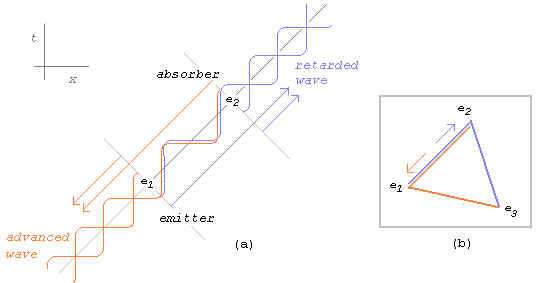
26.) In terms of PM’s reinterpretation of the transactional ‘absorber theory’ formulation of quantum mechanics such an operator loop is readily visualised. Fig.25(a) shows the conventional transactional spacetime picture in which the ‘absorber’ oscillator, a particle e2, is stimulated by the retarded wave arriving from the ‘emitter’ oscillator e1 to emit a retarded wave which is exactly 180o out of phase. The two waves cancel in the positive time direction. But the accompanying advanced wave travels in the negative time direction, reinforcing the amplitude in the region e1 - e2. In the schematic picture in Fig. 25(b) the background coordinate space is lost and the system is closed on itself. As shown, the primitive equilibrium of Fig.18 is subverted due to selecting e1 - e2 as emitter and absorber, and what was there a zero-point symmetric wave function on the whole triad here collapses to a positive-amplitude antisymmetric wave function for the pair of charges e1 and e2. But in the absence of definite constraints this particular transition is an arbitrary choice. Why e1 - e2? Why not rather e2 - e3 ?
27.) We have to assume that a triad in equilibrium retains ideal causal symmetry, and there is no reason not to make the same reduction in favour of e2 - e3 and e3 - e1. Indeed, without doing this there is no way of understanding how e1 can emit in the first place without violating energy conservation. When the causal cycle is completed, a reinforced wave of half-advanced and half-retarded amplitudes on e3 - e1 is revealed as the origin of the quantum operator responsible for the ‘spontaneous radiation’ at e1 with which we began, and so on around the loop. As we saw (Fig.17b) this triad of interdependent oscillating states can be expressed in terms of counter-circulating positive and negative time vectors, and the two wave function solutions represent positive and negative energies; so we have preserved an idealised zero-point equilibrium for a triad of three electrons. By ‘keeping the three plates spinning’ simultaneously, so to speak, we are preventing the system collapsing to a definite positive-energy antisymmetric state, and our ‘three fermions’ in equilibrium are behaving like a Bose condensate.
Fig.25. An adaptation of the ‘absorber theory’ model for a multi-phase c network. On the left (a), a Minkowski diagram shows mutually-cancelling waves propagating collinearly in a lightlike direction with zero-amplitude to past and future infinity. In PM (b) the lightlike directions are no longer collinear but are self-orthogonal spacetimes. Past and future do not exist in this diagram and time-symmetric advanced and retarded waves complete a hyperspace triad at e3. |
28.) It is easy to see that the spontaneous radiation connected with an ‘infinite’ number of virtual photon basis states in the Dirac formalism is here connected with the time-reversal non-invariance of emergent local R3 domains under the super-rule that all paths are closed paths in (finite) CN. Consider a linear range of points (measurements)
A ® B ® C ® D
lightlike separated in a Minkowski spacetime. The absolute square yy* for the photon probability amplitude is always real at the point of measurement (say B) but this amplitude, which as a probability must be projected in the ‘future’ direction from point B, can be regarded as the ‘output’ of a zero-amplitude complex superposition occurring in the ‘past’ direction from point B. When the real amplitude yy* reaches point C it vanishes again into a complex superposition projected in the ‘future’ direction beyond C. But the primitive symmetry of BC contains no sense of a distinction between past and future and so this entire sequence is perfectly reversible, with the amplitude yy* being equivalently interpretable as the past-directed ‘output’ from a future state beyond C vanishing at B.
A ¬ B ¬ C ¬ D
The flat-line complex regions ‘before’ and ‘after’ BC represent zero-probability amplitudes for emission in both -t advanced and +t retarded directions to infinity, which in PM represents the boundary conditions for an isolated dyad.
A ¬ B « C ® D
This is fine, but then we would have to ask how zero amplitude waves going to infinity on the past and future sections of the line can give rise to the non-zero probability of ‘spontaneous radiation’ inside BC.
29.) In quantum field theory, of course, the zero amplitude waves do not represent a state of minimum energy. Indeed the vacuum fluctuations outside the region BC are greater than those inside, due to exclusion of certain wavelengths of the zero-point energy. But it is an unsatisfactory feature of this construction that the zero-point energy is not well-defined. It explains in principle why spontaneous radiation does occur, but it is unsatisfactory that the zero-point energy outside BC is infinitely undefined. The usual absorber construction in the spacetime representation, indeed, seems to require that the vacuum potential well containing BC be infinitely deep, else how is it possible to be sure that amplitudes for spontaneous emission to from B or C to past and future infinity outside of BC are zero? In QFT one has to be optimistic that some future quantum-cosmological theory might absorb the infinite discrepancy into a finite natural relation - as discussed in Section 2.4., this is connected with the ill-defined status of mass and charge renormalisation in quantum mechanics. In PM on the other hand we start with basic geometric definitions which disallow states that are open to infinity.
30.) PM allows nature to resolve these connected ‘problems’ for us because nature is conceived on the deepest level as a system of dyadic self-interactions, discrete path functions supplanting the continuum state functions of R3 representations. Interactions or measurements are interpreted as a breaking of the direction of the lightlike (hyper)line at B and at C along with a breaking of the primitive symmetry inside BC. Breaking the lightlike line destroys the exterior zero-probability amplitudes in both -t advanced and +t retarded directions by replacing them with non-zero amplitudes on finite dyads like AB and CD. In other words, it is only because AB, BC and CD do not lie on the same lightlike Minkowski null vector to infinity that the verification by measurement of the full superspin symmetry-breaking transaction in BC occurs, inside AB and/or CD. And it is this process of transactional verification by external measurement that generates a non-zero amplitude for ‘spontaneous radiation’ inside BC. (In a sense radiation is ‘spontaneous’ to the extent that the advanced-wave solutions for a quantum system are excluded for the special purpose of making theoretical models that simulate the time-dependent evolution of human ignorance. Of course, excluding the advanced-wave solutions is not a free choice for us; nevertheless the fact that we are forced to value local-real predictiveness does not mean that nature need ‘care’ about it.)
go to Section 2.6,
Consistency with gravitational mechanics
go back to
Section 2.4
Foundations
index