 (4)
(4)2.2. consistency with classical mechanics
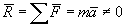
1.) Now we are ready to return to consider the implementation of Newton’s first law, A body continues uniformly at rest or in motion in a straight line unless acted upon by other forces. This law for a body in inertial equilibrium
(4)
is a limit of the Second Law, which states that the rate of change of momentum is proportional to and in the same direction as the force. Both are satisfied by a classical ‘particle’ of any size because of the spherical space symmetry and Newton’s ‘mass point’ lemma for central forces; but insofar as the Second Law might be applied to a ‘particle’ in PM, the First Law is not reached as a limit of it. This can be interpreted as saying that the spherical symmetry of central forces does not hold in PM. The volume element which is the analogue of a ‘point’ in PM space has a directed internal degree of freedom (we do not need at this stage to be able to say what the 'direction' is, only that an act of measurement always reveals it as having one) given by the complex projective identity of point and line such that a particle-analogue isomorphically identified with it cannot occupy a position of scalar equilibrium. That is to say
 (5)
(5)
in any circumstances because, from one point of view, taking the time derivative of velocity to dt = 0 in Newton’s continuous space is a forbidden operation in PM space. The apparent freedom to do so is derived from a conception of absolute universal time, an infinitely divisible ‘flowing’ medium that has no connection with the structure of events. (In fact this global time does not appear in the equations of Newtonian dynamics either.) A PM unit vector is not divisible into an infinite sequence of point-positions associated to point-instants, under the definition of Section 2.1. Para.4.
2.) A Newtonian analogue would be the turning moment on a rigid linear rod subject to asymmetrical forces. (A PM element does satisfy the definition of a classically rigid object, in the limit of all local transformations, as will be shown later.) A force couple, say the torque on a compass needle in a magnetic field, is a special case. But then imagine that there is no fixed axis of rotation; further imagine that the force vectors at either end are arbitrary. How does an ‘observer’ on one end of such a rod find the true resultant of all torques of all forces acting on both ends? Without knowing the moment of inertia she cannot, even assuming that the rod’s geometrical midpoint and centre of mass coincide perfectly. Fortunately Newton’s absolute coordinate background supplies the axis of rotation and angular acceleration and with it all the quantities of force, mass and inertia become interdependently calculable. Everybody knows where they are. But if the coordinates vanish, what then? And what happens to inertia when different observers specify different relativistic forces? The modern field-theoretic idea is that the field carries the momentum and balances accounts for all different observers, which amounts to a conspiracy which distorts the coordinates so that any ‘freely moving’ (i.e., gravitationally constrained) mass always appears to be absolutely at rest. Indeed the concept of ‘force’ all but disappears in such a view. But inertia is not accounted for in a satisfactory physical way in this relativistic field theory of gravity.
3.) The situation we are faced with differs from either of these views. The PM system uses neither a local field nor an absolute coordinate background. It is analogous to a linkage of rods, and the transmitted forces are analogous to classical mechanical contact forces. Instead of a freely spinning needle, imagine a rod joined at its ends by free gymbals into a system of similar rods. As the system changes configuration and the rod rotates, imaginary ‘observers’ at either end can arrange to agree that their equal and opposite angular velocities cancel at the geometrical midpoint, and this will be valid for any arbitrary combination of forces; but this geometrical axis might itself be uniformly moving in another embedding frame defined by some surrounding sub-system of rods. There is no real ‘still centre’ of Newtonian forces on which to anchor an inertial frame. Evidently the closest we can get to an approximately ‘static’ axis of rotation will be found in the frame of an ‘observer’ for whom the vector sum of all rod momenta in the embedding system is zero. Thus we can imagine that only in proportion as the sum is taken over an increasingly large number of interlinked rods will it become possible to identify an imaginary region which for practical purposes represents a single resultant for most observers inside the system; and only in the limit of an infinitely large system of rods of arbitrary lengths does the corresponding region approach an infinitesimal point - a unique axis - where the algebraic sum of moments can be considered to be practically zero, defining a point of functional ‘rest’ for all observers. So there is an ‘inertial reference frame’ in this picture, but it is not an absolute coordinate matrix and is rather a function of the linkage which exists between all accelerations. Therefore the forces that relate to it, whilst not fictitious, are always mediated throughout the entire system in a way that is not necessarily locally transparent. It is in fact not a static reference frame at all, but a dynamical reaction force which is a kind of feedback. In modern language this is a kind of gauge symmetry. Such a picture reconciles a classically reactive inertia with Newton’s Third Law stating that action and reaction must always be equal and opposite. (Given the strict constraint of Section 2.1. para.4 that the PM geometry is to be a complete graph, the perfect rigidity of each rod would actually enforce SF = S-F in the limit of zero forces for the whole system, in the sense that both kinetic energy and tensile stress and strain must be zero everywhere. This suggests that an invariance governing real observer-transformations of the linear element of unit scale in PM must have the character of an elastic modulus. See Section 2.3. for an interpretation of the Lorentz symmetry group.)
4.) This is a purely schematic illustration, of course, but we get the idea that the First Law has only approximate validity as a limit case in PM because the system of actions is self-limiting in some lower bound. This arises because ‘force’ cannot be separated from a scalar ‘mass’ on which it acts; mass, we say, is a force which acts onward (nonlocally, as a ‘contact force’) through the system. In contrast, in Newtonian physics we would be able to say that if we regard acceleration as zero by definition in the absence of force then we are left with a non-zero scalar quantity m which corresponds to a constant absolute mass. Special relativity deals with the total kinetic energy and the equivalent ‘Newtonian’ mass becomes an invariant of the energy-momentum transformations, or a ‘rest energy’; however this is still a scalar. In PM ‘mass’ itself signifies an invariant minimum of force - associated with a pseudo-scalar unit vector which contains an ‘absolute acceleration’. (To be clear, the 'absoluteness' relates to the unoccupied unit state dictated by our geometry; the 'acceleration' represents the mandated occupation of that state by the nonlocally-determined quantity.) So as in GR we can say that ‘inertial frames’ are not truly equivalent. But in GR the non-flat affine connection makes acceleration a function of spacetime geometry which discriminates non-equivalent classes of inertial trajectories and removes the concept of force by, as it were, ‘dispersing’ its function into the continuum geometry. (Actually it is questionable whether this removes or objectifies the notion of force.) In PM on the other hand the linear projective geometry ‘concentrates’ force into a pseudo-absolute and intrinsic elementary property. (This can be thought of roughly as a reincarnation of the Newtonian vis insita inside a relational theory.) The geometry dictates that not only is the product ma a vector, the quantity m must itself be a directed vector. In other words, it becomes impossible to find a ‘particle’-state where a scalar mass can be separated from acceleration in measurement. The reason for this can be expressed equivalently as:
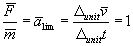
5.) The association of an intrinsic acceleration and an invariant length (‘rest mass’) seems at first sight inexplicable if PM unit scale is non-differentiable. The condition is that
 (6)
(6)
i.e., there is to be no meaning to any smaller time derivative of the vector change of velocity. So where does an ‘intrinsic force’ come in? The answer is that, by the same token, it is because the unit scale is non-differentiable - i.e., because it is a classically-rigid nonlocal ‘object’ - that a degree of freedom comes available for a force invariance which would not be available to a point-particle. That is, a minimum torque.
6.) This pseudo-scalar limit defines a limit of differentiability of ‘unit time’, a cut-off inside which no differentiation of point-instants can be made and from which ‘measurement’ states are excluded in principle (see definitions, Section 2.1). Real time will thus appear only as a result of some operation on unit time, just as real length occurs as a transform of unit scale. According to our definitions this operation will be a ‘measurement’ operation that produces a ratio of finite real-number valued multiples of unit time, in place of an infinitesimal differentiation. Thus unit time rationally supplants the universal continuum role of the point-instant, retaining the essential functionality of the point to the extent that it is invariant under all linear transformations and remains properly scale-free. A primitive quantum of scale which is invariant under all scale transformations obviously has no determinate length at all! It brings with it only a primitive sense of a Leibnizian exclusion of two discriminable position states. But it is important to understand that what is being proposed is no more empty of meaning than an empty geodesic in a spacetime theory. Indeed, the difference is that we are making this unit scale isomorphic in every case with a trajectory, so that every state becomes a filled state with a well-defined spectrum of metrical transformations. (see Note 1) It is possible to think of this procedure as assigning to each PM ‘object’ a complete 1-dimensional spacetime in which, to a notional observer inside it, a metre rod remains a metre rod whatever the inflation rate of the ‘horizon scale’.
Note 1: Obviously we are not yet specifying the complete spectrum of 'particle' states that will do the filling. For these schematic discussions we are to think in terms of electrons and photons, except where stated, the gauge symmetry of QED being a useful heuristic paradigm. We consider the status of weak, colour and gravitational vector particles later.
7.) This invariance therefore gives us the dimensionless identity between all lightlike zero-vectors. In other words, this is the straight ‘geodesic’ trajectory of a PM null signal line. But the same limit also occurs as an improper (local) limit of differentiability of unit length. In the proper, lightlike, limit the line expresses only the basic congruent transformation symmetry of our PM definition (i.e., it rotates identically onto itself; see Section 2.1. Para.4, n.9); this is an imaginary transformation and the set of all such lines does not admit of any real metrical transformations among itself. That is, all such states have interchangeable null identity. The improper, time- or space-like, limit is a limit for the isomorphic set of all such lines which do metrically transform. Away from this limit these metrical states are (by definition) not directly interchangeable because they project into one another only according to the Lorentz group of transformations; however, in the limit of non-differentiable unit scale each line expresses its basic congruent transformation symmetry interchangeably for all observers, and so the only degree of freedom available for non-identical transformations - the registration of forces on the object by co-terminal objects - is rotational. In other words, rest-energy m itself corresponds to a universal lower bound on a transform of the PM unit length (which represents unit speed = c for all vectors), defining a characteristic scale at which this notional zero-point of momentum associated with ‘rest’ goes over to a torque producing rotational moments proportional to a range of negative potential energies (atomic electron energy levels are regarded as negative in somewhat the sense suggested ). We can express this by saying that the constraint which preserves unit length constant for all observers under rotation (which is in general the nonlocal system force responsible for mass) represents a centripetal acceleration of a pair of boundary points that delimit a unit length. And these two propositions combine to imply an invariant lower bound of angular momentum, which therefore appears as a ‘fundamental’ dynamical quantity. Away from this limit rotations of metrically transforming trajectories representing positive kinetic energies will generalise underneath the Lorentz group as relative curvatures.
8.) Leaving the latter generalisation to one side for the moment: According to Newton’s law the inertia of a particle subject to a force ma is an opposite reaction force -ma called into being by the acceleration. But relativistically the status of ‘force’ itself recedes in significance, so is inertia now more than a book-keeping device? This would be useful, inasmuch as conventional relativistic field theory cannot account for inertia anyway. Conventionally therefore one might say that by including imaginary inertia we merely cancel an equally imaginary ‘mass vector’ and restore equilibrium at any point of measurement, restoring the idea of point particles in free space. But it is perhaps worth re-emphasising how and why in PM our basic geometrical definitions disallow this: The mass vector is an internal state of a PM ‘particle’, a non-zero lower bound to the possible scale-transformation of the PM unit vector, not an addition to some recoverable scalar mass. To physically cancel the mass vector would be to cancel the volume-element of space and our isomorphic ‘particle’ with it, returning us to the unintelligible ‘equilibrium’ of a scalar mass-point in one of a degenerate infinitude of empty point states, which is precisely the case which we have striven to exclude in our definitions. A null resultant under this constraint of spatial non-degeneracy is very different from saying that the two antiparallel vectors are not physical states: In the latter case the residual scalar mass-point tells you nothing about force potentials, which remain freely specifiable in some arbitrary theory; in the former case, in which a spacetime interval is included in the first order, the automatic implication is that potentials associated with a force proportional to mass vanish internally, as will be brought out presently. (Note 2)
Note 2: The fact that the potentials do not vanish externally - i.e. that mass is a nonlocal property of closed loops of PM dyads - will be shown later to be deeply connected with geometrical-topological phase effects of the Aharonov-Bohm type.
9.) So it is of the essence of PM that we cannot arrange for mass and inertia to simply cancel one another away (except for the class of proper lightlike null trajectories). And there are sound reasons for wanting to give a physical account of inertia. Assuming that the mass vector m is real we are forced to conclude that the inertial reaction term in an equilibrium equation of state for a point in Newtonian space corresponds to an actual force directed on a line in PM space. Newtonian inertia is then not due to a scalar mass coupling to any generalised coordinates but is a dynamical reaction force in a system of many linear ‘mechanical contact’ forces, in effect just the inverse of the set of actions which generates a vectorial mass, and the inverse, therefore, of that mass itself. This means that there is neither a privileged class of relativistic inertial trajectories (geodesics) nor a privileged class of Galilean inertial frames (uniformly translating observers).
10.) This is a subtle but important conclusion that takes us back to the issue raised in Section 1: In a Newtonian space-and-time theory, or a Minkowski spacetime theory, which both preserve absolute particle-acceleration against extrinsic coordinates, an absence of acceleration classifies some trajectories as inertial. In PM, on the other hand, the universality of absolute acceleration against intrinsic coordinates ensures that all trajectories are inertial. This arises because momenta only change at vertices in PM, and all changes of momentum are rotations of unit vector through some phase angle, so that every origin embodies some new function of velocity squared. In a spacetime theory any arbitrary point of the continuum is a valid origin from which to measure, and it is always possible to ‘find’ some frame in which the instantaneous acceleration of a particle may be relativised away (if it has mass), its momentum notionally ‘dumped’ into the field, such that it becomes a pure timelike trajectory with a space displacement and momentum of zero. But in PM only another vertex is a valid origin from which to measure, and in the absence of instantaneous time derivatives every such vertical ‘observer’ has to associate some non-zero multiple of unit angular momentum with every other vertically-bounded trajectory (see Note 3). It thus becomes impossible, as a result of the basic PM geometry, to support a clear distinction between ‘non-inertial’ unit vector accelerations due to an applied force and intrinsic or ‘inertial’ accelerations where there is no applied force. Given that the PM geometry is to determine for us the structure and dynamics of space and time displacements, we can see that this implies an extension or generalisation of the equivalence principle (EP) from a scalar mass to a vectorial mass-energy that includes some multiple of unit time squared. And from this we will be able (Section 2.3) to make a connection through special relativity to general relativity.
Note 3: Another way of saying this is that no PM trajectory is open to infinity, which is analogous to excluding perfectly monochromatic wavetrains that have been propagating for an infinite time. In a universe that could contain such a wavetrain an infinite number of observers could always be found who would agree on its exact wavelength and momentum. In a PM universe of bounded states all waves must be polychromatic waves of mixed relativistic momenta, where an indeterminacy due to a superposition of wavelengths and amplitudes reflects the finite plurality of different observer 'frames'.
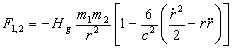
11.) It is interesting meanwhile to compare this proposal with the Mach-Weber theory of inertia for a universe of particles interconnected by nonlocal far-actions. Given the postulate that the sum of all forces on a particle is zero in all coordinate frames, Machian inertia arises from Weber’s force law
 (7)
(7)
which modifies Newtonian gravitation by terms proportional to the relative velocity and acceleration. Here the inertia is a dynamical reaction force. Analyses by Assis (*) and Assis & Graneau (**) show that the long-range 1/r force term proportional to the acceleration (the third term in eq.7) implements Mach’s principle by effectively dividing the cosmic mass distribution into isotropic and anisotropic components. The long-range 1/r force locally will be dominated by the isotropic gravity of the ‘fixed galaxies’, generating inertia as a dynamical reaction against the 1/r2 Newtonian accelerations produced by anisotropic nearby masses. An especially interesting result of the Weber force law (in the context of PM) is that in general the effective inertial mass of a body need not be isotropic, and will depend on the potential where the body is located.
*Assis, A.K.T., "A Steady-State
Cosmology", in Progress in New Cosmologies: Beyond
the Big Bang, Arp, Keys & Rudnicki (eds.), Plenum Press,
NY 1993;
**Assis, A.K.T. & P. Graneau, The Reality of Newtonian Forces
of Inertia, Hadronic Journal, 18,
271-289, 1995;
**Assis, A.K.T. & P. Graneau, Nonlocal Forces of Inertia in
Cosmology, Foundations of Physics, Vol.26, No.2, 1996
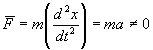
12.) Weber’s postulate means in a sense that Newton’s First Law for a particle in static or inertial equilibrium is extended to particles with all relative velocities and accelerations, or in other words it applies to generalised trajectories. But of course this particle is a Newtonian mass point in free space; the inertia is then an abstract vector opposite to the particle acceleration, due to the 1/r attraction of the distant universe acting always on the point of the trajectory to maintain that point in dynamical equilibrium. Equilibrium then defines ‘stasis’ for the purposes of the First Law and we can say that gravitating frames are all inertial frames in the sense that their trajectories are conservative minima and define operationally the local inertial geodesic structure of spacetime. We have deduced for the nonlocal linear objects in PM that the condition
 (8)
(8)
has essentially the same meaning in relation to trajectories, but the distinction needs to be emphasised again that in PM the dynamical inertial term -ma has an actual representation in the local space structure. It is the inverse, or congruent geometrical transform, of an actual linear object (bounded by points of measurement) on which the limit of the time derivative of velocity does not go to dt = 0. There is thus no real quantity of instantaneous acceleration, and instead of saying (as one may in a Mach-Weber model) that an inertial force produces an effective anisotropy in a scalar particle mass, one has to say in PM that mass is intrinsically a directed force, not a scalar, which has rather different implications.
13.) According to Weber’s postulate inertial force is the dynamical reaction force due to the ‘fixed galaxies’ that restores the vector sum of forces on a particle with gravitational mass mg to zero for all observers. We accept the spirit of this principle, so that
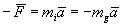
 (9)
(9)
Conventionally the sign is the property of the force vector and therefore vanishes when acceleration goes to zero, to leave just the identity
 (10)
(10)
which states the equivalence principle, a simultaneous identity of two indiscernible scalars which is an unnatural relation in Newtonian physics and an unrealised identity in principle in GR. But in our theory there is no longer an unnatural relation nor an identity in principle, but instead a conditional natural relation,
 (11)
(11)
because mi and mg are force operators and the total mass-energy on any trajectory is always the zero sum of two antiparallel vector operations. These ‘measurement’ operations are conducted by the system of nature on itself not ‘at a point’ in a continuous coordinate space, but over a non-degenerate volume element of PM space; and the two vectors behave like the equal and opposite time-reversed forms of a discrete action. Or +t and -t are interchangeable by a congruent transformation of the line into itself. Thus
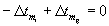 (12)
(12)
and this is why the natural relation is conditional: The identity of mi and mg occurs as a null identity, which identifies it as a proper characteristic of the special class of lightlike zero vectors but not an improper characteristic of the classes of positive timelike or spacelike vectors. In other words, if we ‘view’ the graph of the universe from any given point of measurement (any vertex) we see that a symmetry preserved on lightlike (radial) directions is broken in their transformation to (transverse) displacement 4-vectors, with the emergence of positive-real time and mass. As we will show later this turns out to be the same as saying that mass is an emergent dynamical property of plural PM systems - minimally, triadic systems - and in this way the fact that non-vanisshing positive mass-energy selects out transverse trajectories is intimately connected with the many-centred structure of gravitation in PM space. (It is as well to emphasise that the null mass vector must not be confused with annulment of the scalar mass that couples to the universal gravitational field in GR. We say only that a default state of equilibrium for a system conventionally regarded as ‘two particles’ is that m vanishes on the lightlike path between them. This is not the same as saying that this system feels no gravity or inertia, because the conditions of ‘feeling’ gravity and inertia are precisely those which destroy the default state of equilibrium (Note 4). In this sense structure controls mass, rather than vice versa. This relativistic space structure is developed in Sections 2.3 & 2.5, showing that gravitational ‘attraction’ arises in PM as one pole of an emergent dipole due to a mass-field having these null longitudinal components.)
Note 4: One might suspect, therefore, that this equilibrium is an ideal abstraction with no physical significance. The fact that nature is a plural system means that in general the mere existence of the dyad is sufficient to guarantee destruction of its equilibrium, of course. However it turns out, as we will see later, that extreme thermal isolation can approximate some properties of this abstract equilibrium.
14.) Meanwhile let us further investigate the properties of the unit vector geometry, separating clearly the radiation field and matter field representations from one another (remembering that these remain representations of the same underlying supersymmetric object - Note 5). From bosonic trajectories as the definition of geodesic straightness we will go on to consider the case of curved fermionic trajectories in slowly-varying force potentials. Now we have seen that the condition of ‘rest’ includes an acceleration and that mass is equivalent to a spacetime displacement. These are natural conclusions when rest is a condition that has to be defined not for a ‘mass-point’ but minimally for a pair of co-dependent position states (Note 6). Note that because this limiting vectorial mass is to be a bound property of the related pair it may therefore be considered to include a notional ‘mass’ due to a photon exchanged by two electrons (just as the masses of atoms, nuclei, nucleons, mesons etc., often treated as ‘elementary particles’, are actually the vector sums of several component momenta). Emission at A and absorption at B shifts the balance of potentials in the bound system AB, but re-emission at B and re-absorption at A would shift it back with no overall change in the mass of AB - which paves the way for thinking in terms of the total relativistic mass-energy of the system (Note 7). From this point of view a formal photon ‘rest mass’ of zero reflects the fact that rest is not a condition available to a photon, in that it is a cursor that cannot be freed from confinement (Note 8). Confinement is the paradoxical price of its individuality. The definition of freedom for a photon - a state problematically available in the conventional quantum field formalism, but evidently not in PM - is that it become a ghost, unobservable and virtual (Note 9). This suggests that a total electromagnetic mass-energy of ‘two electrons’ due to their energy of interaction exceeds the sum of the their ‘bare’ self-energies by an amount which is proportional to a virtual photon momentum density.
Note 5: At this stage we use the term 'supersymmetry' very loosely to express the idea that the 'matter particle' and the 'radiation particle' are just transforms of the same basis state. A defence of this proposition in terms of an interpretation of spin statistics will be made later.
Note 6: As indicated in para.13 we will be saying that the elementary unit of PM position space is a triangle of units scale, involving therefore a triad of points of measurement. In general, of course, one can infer that the limit of determinate position for any point of measurement involves a calculation over all the states of the network. See para.3.
Note 7: Consider the emission of the photon from an atomic electron A in quantum state y which accommodates Newton's Third Law by incurring a proportional change in the kinetic energy of the emitting atom . This recoil represents energy 'stolen' from the photon. This limits the ability of another atom B in state y1 to absorb the photon, as it has a longer wavelength than it 'should' have. From the point of view of electrodynamics the photon is absorbable, however, and materials are thus not perfectly transparent to their own radiation, 'because' the atomic energy levels are not perfectly sharp (recoil-cancelling thermal motions also play a part). From the point of view of confinement however this spread of atomic 'energy levels' is not an absolute 'given' property of separate atoms but is rather a graph of the small incremental variations in the total mass -energy of the system, including the photon. As it is not possible to reduce away this vector to an isolated scalar mass-point 'at rest' it is only possible to understand the absence of a photon as a time function of the total mass-energy, i.e. an 'exchange of virtual photons' becomes a periodic fluctuation in an amplitude associated with the whole system. The see-saw of electron energy levels accompanying exchange of a 'real' photon represents an incremental rotation of the whole supersymmetric oscillator. (See discussion of 'Einstein's box' in Section 2.3.)
Note 8: There is a certain analogy with a quark-antiquark pair bound by a gluon string. The components of this object are not realisable due to confinement in QCD, and one can liken the photon zero-vector to a 'line of force' or an infinitely thin flux tube on which the force is independent of distance even though a statistical density of radial flux tubes per unit spherical area falls off as r2. A non-zero photon rest mass is of course inadmissible in a relativistic gauge-invariant theory of particles for what are regarded as fundamental symmetry reasons; but technically it is excluded for reasons that relate to the absorption of infinitely divergent terms into electron mass/charge renormalisation in QED. The origin of this divergence can be traced to the separation of the particle and the radiation fields. PM on the other hand would be radically supersymmetric in a way that admits no such separation, insofar as the number of degrees of freedom for the 'field' in any interaction is limited to the number of doubly-connected position states or 'fermion pairs'. In other words the 'field' is identified with the sum of all such pairs, analogously to the intent of the old Feynman-Wheeler action-at-a-distance 'absorber theory' formalism. The crucial point is that this 'field' now, in a PM interpretation, would not only specify all electrodynamical degrees of freedom but all spacetime degrees of freedom as well; so instead of an integration operation over all possible paths generating divergences at arbitrary energies in the limit of infinitesimal loops, a redefinition of 'all possible paths' to a finite network of lines in PM implies that the QED integral (which is a scale-free operation concerned only with the phase of the amplitude, not its absolute magnitude) should be taken over what can be set as a finite number of discrete paths 'in' the whole of space. This interprets the question in Section 2.1, Note 1 as to how an intelligible causal structure can arise if degrees of freedom x, y . . . n are not available simultaneously to each 'particle' and to all particles equivalently: It is in fact only by removing the continuous coordinates and summing over paths nonlocally that a causal structure simultaneously exploring all degrees of freedom can arise at all.
Note 9: Calculable effects due to virtual particles will have to be reproduced in PM if it is to work, as already mentioned. However, not all such effects are desirable. For example, the conventional energy of the vacuum due to virtual particles is supposedly infinite. In a 'flat' cosmos this leads to what has often been described as the largest single mismatch between theory and observation in the history of science.
15.) In PM therefore a massless vector particle is only an abstraction from an energetic trajectory, a momentum; but there is a sense in which one could say that the First Law finds its proper meaning in PM for the case of massless particles that are always confined. Indeed the First Law is reduced to a truism for a photon in a PM space of irreducible lines, if those lines can be characterised as inertial trajectories. In a relativistic spacetime a ‘free photon’ follows the lightlike geodesics of a flat affine connection, or in gravity follows those of a non-flat affine connection, which in either case is just to specify the constraint. However there is no affine operator in PM space, no continuous geometry to constrain a particle to trace a trajectory. Instead we have a primitive linear object which is the trajectory; we make it impossible that a photon should be anywhere other than on this trajectory just because there is nowhere else for it to be. A photon’s ‘trajectory’ becomes a local operation, performed with a mathematical ‘cursor’ called a photon, on an underlying nonlocal object which has something of the character of a classically-rigid string. So because photon momenta are confined to the minimal 1-surfaces of strings that define ‘straightness’ (by the definition of Section 2.1. para.4) we say that they must correspond to least-action paths of free inertial particles. Their trajectories only change momentum discontinuously at vertical intersections - i.e., they only ‘interact with charges’ - which suffices to represent the radiation part of the ‘field’ as a network of massless null lines and underlies the linearity of the boson statistics.
16.) Consider now the fermion part of this supersymmetric field of charge-confined photon strings - the pairs of boundary conditions on every PM unit vector. These strings are objects that can only be ‘picked up’ by their fermionic ends, and indeed always are - that is, there are no ‘free’ ends in the network according to our founding definitions (see Section 2.1, Paras.4 & 8). A space of these objects contains no true Galilean inertial frames, such as might be associated with two free Newtonian particles each subject to a zero resultant of forces. There is actually no need for inertial frames in Newtonian mechanics either, of course, because Newton’s absolute space supplies a privileged global frame of inertial coordinates available for all motions. But inertial frames become central in SR as the privileged class of reference structures in place of absolute space. Then in GR the function of reference structure is transferred from inertial frames to the affine geodesic. In PM the inertial privilege goes not to a generalised geodesic structure but to any trajectory, as a primitive property, and the ‘reference structure’ is the dynamical nexus of all trajectories. In the case of PM we find that instead of absolute inertial coordinates everywhere in infinite space we have a pseudo-absolute ‘intrinsic’ quantity which is a vectorial analogue of Newtonian scalar mass, an irreducible force quantity which appears with the dimensions of an angular momentum. Each element of unit scale is thus analogous to an individual inertial compass which, rather than aligning to a global ‘north’, sets local ‘north’; but this ‘setting’ is not arbitrary despite the absence of the global field because it is collaborative through the primitive mechanism of ‘contact forces’ on our linkage of pseudo-absolute unit vectors. This is what supplies the key in principle to the understanding of inertia in a relational theory: The traditional distinction between an ‘absolute’ scalar property of a particle (Newtonian inertial mass) and a property of pure relations among an ensemble of particles (Machian inertial mass) relies on a distinction between fermionic and bosonic fields which disappears in our radically supersymmetric picture of extended vectorial strings, which are at once both (fermionic) ‘objects’ and their own system of (bosonic) interrelations.
17.) Now the ‘straight’ line of Newtonian inertial motion has two new projections inside PM which illuminate the meaning of associating mass and acceleration with an element of directed unit scale. Firstly, since we are operating with a minimal definition of a line as the projective dual of a point we are safe to regard this as our ‘gold standard’ of straightness. A ‘curvature’ in the sense of an actual deformation of the internal symmetry of the line requires not only more information, but specifically an infinite number of additional real coordinates in order that by coupling to them in interaction (an observation of some kind) we might be able to discriminate the associated change in some ratio of quantities (whatever they might be) from a variation due to some other functions that we might imagine being attached to the line (i.e. time, velocity). In our construction a first-order deviation from straightness would in fact be the same as the interpolation of a third gauge coordinate and the production not of a curve in one line but of two new straight ones, or: A discontinuous acceleration occurs at the point of application of a force. (Note 10) As we add more coordinates, each vertex of the emergent graph generates a new copy or ‘avatar’ of the line renormalised for the purposes of Newton’s First Law, in accordance with the Second Law. (Remember, we are unable to carry this process to the limit of a differentiable smooth curve because no single path segment satisfies the notions of instantaneous acceleration or instantaneous scalar rest. A smooth curve is a non-rectifiable improper transform of a properly straight ‘object’ defined by no more than two points of measurement. Conversely no sequence of >2 real measurements ever goes over into a smooth curve because integration always ceases in the limit of a series of vectorial ‘rest masses’.) Each finite new trajectory is then available for analysis either in terms of its complementary lightlike, timelike or spacelike aspects.
Note 10: From this we can deduce that the 'rigidity' in our construction is the precise inverse of 'measurement' and so characterises states of the system which the system itself never realises in its own self-measurement. This suggests that the elementary objects in our construction contain in themselves and express in their relations states of the system that are virtual states. That is, each local real state has a dual nonlocal representation as some constellation of virtual states. This promises to be a useful property of PM space because the network is both a simple graph and a complete graph, with neither multiple edges nor loops, on which these virtual quantities need not go to infinity.
18.) We already know that in general the PM unit vector cannot be considered to improperly transform so as to satisfy the First Law for a scalar inertial equilibrium. There is a definition of straightness that satisfies the First Law for the proper lightlike representation of any trajectory, but this definition must be transformed under a conservative law of all possible curved trajectories in PM for all possible observers, because of the inevitability of a relative rotational moment on what is in effect a classically rigid body (being the definition of straightness as properly considered in its own frame), as mentioned above. And we can now see that it is this very nonlocal rigidity of the underlying PM string - paradoxically - that allows the possibility of the orderly variations in length scale and curvature which bring in the relativistic mass and acceleration associated with timelike displacements. The radiation part of the ‘field’ acts as a gauge for the mass-particle (fermion) part of the field. In other words, the lightlike vector is a portable constant of all pairs of ‘charges exchanging photons’, independently of changes of scale or motion, and a ‘curvature’ of the photon signal line is an imaginary curvature only, belonging not properly to the photon but only to its improper representation by a mathematical cursor. (Note 11)But the same is not true for the part of the ‘field’ that describes the entire supersymmetric linear object with its included mass - i.e. if we imagine a displacement of one ‘end’ of the string from the other ‘end’ in a slowly-varying force potential. This lengthening (or shortening) of the trajectory introduces a curvature precisely because of the underlying rigidity of the object.
Note 11: Evidently if we say that the progress of the cursor represents a time-dependent evolution of the state of the line, and if we say that the cursor in this case is a photon, then we have to accept that we are asking the photon to 'react to a force' acting in the 'future' of the line about which it could have no information by means of a timelike signal . But then since the invariant length of a lightlike photon 4-vector is zero this is not so strange. Our construction is fundamentally nonlocal, but it is known experimentally that a theory which seeks to be dual with quantum mechanics cannot be a local theory. EPR correlations prove this. The Cramer 'transactional' model of the wave function using both the advanced (-t) and retarded (+t) potentials is arguably the most intelligible version of the present formalism of QM and eliminates positive-time chauvinism without violating the 'no -signalling' condition for Lorentzian measurements.
19.) The reason for this is that only the assumption of underlying proper rigidity - which equates to the null lightlike line - will allow well-behaved transformations of the trajectory between different relativistic frames, inasmuch as an arbitrary proper ‘flexibility’ would be equivalent to admitting completely undefinable position bases for the emergent unit length, and by extension for the total energy. Or from an opposite point of view: The line metric consists wholly in the sum of the inter-transformations of unit scale among all observer-frames, and a limiting factor in the definition of ‘rigidity’ for the string will play the role of c, the speed of light, in the transformation equations. We notice, however, that this also implies an obverse limit in which the nonlocal rigidity of each string is representable as just the Fourier equivalent of all superposed local curvatures. (Note 12) This interprets the pseudo-paradox of an ‘absolute’ speed at the centre of a theory of ‘relative’ motion. It is an effect that could not exist for a local field-contact theory in a space of classical particles - which is indeed why GR is not fully internally consistent - and one which can be seen as embodying the twinned spirits of Mach’s Principle and Riemannian spacetime in the discrete geometry of PM.
Note 12: And this implies a democratic nonlocal system contribution to the common 'constant' index of string rigidity (a function of mass/length-1 and string tension, in conventional terms) which we have deduced is associated with the quantity c. In other words, we expect that the virtual energy state on any one string, or equivalently the vacuum energy, will appear as in some sense a sum over all the real states of all other strings. (See Sections 2.3 & 2.5)
go to Section 2.3,
consistency with relativistic mechanics
go back to
Section 2.1
Foundations
index