 (3)
(3)2.1. basic philosophy of the state space
1.) This section will inevitably be a bit abstract. A good place to anchor the discussion is Newton’s First Law: A body continues uniformly at rest or in motion in a straight line unless acted upon by other forces.
(3)
The point of stating this law here is not to begin discussing classical mechanics (see Section 2.2) but to remind ourselves of how much is assumed in the simplest of principles. None of the several terms in the verbal unpacking of the first law have meanings that are known a priori. Therefore we propose that definitions of ‘body’, ‘rest’, ‘motion’, ‘straight’, ‘line’ and ‘force’ begin operationally with a ‘measurement’ that assumes nothing about space properties. A measurement is defined to be an operation performed by the system of nature on itself, an operation that generalises to a register of a change in some ratio of quantities (characterised usually by kinematical and dynamical states of ‘particles’). Sets of such operations are the correlatives of ‘observations’, but this implies no preferential status for an ‘observer’, and nothing is known a priori about the mechanism of observation or its correlatives. The system of nature is to be defined as the aggregate register of all such operational ratios arising in the self-interaction of the system. (Note that there is no explicit discussion of the quantisation condition for the system at this stage. From a foundational point of view we regard the need for, and implementation of, such a condition as having yet to be discovered.)
2.) Given simply that ‘things happen’ it is not hard to justify assuming a large number of such self-interaction states (i.e. nature is a plural system, not an undifferentiated plenum), and it seems axiomatic that these states must be systematically distinguished from one another, and systematically related to one another, which in turn leads to the requirement for a space of states. As nothing is known about the nature of this space it can be introduced with arbitrary dimension and no definition of distance. All that is primitively necessary is that registration of discrete states is possible, and so in order to import a minimum of a priori assumptions we will assign each registered state to a distinct orthogonal dimension.
3.) We assume that changes in ratios of quantities must be registered self-consistently on all dimensions, for which purpose the dimensions must intersect one another according to some scheme in order to represent causal contiguity. (See Note 1) Next, if we acknowledge that it is found experimentally and theoretically convenient to identify the registration of states with relative displacements of ‘particles’ (which we are careful not to define too closely just yet), then we would require a position space of n dimensions each representing one of n particle states. Each dimension then acts as the operationally-defined locus of one particle in the space and registers thereby some ratio of quantities which will define its state relative to other states on other dimensions (see Note 2.).
Note 1: This may sound like a superfluous condition. Lorentz invariance requires that all the axes of 4-space intersect one another at every point of space and time equivalently and one would expect to generalise this to any n-space. How could an intelligible causal structure arise if degrees of freedom x, y . . . n were not available simultaneously to each 'particle' and to all particles equivalently? GR tilts the light cones on the tangent spaces and deforms the manifold, but even GR leaves Lorentz invariance intact at every infinitesimal point. How could one coordinatise a (hyper)space where only some fraction of all dimensions directly intersect one another? Even in string theories the compactified dimensions are only inaccessible on large scales and are available equivalently at every 'point' of spacetime down at the string scale. But consider in parallel the orthonormal basis of the infinite -dimensional vector space of quantum theory: Every state vector evolves linearly and causally remote from all others until the point of reduction, so we get the idea of n degrees of freedom in a one-to-one correspondence with n independent processes. Obviously the Hilbert space has a lot of machinery and functions that we don't know about yet and we are not attempting to reproduce it. But it's worth pointing out that we do not know a priori either that there are an infinite number of position states, or that they are a priori interchangeable, or even that the notion of 'position' has a singular meaning; so it is not certain that it is ever valid for vectors associated with a minimally-defined 'point' in a our space of position states to evolve from one common origin. Strange as this may sound, the fact is that the meaning of position is intimately bound up with the meaning of gravitation, and it is in this area that quantum theory is troubled. So in implementing the principle described in Para.2 we will bear in mind that it might not be possible to construct a viable position space for a PM 'particle' where all state vectors pass through a single origin. Whether or not a many-origin space would be useful - i.e., if it suggests a conceptual and formal connection both with GR spacetime and with the quantum vector space - remains to be seen.
Note 2: There are of course more degrees of freedom per particle in conventional physics than just position, but this is in a sense a statement of the problem we wish to solve: What is the general scheme of which these freedoms are a particular case? We justify the simplification at the outset by pointing out that the kinematical state of any fermion in a set of fermions indexes the contributions of all field potentials of the set through its coupling to the gravitational potential.
4.) Now what is the minimal additional structure necessary to permit the dimensions of the state space to represent a range of ratios of quantities? The answer to this question leads us to a nice ambiguity.
Note 3: There are, we know, special geometries in which finite geodesics are unbounded, but these involve postulates in higher-level spaces that are not generated directly in our state space. For example, the violation of the Euclidean parallel postulate in Riemannian space produces a finite and unbounded geodesic line as a closed curve . But our construction is very general and says nothing about any higher-level geometry of the line; we would like it to remain general.
Note 4: This 2-point line will by definition always rotate onto itself in a congruent transformation, which completes the analogy with a Euclidean line. We don't want to place stress on this particular point, however, as we wish later to complicate things slightly by incorporating an 'intrinsic spin' symmetry which means that only one of two rotational degrees of freedom will allow a congruent transformation.
5.) Perhaps the definition in Para. 4 looks less like a minimal definition of a line than like a definition of no line at all? This is so, in the sense that the ontological status of the line is that of any spacetime geodesic line, i.e. an empty state that represents a possible physical state. But we now want to make the line more concrete than any affine geodesic by requiring that that it always be a filled state. Functionally, if one line, or dimension, represents uniquely the ‘position’ of one particle in the state space, then each such position is a unique ‘point’ or each particle state is isomorphic to a volume element of a linear state space, and the definition of a measurement of position in the state space can be nothing other than a set of relations among ‘points’ of different linear scales. Infinitesimal Euclidean points are irrational in this space (schematically, Fig. 2a) because they are degenerate states. Two intersecting orthogonal dimensions of infinitesimal scale are infinitesimally separated, and they cannot be related by a real line. Their co-location robs them of the capacity to represent ratios of quantities (Fig 2b). We could say that they are, conversely, separated by an imaginary line; but this is just another way of saying that their conjunction reduces to a nonlocal identity, from which we still need to recover a local correlation of a pair in order to satisfy the definitions of straightness, boundedness and indivisibility in Para. 4. Notice that we can perform this analysis beginning with either dimension and arrive at exactly the same degeneracy in the position states of the system. They collapse, leading to equivalent definitions of an identity (Fig 2c). Removing this degeneracy requires, apparently paradoxically, an expansion from the singular space of two collocated points to the space of two coordinate lines, thereby exchanging singular definite Euclidean points for doubly-connected position states each with an internal degree of freedom. (see Note 5) We therefore find that two such doubly-connected point-elements of PM space intersect at a Euclidean point in emergent 3-space. (This curious inversion perhaps suggests to us that 3-space Euclidean points behave like defects in the space of PM position states.)
Note 5: A possible analogy has already been hinted at (Note 1) between the element 'unit scale' and the unit vector in an adapted Hilbert space. We can perhaps begin to see how n position vectors each representing a trajectory in PM space might rotationally transform onto one another at a common origin corresponding to a point in 3-space. But one major adaptation, we now confirm, is that the PM position state is not determinate for the set of radius vectors that intersect any single origin, for the reason that it is itself always congruent with one of these vectors. It has two origins, and represents, we will say, two antiparallel moduli which correspond to arbitrary complex arguments . In other words there is a fundamental duality in the PM construction that involves , instead of singular position states, conjugate pairs of (as it were) half- position states which are co-dependent in the sense of the two ends of a string.
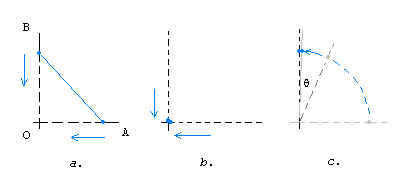
Fig. 2. Schematic illustration of the degeneracy of point states
6.) It seems that we are led to accept this strange property of PM state space which means that we cannot have a non-degenerate notion of ‘position’ which has both the functionality of a point and the definition of a point in Euclidean geometry. This actually turns out to be useful. A Euclidean point is a mathematical orphan that has no viable state except as it is adopted by some imposed metrical gauge, and the reason is that it is (so to speak) born, like the immortal Peter Cook, ‘an only twin’. Laying down sheets of coordinates after the fact, to allow the point to be given a Euclidean representation, is exactly what loses the essence of the functionality which the point has in our representation, and some functionality then has to be reintroduced by making the 0-D point a differentiable function of an n-D continuum, with the result that infinities occur. Instead we wish to preserve our more general definition of a point in state space.
Note 6: We can note at this stage that one way of expressing a redundant pairing of collocated points would be in terms of null lines. Such lines occur in a relativistic spacetime geometry as the signal lines of photons. It is possible to construct a geometry of purely null lines, but obviously some important property of a line gets left out in such a geometry - i.e., real length, whose physical analogue is an ensemble property called relativistic mass. It is a consequence of Lorenz invariance in 4-space that any system of intersecting null lines is automatically a system of orthogonal lines. Consider an arbitrary system of photons: Infinite Lorentz contraction on the proper 'motion' axis of each null signal line reduces away all parallel components of all intersecting null 4-vectors connecting it with the origins of other photons (or, the system of electrons is contracted to a plane normal to the photon spin axis), leaving only 1-space transverse components. Thus, every photon null line intersects all other photon null lines orthogonally. Since only two orthogonal lines define a plane in two dimensions it is obvious that the system of n photon lines where n > 2 is contracted onto a 'plane' of n dimensions. We will show that in PM this hyperplane behaves 2-dimensionally in the sense of a critical-point system whose correlation length is always equal to the confinement distance.
7.) In short, the relation of two particle states must be representable as a relation of two lines primitively; we cannot begin with point states of zero extension but must include extension radically in our definition of ‘position’ in the state space. This means that ‘position’ is never a single-valued function; rather, one ‘position’ enters as a function of another ‘position’, both of which involve pairs of boundary conditions. In this way ‘distance on a line’ enters in the first order as a mechanism for registering a ratio of quantities (inside elementary triads, as we will see), and a single-valued point-position can only be projectively recovered as an extremal idealised case. (Note 7)
Note 7: The original motivation for 'parcellular' mechanics was Schrödinger's argument that classical mechanics had never been deterministic in the first place, since velocity is required as an initial condition but cannot be defined in an 'instant'. The concept of instantaneous velocity is a theoretical abstraction from actual processes, which are minimally pairs of interactions to which an interval of time is innate.
8.) So, if there is no strong a priori motivation for doing so, we do not propose attempting to reduce this redundancy. We accept that a rotation of points into lines and lines into points is an elementary symmetry in PM space. This is extremely useful because it allows us to resolve what would otherwise be the paradox of an infinite number of points of zero-dimension redundantly defining each of an infinite number of empty position states (which is to define a continuum singularity). The solution will be that points of dimension 0 have, irreducibly, equivalent projections as lines of dimension 1, because points do not occur other than as the termini (i.e., in general the vertical conjunctions) of lines; conversely every conjunction of lines, and only a conjunction of lines, defines a unique point. The result of this construction, given a PM space of n volume elements (see Para. 4 above), is that each such unique point in 3-space ‘contains’ roughly n1/2 lines (or what we might call ‘virtual’ degrees of freedom).
9.) The above considerations show that the natural framework for PM space is given by the axioms of projective geometry, which assert a complete duality between points and lines, such that:
ii) for any two lines there is one unique point that is the intersection of them both.
A projective 3-space built from such point/line elements has the properties that
iv) each line in the projective plane is a family of such lines, including a line ‘at infinity’.
This is a non-Euclidean geometry of the greatest possible generality (which has similarities to the projective twistor correspondence). We will try to preserve a definition of a line or point which retains this generality, and avoid a field of continuous background coordinates. The elementary unit of point-line relation under this definition will be 'unit scale', for which the first real values will be generated trigonometrically in triads, extending over a complete graph of triads of intervals transforming under the Lorentz invariance group. We assert that it will be possible to recover the Riemann general analytical transformation for continuous geometries of n dimensions from the type of projective geometry envisioned here, and in particular that geodesic displacements on the curved 4-space manifold of GR can be shown to be dual with the more primitive Cayley-Klein type representation of distance in terms of projections between points and lines.
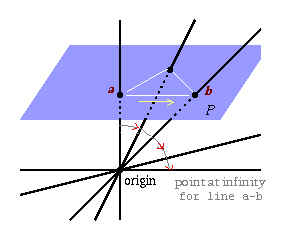
Fig. 3. Projective geometry. A line ab in projective plane P bounded by limiting lines through an origin lying on a line at infinity in 3-space. A sheaf of three boundaries generates a triangle on P.
10.) The conservative definition of Para.4 ensures that there are no degrees of freedom for the line (or point) other than those determined by other points (or lines). In other words an assembly or network of lines self-sufficiently defines and exhaustively fills the n-dimensional ‘pseudo-volume’ of its own space; there is no embedding space from which a line or point may borrow infinite degrees of freedom. We have obtained this by allowing each linear element of unit scale to define one orthogonal dimension and requiring it to be a filled state. (Aside from conserving the generality of the projective axioms, this may seem at first not to be physically conservative despite Note 1; but for now we leave this procedure to be justified by its results.) A number n of exemplars of linear unit scale can then be regarded as analogous to the n volume elements of a PM space of arbitrarily high dimension n.
11.) The boundary condition in this space is neither at infinity nor at any definite real ‘radius’. The n volume elements are all bounded and dimensionally orthogonal, and realise an arbitrary spectrum of real distances. This is not a space that has any well-defined characteristic scale. Every point (of ‘measurement’ or self-interaction) is a distinct projective origin, and there will n pairs of boundary conditions on n lines, each pair projecting to approximately n1/2 ‘points at infinity’, with each ‘point at infinity’ being a common boundary condition on n other lines. We can think of the boundary condition as having been distributed or dispersed (in a process of ‘virtual partition’, see Section 2.5) through the body of PM space so that every one of n1/2 boundary nodes is a new point at infinity, an origin for a ‘new’ projection of lines (see Fig. 4) in a vector-space which (for finite n) always remains closed. (Note 8) A related conservative assumption will be that changes occur only in the form of registrations that can be self-consistently absorbed into the state of the whole network of lines and points without the associated quantity going to infinity. (Note 9)
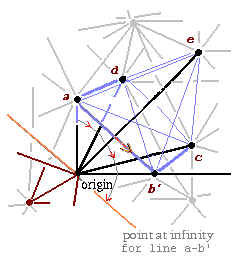
Fig. 4. A generalisation from Fig.1. Lines whose boundaries are generated from any common origin lie on arbitrary numbers of different planes in projective 3-space.
Note 8: This ramifying network could be thought of as analogous to the Huygens construction mapped to an arbitrary number of projective planes, where an infinite number of wave normals is replaced by a finite number of discrete 'rays'. With the exhaustive connectivity of a complete graph, each junction renormalises phase at a new projective origin for the entire network.
Note 9: This constraint on the graph - expressed also in the PM 'exclusion principle' which, as will be shown, generalises to require the non-degeneracy of lines (i.e. pairs of 3-space points) - implies the absence of multiple edges and loops - a loop being the exclusive connection of a point with itself. The absence of self-connected loops is equivalent to eliminating the self-energy of an electron's self-interaction via the field and 'multiple edges' only occur in the sense of states wholly separated 'in time'. In other words the PM 'supersymmetric' exclusion principle acts on lines so as to demand that 'multiple-edges' are not parallel-occupancy states but are serial-occupancy states , i.e. they define a sequence where an angular frequency associated with a periodic stationary condition defines a local 'clock rate' or time displacement rate. Expressed as the bosonic state of the PM unit-object this becomes a photon exchange rate, which quantifies the charge coupling constant. I wish only to note in passing at this stage that these constraints produce the logical structure of the canonical Einstein quantisation condition for radiation: That one photon from one electron goes wholly and uniquely to one other electron. The conserved quantity associated with time displacement symmetry is energy, and in general we would expect the linear interaction condition of our finite graph to produce the characteristic energy spectrum of a finite-state 'cavity'. From this networked cavity of linear stationary states we hope to pass in a direct way to a model of quantised oscillators from which the Planck radiation theory can be recovered.
12.) PM space will have many distinct boundaries or peripheries, each also a distinct projective origin or centre. This may seem paradoxical but physically speaking it is highly desirable, and consistent with the principle of relativity. Interpreted in the light of quantum theory, the deep meaning of GR is that space is a structure composed of many views of itself, all of which are reconcilable but none of which are quite equivalent. Like the so-called holographic theories, PM realises this condition. Because it is a process of self-interaction, not an object, PM space is a register of operations, and the sequencing of these operations displaced in space and time is the obverse of a simultaneous collocation of coordinate origins. In other words we cannot treat any actual origin (point of measurement) as simply reproducing the function of a single imaginary origin, and we cannot treat any single operation as an equivalent scaled down copy of the sum of all such operations. It is therefore never valid to map any number of original operations onto the same set of simultaneous co-original Cartesian coordinates. (Note 10)
Note 10: This doesn't mean that such a mapping to co-original coordinates cannot be done; only that the map will fail to disclose the underlying divergent causal structure and, used as a guide to new theories, will mislead. The tension inherent in such mappings can be seen in SR, where Minkowski geometry allows one operation to transform onto another according as different observers choose different spacetime coordinate axes. Insofar as all lightcones are parts of the same flat lightlike hypersurface this is still a continuum approach, which fights against quantum theory, but an idea of the distinctness of inertial observer-frames is contained in the fact that transformations are now no longer simple Galilean translations which, if the coordinates were rescaled, might be superimposed, but are instead relative rotations that break (though continuously) the simultaneity condition of the Cartesian symmetry. In GR the lightcones are tilted and this tension is extended to a distortion of the manifold itself, associated with individual mass-energies; but the twisted 4-space map remains unbroken and so the Cartesian positional degeneracy is preserved. The paradigm of such degeneracy is of course the Big Bang singularity. In PM, spacetime singularities and matter singularities are both forbidden by the same dualising 'exclusion principle' which states that no two mappings of PM space onto any two points can be co-original mappings - they are always boundaries on a line in 4-space.
13.) In PM space it is logically necessary that each elementary measurement operation, where a point operates on the boundary conditions of a line, defines a plane triangle. But this will not be a Euclidean triangle in the real number plane, where two degrees of freedom suffice for the components, x and y, of one real-valued vector argument; because a plane Euclidean triangle of real vectors belongs to the space of synchronous Cartesian coordinates and is governed by the group of Galilean transformations. We know that Galilean relativity has to be subsumed by the Lorentz group, which can be represented as a rotation on a flat affine Minkowski 4-manifold. But SR does not ‘include gravity’, and in any case our requirements rule out the differentiable manifold, so we look for a different representation of the Lorentz symmetry. A non-Euclidean space of real vector gradients (tensor space) as in GR does ‘include gravity’ by confining Lorentzian symmetry to an infinite number of infinitesimal domains, but this will not do for us either, because the tensor space preserves the affine connection through a continuous transformation. GR implies the need for a many-centred structure but does not really supply the means.
14.) Instead of distorting the SR manifold continuously we need to break the SR symmetry discontinuously somehow. And because the general double-connection of position states in our theory is prior to metrical scale it is evident that the symmetry breaking phase must also occur throughout the network independently of distance scale. This involves breaking the symmetry of the group of affine transformations which is fundamental to conventional metrical space, abandoning the idea of parallel displacement of infinitely-near covariant field vectors in favour of a scale-invariant type of transformation between the different and changing ‘celestial spheres’ as it were ‘seen’ from each of many distinct projective origins. The type of transformation suited to this structure is a multi-centred rotation which breaks the global continuity of the affine 4-manifold and so, by definition, will not offer a smooth transformation between all views (Fig.5). The point is that this is to be a topological procedure at a more primitive level than the transformations of relativity theory. Making such an idea work depends on the idea that each displaced view of the world sums over many distinct representations ‘simultaneously’ with actuality emerging in the sum of all (complex) views.
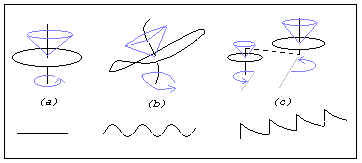
Fig.5.
Schematic idea of discontinuous transformation of Lorentz
symmetry in PM.
(a) SR, continuous flat affine rotation. (b) GR, continuous
non-flat affine rotation.
(c) PM, discontinuous non-affine rotation.
15.) Each of these projective origins (corresponding to a point of measurement) has to allow the system of nature to reflect itself there by generating a unique system of coordinates, each encoding one (dynamical and kinematical) view of the whole, such that the superposition of all such states reconstructs (in imaginary time) ‘the’ state of the whole. Such a space is plainly nonlocal in some degree, but this is arguably a requirement of any modern fundamental theory (context-dependent intrinsic spin parameters, Aharonov-Bohm type effects, EPR correlations in general, and nonlocal energy in GR itself - not to mention the problem of inertia - are all major reasons for believing this). At this point we notice once again that the type of structure we are moving towards appears to have a more natural affinity with the structure of quantum mechanics than does the continuous differentiable manifold. To implement this idea in a toy form we will show (Section 2.3 & 2.5) that a trigonometry of vectors in a ‘stack’ of complex planes has a rich enough internal symmetry to associate each distinct operation - that is, each distinct vertex - with a unique centre of rotation in PM space, and propose that oscillating states generated within the superposition of complex vector arguments encoded at each vertex can represent the quantum wavefunction. This strategy shows an obvious affinity with the complex rotational invariance used in the gauge theory of electromagnetism and will hopefully allow us to understand (when generalised) how a huge but finite number of superposed Lorentzian domains, each associated to a privately coordinatised complex hyperplane and displaced by some ‘hidden’ fraction of phase, goes over to GR continuity on the one hand, and on the other hand deconstructs to a projective space of quantised linear actions.
We now have a clearer understanding of the motivation for the prospectus set out in Section 1.1: Points of measurement are nodes in a graph of complex vectors with self-orthogonal components. They are projections of lightlike zero vectors in a hyper-complex space CN. These linear vectorial objects are the primary objects, not their nodes; they are supersymmetric and each properly preserves time-reversal invariance on a unit scale in CN. There are only filled states and no empty states, each of N objects being isomorphic to one of N linear 'volume elements' of a state space of arbitrary dimension N forming an exhaustively connected network, i.e. a complete finite graph. It is also a simple graph without loops or multiple edges. The Lorentzian local space R4 describes a projective evolution of R3 surfaces inside CN due to a spontaneous supersymmetry-breaking. We recover the Euclidean plane triangle as the minimal structural element of a hyper-complex space CN which behaves as a 2-space, in the sense of the reduced dimensionality of a critical-point system with a correlation length always equal to the scale on any 3rd dimension. |
go to Section 2.2,
consistency with classical mechanics
go back to
Section 1.2
Foundations
index