2.3 consistency with relativistic mechanics
1.) How can a theory of nonlocal ‘far action’ forces possibly be dual with the pre-eminently local ‘field contact’ theory of relativistic mechanics? So far this possibility has been asserted but not demonstrated. Here we will try to do so. First of all, in general, how can we assert that PM requires breaking of Lorentz symmetry and at the same time has consistency with SR? This question should be seen in context with the fact that the existence of structure per se is a breaking of Lorentz symmetry. The group contains no preferential space direction, and indeed is invariant under CPT reversals, yet nature is full of ‘preferred’ directions in spacetime, due to mechanical forces, gravitation, intrinsic spin vectors and so on. The structure of a crystal, for example, represents breaking of rotation and velocity transformation symmetries for a particle moving inside it. Lorentz symmetry is strictly-speaking spontaneously broken for every directed trajectory. But this doesn’t seem to be what is usually meant by a broken Lorentz symmetry. The usual tacit assumption is that if you could see the underlying pattern of possible directions centred on every infinitesimal point in space then it would in every case be perfectly Lorentz symmetric, no matter that few of these possible states are ever filled by observable particles.
2.) This is expressed by the idea that the patterns which break symmetry in matter do not reflect the existence of pattern in the vacuum; that is, the vacuum is a perfectly isotropic continuum, a blank unwritten sheet on which true Lorentz/CPT symmetry is preserved. Theorists have considered possible breaking of the vacuum symmetry and have looked for evidence of subtle anisotropies that might reveal fine-scale ‘graining’ of the spacetime background underlying particle trajectories, so far without success. But clearly in PM the idea of a background graining has no meaning, because there is no homogeneous continuum of vacuum quantities to be specified. Rather, every trajectory is a spontaneous breaking of the (linear) vacuum symmetry and there are no empty vacuum states.
3.) The issue of how locality can coexist with a space structure of nonlocal forces is more subtle, but in essence it can be understood by reference to the problem of the ‘ether’. As is well known, special relativity did not eliminate the possibility of an ether but made the hypothesis redundant by ensuring that the result of any experiment designed to reveal a motion relative to the ether would be the same as if the ether a) did not exist or b) conspired always to share the same kinematic frame of reference as the experiment. It should be noted that general relativity lays a similar condition on an experiment designed to reveal a distinction between inertial acceleration and a gravitational field gradient. In GR the conspiracy mediated by the non-Euclidean spacetime geometry is closely analogous to the conspiracy which SR requires to be mediated by the ether. In neither case can any direct measurement reveal the distortion. In the case of the ether, relativity dismisses as superfluous the presence of a ‘metric’ that transforms unmeasurably underneath the Lorentz equations; in the case of spacetime curvature, relativity welcomes the unmeasurable metric tensor as a boon which ‘explains away’ the force of gravity. The essence of both is that they elude calibration. In GR the force of gravity is superfluous, only the action of gravity remains, and the motivation of this programme is that the action is supposed to be locally specified in a theory that explains inertia. But GR is not properly local, and does not explain inertia either.
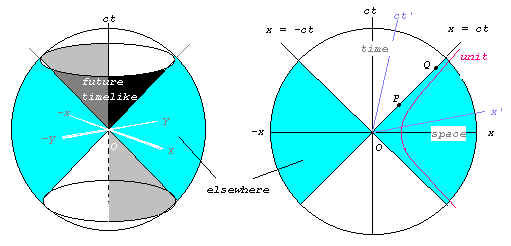
4.) So it is with all this in mind that one should look at the question of SR’s supposed incompatibility with a nonlocal physics of far actions. In fact a great deal of physics appears to be nonlocal. The spin parameters that describe atomic and molecular structure in accordance with Pauli exclusion govern nonlocally; EPR correlations are ubiquitous in spin interactions and are routinely demonstrated over large distance scales. The Aharonov-Bohm effect and related quantum topological phase effects are well-studied examples of nonlocal far action. What does this mean? If we consider the causal structure of SR in terms of the light cone we can see that precisely because c is a finite constant it is possible to define the section x = ± ct of the lightlike hypersurface in Fig.5 in terms either of the past-future timelike zones or of the zone of elsewhere, which vanishes as c goes to infinity. From a certain point of view the local causal structure of relativity only exists because it is the obverse of an embedding nonlocal structure. The function of c is to enforce the equivalence of causal physics for all different observers by enforcing the non-equivalence of observer locations according as they have the possibility of being spacelike separated. It is in one sense ‘obvious’ that the relativistic simultaneity of two points joined by a spacelike vector forbids by definition the exchanging of timelike or lightlike information between them. Less obvious, perhaps, is the fact that rendering all intervals timelike or lightlike by letting c tend to infinity would mean that no two points could be improperly simultaneous; every measurement would be completely determined by its local connections to every other state as far as past- and future-timelike infinity. So the fact that origins of timelike intervals can be spacelike-separated objectifies the notion of ‘chance’ and is thereby fundamental to the causal structure of quantum theory. In terms of quantum electrodynamics, locality of the electromagnetic gauge field is expressed in and is expressed by the fact that Pauli exclusion nonlocally enforces the non-equivalence of pairs of electrons.
Fig.5. Causal structure of the light cone and Minkowski geometry, showing one branch (red) of the spacelike ‘internal hyperbola’ of unit distance
5.) From the point of view of PM this Leibnizian non-equivalence of displaced points of measurement enforced by c can be seen as the true meaning of Pauli’s exclusion principle and is the essence of the non-degeneracy of position states in PM. In other words, nonlocal physical structure is not by any means ruled out by SR: nonlocal connections coexist peaceably with SR because of the ‘no signalling condition’ which rules out the possibility that any causal connection should appear instantaneous to observers attached to different fermions moving at <c. The cost of this is to create a class of bosons invariantly ‘travelling at c’ to which no (real) observers may be attached. This class supplants the function of the undetectable ether, insofar as attaching an observer to a boson would make instantaneous contiguity an observable, just as attaching an observer to the ether would make absolute motion observable.
6.) Far from it being the case that a Newtonian nonlocal structure was demolished by SR, it is obvious that the concept of nonlocality would have meant nothing to Newton because it only appears with the restriction imposed by relativity - the finite speed of light. SR brings into existence a class of relations which appear from the point of view of local observers not to take part in the causal structure of the world as defined by positive-going timelike vectors. But not only does SR not require that this appearance is actuality, SR itself provides a frame (c) in which all spacelike and timelike intervals rotate into one another identically. And in doing so it provides a new degree of freedom for the causal structure which Newton could not have dreamed of (even though it is implicit in the symmetry of his own equations of motion) - time-reversal symmetry.
7.) In Fig.5 the coordinate system (x,ct) is a Minkowski-orthogonal pair of axes bracketing timelike and spacelike regions which are causally distinct for an observer at O, the distinction in terms of c being the signal velocity required for a causal connection: <c on the timelike side, >c on the spacelike, the latter implying reversal of +t to -t for a class of observers. In general spacelike causal connections with -t are ‘forbidden’, in the sense that all observers must be able to agree on the same causal order - this so as to preserve the uniformity of the ‘laws of physics’ in all frames, which after all is what relativity is supposed to be for. But this says nothing about the ontology, only that the resultant of some complex combination of time operations of opposite sign - a superposition of advanced and retarded solutions of the quantum wave function - will have a positive real outcome in the ‘forward’ time direction. Quantum mechanics in fact goes so far as to require this complex time representation, in the form of a procedure for reduction of the state vector which is technically equivalent to mixing (>c, -t) and (<c, +t) wave trajectories. (The probability is proportional to the product of the vector amplitude with its complex conjugate. The formal equivalence to time-reversal is well known and forms the basis of the Wheeler-Feynman absorber theory and Cramer's transactional interpretation, as discussed later.)
8.) Para.7 implies that if QM is to be relativistically invariant then SR itself must be able to represent such complex entities, as of course it does. In Fig.5 another inertial frame moving with positive relative velocity in the x direction has Minkowski-orthogonal axes (x’, ct’) which are approaching the lightlike null line x = ct. In this and in any other case (x’’, ct’’ ) the space and time axes remain perpendicular. For the case of an interval PQ lying on the lightlike line x = ct (common to all frames) it is said that the interval PQ is perpendicular to itself, because space and time axes must coincide, and its invariant 4-dimensional length s2 vanishes to zero. This result can also be expressed by saying that the calibration hyperbola of unit distance from O in Fig. 5 intersects x = ct at infinity. The photon zero-vector can therefore be seen as the null superposition of a <c timelike and a >c spacelike vector, or of positive- and negative-timelike velocities. This represents the fact that in QED a photon is its own antiparticle.
9.) Rather than eradicating ‘instantaneous’ far actions, relativity provides a rigorous physical interpretation of how ‘instantaneity’ works, in place of Newton’s naive extrapolation from sense experience. It now has a more limited meaning, but a precise meaning. Instead of being realisable in principle for all classes of relations in a system it is now realised in practise for one very well-defined class of relations. What relativity does is to reconcile ‘action-at-a-distance’ forces with ‘contact’ forces by replacing both with the concept of action-at-no-distance, and the proper and improper views of the network of photon signal lines realise the projective transformation of point and line in the PM geometry. Our understanding of relativity in PM is that the vanishing of the interval on null geodesics represents the action-at-no-distance between trajectories, or the ‘contact force’ between contiguous ends of PM unit vectors. The unit vector enters as the value-free basis state of all relative scales, not as an infinitesimal differential, and it is the self-interaction of the system of these unit objects which occurs (at vertices) at ‘no distance’.
10.) Very schematically (see Note 1), the point-representation of PM supersymmetry as ‘seen’ by a system of N photons can be thought of as a ‘lattice’ of N ½ particles with a zero packing distance, each of which has ‘internal’ negative dimensions projecting along imaginary extensions of each of N photon spin axes. (See Fig.6) Each internal dimension represents two degrees of complex freedom in the form of a pair of antiparallel state vectors. (These will be pairs of basis states for electron spin in 2N ½ ‘directions’.) The complementary line-representation projects these internal dimensions on lightlike 4-vectors whose antiparallel components become advanced and retarded actions in negative- and positive-going time directions. In the line-representation, then, the nulls ‘inflate’ to lines on positive PM dimensions (spacetime intervals become real) whilst reciprocally the point retreats to the status of a connection occurring at zero-distance at vertices between bosonic lines. In the point-representation, on the other hand, it is the line that shrinks to the status of an interaction at zero-distance, between fermionic points, whilst the points ‘inflate’ in internal negative PM dimensions (spacetime intervals become imaginary).
Note 1: It's important to remember in what follows that we generally have in mind , as exemplar, electrons and the electromagnetic interaction. This obviously leaves out of account the role of positive nuclear charges in atomic structure, positrons and a great deal else - for the time being. But the character of the photon-electron relation is the essence of QED, and as such is paradigmatic. I should also remind the reader that an interpretation of fermion and boson spin statistics in PM is given later.
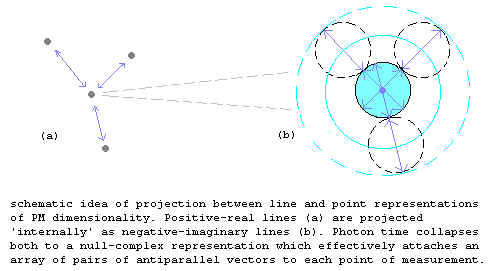
Fig.6
11.) In this way we get the idea that ‘supersymmetry’ appears to us to be broken because our nature as plural systems of vertices embodies the PM exclusion principle and the SR locality condition. The ‘microscopic reversibility’ of processes in Newtonian and quantum systems appears to imply that the reversibility is itself a scale-dependent principle; but PM has a scale-free reversible symmetry isomorphic to its scale-free elementary object, and it is only in the registration or ‘measurement’ of states that a distinction between ‘microscopic reversibility’ and ‘macroscopic irreversibility’ emerges (the implication being that entropy has an altered status in PM; see Section 2.4.). The necessary logical structure of relational ‘measurement’ mirrors a necessary physical structure which is ‘interaction’, a structure which is the essence of the many-centred ‘observing’ system(s) we are. The underlying complex PM geometry reveals that ‘radiation’ and ‘particle’ components of the field are projective representations of the same set of basis states, projections that simultaneously enfold and expel one another. We can describe this point of view as a relativistic 'dynamical supersymmetry'. (Dynamical supersymmetry is an idea more familiar in the quantum theory of the nucleus. Here we are effectively generalising the concept to all fields.)
12.) By rotating between these reciprocal perspectives we are able to see (still in a schematic way) that the plural light-cone structure is an interlacing of local and nonlocal views whose self-consistency is somehow crucially dependent on the fact that the world is a many-centred system in the sense of PM’s ‘exclusion’ of degenerate states. We can express this in terms of the light-cone by saying that it is always possible, by an appropriate choice of observer coordinates, to make two spacelike-separated world-points simultaneous in time or two timelike-separated world-points simultaneous in space, with ct = 0 or x,y,z = 0; but it is not generally possible to obtain ct = 0 and x,y,z = 0 between the same pair of points. This identity is only realisable for the set of all points in a lightlike relation to O (like P and Q in Fig.5). Otherwise, the two sets of hyperboloid sheets of unit distance and unit time for two origins O and O’ in two real observer frames S and S’ do not intersect simultaneously, expressing the fact that any real relation of O and O’ has to be spacetime non-degenerate and that our world-representation is therefore irreducibly dual.
13.) An implication of this duality in PM is that Newton’s Third Law cannot be strictly true for the point of application of a force. Taken over the entire interaction path the action and reaction will be antiparallel; but this means in the limit of arbitrary path length and complexity, in the frame where the vector sum of all momenta is zero. At the points of measurement there will generally not be found an equal and opposite reaction. Ideally the Third Law would be obeyed in the Newtonian inertia of a scalar particle (Note 2) and this idea is realised in a non-relativistic Machian theory where inertia is a dynamical reaction force due to a Weber-type potential. But in relativistic mechanics, as in PM, momentum is not rigorously conserved at the point of interaction.
Note 2: As already pointed out Newtonian inertia itself is not a conservative force in the sense of the Third Law because absolute space cannot react, by definition, to the forces of motion which act against it.
14.) In SR we are forced to admit the non-conservation of instantaneous momentum in any given frame. Only between the start and end of an interaction is it possible to say that momentum is conserved for all observers, which involves a certain arbitrariness; and between initial and final states some pair of ‘interacting particles’ always violates, instant by instant, the law of conservation of momentum. Conservative order is restored only by invoking the concept of the field as carrier of momentum and energy, so that descriptions of the state of the field in all frames may be so constructed as to conserve the total momentum. Of course invoking the field brings with it other problems, particularly when it has to be quantised with the result that the vacuum energy goes to infinity. In PM the particle action or local group velocity of the near field is supplanted by the unit vector, and the operation equivalent to invoking the infinite degrees of freedom of the far field would be to invoke the superposition (in imaginary time) of all frames. (Looking ahead a little: In the first analysis 'all frames' means all vertices of vectors of which the local transform of the unit vector can be found as the scalar product. These vertices are - for our immediate purpose - equivalent one-hop contributions to the path integral; but each vertex also nonlocally contributes to the momentum in an indefinite number of alternative 'acts of measurement' on increasingly circuitous pathways, which are not equivalent but which we can reasonably hope will take the form of a sum over a reducing series of perturbation terms in the sense of Section 2.2, Para. 3.)
15.) The non-conservation of relativistic momentum in Para.12 is closely related to the supposed prohibition of action-at-a-distance forces by SR. This prohibition consists in the statement that it is not possible to identify a unique form of the interaction between two particles, meaning that action-reaction equilibrium cannot be given a clear meaning for all observers at an instant, therefore instantaneous far actions have no objective physical status. Insofar as SR is only able to retain the concept of a rigorously conservative ‘force’ by invoking the local field as book-keeper for the transition momentum during interactions, then it has indeed given up the prospect of maintaining the Third Law for measurable ‘particles’ except over infinitesimal distances. Yet the situation in PM, as we have seen, is that Newton’s Third Law cannot be satisfied for an elementary object in the theory precisely because of an underlying structure of nonlocal ‘contact forces’ due to which there are no infinitesimal distances between points of measurement. There is no paradox because an underlying nonlocal structure that transforms isomorphically to the relativistic interval has the same status as a dynamical ether and may do so without violating definitions of observer time within an SR system. But is not such an underlying matrix merely as superfluous as the ether unless it introduces some superadded ‘force’ contribution to the system? And if it were to do so - say by way of the geometry of this matrix - would not this force by definition be superadded to, and therefore outwith the control of, those transformations governed by the Lorentz group of SR? Indeed so, and the underlying structure then acquires the same status as the GR metric tensor.
16.) Newtonian gravity proves that a very effective theory (though, in this particular case, a slightly imperfect theory only accurate to about one part in 107) can be made by assuming a network of instantaneous far actions; it doesn’t matter that differently moving observers inside the light cone cannot share a frame in which instantaneity is measurable. The very structure that excludes them from such a frame by denying them a common definition of simultaneity ensures that there is one, traced by the network of null photon lines. As mentioned above, relativity gives a physical meaning to instantaneity in the form of a scale-free function of a finite velocity, replacing the Newtonian conception of instantaneity whose physical meaning depended on the idea of an instantaneous time derivative of an infinite velocity. The latter can be thought of as the vector resultant of an infinite series of positive-going +t trajectories; the former, as the vector resultant of a finite series of +t trajectories and their time-reversed -t conjugates. (I use the term 'conjugate' to flag up again the connection to the process of quantum state vector reduction, which is discussed later.) The Newtonian instantaneous state is the irrational end of a divergent series; the relativistic zero-vector is the rational end of a convergent series. The affinity between PM and SR is self-evident here. In PM the null resultant occurs for any finite number of whole iterations of the complex process +/-t and expresses an intrinsic limit due to a cancellation of intrinsic vectors, which can never be reduced away to an instantaneous acceleration for any series of addition of velocities
17.) Another point about transformations under the Lorentz group: It has already been pointed out that the Newtonian scalar quantity m occurs as a vector in PM so as to modify the force vector under acceleration. In other words, in Newtonian mechanics the time derivative of the momentum, or the force F, is in the direction of the acceleration; but this will not hold in PM because the quantity m is itself an indeterminate vector associated with a non-zero extension, x. The trajectory x, which has to be treated as an elementary whole because of its underlying nonlocal objectification, does not satisfy Newton’s first law for a mass point in scalar equilibrium. The force in general cannot sum to zero and the resultant will be a torque. Momentum is therefore always the vector sum of a resultant in the x direction which is an invariant for all observers and an intrinsic pseudo-absolute acceleration which is an indeterminate component in the transverse y direction.
18.) This is consistent with the way Newtonian forces transform in special relativity, where the acceleration is not an invariant. If we take Newton’s Second Law in the form
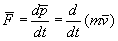 (13)
(13)
where
 (14)
(14)
is the mass of a particle instantaneously at rest in a frame with velocity v, then parallel and transverse forces F0x and F0y , producing accelerations a0x and a0y as measured in the rest frame of the particle, do not both transform invariantly in a laboratory frame with relative velocity -v, where
 (15)
(15)
so that the ratio of the components of the force is proportional to 1/(1- v2 / c2). Only for the special case g = 1, in the ‘instantaneous’ rest frame of the particle, would the time derivative of the momentum always be parallel to the acceleration.
19.) In PM there is no true instantaneous frame, except the proper frame of a lightlike zero-vector, so the forces are in general never parallel. SR admits an instantaneous proper particle frame but forbids any improper observer to share it. That is to say, only by being that same particle would ‘another’ particle do so, which of course would mean that it was not an improper observer, by definition! By imposing the condition v £ c for any timelike fermion, SR denies the improper observer the ability to freely transform her view of another arbitrary particle into an instantaneous identity (i.e. by bringing both into a lightlike relation), and by means of the term g it quantifies the infinite energy cost of the task of attempting to recover such an identity. Thus we can see that a relativistic electrodynamics which has discrete quanta of charge automatically implies an exclusion principle for fermion position states. The underlying structural reason is illuminated from the perspective of PM.
20.) In SR one says that a particle with mass cannot be accelerated to a velocity c. In PM this becomes the fact that, as ‘observed’ from any singular point of measurement (or vertex), all vectors where mi + mg ¹ 0 (i.e., vectors that acquire non-zero observed mass) are transverse vectors, neither of whose boundary conditions is the point of measurement concerned; i.e., they are not longitudinal vectors originating at the point of measurement. We can see that this distinction corresponds in our scheme to the distinction between fermion-dominated and boson-dominated representations of a PM supersymmetry ‘broken’, for any one vertical point of measurement, by the existence of a plurality of such vertices (para.11). And so transforming a massy transverse component into a massless radial zero-vector component of the field is equivalent to realising an identity between points of measurement with different position states. Bringing points A and B into a common lightlike relation with C would violate PM’s geometrical ‘exclusion principle’, which, by forbidding multiple edges in a simple and complete graph, ensures non-degeneracy of position states in n-dimensional PM space. (Note 3) The positional point-state at A is not an independent locale which may be vacated and then refilled by B, but rather it is a relative function of the system including A and B (it is in fact a ‘half-position’ state in the PM geometry), so the dynamical transformation in which we might seek to introduce A into the position state of B is the very action that ensures that the latter is no longer available.
Note 3: We can express this as a prohibition on the reduction of the included angle to zero , or more generally by saying that a pair of PM components may share one vertex, but not two. This makes the complete PM exclusion principle a quadrupole symmetry or 'force' residing in pairs of spin dipoles. See Section 2.5.)
21.) In this context we can see that the local limit c has the same exclusion function in SR, precluding the degenerate simultaneous identity of two position states in 4-space. And, most important, acts of actual ‘observership’ on some state, acts in which ratios of quantities appear and are registered, occur inside systems composed both of massless null radial and of massy non-null transverse components. In other words the included angle at the vertex of two components conjoint with a third component is integral to the physics of ‘observation’, and the inclusion of this angle is equivalent to ‘breaking’ (or rather, expressing) the PM geometrodynamical supersymmetry of boson and fermion. Moreover, the process is an irreducibly plural and mutual activity involving an exchange of roles from vertex to vertex to vertex which rotates the ‘mass’ around the triad as the scalar product of three different pairs of vectors. (Note 4) Thus the triad is the minimal symmetry group for the emergence of a nonlocally-distributed dynamical quantity called ‘mass’.
Note 4: This rotating construction will underlie the quantum commutation relations in PM and depends on the fact that each of these vectors - complex vectors in a plane of real and imaginary coordinates as described in detail in Section 2.5. Consistency with Quantum Mechanics - operates both in a kinematical and a dynamical role to supply both force (momentum) and displacement (position) amplitudes.
22.) We can illustrate the natural relation in PM between a finite wave speed c and the exclusion of point measurements (or the inclusion of angle) in terms of the physics of simple strings. If we think of c as characterising the proper null lightlike ‘rigidity’ of the unit vector (see Section 2.1. paras.18 & 19) we can then also think of it as a dynamical constant of improper states of ‘tension’ or ‘compression’ (see Section 2.2. para.3). Where these force vectors are exactly antiparallel the equilibrium condition of ‘rigidity’ will be a constant whatever the improper lengths of the vectors. Thus for the lightlike case we have the cancellation -mi + mg = 0 (see Section 2.2. para.13) and the proper equilibrium will be a pseudo-scalar constant of any null, longitudinal, massless, radiation vector, which qualitatively describes c. The problem is that c is supposed to be preserved not only on the massless longitudinal zero-vector but also for all different frames in which it undergoes arbitrary improper tensile deformations as a massive transverse fermion vector - i.e, not only for A and B, but for C, D, E . . . n as well. If the relativistic transformations involving n different velocities are analogous to varying string tensions, then the wave speed becomes a variable too, so how is it possible to maintain that c is a relativistic constant for all observers?
23.) As a preamble to that question, consider that in a system of relative scales a spectrum of states of positive tension is constructively equivalent to a spectrum of states of compression, except that whereas a compression of two position states could go to a degenerate limit, it is easy to define a natural lower bound to tension. That is, an infinitely large compression implies the inevitability of collocation (singularity); an infinitely small tension does not, and preserves duality at the point where the string ‘goes slack’. But even so we do not wish to realise this limit of slackness: Obviously a string with zero tension has a wave speed c = 0; but more fundamentally a string with an absolutely zero (or absolutely negative) proper tension is unintelligible insofar as it violates our founding definition of straightness (Section 2.1. para.4). We cannot admit this because arbitrary degrees of freedom would then have to be introduced to map an arbitrary number of indistinguishable (because unobservable) configurations of the string defined by (and only by) the same two points. This would import an infinite number of ‘virtual’ states, and thus would merely substitute a tensile degeneracy for a compressive degeneracy. Fortunately, the above argument reveals that ‘tension’ is just another way of defining ‘straightness’, and we are therefore able to stipulate that a minimum condition of all intervals is to be a state of positive proper tension, meaning that states of measured ‘negative tension’ will always be states of relative tension which (like curvature) occur as improper observer transformations. So a string’s minimal proper tension acts as an invariant lower bound to a range of relativistic energies corresponding to improper string tensions. This irreducible proper tension, then, looks very much as if it might behave like a ‘rest energy’ associated with a non-zero minimum of a range of wave speeds.
24.) Now, from the point of view of a single string considered in isolation the relativistic mass-energy relations involving c are easy to understand in this way. The relation between mechanical wave speed and string tension is
 (16)
(16)
where T = tension and m. = mass/length-1, and we can see that if string tension is allowed to vary then in order that c be held constant mass/length-1 has to vary in direct proportion (Fig. 7). So it automatically follows that if the total mass is a constant while string length (a photon ‘trajectory’) increases or decreases proportionately to tension under ‘force’ transformations, then c in turn cannot be constant. But since we require c constant for all deformations of the string these changes in measured string scale (‘tension’ and relative ‘compression’) will be described by a relativistic dynamics of the system, to include Lorentz dilations and contractions, in which the total mass varies exactly like the total energy E, which we can show is the same as T.
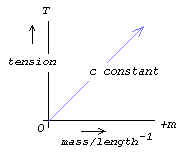
Fig. 7. Constant c and relationship between string tension and mass-per-unit-length.
25.) With mass/length-1 normalised to m = unit mass = m for unit length, we have
 (17)
(17)
or
 (18)
(18)
where T0 is just unit tension or the proper tension of an ‘untransformed’ string of PM unit length. So we have that unit tension equals unit energy, or T0 is equivalent to the relativistic rest energy E0. Now remembering that this unit ‘rest’ energy occurs as a stationary condition of the whole non-differentiable string, not as a property of a point-event, then we get the total scalar energy E of the string under relativistic displacement by the transformation
 (19)
(19)
where v is the component of velocity parallel to the length of the string AB relative to a displaced point of measurement C (Fig.7). A positive energy E0 occurs as an invariant limit corresponding to a minimal proper tension, and we conclude that states of negative proper tension would be negative mass-energy states, which will therefore correspond only to relativistically imaginary or time-reversed states of the string (+/-m ® -/+m), and in this sense c is again seen as the fulcrum of PM exclusion.
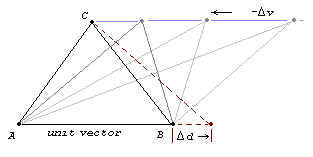
Fig.8
26.) Now suppose that the pair of vertices A and B in Fig.8 move apart in the manner of ‘two electrons’ (Note 5) by an increment Dd with velocity v, due to a Lorentz dilation in some frame S attached to a third ‘electron’, C, decelerating from velocity v’ to v" relative to (say) A. The total mass of A and B is a property of the string AB. (From the point of view of A or B, of course, AB has no mass; the quantity called ‘the total mass of A and B’ appears in the system ABC. [Note 6]) Because this dilation of distance Dd is in every sense a material expression of relativistic spacetime (Dd represents a changing charge density at AB which corresponds to a changing magnetic force on C - we assume ABC to be embedded in the indefinitely extended reference system of PM space.), we conclude that AB ‘really’ does stretch, that real work is done, and that Dd is proportional to an increase DT in string tension. Eq.16 tells us that if string tension on AB increases by DT, then c must also increase if mass m stays constant. Therefore if c is to be constant there must be an increase Dm in mass-per-unit-length in proportion to the tension.
Note 5: This is a concession to convention. Remember that 'an electron' in our construction cannot be said to be 'at A' or 'at B' or 'at C'. The three supersymmetric components of this triad, each characterisable as a bosonically coupled pair of fermion states, are the vectors AB, BC and CA; the vertices are the points of interaction.
Note 6: It's very important to note that according to para.17 and Eq.18 the 'total rest mass' of AB is always just mec2, not 2mec2. See Section 2.4 for the meaning of this in terms of the dynamics of particle 'pairs'.
27.) This could be interpreted from a particle point of view as saying that we take A to be ‘at rest’ and that an ‘inertial mass’ attached to B (call it mb) increases as B recedes from A in proportion to g(m). But we cannot measure Dmb directly; it is a component of a kinetic energy measured at B relative to A in a certain frame S. We could say that because the positive acceleration Dv of B relative to A is inversely proportional to the negative difference v’- v", then this increase in mb = E0 will be cancelled out by a decrease Dmab in the total relativistic mass of AB, so that the total energy E is conserved. Evidently there is a sense in which any variation in a ‘rest mass’ is actually an abstraction, along with the point-particle to which the notion of ‘rest mass’ is attached, because what any ‘observer’ like C measures for any given DT is just the displacement corresponding to an increment DE in the total energy. In PM we cannot give a clear meaning to this increase in terms of an objective property attached to A and yet not to B. No scalar mass can be ‘freed’ from this dynamical confinement. Insofar as the interaction A « B is modelled as a photon exchange we could equally well call DE0 a photon mass (see Section 2.2. para.14) if we wish; but if we arrange (in imagination) to put ourselves in the position of A or B so as to investigate a photon by direct inspection - i.e., we become ‘an electron’ so as to ‘absorb’ it - then AB becomes null lightlike and vanishes in the act of inspection (i.e. the spacetime interval s2 and the photon momentum density both go to zero with each act) expressing the fact that the ‘inertial mass’ vector +mi is automatically annulled by the antiparallel ‘gravitational mass’ vector -mg to give zero mass-energy over all. (This is our restatement of Weber’s postulate that the sum of all forces on a particle is zero in all coordinate frames; see Section 2.2. para.11.) The force and the photon in AB are only real for a system including a third point of measurement, C. So a variation DE0 in rest mass can only be regarded as virtual, in exactly the same sense in which a photon at rest is unobservable. Or: the work of displacement corresponding to an increment DE in the total energy is an alteration in the state of rest of the unit AB. (A detailed thermodynamical justification of this point of view is given in Section 2.4.)
28.) Remember that the ‘electron rest mass’ is the quantity E0/c2, which is not an isolable ‘thing’ but an invariant component of the total kinetic energy in Eq.20. The fact that E0/c2 is not isolable from the total energy of AB reflects the fact that kinetic energy disappears at rest (by definition), and since a scalar point particle contains zero internal energy its state of ‘rest’ is just its annihilation, which is why we say that PM mass is vectorial. The components of the total energy in the Hamiltonian of a free scalar particle are not well-defined because a free system has no well-defined state of kinematic rest. In relativity this translates ultimately to the lack of a rigid global boundary condition on spacetime and an uncertainty in defining the gravitational energy of a particle. PM questions the meaning of a scalar particle and offers the Hamiltonian a local habitation inside the boundary condition of each exclusive vectorial dyad, thus effectively eliminating the free energy from the thermodynamic equation by identifying it with the internal energy of a system always in conservative equilibrium. In PM it is inescapable to associate the invariant E0/c2 with the string as a whole, for how should we separate one ‘end’ from the other? Instead of being the mysterious internal energy of a scalar particle which may be sometimes at rest, E0/c2 becomes an invariant limit on the internal energy of a unit vector which is always functionally ‘at rest’ (by the PM dynamical definition of ‘rest’; the reader may wish to consider this statement in the context of the introductory discussion of absolute and relative theories of motion in Sections 1.1and 1.2.). Relativistic kinematic transformations of this invariant unit vector are improper views.
29.) This dynamical conception of rest inevitably involves both the ‘radiation’ and ‘matter’ components of the dyad simultaneously in the PM supersymmetry - the ‘ends’ of the string together with the connection between its ends. In general, a ‘rest energy’ can be interpreted as the kinetic energy of internal components whose vector sum of momenta is zero for some class of observers. But if all the energy of AB is to be seen as internal energy (because we have eliminated the ambiguous free energy), and if the vector sum of momenta internal to AB is to be zero for all observers (i.e., E0 = constant defines ‘absolute rest’) then the component momenta are the momenta of massless particles oscillating at the speed of light. Considered as a whole the ‘electron pair’ A and B confines the virtual momenta p = E/c of photons carrying inertia (virtual mass) mg = hn/c2, and the total ‘rest mass’ of A and B becomes equivalent to the electromagnetic self-energy of their interaction. So it is precisely the relativistic locality condition introduced with the invariant photon speed c which ensures that E ‘contains’ E0 in sense that E0 is in the past of E whenever we make a measurement. (This follows by definition in PM from the identity unit tension º unit time º unit length º unit speed.) Again, the fact that ‘a photon disappears as soon as it stops travelling at c’ is seen to represent both the confinement-bonding of A and B and their dyadic exclusivity as vertical position states in PM.
30.) If a photon disappears as soon as it stops travelling at c one might say that the experimental condition for confirming that a photon travels at c is never to observe it! In this sense the photon has a unique and indeed rather curious role in a science of measurement. There is a profound issue exposed here: We can in principle make two ‘position measurements’ on a photon, at points of emission and absorption; the second measurement not only brings it to ‘rest’ but annihilates it, which means that we need a new photon for any further experiment. It seems possible to go so far as to say that an inability in principle to make an observation on a photon ‘in motion’ is precisely the essence of what we mean by the ‘speed of light’. Two positions and associated times can only define a velocity, but three could in principle define an acceleration. The fact that we cannot achieve three points of measurement on the same photon can be seen as the ‘reason why’ we say that a photon ‘cannot accelerate’, meaning that it ‘travels as fast as is possible all the time’. This is both the definition of the limiting relativistic velocity c of a photon whose momentum cannot be transformed away to zero for any observer, and the definition of an elementary object in PM geometry (i.e., a non-Euclidean straight line completely determined by two and only two points; see Section 2.1.para.4).
31.) This bears some unpacking. It might be objected that scattering of photons, in the Compton effect especially, shows that it is possible to make more than two position observations on a photon. But this only underscores the subtlety of the question of continuity of particle identity in quantum theory. In the classical view of the scattering of light by an electron, of course, this issue of continuity of identity would not arise in the first place: Scattering is stimulated re-radiation of a new continuous wave by a charge set in oscillation by an incident wave, and so one could say that precisely because the scattered wavelength is exactly the same as the incident wavelength there is no continuity of wave identity implied classically. Paradoxically, it is the very absence of continuity of wavelength through the Compton scattering process in quantum theory that then encourages us to imagine a continuity of particle identity because the discontinuity is proportional to the Planck action constant. But it is not possible to spatially localise the quanta in a light wave and the mental picture of a ‘particle of light’ is misleading. True, the Compton effect demonstrates that a photon cannot be ‘split’; but since a perfectly monochromatic photon would be a wave train of infinite length which would take an infinite time to reflect from a mirror this is hardly helpful to the conception of a ‘particle’ (Note 7). It remains necessary to model scattering in terms of interference. Hard X-ray or gamma ray photons with wavelengths close to the Compton wavelength of the electron are needed, and in a process of intermodulation the photon and electron wave functions are superposed to produce a new photon wave-packet. The result is that the incident and scattered photons are not ‘the same photon’, and this is so in an even stronger sense than ‘two interacting electrons’ are not ‘the same electron’ for the reason that each of the two photons is ‘internally marked’ with a different wavelength whereas ‘an electron’ (as a conventional particle) never is.
Note 7: Such an infinite wavetrain is of course not realistic and perfectly well-defined frequencies are not encountered. Nevertheless a photon must spend some measurable time inside a scattering region with a measurable length, because an infinitesimal wavetrain would have infinitely indeterminate momentum. In PM this means that photons are confined by the pairs of boundary conditions of the geometry and our inability to separate force from mass (Section 2.2.) inside a system of exhaustively interdependent unit vectors leads to finite limits on pairs of conjugately variable measurements.
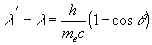
32.) In an electron-electron scattering the question of continuity or discontinuity of identity loses meaning in QED: Firstly the Heisenberg relations mean that the two position states cannot be definitely discriminated, and secondly the commutation relations mean that the two electrons cannot be uniquely marked either. (This is natural in PM, remember, because ‘two electrons’ do not have separate identity in the first place, or they each have half of the same identity). In a scattering context the rule that an electron cannot be marked is just what we mean by a constant electron ‘rest mass’: two electrons come out of the scattering region each with the same invariant equivalent wavelength of 0.51 MeV. On the other hand according to the Compton relation
 (20)
(20)
an X-ray photon l¢ emerging from the Compton scattering region at any non-zero angleq cannot be unmarked, because of the constant h. In this sense it is an intrinsic serial non-identity of ‘two photons’ which is at the heart of the statement that a photon does not have ‘rest mass’, whilst an intrinsic parallel identity of ‘two electrons’ is at the heart of the statement that an electron does have ‘rest mass’. In terms of PM’s projective geometry of non-differentiable doublet states this relation becomes very natural. (Note 8)
Note 8: The serial non-identity of the two photons can be seen to be the effect of the PM exclusion principle requiring a non-vanishing phase angle (i.e., excluding rotations of 180o and 360o) between two co-vertical vectors with equal unit magnitudes. A vanishing angle in this case would be the same as a congruent transformation of the line into itself , either a.) by virtual exchange of end labels (180o) or b.) by an 'inflationary' doubling of unit scale (360o). Both transformations duplicate an indiscernible identity of the photon state in the PM geometry. The rotation in a.) represents the time-reversal of the photon vector into its own antiphoton vector; the dilation in b.) represents the fact that the resultant photon zero-vector is properly independent of scale , or put another way the relativistic invariant s2 vanishes for all observers. This is intimately related to the different phase rules for displacement of neutral and charged particles in gauge invariant QED. See Section 2.4.)
33.) All of the aforegoing raises questions about what can be meant physically by the constancy of quantities like rest mass and the speed of light in a discrete, relativistic PM theory. We will be able to address these more fully in the light of the thermodynamical statistical considerations of Section 2.4. Meanwhile consider the suggestion that in a relativistic theory the meaning of a direct comparison of c on two closed trajectories AB and CD that are parallel-displaced, or on two arms of a scattering trajectory displaced by some angleq = BAC, becomes impossible to define except operationally. When we say that a photon g of frequency n on signal line BA and another g’of frequency n’on AC are related via a scattering region at A we automatically specify A as the vertex of a definite angle closed by measurements at B and C, and a determination of c in respect of g and g’ always involves relativistic specifications of time and distance and mass-energy on three sides of a triangle of fermion positions. The absence of a singular objective state ulterior to the differently transforming views of A, B, C and D means that comparing measurements is a process of preserving a dynamical self-consistency between serial views of a plural system, and it is not obvious that a relativistic ‘field’ theory can be discriminated from a sophisticated renormalisation device for keeping numerical ‘constants’ constant in terms of one another. (Note 9)
Note 9: A singular ulterior state may be considered to exist in a Bose-Einstein condensate at temperatures near zero K when all fermions are describable by the same function of position in 3-space. From this point of view the critical temperature of the phase transition marks the point where the constancy of c changes from an index of dynamical consistency to an index of statical consistency. The thermodynamical significance discussed in Section 2.4 is that c represents equilibrium.
34.) Does c really exist ‘out there’ other than in a formal sense? Yes, but the ‘obvious’ qualification is that it exists as a constant only for systems of dyadic PM units - because the physical objectivity of ‘out there’ consists in the process of self-interaction in such a system. The fact that c is dimensionally a speed rather than a pure number tells us that it is intrinsically a ratio and has no determinate value inside BA or inside AC, only between them. So the basic structural relation between the elements of a PM system required to produce this ‘determination of c’ will, we infer, always be just the type of structure required for a determination of the ratio of the electrostatic to the electromagnetic unit of force, this being the original physical meaning of the quantity first experimentally derived in 1856 by Weber & Kohlsrauch. A dozen ingenious measurements were made of this ratio during the next thirty or forty years by means of Leyden jars, galvanometers, resistance coils and battery circuits and it was well known that c, the reciprocal of the square root of the product of the vacuum permittivity and permeability, was invariant in terms of units of length and time. One especially vivid definition of this ratio was given by Maxwell:
Maxwell was thinking in terms of c as a disturbance propagated in a continuous elastic ether, and of course this was completely independent of later relativistic theory; but intriguingly it prefigures the Minkowksi spacetime representation of special relativity in 1908 according to which Lorentz transformations between relatively moving bodies become 4-rotations of systems which are considered to be ‘travelling through spacetime’ uniformly at the speed of light. This conception of an ‘absolute’ ensemble velocity (strictly a speed, a directionless scalar) is in its way no less difficult to interpret physically than is a convective ether. On the other hand, the highly intuitive description of electric and magnetic field interactions in terms of Lorentz-transformations of moving charge-densities made possible by SR seems closer to the spirit of electrodynamics prior to the Maxwellian synthesis. The actual theoretical and practical structure of the acts of measurement involved in determining c can be described as precisely that structure of interdependent relativistic self-adjustments required to ensure that the same value of c is always generated.
35.) In a certain sense the very essence of relativity is its circularity. It appears that a relativistic ‘field’ theory cannot be discriminated from a sophisticated renormalisation device for keeping numerical ‘constants’ constant in terms of one another, for the very good reason that the theory so marvellously models a renormalisation device which is the structure of Nature itself. Einstein stated that he was led to SR largely by the conviction that an electromagnetic field in one frame was nothing but an electrostatic field viewed in a differently moving frame. Today we are more used to hearing the story told in terms of the Michelson-Morley experiment, whose null result certainly makes the idea of a global rest frame in the form of a continuous ether difficult to support; but what Minkowski spacetime puts in its place is too often interpreted as though it were just some subtler kind of ether. Statements such as that ‘the speed of light is the same everywhere’ or that ‘an observer travelling at 0.9c would still see a beam of light overtake her at c’ perpetuate the misleading notion that making c equal in all reference frames is the same as setting some global parameter of a continuous ether. Of course one cannot observe the motion of a light ray in vacuum, and the meaning of ‘everywhere’ is changed by SR in such a way that the mapping of the field of ‘all observers’ onto a continuous substrate requires the mixing-up of space and time and the dislocation of planes of 4-space simultaneity, a process carried to the extreme of singular rupture of the continuum in GR, a geometrical theory whose entire force is in the unmeasurability of its fundamental geometrical elements.
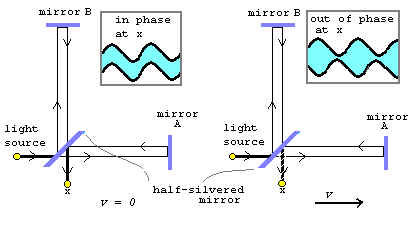
Fig.9. Schematic of the Michelson-Morley apparatus showing expected result for a relative ether velocity. Measurements parallel and transverse to the motion of the earth are compared by rotation of the whole experiment through 90o. If light propagates through a stationary continuous ether medium at c, split beams that arrive back at x in phase when arm A is transverse to the motion (left) should arrive out of phase when arm A is turned through 90o (right). They don’t. SR concludes that the speed of a light wave is defined only with respect to its source, not with respect to a background medium.
36.) PM proposes that this continuous mapping should be radically broken up and abjures the substrate from the start, accepting that the interlocking conspiracy of relativistic physics works on the more subtle level of pluralism. From this point of view the Michelson-Morley experiment (Fig.9) is an apparatus for exhibiting the fact that the phase-locking of clock rates occurs by definition when we stipulate that the rates of the clocks are to be determined by the phase, which follows from assuming a constant identical ‘speed of light’ on both arms of the interferometer. Asserting this identity is a ‘choice’ forced upon us by a ‘conspiracy’ of nature in the sense that the only possible definition of identity is precisely our inability to demonstrate it in direct measurement. The simple fact is that two dyadic exemplars of unit speed are by definition closed to direct inspection by one another. To certify metrical identity by applying one measuring rod directly to another is a process that can only be completed by asserting their ontological identity. But in physics there is at least one electrodynamical interval and an included angle that identifies two distinct rods in the first place. That the essence of ‘measurement’ is the separation of systems by lightlike intervals is if course the core insight of relativity, and amounts to the assertion that an electrodynamical manipulation of a system that reduces the angle f towards zero in Fig.10 is a process that would simultaneously constrain unit lengths a and b to transform to an indiscernible identity if f were ever zero. This is an operational statement that denies the meaning of ontological identity in a plural physics.
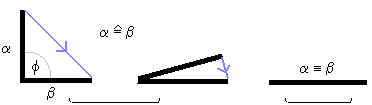
Fig.10. The essence of physical measurement is the scaling algorithm that maps a onto b. The degenerate identity a º b has no metrical meaning because it is not an operation.
37.) Consider the gedanken experiment of Einstein’s box: A tubular box has a spring at one end A and a sticky pad, B, at the other. A ball is fired by the spring from A and sticks on the pad at B. Like a Mexican ‘jumping bean’ the box recoils against the release of the spring and moves in an opposite direction to the movement of the ball, until the arrival at the ball at the far end cancels the momentum and stops the box. Knowing the distance through which the box has shifted, the travel of the ball from A to B, and the total mass, one can work out the mass of the ball which has been transferred from A to B. One finds that although the box has moved in the direction of A the centre of mass has not. (See Fig.10) Similarly, from the shift of a light-box due to a photon flash and Maxwell’s theory of light one can work out, for a constant speed of light, that there is a mass transfer from A to B equal to the energy of the flash divided by c2. This result holds for any observer of the box and for any similarly constructed box of any length.
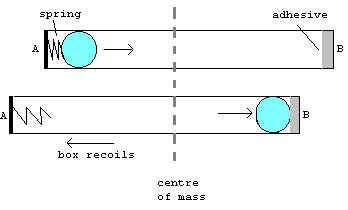
Fig.11. Einstein’s box. Transfer of energy from A to B by a photon, as by the ball, results in recoil of the box. If momentum is conserved the centre of mass in an isolated system cannot spontaneously move, so this proves that the energy of radiation carries inertial mass.
But how in practice do we measure the movement of the box to determine where the centre of mass is? If we have a single box suspended in some fixed laboratory reference frame the meaning of the experiment is plain. But now consider that an experimental event is schematically represented by a chain of such ‘closed’ boxes, interlinked in such a way that a transfer of mass-energy in AB is able to trigger a flash in CD, and so on. Make the system entirely self-contained with no background ‘gravitational field’ for a reference frame. Moreover let the ‘rigid’ frameworks of the boxes be dissolved, leaving pairs of contiguous ‘ends’ each subject interdependently to one another (Fig.12). Analogously, each of our PM dyads represents such a closed Einstein’s box, closed in the sense that we can form no conception of seeing into it ‘sideways on’, or of placing a mark on it externally, and there is no frame of reference other than may be provided by some configuration of other boxes. Since we can only examine each closed box by its ends, and because this examination can only take the form of registering the states of adjacent boxes, we have to question the force of the claim that c is a global constant with the ‘same’ value inside AB as it has inside (say) XY.
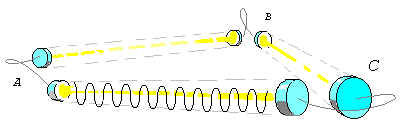
Fig.12. Schematic idea of a system of interconnected ‘Einstein’s boxes’, observationally connected to one another only via their ends. As an isolated system this is a relativistic ‘three-body problem’ with only emergent solutions for variables of mass, length and time where c is not an externally-fixed absolute. A ‘constant speed of light’ can be seen as a normalisation parameter, representing a self-consistent equilibrium condition for the system. From this point of view a state of agreement on a normative value of c stands for the system attractor of highest photon entropy.
38.) Because we cannot ‘look inside’ a box our confidence evidently reduces to the operational fact that a subsystem of boxes called an ‘observer’ gets consistency in her ‘measurements’ by using the same value of c to relate other subsystems (or ‘objects’) to herself and to one another. Assuming that c ‘really does’ transfer from box to box in some absolute ontological sense can be seen to be equivalent to the assumption that unit scale transfers intact underneath a Lorentz transformation of unit distance. But does c or unit scale ‘actually’ transfer with objective constancy in this way? The relativist must answer: ‘The point is, how could we possibly know? The meaning of relativity is that no further reduction by metrical inspection is possible.’ Indeed, but for that reason SR tells us nothing directly about the presence or absence of absolute qualities, only that they cannot be measured (by definition of measurement as ratio), so this fails to get to the heart of issue - which is that rational comparison depends on a prior condition: The possibility of distinction. Relativity itself cannot supply this primitive condition, which is the plurality of the world exemplified in the Pauli exclusion principle. So the theory of PM postulates just such an ‘absolute’ quality of distinction in its primitive geometry and extends the exclusion principle accordingly to an indefinite series of ‘quantum numbers’ associated with each of the doubly-connected position states of PM space. And now, because this absolute object is a discrete a priori structure in PM space, instead of a value recovered in the limit of a continuum of distances and times in smooth classical space, we have no interest in its quantitative ‘constancy’. Indeed its essential characteristic is that it should be the very antithesis of a transferable metrical quantity.
39.) SR itself strains towards the same perspective. In denying the possibility of the globally fixed frame of reference in which such a transference of an absolute comparator might have meaning, it requires the introduction of a local absolute whose comparison has no meaning. Due to its classical origins the theory is structured in such a way that time, distance and mass-energy conspire in order to preserve the idea of the constancy of c in a continuous vacuum. But, of course, as soon as SR is generalised to ‘include gravity’ the first thing GR demands is that we replace the idea of the constancy of c in vacuum with a route-dependent variable corresponding to curved lightlike geodesics. This is done by what Eddington famously described as a ‘put-up job’, a circular conspiracy of nature in which no measuring rod can be applied which doesn’t share the spacetime geometry of the rod to be measured, and so the unique ‘constancy’ of c in fact consists in the prohibition of meaningful comparison of c with itself in the system of nature. So we see that in a clear, if subtle, sense the value of c not only might be arbitrary in respect of its underlying discrete function but, if relativity is radically true, must be. (The differentiable manifold of GR, being not part of a discrete theory, would not of itself be 'radically true'.)
40.) In the end we realise that inside a spacetime theory it does not matter whether or not the c in one measurement is the ‘same’ as the c in the next because we can give no clear meaning to the question in terms of spacetime relations of observables. But the fact that it does not matter is itself the key to a meta-relativistic physical principle: The crux of Einstein’s insight appears to be that c becomes a constant of varying norm and the reason that this is possible consistently with experience and relativity theory can be seen to be that the variation in norm of c is not a continuous differentiable function of spacetime interval for any possible pair of measurements. In a sense, of course, this is ‘merely obvious’ because, as we have argued, it is only the same as saying that photons cannot accelerate (or more exactly, never exceed the speed of light) in 4-space. But the true meaning of why they cannot is only obvious when understood in the context of a many-centred space structure like that of PM, where an ‘absolute’ acceleration can be represented as a rotation of a primitive unit vector in a space of complex planes (see Section 2.5), and where a complete, simple graph without loops or simultaneous multiple edges supplies the boundary condition that enables this variation to be discrete.
41.) One interpretation of this system of discrete norms is that c is an extremum of a gauge invariance Q which would exist for any (isolated) set of PM elements at an arbitrary common value of Q, in the sense that only DQ has physical significance rather than any absolute value of Q itself. In other words, c = constant can be regarded as a normalisation parameter for an open, irreversible, metrically-disordered, relativistic singlet phase of a system which has a closed, reversible, ametrically-ordered, absolute doublet phase in underlying equilibrium. Then c stands for the proper reversibility of the fundamental mode of a string of unit length, a reversibility reflecting the zero potential difference associated with a stationary eigenvalue of the doublet energy state. This energy eigenvalue occurs as a time-independent extremum of the relativistic phase but is absolutely indeterminate, and can be described as the relativistic limit of two opposite-going wave functions, the normal Schrödinger function and its time-reversed complex conjugate.
42.) An ideal closed system (a triad) which preserves this time-reversal symmetry unbroken preserves Dc = DQ = 0, and preserves also the possibility of identifying unit mechanical mass mmech = T/c2 of each string as internal heat energy or, reciprocally, identifying a thermal interaction energy dm of the system as a multiple of unit mechanical mass-energy residing in a system of strings. This is an abstraction of course. A stationary eigenstate of a system of strings represents an unstable fixed point in the coupling space of all strings. The ametrical order preserving identical reversible inter-transformations of unit scale gives way to a generally irreversible process of generating 4-space volume, in which the nonlocal supersymmetry of multiplet states is broken down to an emergent local symmetry of singlet displacements generated in the process of 'measurement' (self-interaction). The transformation group of this emergent symmetry has c = constant; but the underlying equilibrium of the absolute doublet phase has the metrically indistinguishable condition Dc = DQ ¹ 0, a degree of disorder which, insofar as c embodies the spacetime structure, allows us to label ‘gravitational’ entropy positive in harmony with the positive entropy of thermal systems. A c which is a constant of varying norm thus represents the disorder of the gravitational field, a quantity which is mysteriously missing from the homogeneous and isotropic space of GR.
Note 10: Later we identify the invariant Q as a fraction of complex phase due to breaking of 'superspin symmetry' on the string network. See Sections 2.5 & 2.6.
43.) Cosmologically, this can be seen to be equivalent to addressing the flatness problem by means of a type of discrete VSL (variable speed of light) theory, but a theory in which the spacetime ‘origin’ is a vacuum equilibrium, a flat sheet in PM state space rather than a singularity, recovered by a subtraction over Dc on all lightlike paths. In the standard FLRW-type cosmological models based on modifications of GR the idea is to devolve various quantum fields back to a cosmic t = 0 in order to reconcile gravitational negentropy and thermal entropy, matter and radiation. Our interpretation on the other hand is based on a geometry designed to exclude singular degeneracy and depends on the idea that the entropies of the ‘radiation’ and ‘matter’ components of a PM system are always in underlying thermodynamic and supersymmetric equilibrium. This is the issue to which we now turn.
go to Section 2.4,
consistency with quantum thermodynamics
go back to
Section 2.2
Foundations
index