 (21)
(21)2.4 consistency with quantum thermodynamics
1.) We showed in Section 2.3 that the meaning of relativistic rest mass as an invariant is naturally associated in PM with a minimum condition of the energy of the ‘string’ as a whole. The kinematical meaning of the term ‘rest’ now disappears into a conservative zero-sum of the kinetic energy +DK and the potential energy -DU of the two displaced ends of the string. In other words it describes a stationary condition of the Lagrangian function of the interval AB. But this doesn’t mean that the string as a whole takes on a ballistic role as a species of ‘free particle’; in PM space the concept of such a free kinematic object has altogether disappeared.
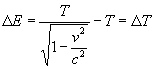
2.) Instead, the function of the term ‘rest’ is now that of an essentially dynamical limit of the transformation
(21)
which we will say is just the relativistic fluctuation in a total internal energy (E µ tension T) where a lower bound E0 represents a limit on a transformable free energy available for ‘inspection’ (mutual work of inter-transformation) among a system of dyadic strings. This equivalence between mechanical mass-energy and thermodynamical energy depends on the system being reversible and on the possibility of representing mass-energy as heat; but, assuming (for the moment) that we can demonstrate these conditions, it is straight away evident that E0 represents only an extremal value of this thermodynamical limit. The only value of E0 to which we ever have access is a ratio, since the notion of ‘weighing’ an absolute mass in isolation has no meaning. So in principle this extremum occurs at any arbitrary common value of E, because only DE has physical significance rather than the absolute value of E itself. In terms of such a general dynamical definition we are able to say that a fermion dyad and the photons it ‘contains’ are jointly and equally ‘at rest’ in a system whenever the free energy F vanishes, that is when
F = E - TKS = 0 (22) |
where E is the mean energy, TK is the absolute temperature (Note 1) and S is the entropy. It is a basic thermodynamic principle that for any TK a system spontaneously seeks to minimise the quantity F, and dF becomes zero at equilibrium. Because TK is essentially independent of E and S it happens that at high TK the system minimises F by maximising S, whilst at low TK it does so by minimising E. In PM we are able to say that any dyad has minimal free energy and is therefore at dynamical rest in a system which is always in underlying equilibrium, and the reason why this why this does not imply a homogeneous and isotropic universe in PM is to be found in the scale-free supersymmetric geometry of the theory.
Note 1. We adopt TK for the temperature to avoid confusion with T = string tension.
3.) The semi-classical spacetime view from which the basic Planck-Einstein quantum condition was developed is obviously very different, because equilibrium in that case does imply homogeneity. There is a thermodynamically favoured expectation that the universe should be in equilibrium, in conflict with observation on moderate scales easily accessible to us where plainly it is not at all homogeneous but rather has elaborate structure. This leads to the need to resolve the conflict by recovering far-from-equilibrium complexity as a mesoscale condition from a theoretical presumption of homogeneity at the extremes of micro- and/or macroscales, which extremes are considered to embody the smooth simplicity of a ‘fundamental’ state from which the universe has devolved. (see Note 2) Microcosmically this ‘classical’ view assumes the continuity of a smooth spacetime background which can be approximated by averaging particle actions over smaller and smaller scales. Macrocosmically the same presumption is implemented by the technique of averaging energy-density variations over larger and larger volume scales until, at some cosmic scale called the ‘homogeneity scale’, it is supposed to become possible to treat galaxy clusters as small energy-density fluctuations in a smooth fluid.
Note 2. It is interesting to speculate that there are historical reasons for this perspective. The birth of mechanics took place in the context of a pre-scientific mediaeval religious cosmography, according to which earth was nested at the centre of a series of increasingly-perfected celestial spheres culminating in the outermost unblemished crystal sphere of heaven. It may be that lingering echoes of the dogma of superlunary perfection, refracted through Galilean and Newtonian mechanics, remain undamped even today.
4.) This procedure ratifies as valid the application of GR to cosmological problems. But the procedure does not guarantee that the smooth spacetime field modelled in this way is other than an effective field, produced by applying a ‘normalising factor’ to some topologically more intricate structure. Quantum gravity theories admit the likelihood of a flaw in the microscale implementation of this homogeneity principle and seek a discrete structure specific to very small scales; but they never consider the possibility of a flaw in the assumption of macroscale homogeneity. (see Note 3) This is because of the success of GR of course; but GR is a classical continuum theory that predates quantum theory, and this is reason to suspect that attempts to quantise ‘spacetime’ are attempts to quantise a normalised effective field that is only a shadow projection of the underlying structure. PM is even handed, by contrast, insofar as scale per se is to be emergent and the underlying discrete structure of spacetime will have a scale-free representation. Homogeneity and isotropy, then, are not fundamental principles in PM and local variations in energy density map to an underlying nonlocal equilibrium whose dyadic units are connections in a scale-free complete graph.
Note 3. There are some astronomers and cosmologists who do, based on observational evidence of fractal dimensionality in galaxy distributions (see Section 2.6); but they are few, precisely because there is no plausible connection between fractal clustering and the standard physical models based on GR.
5.) In a semi-classical ‘particle’ view, two interpermeating ‘gases’ of point-electrons and point-photons (schematically speaking [see Note 4]) are each far from equilibrium in Nature, constrained into highly ordered structures with generally small entropy, and special conditions are specified - such as those of cavity radiation - to investigate the behaviour of radiation in equilibrium with matter. In the case of black-body radiation in equilibrium with an ordinary cavity its entropy is considered to rise to a maximum value for a given energy. Crudely speaking, the photons are maximally disordered analogously to thermal particles and F is therefore minimised for large E by Eq.22. Classical spacetime theory locates a condition of actual equilibrium in the cosmological past, when spacetime itself had the character of a black body cavity prior to the decoupling of the CMB. The essence of PM is to propose that there is an underlying non-continuum point of view from which radiation is always in equilibrium with matter and that any structure of PM dyads has the character of a black body cavity, independently of emergent 3-geometry.
Note 4. Actually the distribution of photon momenta p = E/c = hn/c given by the Planck-Einstein quantisation condition can only be considered to become particle-like throughout the cavity at high frequencies; in general the wave modes have to be taken as filling the cavity at all wavelengths to properly represent the probability. Nevertheless, the emission and absorption probability distribution is in general particulate (energy hn goes wholly and uniquely from one electron to another) and, given a vacuum cavity, in the 'Wien part' of the Planck law where the constant h becomes significant the probability distribution is obviously isomorphic to the electron distribution of the cavity wall for Smax.
6.) An illuminating way of looking at this is from the point of view of the definition of entropy, S. Entropy is often thought of as a measure of disorder, but the meaning of order is ambiguous and difficult to quantify. Perhaps more fundamentally S measures the proportion of a system’s energy unavailable to do work. Thus by Eq.22 if a ‘gas’ of photons totally reflected inside a classical cavity (in vacuum) were to be thought of as a system of kinetic particles with uniformly the highest possible thermal speed, then F will be minimised by way of the system seeking the largest possible S. (see Note 5) This large entropy will signify the maximum of some quantity measuring ‘energy unavailable for thermodynamic work’. Now in general the unavailable quantity is heat; but this is also just the definition of ‘rest energy’, a quantity of untransformable internal energy locked in as E0. The question then arises as to why photons are absolutely massless and, in a closed cavity, make their energy unavailable as completely thermalised high entropy radiation, when thermodynamically speaking they could equally well make it unavailable in the form of mass and low thermal velocities.
Note 5. 'Particles' with zero inertial mass are obliged to bounce around at the maximum possible velocity all the time. From this 'Brownian motion' point of view we can connect the radiation entropy with an equal probability of 'finding' the same speed of radiation at any possible point of measurement. Given c = constant this speed field contains zero negentropic order.
7.) A standard answer to the subtle question ‘why do photons have zero rest mass?’ is that they are required to do so as vectors of an infinite range electromagnetic gauge field. But this answer is really an equation in several unknowns - the meanings of ‘absolute’ rest; the absolute speed of light; ‘range’ in an infinite 4-volume; the fact that the electromagnetic action is not exclusively local (see Note 6) - and thus it depends on some unknown physsics, not least the origin of inertia. We can gain some insight into the question from PM’s point of view by returning to the fact that according to the equation E = mc2 and the thought-experiment of ‘Einstein’s box’ (see Section 2.3) energy carries inertial mass, and so according to GR it must also couple to the gravitational field. The mass of a box of thermal radiation at rest therefore includes a certain contribution due to the photons it contains, and an ensemble of such boxes will gravitate towards one another on a steeper gradient than will a similar ensemble of boxes containing no radiation. Each box is entitled to regard itself as at rest, and its contents are a part of its rest mass-energy. Therefore in a spacetime representation there is an important difference between radiation considered as internal energy or as external energy, reflecting the fact that ‘rest’ and ‘mass’ are co-dependent properties of the underlying topological structure:- closed geometrodynamical ‘loops’, or the general class of structures replicating the closure of triads in PM state space. We will have much more to say about this later and in Section 2.5.; but here we note that the masslessness of ‘the photon’ can be identified with that discernible non-identity of states which constitutes an emergent local time order. This is the principle that in general no pair of photons may have the same determinate 4-momentum, inasmuch as the definition of rest mass is inherently an extremal equilibrium condition of a bounded ensemble of momenta, and we see here the familiar PM exclusion principle requiring the serial non-identity of photon pairs as the obverse of the parallel identity of electron pairs (see Section 2.3 para.32).
Note 6. Specifically, experimental effects of the Aharanov-Bohm type show that an electron's phase may be affected by the variation of a magnetic field even if it is in a region from which the magnetic field is completely excluded. See later.
8.) The quantity which is minimised internally by a confined thermal gas of particulate photons in accordance with Eq.22 is Dp, the fluctuation in mean momentum density, leading to large S and vanishing F. That is, the high entropy of cavity radiation means that there is no momentum density gradient across any part of the phase-space volume (on some cell scale which becomes the basis of the classical quantum statistics) available for internal work, and this applies for any arbitrary total mean energy E because only Dp is physically significant and Dp - for practical purposes - is zero. However the same E does become significant when cavity a is brought up to another cavity b with a uniform energy E’ = E ± dE, because now dE reappears as a potential gradient that may do external work on a and b. When both ‘boxes of radiation’ remain at equivalent inertial rest in the doing of it we say that they gravitationally attract one another.
9.) So we find that radiation does have a scalar mass charge or ‘rest mass’ for the purposes of GR when considered as the internal energy U of a closed system; and for an ensemble of such closed systems (which we may then consider to be at rest in a TK<< m radiation bath) the Helmholtz free energy F of the ensemble is minimised collectively, in proportion to the inertial masses of its members, where that inertia represents, equivalently, both unavailable thermal internal energy (high S) and minimised external kinetic energy (low E). This describes a system of massive particles each being a composite of individually massless particles. The fact that we can characterise the same particles in these different ways depending on emergent spacetime relations suggests that it would be consistent to extend the co-dependency of ‘rest’ and ‘mass’ proposed in para.7 to the implication that rest mass and volumetric scale are similarly co-dependent on a more fundamental topological property of those relations.
10.) This approach is inevitable from the point of view of PM’s geometrical definitions. It is attractive because the volumetric quantum field approach leads to divergences as a result of not being well defined in the limits. For example, we can suppose this new ensemble to be a free-falling inertial system of spherical cavities contained in a larger volume, an ideal gas at minimum kinetic temperature all of whose free energy is locked in the inertial mass of a system of ‘particles’ at rest - small DE, small S. This is a new thermodynamic phase of the system, call it phase 2, in which the thermodynamic contribution of phase 1 assumes the status of an unmeasurable internal energy-per-particle, Uunit, equivalent to the ‘mechanical’ or ‘bare’ mass, mmech. This quantity mmech can be completely arbitrary, but all that is measurable is the experimental mass mexp corresponding to the energy that the particles have when their energy of interaction DE is non-zero (interaction º measurement), which incorporates a term dm » DE, so that mexp = mmech + dm. The meaning of an invariant rest energy then appears as an ill-defined quantity which can only be treated by being effectively eliminated by a vacuum renormalisation, leaving an experimental mass which is not an invariant. It is not invariant because it depends on a relativistic interaction energy - for example, on the electromagnetic interaction energy of one ‘particle’ with another - which involves variables that are intrinsic to the process of measurement itself. This process is just the process of existence of the particle.
11.) The analogue of such a renormalisation process in QED when carried out covariantly for all observers leads to a way of formally sweeping under the carpet a quantity that cannot be measured; in effect it sets mmech infinitely negative, by hand, so as to cancel an infinite positive quantity dm coming from the electron’s interaction with the quantised field and with itself. This leads to doubts about whether renormalisation can be regarded as a mathematically valid procedure and whether QED is a fully consistent theory. However the infinite dm comes in the first place from quantising a continuous field over an indefinite spacetime volume where there is no limit on the virtual particle proliferation that contributes to the ‘phase 2’ experimental mass mexp. This is equivalent to being unable to set an upper bound on the temperature of the (vacuum) radiation bath because of an enclosing infinity of nested ‘cavity’ volumes, which can be assumed to cancel against a mirroring infinite quantity of unmeasurable internal phase-1 mass-energy. But if infinite renormalisation is mathematically invalid this obviously doesn’t mean that renormalisation theory itself is physically invalid. Renormalisation is the physical essence of the quantity ‘mass’. The question is how a cancellation of unmeasurable quantities can be recovered as a finite natural relation.
12.) We can view renormalisation as a process of attempting to realise an equivalence between mechanical energy and thermodynamical energy in the form of an equilbrium constant called ‘rest mass’, an equivalence which as we noted earlier is realisable only for a system that is reversible. But the 4-space representations of natural processes are not reversible, or are in only some instances approximately reversible, which is a statement of the Second Law of thermodynamics. In thermodynamical terms ‘rest mass’ represents an extremum of entropy, as we have seen, a maximum of energy unavailable for work; but the Second Law states that maximum entropy is only completely determined inside a closed system. This is frustrating for a spacetime representation because of the causal time-asymmetry dictated by the expanding spherical wave fronts. There are no truly reversible closed regions of spacetime: the past light cone of every observer is locally closed, but it is not reversible; likewise the sum of all past light cones of all possible observers. Only a phase volume equal to the whole of spacetime contained in the past and future light cones of all observers can be regarded as both closed and possibly reversible in principle. But this volume is not really available to any observer; the sum is not local.
13.) So this is why the best solution to mass renormalisation in QED is to be found by summing over in the limit of all possible virtual spacetime trajectories, leading to what is in effect a heat bath of infinite temperature. A heat bath of indeterminate but finite temperature cannot be calculated with, in a spacetime representation, because it implies a system either not truly reversible or not truly closed; there is then no natural relation between the internal mechanical mass-energy of the particles (phase 1) and the thermodynamical energy of the system (phase 2). However the infinity of energy states contributing to dm in the sum over all possible virtual spacetime paths relieves us of the responsibilities of having to calculate dm or of having to interpret what is, in an irreversible system, an unnatural relation between dm and mmech. Declaring both unknowns to be infinite means that dm has an infinite probability of endothermically reversing an infinite disorder incurred in the work done exothermically by an infinite internal mechanical energy mmech.
14.) In this way all values of mexp can be made to lie on one critical surface in an infinite-dimensional coupling space. The effect of this is equivalent to ensuring that absolutely any experimental rest mass whatsoever signifies an extremum of entropy which is a constant for a system in equilibrium. But although defining an equilibrium condition in this way permits perturbative calculation to proceed beyond the first term, it is ill-defined in principle, and this is the problem with the renormalisability of QED. An infinite-dimensional coupling surface can be said to have all possible topologies. Without a finite boundary condition any point on the sheet can be regarded as coupled to any other point and to itself in an infinite number of arbitrary ways. Or in other words this coupling space can be said to attain a critical-point dynamic equilibrium for mexp, but only because an infinite spectrum of values of the correlation length are granted equivalence.
15.) So we see that the appearance and the cancellation of infinities in renormalised QED are obverse sides of the same pathology connected with correlation ‘lengths’ that appear as infinitesimals, loops and multiple edges, because the absence of a finite scale factor and the absence of any topological constraint go hand in hand. In a properly consistent theory where the equilibrium function of mass can be well-defined in principle it would be necessary to constrain the topology of the coupling space to remove infinitesimals, loops and multiple edges, and we recognise this as a description of three of the founding definitions of our PM state space, where proper reversibility is preserved on dyads of all scales. In other words the infinite-dimensional coupling space of QED and PM state space are approaching the same conception from the directions of continuity and discreteness respectively, but the top-down continuum approach imports a semi-classical pathology. The finite PM state that we have begun to build bottom-up can be described as being a critical surface in the sense of an effective 2-space due to the reduced dimensionality of a hyperspace of N dimensions where the ratio of ‘correlation length’ to ‘lattice spacing’ is always just unity on any dimension irrespective of emergent metrical scale (i.e., the ‘lattice’ is not metrically regular of course; it is a scale-free graph where all couplings are effectively ‘nearest neighbour couplings’). As we will see in more detail in Section 2.5, each of these N objects is itself actually a complex self-orthogonal 2-manifold whose proper null state superposes +t and -t improper representations indiscernibly. This is the origin of a proper reversibility underlying the spacetime representation with its emergent improper irreversibility, as noted at the end of Section 2.3.
16.) PM’s discrete projective pre-geometry thus gives the closure and reversibility needed for consistently interpreting mechanical mass-energy as ‘heat’ in an N-dimensional equilibrating phase space. It does this by abandoning the idea of mass as a scalar property and substituting the idea of a vector resultant, innate to elementary dyads, which is only ever non-zero in improper (i.e. local spacetime) system representations. In terms of thermodynamics this means that equivalent equilibria occur at both extremes of internal kinetic energy and are independent of the absolute temperature; in terms of string modes it means that the fundamental mode of all partial harmonic modes, and the resultant of all partial modes, are views of the same mode, in the one case deconstructed analytically, in the other constructed synthetically. The absolute value of both Fourier transforms in the proper state is the same - zero. The absolute value of both transforms in the improper state is again the same, but now it is unity, the unstable fixed point of the renormalisation group transformation. The dyad acquires unit scale in the elementary measurement system of an equilateral triad; but it is still a reversible superposition of +t and -t and so it remains possible in this case to say that the appearance of an invariant phase-1 E0 is coemergent with the maximum-entropy equilibrium of phase 2. If the triad of dyads is ‘three electrons’, then a ‘bare’ or mechanical mass is just the inverse of the ‘electromagnetic mass’, or the dressing, and the antiparallel vector resultant remains zero. Here the phase transitions occur not as upper/lower, inner/outer state boundaries in a differentiable space, but on a non-differentiable path around a closed loop, yielding an isentropic adiabatic relativistic zero-mass as a stationary state of a dynamical equilibrium between oppositely propagating vectors in a linear sequence of running constants renormalised at unity.
17.) In general, dm and mmech are identifiable with the free and internal energies. On any network path these quantities are properly cancelled against one another, reversible-closed-dyad by reversible-closed-dyad, like mi - mg = 0. Fermionic ‘matter’ and bosonic ‘radiation’ preserve a context-dependent supersymmetric ambiguity on such a path, which can be traced in terms of creation and annihilation of virtual photons and electrons. But these modes separate out in the 4-space representation, where mi - mg ¹ 0. This is because what 4-space represents is a structure of intersecting paths. It is a state function corresponding to all possible different path functions in the state space defined in relation to some emergent kinematical zero-point of inertial ‘rest’. In PM the path function is fundamental to the state function, and the breaks in the complex path are boundary conditions of 2-manifold phases that interpenetrate linearly without regard to scale (the nonlocal subset of all pairs of electron states) instead of being nested volumetrically dependently on scale (the local subset of all individual electron states). In other words the set of states R3 lying on a 3-surface exists at the intersection of N members of a universal set CN of complex 2-manifolds (Fig 13).
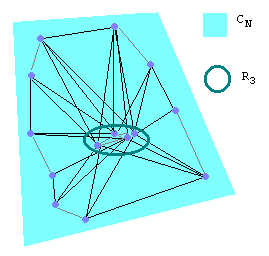 |
The surface
defined by the set of states R3 exists
at the intersection of N members of a universal
set CN of complex 2-manifolds. The
local space is nonlocally context-dependent within the
projective space of CN. The hyperspace CN is a complete graph, but for clarity only
a few of the 2-manifolds connecting points of measurement
in the state space are shown. Fig. 13 |
18.) So it is because the renormalised mass phase is fundamentally a reiterative path function in CN and only emergently a local state function in R3 that the renormalisation of phase at a ‘particle’ surface in R3 is not well-defined. And to characterise the mass of confined radiation, instead of saying that radiation contained in a closed cavity volume of radius r is ‘really’ composed of massless phase-1 vector bosons with infinite range, but has an effective phase-2 rest mass m, we can speak of the mass mg of vector bosons confined on linear ‘flux tubes’ of a gauge field of N broken phases of arbitrary range Dx.
19.) Here any value of relativistic scale associated with Dx always defines an absolute unit scale associated with a pair of mutually-cancelled changes of vectorial mass phase. The emergent relativistic symmetry of the system describes it as a local kinetic system of monadic mass-points analogous to a far-from-equilibrium thermal gas, but underlying this symmetry is a nonlocal system of stationary states in equilibrium where all dyads are massless at dynamical rest. The mass-point picture deals in state functions; but a photon is massless because it is intrinsically a path function of a system, not a state function. This is only to say, as we did in Section 2.3, that dyadic confinement by no more and no less than two measurements is why a photon is ‘massless’ and can’t be accelerated (in the ‘vacuum’ of this cavity) and why to ‘observe’ a photon is to annihilate it - photon energy is pure work and in a sense it never existed because this work is the expression of its equilibrium with electrons by complete confinement to the supersymmetric PM ‘cavity’. It is, as we have seen, actually one aspect of the thermodynamic equation of state of the PM dyad and represents (for the simple electrostatic case) the displacement work done on A and B by one another (as measured at C, of course), which is emergent as the Coulomb repulsion due to what we call charge.
20.) In PM the underlying equilibrium state of cavity radiation is a constant path function of any system of charges in CN, which is emergently recovered or imitated in the form of a state function for certain R3 configurations of charges. We deny that there is any probability of ‘finding a photon’ except where there is some measurement of the state of a charge, which means at one or other end of a string joining two electron energy levels (free or bound). The photon momentum pg = E/c is an excited state of a string, the square of its ‘rest’ momentum m = E/c2, which, given E = hn, is the angular frequency or ‘pulsatance’ of a stationary wave equivalent to a ‘photon mass’ mg = hn/c. This represents a departure from an ideal extremal equilibrium (supersymmetric mass mi - mg = 0) to a real dynamical equilibrium where mi - mg ¹ 0, corresponding to non-zero Lorentz forces. The point is that the equilibrium is preserved for these arbitrary force transformations by the vertical renormalisation of the string because (as suggested in Section 2.3), c = constant is a normalisation parameter for a system in underlying thermodynamic equilibrium. A non-zero probability density of photon distribution remains confined to the boundary conditions of the network of Ng lines connecting all charges in the cavity wall and will thus vary with the wall’s electron density Ne like Ng = Ne(Ne - 1)/2. So in a sense we resurrect Planck’s conviction that the quantum of radiation action is related to the quantum of charge and must be a property of the resonators: We say that the entropy of the radiation behaves statistically like that of a system of independent particles because the resonators are not independent particles. Instead of taking Einstein’s route, which rather than quantising the resonators leads from h to the quantising of a set of interacting fields, we bring the quantisation condition back to stationary conditions of supersymmetric dyadic resonators - PM strings.
21.) PM supersymmetry gives us this dual view: A spacetime theory (infinite internal degrees of freedom in 4-space), which is the reciprocal of a free point particle theory (zero internal degrees of freedom in 0-space), breaks an underlying supersymmetry of a linear network (finite degrees of freedom, neither internal nor external but both). Paths on this network are geodesics of a non-differentiable hypersurface - a 2-space in the sense of reduced dimenssionality of a critical-point system with a correlation length always equal to any 3rd dimension. Normally we would say that such criticality is characteristic of a low-temperature phase where electron F is minimised through the minimising of E, with quantum behaviour emerging close to absolute zero. But this (projective) 2-surface carries the contracted representation of the world as mapped by photons, and can be thought of as analogous to a ‘high TK crystallisation phase’ of matter where all proper distances are normalised to null unit distance. From the point of view of this mapping, E becomes completely arbitrary because of the vanishing of DE - of all fluctuations in fermion energy - as measured from a zero-point vacuum energy renormalised (for relativistic invariance) at infinity. (see Note 7) One could say that an identical maximum boson entropy condition obtains for any ensemble of photons whatsoever, because a complete uniformity of relative speed (c) identifies all possible universal configurations of charges as equivalent ‘cavities’ of minimum fermion entropy, and that this is why the real meaning of radiation in equilibrium - touching again on the quantisation issue in PM - is to be found in bridging the divide between the physics of fermion and boson such that apparent Smax cancels against apparent Smin. We can already see from the above that the key to this bridge in PM is again the fact that c becomes a constant of varying norm.
Note 7. In other words, the spectrum of particle masses is a hierarchy of DE associated with different phase changes in the R3 vacuum expressing the same entropy in terms of different TK and different characteristic length-scales, with the standard deviation of the distribution curve of length- scales increasing as the peak value of TK decreases. The resemblance of this pattern to the experimental black body law described by the Planck distribution (and also qualitatively by the Maxwell-Boltzman ideal gas velocity distribution ) is not accidental.
22.) In PM because of ‘photon confinement’ we can say that a supersymmetric equilibrium is conserved in each dyad. High TK photons maximise their entropy S as an absolutely orderless ‘gas’ with c = constant, no part of which is free energy F available for internal work, exactly to the extent that the photons are confined always by low TK fermions and can thus contribute an internal energy U which is the rest mass E0 of a ‘pair of electrons’. Conversely, then, this pairing is rather rigidly ordered in the sense that its large locked-in energy me represents the same quantity U in a form which is unavailable (chemically) for external work. No work at all is done overall, in the sense that all work is virtual work (see later) of longitudinal scale transformation, a reormalisation of the doublet state of gravitational rest. The low TK ‘electron pairs’ which carry this large locked-in energy E0 seek to minimise F by minimising their kinetic energy DE; and to the extent that DE is just the displacement work done by the photon energy U this is why we can say that an electron’s mass-charge resists Coulomb repulsion due to its electric charge with an exactly equal and opposite inertial force: The electric charge and the donated photon mass are one and the same thing, and that thing - the dyadic gravitational mass - is the vectorial inverse of the dyadic inertial mass. Inertia is thermodynamical. Looked at differently, the relativistic increase in electron inertial mass with increasing v is a response to increasing kinetic energy E - coming from energy of electrodynamic acceleration - by tying up an increasing fraction of the Helmholtz free energy F as entropy, in the limit of S = me = ¥ at c. So for fermion and boson considered together, the free system-energy F is minimised overall. (Note 8)
Note 8. From a spacetime point of view this is why a single electron isolated in an empty universe could not radiate, having (in the sense of the Wheeler-Feynman theory) no absorber: The Helmholtz free energy of a radiation field open to infinity has no upper bound.
23.) If the momentum density of a virtual photon ‘gas’ and a relativistic electron mass can be thought of as dual representations of the PM supersymmetry then the increase in ‘inertial mass’ with Lorentz contraction of the ‘cavity’ AB at increasing relative velocity is analogous to an approximately adiabatic compression of an ideal gas. At low rates of compression the internal energy changes in balance with the rate of heat flow from the environment, or in other words the mass lies approximately on a Newtonian isoinertial curve. As the rate of compression increases, however, the heat transfer lags behind the internal energy so that the rising curve of the mass point on the ‘pV diagram’ in Fig.14 below cuts with increasing steepness across successive curves of constant inertial mass. Such an adiabatic process is generally isentropic, if it is reversible; and indeed any process like a displacement in AB is individually reversible. So the proportionality between mass and entropy suggests that the reason why processes involving multiple AB-like systems are not reversible is connected with the fact that mass is an emergent property only of transverse vectors in larger-than-triadic systems in PM.
24.) The ‘end-on’ aspect of an abstractly isolated single unit vector has no associated properties of mass or scale. Only in its photon representation does AB behave like a perfectly reversible isentropic, isothermal ideal gas where DU = 0 and Q = W. This is equivalent to saying that the photon density of the system AB is an isolated ideal gas, or that being an ideal gas its internal energy U is dependent solely on a temperature which is by definition always as high as possible (the kinetic energy of a fixed density of confined photons all moving at c cannot change). But it is also valid to say in these terms that any heat entering the gas has to leave it immediately as work, keeping the internal entropy (photon ‘rest mass’) constant (at zero) independently of any change in ‘pressure’. Therefore we can have the case of a quasi-isolated system which behaves like a cyclic heat engine, a periodic system with some rate of positive or negative work due to a throughput of energy exchanged with adjacent systems.
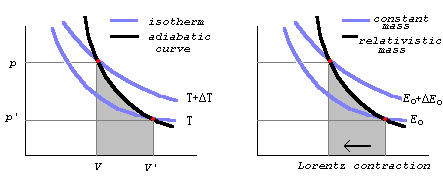
Fig.14. Analogy between approximately adiabatic compression of an ideal gas and relativistic contraction of PM ‘cavity’. The inertial mass behaves like the photon energy density of an isolated system.
25.) In this view an external source of energy may assume an equivalent role to that of an internal non-zero photon ‘rest energy’. If we imagine a closed network of coupled systems, a triad of resonant oscillators AB, BC, CA, then if they are free to do so they will tend to an equilibrium condition where three values of TK are the same and overall no work of displacement is done, but the equilibrium energy is arbitrary; there is no way to determine an absolute internal energy of this isolated system. The only way to determine a characteristic energy of ABC is to bring it up to another network DEF and measure a potential difference; otherwise, its arbitrary equilibrium energy will be the zero-point energy. This is the same as being unable to measure an absolute internal energy U in a gauge theory where only DU has physical meaning. Extending this to the whole of PM space we can imagine that such an unknown equilibrium condition exists as the ground state for a complicated network of many semi-autonomous interacting processes where entropy will in general not sum locally to zero over subsystems like ABC. In this network photon momenta become subsumed in a system of potentials coming from fermion mass constraints, and an ideal gas model gives way to critical-point complexity. The scale-free correlations of PM supersymmetry represent this critical-point behaviour, embedding self-organising islands of emergent local stability on a surface of dual phase in the state space.
26.) If the dynamical meaning of ‘rest’ refers to thermodynamic equilibrium, the universal closed set of dyads must be assumed to be in underlying equilibrium in the sense that kinetic realisation of ‘absolute rest’ occurs (in principle) at extremes of global temperature. The low temperature global equilibrium is a minimum of energy DEset = 0, locally approximated when electromagnetic gauge symmetry breaks in a superconductor below Tcrit and photons’ ‘range’ is restricted to the surface by acquiring a ‘rest mass’. Kinetic rest is here realised for a fluid lattice of ‘electron pairs’ whose relative speeds are uniformly zero (Cooper pairs). The magnetic field is expelled completely from the conductor, which is a way of saying that the photons take away the mass shed by the electrons from the inside of the conductor. Loops of the photon mass-gauge field now run around the outside but none cut the surface of the superconductor to terminate on the massless pseudo-bosons moving in it. According to PM the ‘cutting off’ of the Cooper pairs from this outside gauge field (see Note 9) now makes overt the complete photon confinement ‘inside’ them which is the supersymmetric state of PM symmetry. (In a sense these objects are analogous to isolated ‘magnetic monopoles’ of the PM gauge, despite their doublet position basis. The efficiency of superconductivity should be proportional to the completeness of this divorce of the current from the encircling gauge loops. See Section 2.5.) Inversely, global equilibrium at high temperature would be a maximum of entropy, which is equivalent to all electrons attaining relative rest by uniformly moving at the highest thermal speed possible, or at c. That is to say, at c all electrons realise their underlying dyadic nature, all possible pairs being Lorentz-contracted isomorphically to the null intervals of their own photon bonds, effectively coming to ‘rest’ as a null field of massive vector bosons. In this way the absolute zero of temperature mirrors an absolute maximum of temperature, opposite limits corresponding to thermal speeds of c and -c, and the breaking of electromagnetic gauge symmetry occurring at either extreme realises the virtual photon mass of the supersymmetric PM dyad.
Note 9. The 'cutting off' occurs only in R3, of course, as a breaking of Lorentz symmetry. The underlying topology in CN remains that of a complete graph.
27.) The point is that PM forces us to generalise these extreme thermal equilibria and say that not only extremal conditions of the dyad but all intermediate conditions of the dyad are at dynamical rest, in the form of scale-free stationary states. What allows us to do this is the elimination of real free energy. All kinematics become equilibrium-conserving transforms of unit scale, and in a sense all displacements become virtual displacements, referring dynamics back to statics according to d’Alembert’s principle, such that the very existence of a non-zero limit on untransformable internal energy (i.e., the existence of a rest energy E0) arises from a conservative equilibrium of applied and constraining forces.
28.) Determining constants E0 and c of the relativistic energy in a given dyad, AB, is analogous to setting the absolute internal energy Uunit = const., precisely for the reason that these quantities cannot be directly known. In the normal way, U is assumed to be a constant of any free-expanding system (such as AB in isolation, free from any constraint); but the components of a Lagrangian function L = K - V for confined virtual-mass vector particles (kinetic + potential energy of photons internal to AB) cannot directly be seen. Thus to state that U cannot be directly measured simply restates the definition of U as a constant of the system, in the sense of c = const.: That is, U can only be deconstructed by inspection into separate components K and V of the total Lagrangian by a process of de-isolation which changes U. This means that the significant quantity is DU or the change in U, which can be measured (because its change is the process of ‘measurement’), by the application of constraint due to adjacent similar systems. In this ‘measurement’ process (interaction) we have DU = Q - W, or the change in internal energy of AB equals ‘heat absorbed’ from the environment of AB minus ‘work done’ by AB on its environment. Since ‘the environment’ is the set of other systems like AB interacting with it, where the total energy of the set Uset = Qset + Wset = const., we can see that heat exchanged and the work exchanged are different names for the same quantity measured as energy transfers with different sign, so that energy changes DE in each system like AB sum to a constant quantity Eset. This conserves total energy and so satisfies the First Law of Thermodynamics for the set.
29.) If the set is in perfect isothermal equilibrium then the work done on each system in the set is obviously identical to the heat supplied in each system in the set, or Q º W = 0 = DU for any arbitrary temperature of the set. If the set is not only in equilibrium but completely isolated (i.e., the finite universal set of systems like AB is self-contained) then the total heat supplied is zero and the ‘electron temperature’ of PM space is zero by definition, whatever the ‘photon temperature’ corresponding to the constant mean internal energy of each individual system. Absolute zero therefore defines an equilibrium condition which is not automatically the state of lowest energy density. In the sense that this zero-point temperature of the set is completely independent of its ‘absolute scale’ and of the internal energy U of its component systems like AB, we can apply a ‘virtual’ energy increment DU which is equivalent to a quantity of ‘virtual work’ done in a ‘virtual free expansion’ of the set, without changing the thermodynamic equilibrium.
30.) This can be likened to a global increase in a scalar field energy functionally equivalent to an ‘inflation’ and in those terms would be equivalent to varying c inside a global relativistic symmetry in a VSL-type theory. In PM, however, the notion of a unique history of a global vacuum that occurs in GR is an abstraction; it is, on the contrary, the locality and pluralism of SR that paradoxically gives physical meaning to Dc and thereby to the complete complex causal structure involving both ‘subluminal’ deterministic histories and ‘superluminal’ scale-free nonlocal correlations (see Section 2.2). The set of N systems is analogous both to a PM quantum ‘field’ with N particle states continually fluctuating around an average value (a self-driven resonance around the network), and to a set of quantum fields, like N ‘Higgs fields’ each associated with a different breaking of the PM supersymmetry, each yielding a different mass vector with a different phase of c. In this unusual sense the analogue of ‘inflation’ can be said to be driven by the ‘fluctuating value of the Higgs fields’. The thermodynamics of PM supersymmetry are such that both the smoothness due to scale-free correlations, and the anisothermal, anisotropic structures of local measurement, are coemergent aspects of an overall isentropic reversible system where DS = 0.
31.) In the emergence of real energy differences DU between systems in the set, real work is done so that in individual systems DU = Q - W ¹ 0, although DEset = 0. But according to PM the important point is that this work always represents the appearance of an improper distinction between two components of the internal energy - the heat energy DU and the free energy, F, the portion available for transformation to do external work. The emergence of this distinction corresponds to the exclusively improper emergence of ‘electron mass’ in thermodynamic disequilibrium, because the electron mass is this distinction, or me = Dm = mg - mi. But simultaneously the exclusively proper cancellation of this distinction in the null massless photon representation expresses the conservation of a supersymmetric equilibrium in each dyad.
32.) This emergent distinction of DU from DF is relativistically improper in the sense that it belongs not to the unit system (the PM dyad) but to the embedding set of systems constituting the environment on which work is done; neither is it a property of that global embedding set inasmuch as there is no embedding meta-set constituting an external environment for it to do work on. In other words neither an individual dyad AB nor the universe as a whole has an intrinsic mass because both are closed sets: The former minimal set is abstracted from its embedding, whilst the latter maximal set negates the meaning of embedding. One way of expressing this is to say that both these extremal sets are representations of absolute mass |m|, which is always mg - mi = 0, whereas real relative mass Dm belongs to embedded multiplets where mg - mi ¹ 0. If we think about this we understand in a new way how the essence of mass in relativity is in fact its pluralistic nonlocality.
33.) That the distinction between components of the system energy corresponds to the emergence of a distinction between mg and mi has a clear formal basis in quantum theory and classical gravity. That is, the internal energy U corresponds to the Lagrangian of component kinetic and potential energies coupling to the energy-momentum tensor Tmn , so we can say that DU = Dmg, or the gravitational mass-energy. However the free energy F corresponds to the Hamiltonian energy function for the work done against external generalised momentum coordinates, DF = Dmi. These are components of a mass shift which can be shown (Note 10) to occur due to finite-temperature radiative corrections to the mass of an electron in a heat bath of photons of temperature TK much smaller than the electron mass-energy me. The two components (of the shift dm) are related like dmi - dmg = 0. The two total masses are identically m at TK = 0, but at TK ¹ 0 then
mg = mi -Tk(d/dTk)mb = mi - 2mb (23) |
where mb is the radiative mass correction. But correction to what? What is m? In PM, the only answer is that mb is a correction to a ‘unit’ mass or absolute mass |m| with no determinate value at all, which is a scale-free null-vectorial property of all ‘electron pairs’ and has no meaning as an isolated scalar quantity. So a ‘measured’ quantity of mass must by definition be entirely such a ‘correction’, emergent in the interaction of a system of such ‘pairs’ (the minimal system being the PM triad) and proportional to a departure from perfect thermodynamic equilibrium.
Note 10. John F Donoghue and Barry R Holstein, 'Aristotle was right: heavier objects fall faster', Eur. J. Phys. 8 (1987) 105-113.
34.) At equilibrium TK = 0 we say that the electron mass vanishes, as exemplified in the vanishing of inertial mass in the ‘broken electromagnetic gauge symmetry’ of superconductivity or the superfluid regime. The Cooper pairing reveals this phase as a special case of the general PM principle, which we see not as breaking a symmetry but as repairing the PM vectorial supersymmetry in which mg and mi cancel one another away. Conventionally, even though the strong equivalence principle enshrined in GR states the scalar identity mg º mi, there is no profound theoretical demand that gravitational mass should vanish together with inertial mass. GR cannot allow it to vanish because gravitation is required to be a field coupling with a scalar mass charge equal to the total energy. Only if the total energy vanished could the mass charge coupling go to zero, and energy conservation is required by time displacement symmetry everywhere on the manifold continuum in GR. But from our point of view mg must indeed vanish along with mi at TK = 0, and this goes hand in hand with the time-reversal symmetry on the discrete PM dyad. (see Note 11) We propose that a continuum field-coupling type of theory like GR cannot apply to the limiting equilibrium states of simple systems of small N (irrespective of scale), where the linear relation between the mass-energy and the gravitational potential, which in GR applies for off-equilibrium systems of large N, breaks down. (See Section 2.6)
Note 11. Energy conservation is the principle associated with time-displacement symmetry in spacetime theories governed by Noether's theorem, just as momentum conservation is associated with space displacement. However it is well known that the theorem doesn't apply in the case of time-reversal symmetries.
35.) The null cancellation mi - mg = 0 represents the renormalisation of Eq.23 above for the case dmi - dmg = 0, TK = 0, which is what we have deduced for the case of PM equilibrium. Our point of view must be that all of the effective electron mass is a ‘radiative correction’ to an unmeasurable internal energy U of a dyad which is just U = Eunit, and that m only ever has physical significance as DE µ dm when TK ¹ 0. The reason why me ¹ 0 can thus be expressed equivalently as: (a) because perfect equilibrium does not obtain; (b) because there are always photons in the equation; or (c) because the speed of light has a determinate value - which is the obverse of a perfect equilibrium condition in which a ‘ratio’ of degenerate values of c could have no meaning. (The emergence of non-degenerate phases of c is discussed in detail in Section 2.5.)
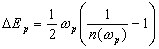
36.) We can compare our model with the canonical ‘particle in a box’ where DE µ dm is a property of the box, not of the particle, in the sense that it can be seen either as a contribution due to photons emitted and absorbed by the charge on the particle, or as a shift DEp in the energy of each of the zero-point radiation modes of the box due to the presence of the particle,
 . (24)
From this latter point of view DE can be thought of as proportional to a certain ‘refractive index’
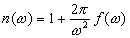 (25)
(25)
where f(w ) is the forward scattering amplitude for a photon of energyw . Here n(w ) is associated with the altered matter distribution in the box due to the presence of the particle, and is proportional to the particle’s ‘bare’ mass m before the radiative correction dm - i.e., m has to be brought in as iit were from outside the experiment. But the problem is that the unrenormalised electron self-energy in QED is infinite, which means that DE blows up. In PM on the other hand the unrenormalised dyad self-energy is zero, because the renormalising ‘radiative correction’ which alone generates a non-zero mass is a consequence of the ‘experiment’ performed by nature itself on the ‘box’ of the PM dyad.
37.) This experiment consists in the spontaneous emergence of local Lorentz symmetry which transforms dynamically on top of a nonlocal equilibrium condition in which energy conservation is completely undefined. On the underlying graph time-reversal invariance is preserved where all energy states are interchangeable and DE = 0 in the absence of coupling. Or in other words the basis state of local position-momentum coupling is not fundamental; it is a transformation of the underlying nonlocal basis state. It represents the transition from time-reversal invariance to time-reversal non-invariance, which is the same as the appearance of thermodynamic potentials. The thermodynamic ‘direction’ of time thus has a local projection in a sequence of states of R3, but this is only the shadow of a path function in CN. (This point of view is very reminiscent of Bohm's 'implicate order'.)
38.) The unique direction of logical time for coupled systems is a universal, since the universality is just the criterion we use to define a ‘direction’ of time. This is thermodynamic time, based on an emergent state phase of the system where an evolving surface divides the phase space into inner/outer, earlier/later, smaller/larger - the topology of R4 which assigns positive/negative values to a cosmic time. But in PM this projection is relatively inessential. Just as the analogous logical invariance of spin-up/spin-down does not derive from a physical universality of spin direction (i.e., there is no cosmic up/down to which spin states may be referred in R3) so there is no physical universality of cosmic time belonging to R4 from which ‘microscopically reversible’ values of +t and -t acquire an absolute orientation. On the contrary, R4 time-reversal non-invariance is a secondary emergent property incurred in what we might call a second-order process of renormalisation of states of R3 (in 6-dimensional position-momentum phase space) each representing the nonlocal folding of all paths, which are first-order renormalisations in CN.
39.) In CN the unrenormalised self-energy on every dyad is conserved at zero, because only in a path (or state) renormalisation does energy emerge as a meaningful quantity, and the absolute null entropy actualises both the maximum and minimum force-free extrema of the relativistic case, i.e., we completely realise Weber’s principle ("the sum of all forces on a particle is zero in all coordinate frames"; see Section 2.2 para.11) as a path function of the system in CN, but not as a state function of the system in R3 where there is no time-reversal invariant equilibration on routes. Where non-invariance supervenes then operator orderings become significant (see Section 2.5); paths contribute differently, and interference of amplitudes gives DE ¹ 0 µ F(C), where F(C) is an electromagnetic flux through a region or contour C identifiable as some surface in R3. The broken supersymmetry on R3 states locally dissociates PM dyads into electron and photon states. For photons the new dynamical minimum is realised around a loop that relates successive states at the same ‘point of space’, or at the same vertex, but displaced in time; whereas for electrons this minimum is realisable for measurements at pairs of simultaneous states, or at different vertices displaced in space (referring us back to the contrast between the serial non-identity of photons and the parallel identity of electrons brought out in Section 2.2). This is of course the relation embodied in the standard gauge theory of quantum electrodynamics:
40.) Consider that the rate of change of phase of the wave function of a neutral particle is a quantity belonging to a series of measurements on a spacetime path. It is governed by the relation
 (23)
(23)
where v is the particle velocity. This change connects definite ‘points in spacetime’, i.e. a relationship between phases of the wave function at the start and end of a spacial displacement. Why does this apply neither to an uncharged boson like a photon nor to a charged fermion like an electron?
41.) Evidently for a massless particle Eq.23 would predict an infinite phase shift which is not physically meaningful, so to make it applicable to a photon would require a photon to acquire a mass. On the other hand an electron obeys the different relation
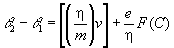 (24)
(24)
which is the rate of change of phase from Eq.23 plus an added factor proportional to the electromagnetic flux µ DE. This electromagnetic flux, F, which is known from the Aharanov-Bohm effect to represent a potential that acts nonlocally on the electron phase, is thus in some sense equivalent to a photon mass. We can see that this follows naturally from the PM geometrodynamical supersymmetry introduced in Section 2.3 and on this picture the ‘number of lines of force’ threading the contour C will correspond to some finite definite number of strings ‘cutting’ an abstract surface in R3, whilst the A-B effect signifies the underlying connectivity of the complete graph in CN recovered in the approach to low-temperature equililibrium at Tcrit.
42.) In quantum theory it is true to say that the ‘charge on the electron’ is its (probability of emitting and absorbing) virtual photons. In PM the degrees of freedom of the field are restricted to exchanges; there are no empty states and the boundary condition is isomorphic to all possible pairings of vertical position measurements, not at real infinity. That the neutrality of the photon is another name for what we call the charge of a pair of electrons is already ‘obvious’ in the sense that the lightlike 4-vector is the vector of the Coulomb force; in the Feynman representation it is also obvious that the same neutrality represents a time-reversal symmetry under exchange of electron/positron labels on the spacetime diagram (photon and anti-photon being always self-orthogonal). But this picture is only fully realised from the point of view of PM’s dyadic structural supersymmetry, where we see that the ‘masslessness’ of the photon (or anti-photon) is another name for what we call the ‘mass’ (vectorially annulled) of a ‘pair of electrons (or positrons)’.
43.) The closest we can get experimentally to realising this structure in a theoretical extremal condition where DE vanishes is the superconducting regime close to 0oK, where thermal isolation of a system approximates this theoretical isolated equilibrium and exposes PM supersymmetry in the form of pseudo-bosonic inertia-free pairings of ordinarily repulsive charges. In this case it is possible to say conventionally that breaking of the electromagnetic gauge symmetry causes photons to acquire mass whilst electrons lose their mass inside a region where the electromagnetic flux F(C) vanishes. Inside this quasi-isolated region we have the elimination of relative acceleration between coupled charges with the concomitant elimination of their internal field. We say that the region inside the expelled magnetic field of a superconductor is an approximation to an ideal CN path function in terms of states in R3.
44.) Such an ideal state would exist in the isolated equilibrium triad we have already described, where the rate of change of phase around the system would correspond to a neutral massless ‘superon’. But this system remains a pure path with no coupling, each dyad being isomorphic to a string of unit scale in an underlying graph where time-reversal invariance is preserved, where all energy states are interchangeable and where DE = 0. This complete, simple triadic graph is a limit case of the set of all possible complete simple graphs, and going from this extremum to the general case corresponds to the reduction of the quantum state vector via decoherence (see Section 2.5). From the point of view of PM extremal coherence expresses a latency of two phases of the same supersymmetric dyadic object, phases which, with spontaneous thermal symmetry-breaking, separate out in interaction, and the limit of low temperature equilibrium will not be a statical but a dynamical equilibrium superposition of these phases. The two coexisting phases of a system of Cooper pairs are characterised by a strong interaction with external magnetic fields (even though no external flux lines cut the surface of the conductor in R3) and the entire absence of internal magnetic fields. The same superposition of phases can be identified with the coexistence of two forms of the mass m in Eq.23 which is already recognised in the conventional quantum formalism. These forms are the gravitational mass mg and the inertial mass mi (which of course are none other than our antiparallel PM mass vectors). The former is considered to couple to the energy-momentum tensor and corresponds to the internal energy which in our supersymmetric theory is a quantity belonging to the photon (pseudo-fermion) representation; the latter is the Hamiltonian mass-energy corresponding to the free energy which belongs, we say, to the electron (pseudo-boson) representation.
45.) But it is important to emphasise here that according to PM the ‘elimination’ of the internal mass field is just the recovery of an intrinsic default state, because non-zero mass is an emergent, off-equilibrium system property. The external mass identified with the free energy continues to quantify a strong coupling of the system of dyads as a whole with the external network, because that is where the system’s free energy is. The system can be said to have minimised its free energy by donating it to its photons, then eliminated it entirely by expelling them - in the very particular sense that there is no available gauge loop within the system by which a transported photon phase vector can be brought ‘back to itself’ with a spin of one (which is a possibility only generated by states of ‘itself’ represented in an electron displacement; see below). The system has only photon annihilation operators and no creation operators. Any available internal loop produces an identical phase shift of zero in the electron ‘condensate’, which is not a spin-one photon state. Picturesquely, we can say that the line of force or the ‘electromagnetic flux tube’ of PM photon confinement has been expelled from the dyad. So this is the meaning of the fact that the magnetic flux is expelled to the surface of the superconductor, and the externalisation of mass explains the reason why we can still describe the dyad as a massive boson in terms of a relation like Eq.23: It retains mass in terms of its participation in the total inertia which its parent system represents in the network, even though its internal mass-energy is considered to vanish (i.e., to realise its zero-point energy). (Note 12)
Note 12. This is obviously analogous to the way in which the individual component momenta of a system of thermal particles can be treated as zero if the vector sum of momenta can be treated as zero. In this case we ought to say that zero-point fluctuations in the resultant mass vectors of individual dyads sum at any 'instant' to the zero-point mass energy of the whole, which is a dynamical vacuum equilibrium.
46.) If each dyad is always a properly null path element in the phase space of CN independently of its state-renormalised potential in R3 then in CN we have equipartition of energy DE = 0 in phase-space cells of ‘constant (null) size’, according to Liouville’s theorem; but, because the distribution is real scale-free and equilibrium occurs at an extremum which is a null stationary state, there is no black-body uv catastrophe in CN. The function of what we call the ‘quantum condition’ for R3 thus appears in the mapping from CN to R3, and corresponds to this inversion: That the true position-momentum space for radiation (i.e., the quantum space) is the space CN of doubly-connected path elements, not the volumetric phase space of singular point states in R3. Cavity confinement is a path function of lines in PM, not a state function of points, and the infinite self-energy and uv catastrophe are avoided by the same finite renormalisation.
47.) Position states in CN are minimally defined by pairs of particles in R3. Conventionally, the number of intermediate states contributing to the self-energy of a half-pair would normally be infinity minus one, the one Pauli-excluded transition corresponding to the state of the other half-pair. An infinite renormalisation is needed. (The same occurs in a classical theory, where the infinite energy of self-interaction of a point particle with its own field, due to e2/r where r ® 0, appears proportionally to the acceleration in its equation of motion.) But taking the 2N half-pairs always together in PM we get N doubly-connected null-vectorial (but not zero scalar) position states, which are all ‘volume elements’ of the state space, at rest regardless of the continuous d’Alembertian virtual displacements going on due to relativistic scale transformations. These position states exhaust the degrees of freedom of a finite graph with no loops or multiple edges; consequently the sum over any proper path in CN is zero, and since the renormalised improper ‘self-energy’ of any dyad is calculated over a finite number of intermediate transitions in CN the total energy remains finite in any numerically smaller region of R3. Because the ‘bare’ theoretical (i.e., proper) energy of an isolated dyad is always zero, we can say (a) that the electromagnetic energy of every dyad is its energy of electromagnetic interaction, and (b) that the inertial mass of every dyad is its energy of gravitational interaction. There is no isolated self-energy or bare mass. Radiation and mass are ensemble properties.
48.) Remember that each dyad is a stationary condition, an extremal resultant of all possible path functions in CN, so its zero-point energy represents a zero of potential in CN. But this does not imply an absolute zero of energy in R3. The ‘end-on’ aspect of an abstractly isolated single unit vector AB has no associated properties of mass or scale, but this means that only in its photon representation does AB behave like a perfectly reversible isentropic, isothermal ideal gas where DU = 0 and Q = W. As earlier argued, the network achieves for every dyad the approximate dynamical equivalent of ideal isolation in CN in the form of a stationary state where heat entering the ‘gas’ has to leave it immediately as work, keeping the internal entropy (photon ‘rest mass’) constant (at zero) independently of any change in ‘pressure’. AB is thus a quasi-isolated system which actually behaves like a cyclic heat engine, a stationary state of an underlying periodic system which we can identify with a cancelled null rate of positive and negative work due to local-coupling-free time-reversal invariance preserved on a proper path in CN, a throughput of positive-going and negative-going amplitudes exchanged with adjacent dyads, which becomes a time-reversal non-invariant potential in R3. We can say that the ‘open’ string mode in Fig.15 represents the nonlocal scale-free coupling which is recovered when local scale-specific coupling is removed.
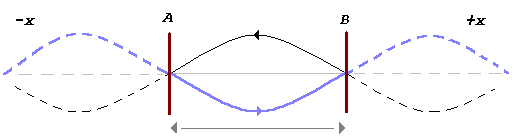
Fig.15. Ambiguity of AB as both closed and open stationary conditions. The fundamental mode of the ‘closed’ string AB is a driven resonance in terms of the ‘open’ string -x « +x.
49.) Each state’s energy is a ‘correction’ to its own zero-point energy appearing nonlocally in its relations with other states. Each dyadic m can be regarded as a correction to an absolute longitudinal mass |m| = 0, or as the residue of an imperfect cancellation of two arbitrarily large but finite near-identities mi - mg appearing with the coupling. So for all real improper Lorentz-transformed views, i.e. transverse views, we have a string tension T (see Section 2.3)
T µ E ³ 0
and hence the ‘photon momentum’ p = E/c is a quantity which can never be transformed away to zero for any observer. This fact in SR is the reason why vacuum pair-production of an electron and a positron from a photon is not spontaneous but requires the involvement of a mediator particle in order to satisfy momentum conservation.
50.) In SR the energy of a photon track equal to or greater than 2mec2 can go into generating a diverging electron-positron pair whose combined linear momenta can always be cancelled away by being made equal and opposite in some observer frame. Because photon momentum can never be transformed away, this is only possible if the ‘residual’ momentum is taken up by an additional ‘sleeping partner’ in the interaction (say another electron or typically a more massive proton). So a boson cannot just spontaneously ‘decay’ into two free fermions; the two new points of fermion measurement are ‘anchored’ by momentum conservation to a third. In PM this translates as the rule that a string cannot be separated into two free ‘ends’, and again the PM exclusion principle is implicit in the forbidden proper transformation of a massless, pure lightlike, longitudinal field component to a massy, space-timelike component. Only a displaced pair of points of measurement can conjointly embody this transform to a transverse field component, improperly, in relation to a third. As already mentioned, the included angle is integral to the physics: The process of measurement of mass is fundamentally triadic, because the quantity only begins to acquire meaning along with the elementary unit of relational position in PM, which is the triangle of vectors.
51.) Obviously the (broken) symmetry which enacts this superposition of proper and improper views is cognate with the transformation of the time in SR, which allows an arbitrary inertial observer S (velocity v) and an observer in another frame S’ comoving with a dyad AB (velocity -v relative to S) to disagree about the length of AB because their own clock rates differ by a factor proportional to g(v). But note that although S’ is comoving with AB it is essential to the very notion of transformation in SR that the proper clock time in S’ is not a proper clock time of AB itself, measured at A or at B; rather it is another third-party measurement. SR defines ‘measurement’ as a third-party transverse operation, which is why AB, as self-observed in isolation, does not contain a real clock at all. It is a null lightlike interval which only ‘contains’ an imaginary projective time; real time is a function of the structure of AB’s environment; and this again expresses one of the aspects of its dual character as a longitudinal component of PM space, the null and scale-free or ‘rigid’ PM unit vector underlying transformations of transverse scale.
52.) The geometrical interpretation is that the PM exhaustive-connectivity rule for a bounded complete graph (Section 2.1. para.4) requires that two arms of any angle cannot be open to infinity but must always be closed by a third. However you attempt to evade this rule and treat vertices as free monopoles, theoretically ‘collecting two mass-points together’ to get 2m, you are always collecting the two vertices joining at least three strings together. This must mean that the quantity E = 2mc2 is an unstable energy configuration belonging to this ‘second-order perturbation’ term involving at least three ‘particles’ of total rest energy E ³ 3mc2. In the maximum-entropy condition of supersymmetric equilibrium, where DE = 0, the equivalent mass of each of three dyads is indiscernibly just m, or the group is symmetrical in m under exchanges of all pairs of measurement coordinates. The perfect antiparallelism of self-orthogonal vectors in each 2-manifold produces no tensor gradient and +t -t = 0.
53.) In this limit |m| is properly and improperly zero (or rather, there is no improper relativistic state of the system). But in general, when we bring in the local coupling of the network ‘environment’, the quantity m is no longer zero even though it remains minimally the scalar product of two vectors because these two vectors are no longer equivalent zero-vectors. The local equilibrium contains a tensor gradient on which time-reversal invariance has been broken, which means that the self-orthogonal components of each 2-manifold no longer have identical amplitudes (see Section 2.5) and operator ordering becomes significant, transforming from R3 to R4, and the system acquires improper relativistic states. The triplet group is no longer symmetrical in m under exchanges of all pairs of position coordinates. In other words the condition of preserved supersymmetry is itself unstable and is destroyed by local Lorentzian coupling, which is to describe the way that the supervening of accelerations due to ‘other forces’ on the idealised ‘gravitational tensor’ of flat, empty, homogeneous and isotropic space is the same thing as the emergence of non-zero improper mass. (Note: The extra degree of freedom rotates around the triplet as a vector product at each of three points of measurement, so that the idealised R4 equilibrium actually occurs in a tetrahedral sextet of vector products. See Section 2.6.)
54.) If time, mass-energy and gravitation are co-emergent in the ensemble then the work product, the mass action, will also be co-emergently continuous in R4, but discrete on a broken path in CN. Thus we conclude that continuous scale-specific gravitational action in R4 corresponds to a discrete scale-free null structure in CN and has an extremal stationary value in R4 just as continuously-variable mass-energy in R4 has an extremal stationary value Dm = 0 corresponding to a discrete null element |m| in CN. This absolute gravitational action |ga| must be zero in CN but will have a minimum value Dga = 0 in R4. In fact we say that Dm and Dga are the same tensor quantity, not merely proportional quantities as in a field theory, and thus we avoid the issue of how the energy-momentum tensor couples to the metric tensor.
55.) In an effective-field representation in R4 we can use a perturbed state of the metric tensor to define local kinematical rest and so ‘correct’ the experimental masses of ‘separate’ free particles by reference to this independent spacetime gauge; but PM implies that this gauge will be inaccurate. There are no free mass monopoles in PM because the ‘graviton’ in this theory (see Section 2.6) is its own antiparticle, just as the photon is its own antiparticle. (Or to put this another way, to exclude free point-masses is to exclude gravitomagnetic monopoles.) We can only pick up a supersymmetric PM unit vector ‘by its ends’ as a complete parcel, as we have seen (Section 2.1. para.16), for a reason closely analogous to quark confinement, which is that to attempt to separate the two ‘ends’ would be to separate inertial mass mi from its own reflected identity, gravitational mass mg, or (in terms of R4) to separate the energy-momentum tensor from the metric tensor. Evidently the whole meaning of a constant positive local rest mass is just that the identical quantity m is measurable redundantly at both ends of any dyad when it is at dynamical rest, and this is equivalent to saying that the non-zero value of m measures an irreducible vector resultant in CN which behaves as an inflationary vacuum energy or ‘cosmological constant’ in R4. In other words, we can say that a ‘dark energy’ is in the rest mass.
56.) This is quite an interesting result. If two components of a vectorial dyad contribute jointly only half the 'rest mass energy' as measured over a path in CN that one would calculate by adding up scalar monads separately in R4 then this is equivalent to saying that there is a notional positive quantity 2m attached to every dyad in R4 which never appears in measurement because it is taken together with a hidden quantity -m. Or, the total apparent mass-energy M of pairs of cosmic masses calculated from summing particle numbers in R4 will need to be corrected by a negative energy quantity equal to -1/2M to accurately model the gravitational dynamics. The result is that the simultaneous hypersurface of rest in R4 will not be quite where we think it ought to be.
57.) In the case of two locally ‘free particles’ in R4 we would expect to measure a total mass-energy of 2m when simultaneously at rest. But the local independence of me1 from me2 is exactly what makes simultaneity difficult to define as any definite state in R4. Weighing the two vertices ‘simultaneously’ requires us (conventionally speaking) to ensure that they are on the same spacelike hypersurface for the initial conditions of the measurement; yet the local affine structure of the manifold at any point in space is unknown a priori and could contain any arbitrary curvature, indexing not only a mass-energy density due to unknown charge distribution and other mechanical accelerations that we have to account for, but also an indeterminate curvature proportional to a ‘cosmological’ factor (this reflects the existence of solutions of the GR field equations for spacetimes with zero mass-energy). So the process of existence of the system itself denies us the chance to disprove the PM contention that the whole supersymmetric unit carries mass m because we cannot separate one end from another so as to get a pair of monopoles, this being expressly the physical state that the foundational definition of PM excludes.
58.) By the same token, stating that each dyad has mass m does not mean that there is any sense in which each ‘end’ can be assigned a mass of ½m. This is an inverted way of thinking, applying R3 as a constraint on CN. If we test this prohibition by comparing the weights of each end of the object consecutively in an identical gravitational gradient we will merely confirm that the identical result m holds for each end, surprising nobody of course. Conventionally, we say that by disturbing e1 from ‘rest’ we elicit an inertial mass me1 equal and opposite to an acceleration a which we suppose exerts no direct far action on me2, leaving e2 at rest. Similarly if we apply a at me2 we expect no far action to perturb e1 simultaneously. Only field contact forces transmitted at the speed of light communicate on the line between them, producing a retarded local action. This appears to contradict the PM prohibition on separating one ‘end’ of the particle pair from another, and tells us that in general such separation is the rule. And indeed it is, inside R3. But any region R3 of the spacetime R4 represents a domain of broken supersymmetry that is a subset of CN. The measurable local independence of these two accelerations in R4, each equal and opposite to me1 and me2, presupposes that we are able to dependently specify a = 0 at e1 and e2 in the first place, i.e. to specify a common state of inertial rest in R4. And this problem is exactly the reason that SR is generalised to GR, in order that any accelerated point state whatsoever may be independently regarded as ‘at inertial rest’ by the specification of a suitable gravitational field. Now we can see that the underlying motivation for this procedure is the redefinition of rest from a linear kinematical state function in R3 to a nonlinear dynamical state function in R4. But in GR R4 does not repair the broken supersymmetry. The significance of the underlying connectivity in the embedding set of CN is that the continuous gravitational field in R4 corresponds to a quantised supersymmetric path function in CN. In other words, the GR-type continuum representation of the gravitational interaction defining the local condition of kinematical rest is only a mapping onto the state space of R4, an effective-field representation; but the gravitational mechanism (i.e., the theory of quantum gravity) lives in the path space of CN, not in the state space of R4, because the underlying ‘absolute’ state of rest is a dynamical path function not a kinematical state function.
59.) To recap: In general, dm and mmech are identifiable with the free and internal energies. On any network path these quantities are properly cancelled against one another, reversible-closed-dyad by reversible-closed-dyad, like mi - mg = 0. Fermionic ֥matter’ and bosonic ‘radiation’ preserve a context-dependent supersymmetric ambiguity on such a path, which can be traced in terms of creation and annihilation of virtual photons and electrons. But these modes separate out in the irreversible 4-space representation, where mi - mg ¹ 0. This is because what 4-space represents is a structure of intersecting paths. It is a state function corresponding to all possible different path functions in the state space defined in relation to some emergent kinematical zero-point of inertial ‘rest’. In PM the path function is fundamental to the state function, and the breaks in the complex path are boundary conditions of self-orthogonal 2-manifold phases that interpenetrate linearly without regard to scale (the nonlocal subset of all pairs of electron states) instead of being nested volumetrically dependently on scale (the local subset of all individual electron states). In other words every set of states R3 lying on a 3-surface exists at the N ½ intersections of N members of a universal set CN of complex 2-manifolds. Such a space has no true ‘homogeneity scale’.
go to Section 2.5,
Consistency with quantum mechanics
go back to
Section 2.3
Foundations
index