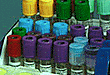
The order in which tubes should be filled seems to mutate daily into increasingly creative incarnatios, In fact, it mutated right out of existence last year when one workshop presenter astonished her attendees by stating, "There is no order of draw." Adding to the confusion are Internet phlebotomy sites, training manuals, certification study guides, and textbooks that perpetuate many variations.
The proper order in which blood-collection tubes should be filled is designed to prevent the carryover of additives from one tube to the next. Such carryover alters the composition of the next tube and can lead to erroneous results--with the potential to mislead physicians and invite catastrophic errors in patient management. For the record, the order of draw has been established by NCCLS--the National Committee for Clinical Laboratory Standards, which develops voluntary standards--through its consensus process with industry, government, and laboratory professinals and is published by NCCLS in document H3, Procedure for the collection of Blood Specimens for Diagnostic Testing by Venipuncture.
The order was revised and simplified this past December to one that works for both glass and plastic tubes, regardless of whether the specimen is drawn by using a tube holder and needle assembly or syringe. To understand the necessity for the order of draw and to clarify the widespread confusionon the matter, let us examine the history on how the order came about and how it has evolved through the years.
Historical perspective
The order has its origins in the literature as early as 1977, when evidence that additive carryover occurs was first published in the American Society of Clinical Pathologists; (ASCP's) Summary Report. (1) Authors Nilda Sun and Rita Knauf at the St. Barnabas Medical Center in Livingston, NJ, reported their observation of an asymptomatic patient who had a potassium level of 25.4 mEq/L (normal 3.5-5.3 mEq/L) obatained from a nonhemolyzed specimen. Upon Investigation, the authors discovered that the phlebotomist filled the lavender-stopper tube containing potassium EDTA immediately prior to filling the tube from which the elevated potassium was obtained.
|