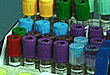
Historically, tubes with anticoagulants (e.g., EDTA) or preservatives (e.g., sodium fluoride) were referred to as "additive tubes." In 1998, it was proposed that separator tubes containing gels and either a clotting activator or an anticoagulant also be considered as additive tubes. (4) The NCCLS incorporated these tubes into the order of draw in its 1998 revision (H3-A4). (5) The order evolved with the gel tubes (serum and plasma separators) following the citrate tube (blue stopper):
1. Blood-culture tubes,
2. nonadditive tube,
3. additive tubes (in the following order):
a. sodium-citrate tube,
b. gel separator tube,
c. heparin tube,
d. EDTA tube, and
e. oxalate/fluoride tube.
Since possible carryover of the clot activator could conceivably alter results, a gel tube with a clot activator had to be drawn after the blue top. Although not spelled out, the serum gel tube should be drawn before the plasma gel tube, as the latter often contains lithium heparin, which could affect the accuracy of a patient's lithium test in the serum tube.
If required, a plastic red-stopper tube (plastic tubes contain a clot activator) can precede a heparin (green top) or EDTA (lavender top) tube without concern for carryover. The logic is that any carryover of the clot activator into tubes other than blue tops is irrlevant, since carryover should be neutralized by the excess anticoagulant. In contrast, carryover of a clot activator into a sodium citrate tube (blue top) could interfere with clotting factors, leading to inaccurate results.
Some facilities maintain the necessity for a different order for syringe transfer because not all syringe draws go quickly and, therefore, the potential exists for clotting to occur in the syringe prior to blood transfer to successive tubes. (6,7) To prevent clotting within the syringe, an order is implemented that fills all additive tubes first and then the nonadditive tubes. NCCLS consensus concluded, however, that the potential for carryover from the needle of the syringe had the potential to be a more significant problem than any clotting that might take place in the syringe during a properly performed venipuncture. Therefore, the 1998 NCCLS revision also recommended that the same order of draw be followed when transferring blood specimens from a syringe to multiple blood-collection tubes.
|