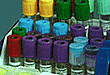
Plastic tubes
Motivated by increasing concern over broken-glass exposures, high biohazardous waste-disposal costs, and Occupational Safety and health Agency (OSHA) guidelines mandating substitution, many laboratories began switching from glass collection tubes to plastic (see "Richard Fairfax of OSHA Talks About the Bloodborne Pathogens Standard" February 2003 MLO, p.32) This industry-wide transition from glass to plastic necessitated a modicication to the order of draw. Plastic serum tubes are now positioned the same as gel separator tubes, which contain a clot activator. The revised order, "published in December 2003, is now as follows:
1. blood-culture tube,
2. sodium-citrate tube (e.g., blue-stopper)
3. serum tubes with or without clot activator, with or without gel
separator (e.g., red-, gold, speckled-stopper),
4. heparin tubes with or without gel (e.g., green-stopper).
5. EDTA tubes 9e.g., lavende3r-stopper), and
6. glycolytic inhibitor (e.g., gray-stopper). (8)
In the revised standar, NCCLS recognizes that some facilities may still be using glass werum tubes without a clot activator to serve as a waste tube before collecting special coagulation assays. Although the revised order functions well regardless of the presence of a clot activator in the facility's serum tube, a provision withitn H3-A5 affords the option of keeping the nonadditive serum tube before the citrate tube in the following passage: "The order of draw has been revised to reflect the increased use of plastic blood-collection tubes. Plastic serum tubes containing a clot activator may cause interference in coagulation testing. Glass nonadditive serum tubes may be drawn before the coagulation tube."
The NCCLS order of draw has gone throughseveral revisions dictated by technology, publication, and common sense. The latest revision should make it easier for educators and trainers to teach the order of draw and prevent additive carryover, which can affect patient results.
References
(1) Sun N, Knauf R. Cross contamination solved by technique. ASCP Summary Report 1977;14(3):3.
(2) Calam R, Cooper M. Recommended "order of draw" for collecting blood specimens into additive- containing tubes. Clin Chem. 1982;28:1399.
(3) National Committee for Clinical Laboratory Standards. Procedures for the Collection of Diagnostic Blood Specimns by Venipuncture. Approved Standard, H3-A2, Villanova, PA; 1991
(4) National Committee for Clinical Laboratory Standards. Procedures for the Collection of Diagnostic Blood Specimens by Venipuncture. Approved Standard, H3-A5, Wayne, PA 2003 |