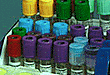
The first recommendation on establishing a formal order of draw for blood collection was published in a letter to the editor of Clinical Chemistry by RogerCalam, PhD, and Marsha Cooper of St. John Hospital in Detroit, MI, in 1982. (2) Although tube manufacturer Becton Dickinson (BD) had been recommending as early as 1976 that all additive tubes be drawn after non additive tubes, with citrate tubes being the first additive tube filled, Calam and Cooper postulated that a more detailed order was necessary for additive tubes. They reported five cases in which they observed spuriously abnormal potassium and calcium levels, all of which resulted when a lavender-stopper tube containing potassium EDTA was filled immediately prior to the gel tube intended for chemistry tests. When specimens were re-collected, potassium and calcium fell within normal limits. Based on these observations and those of Sun and knoff, Calam and Cooper concluded that not only should additive tubes be drawn after nonadditive tubes, as BD had been suppesting, but that heparin, EDTA, and potassium-oxalate/sodium-fluoride tubes (gray stoppers) should have a specific "order of draw."
The reasoning for their proosed order was based on the fact that if EDTA could carryover into nonadditive tubes, it could also carryover into tubes containing other additives. Such proof suggested that the additive of any tube could also carryover into a subsequent tube, threatening the accuracy of results.
The authors proposed that heparin tubes be drawn before the EDTA tube, and the EDTA tube should precede the oxalate/fluoride tubes. Since oxalate/fluoride is disruptive to cell membranes, placing it subsequent to the EDTA tube prevents problems with cell morphology that might otherwise occur. Also, with the gray top drawn after the green top, neither potassium oxalate nor sodium flouride in the gray-top tubes would contaminate sodium or potassium testing.
The order proposed by Calam and Cooper for filling additive tubes (following nonadditive tubes) was adopted by the NCCLS in 1984 in document H3-A2 as: (1) sodium-citrate tube; (2) heparin tube; (3) EDTA tube; and (4) oxalate/fluoride tube. (3) Gel separator tubes and clot activators.
The introduction of serum gel tubes (1976) and plasma gel tubes (1987) provided a convenience to specimen-processing personnel who had been required to remove the stoppers of nongel tubes after centrifugation and physically remove the serum or plasma for testing or storage. The gel tubes provided a physical barrier between the serum or plasma following centrifugation, preventing the changes that occur when serum or plasma is allowed to remain in contact with the cells for prolonged periods of time prior to testing. Serum separator tubes contain a clot activator (glass or sillica particles) to facilitate clotting. Although clot activators may shorten the time it takes for the specimen to clot, manufactureres stress that such tubes facilitate complete clotting, not rapid clotting, yielding serum that is less likely to contain fibrin strands that can interfere in testing. |