All about hovercraft. Where to see them, get them, buy and build them. Applications, links, instructions and information. Clubs.

Ultimate vehicle around the world since from 1959


HOME PAGE

WE THANK

RESPONSE FORM

PHOTO GALLERY

MEET FRIENDS

SIR.M.V.I.T

MORE INFO

GENERAL DESIGN AND CONSTRUCTION.

HULL

SKIRT

LIFT

THRUST

STEERING


WELCOME TO THE WORLD OF HOVER CRAFT�

�����

��� GENERAL DESIGN & CONSTRUCTION OF A Hovercraft

������������


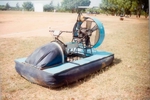
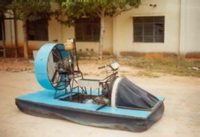
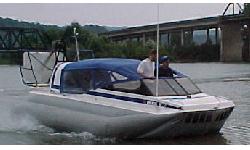
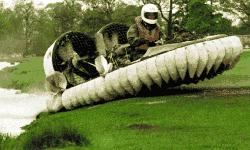
A HOVERCRAFT IS A VEHICLE, WHICH IS SUSPENDED UPON A CUSHION OF AIR. THE AIR IS GENERATED BY A FAN , WHICH IS COUPLED TO A ENGINE. THE CUSHION OF AIR IS CONTAINED BY A FLEXIBLE SLEEVE CALLED A SKIRT, THAT IS ATTACHED AROUND THE PERIMETER OF THE CRAFT TO HOLD THE AIR UNDER THE CRAFT &THUS UPON ON AIR CUSHION. THE CRAFT IS THEN PROPELLED BY WHATEVER MEANS NECESSARY TO MOVE� IT� FORWARD. MAJORITIES� OF THE CRAFT SIMPLY UTILIZE A DUCTED FAN OR PROPELLER ATTACHED TO A SMALL TWO OR 4 CYCLE ENGINE. CONTROL ON THE HOVERCRAFT IS ACCOMPLISHED PRIMARILY WITH A RUDDER SIMILAR� TO THAT USED IN AN AIR CRAFT. THE MAIN DIFFERENCE WOULD BE, HOWEVER THAT HOVERCRAFT GENERALLY UTILIZE MANY RUDDERS RATHER THAN JUST ONE.

more photos in photogallery.

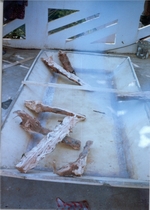
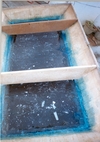
1)HULL:-WHICH IS ALSO CALLED AS A SKELETON� OF� A HOVERCRAFT UPON WHICH ALL OTHER PARTS ARE BUILT& IT IS MAINLY� RESPONSIBLE FOR PRODUCING AIR CUSHION, SO THAT IT CAN SUPPORT WHOLE� CRAFT. THE HULL IS MADE-UP OF FIBERGLASS, WHICH IS A VERY LIGHT MATERIAL & HAVING ENOUGH STRENGTH TO WITH� STAND INDUCED STRESSES. THE HULL IS MADE WITH A PROPER DESIGN SUCH THAT THERE IS A CONTINUOUS SUPPLY OF AIR� UNDER PRESSURE� TO REPLACE THE AIR ESCAPING FROM THE UNDERSIDE OF THE SKIRT.

������� HULL IS MAINLY RESPONSIBLE� FOR HOLDING THE SKIRT, WHICH IN TURN IS RESPONSIBLE TO MAINTAIN PROPER AIR CUSHION & MAINTAIN THE CRAFT'S FLOATATION ON THE AIR CUSHION.

�To obtain best power to weight ratio relationship, structural fabrication is based on aviation technology than on marine practices. Now a new technology has been developed which utilizes an aluminum honeycomb paneling separated by frames to provide buoyancy for the craft and in many smaller craft�s fiberglass hull structure has been adopted.

����Usually hull is made up of composite materials, but in certain cases composite materials by themselves will not be able to withstand high stresses, so for this care must be taken to go for a combination of conventional as well as composite material. A sandwich structure of a hull is made up of wood, glass fiber reinforced plastic and polystyrene is having enough strength to withstand any kind of load. The wood absorbs most of the stresses developed while the GRP face sheets absorb normal stresses. The polystyrene provided within the wood skeleton absorbs shear stresses generated due to the loads. By providing aluminum channels instead of wood also provides better strength and reduces the weight of the craft.

���������

2)SKIRT:- The skirt is one of the most important part of a hovercraft as it is the part that allows the hovercraft to clear the obstacles. Generally speaking the higher the skirt, the larger the obstacles that the craft will clear. However, if the skirt is too tall, the craft will �slide off� the cushion and the cushion will deflate or the craft will become extremely unstable.���� All modern hovercraft large and small- use a skirt of one sort or another for their suspension system so that the power required to lift the craft can be minimized. A hovercraft skirt is required to fulfill the following functions:

�1.���� contain the cushion of air beneath the craft at required hover height.

2.���� Have the ability to conform or contour efficiently over obstacles so as to keep to minimum the loss of cushion of air.

3. Offer little or no resistance to passage of obstacles beneath it.

4.���� Have the ability to absorb a large proportion of energy which is produced on impacts or collision with obstacles greater than hover height or cushion depth.

������ There are several types of skirts utilized in hovercrafts, but mainly three types are used:

������������������������������� a)���� The bag skirt.

b)��� The finger or segmented skirt.

c)���� The bag and finger skirt.

1)BAG SKIRT:-The bag skirt should probably be called a tube skirt because it consists of a tube that encircles the perimeter of the craft. The bag is inflated which serves to lift the craft off the ground and more importantly, to contain the air cushion. There are two methods to inflate the skirt, the first being serial feed and the second being parallel feed. The serial feed method requires that air be directed from the lift fan through the skirt and then out into the cushion. The parallel feed method requires that a certain amount of air be split off the lift fan into the skirt (about 10%) and the rest into the cushion.

2)FINGER OR SEGMENTED SKIRT:-

The segmented skirt is also called a finger skirt because it consists of several nylon segment that, when inflated, press together to form a shape that looks like fingers of a hand that are pressed tightly together. Although much more complex to manufacture than a bag skirt the segmented skirt offers much less resistance to obstacles & much more easy for repair when damaged since you only need to replace one or two damaged fingers instead of an entire skirt. segmented skirt craft, however are less stable than bag skirted craft.

3)JUPED� SKIRT:- The Jupe skirt (a.k.a. cell skirt) consists of several cells that look like cones with their tops cut off and have their bases attached to the bottom of the craft. When inflated, these cones readily support the weight of the craft upon a stable cushion. A Jupe skirted craft generally utilizes a minimum of 2 or 3 cells surrounded� by a large Jupe that encompasses the perimeter of the craft. Although a Jupe skirted craft is very stable, it will experience difficulty when attempting to inflate the jupes on a rough terrain such a tall grass or deep gravel. Jupe skirts also tend to scoop water in rough conditions and drag on grass.


3)LIFT SYSTEM:-A lift system is defined as a system which raises the whole body or� vehicle� above the ground surface from the influence of earth's gravitational force. Usually it is located� at front end of the� hovercraft fitted with two separate� engines( one is for lift & another one is for thrust system), & in some craft it is located at rear end in which both lift & thrust systems are integrated with a single engine with a single fan or propeller. The main function of� lift system is to inflate the cushion contained within the skirt beneath the craft . It is mainly responsible for maintaining constant�� air cushion & constant� air circulation� below the hull surface.

�������������� For� a LIFT SYSTEM we can use fans or� propeller for pushing air below the craft & they are described as follows:-

FANS:- .� Fans are a very important part of a hovercraft whose primary purpose is to inflate the cushion contained within the skirt beneath the craft as well as to provide thrust with which to propel the craft forward.

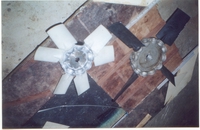
PROPELLERS:-� Propellers typically utilize between 2 and 5 blades that are quite a bit longer than those used on ducted fans.� Although propellers are generally more efficient (and safe!) when placed in a duct, ducting
is not a necessity as propellers will function well in open air.� Propellers must be replaced if damaged by debris whereas a blade is replaceable on a ducted fan.� Propellers are generally noisier than ducted fans.� Propellers can be used to provide either lift or thrust.

COMPARISON� BETWEEN FAN & PROPELLER

FANS:-� ���������������������������������������

�No blade edging

�More costly

�Quiet

�Slow Rotation

� Less blade erosion

� Smaller diameter

� Duct is also a guard Only to c. 48� diameter

� Slow throttle respectively

�Replace individual blade.

��� PROPELLER:-

More thrust/HP

Less costly

�Noisy

�Rotate fast

�more blade erosion

�Edge blades avail Large Diameter

�Must have a guard 8� and more diameter

�Fast throttle respectively

� Replace whole prop

4)THRUST SYSTEM:-

Thrust system is the fourth principle part of the hovercraft which is always located at rear end of the hovercraft. The main function of� this system is to propel the craft forward by rotating it's fan located at the rear end of the craft. The axis of rotation of the fan (hub of the fan )is horizontal to the craft, it appears vertical to the front view of the craft.

����� A two stroke or four stroke engine is normally� used to drive the thrust system with direct coupling to the engine or through a complicated belt drive or� chain drive. The amount of� RPM is required is in the order of thousands for� even� a small hover craft. As soon as fan is� rotate to the required RPM it will take air inwardly, so that at� the other end it gives THRUST� due which whole craft is propel in� the opposite direction� of� air� entering to the fan. The amount of thrust generated in this system is mainly responsible� for craft propulsion.��

5)STEERING SYSTEM:-

This is a system through which a whole craft can be directed to the required direction. It consists a wooden plank or� aluminium� sheets fixed vertically at the rear end of the craft, which are aerofoil shape located� exactly at behind of the thrust system. This aerofoil shape structure is called RUDDERS� which will direct the air that is coming from the thrust fan so which in turn controls the direction of the craft. This rudders are controlled by the driver through a handle. Rudder may consists two or single wooden or aluminium structures fixed vertically to separate frame or to the casing of the thrust fan.�

Can we make a hovercraft stop and back-up?

Yes, although it requires some mechanical wizardry since no part of the craft is in contact with the ground.� This is generally accomplished via reversible pitch fan, 'reverse bucket', transmission, or 'puff ports'.

>1.� Reversible pitch fan
A reversible pitch fan (or propeller) is a fan that allows the operator to physically reverse the pitch of the fan blades thus reversing the flow of air forward thus slowing and/or reversing the direction of the craft.� These are mechanically complex and are not useful in a craft of single fan design . since the reversing of the airflow would essentially create a vacuum in the cushion and suck the craft to the ground.

>2.� Reverse bucket
A reverse bucket is placed, mechanically, directly rearward of the thrust fan to redirect it's airflow forward via a curved surface when the operator wishes to slow the craft or stop.� Although this method is much simpler than a reversible pitch fan, the bucket adds weight to the rear of the craft in addition to the engine, duct, fan, and rudders.� Also, reverse buckets are only useful with smaller diameter fans.

>3.� Transmission
A transmission is sometimes as complex a solution as a reversible pitch fan.� As in an automobile, a transmission reverses the rotation of the fan and is attached to the driveline between then engine and the fan.� A transmission may utilize gears as in an automobile or belts as in a 'mule drive'.

�>4.� Puff ports
Puff ports are apertures through which air is redirected from the lift or thrust system to the front or sides of a hovercraft.� When a puff port is opened, the air is allowed to flow out of the craft in whatever direction the operator desires.� Realistically, puff ports are only useful at slow speeds since they often lack the ability to pass air at a sufficient velocity to counteract a craft with much momentum and are used primarily for low speed maneuvering.

Please mail your response to [email protected].

Hosted by www.Geocities.ws

1