| Berlin was the most educational city for us. We have learned about German history and war history in many of our German and history classes, but Berlin brought home the dramatic results of tyranny and suppresion, a city fighting to renew itself after years of occupation and politcal flip-flopping. We had to continually remind ourselves that many of the "old" buildings we were seeing were actually rebuilt after the allied bombing of WWII. Other buildings were remodeled after years of communist rule. Two ways of life and two governments in the same city separated only by wire and concrete. |
| Berlin, Germany September 11-14th, 2004 |
| To continue your virtual tour, follow the links to the cities at the top or bottom of this page, or simply click next |
 |
 |
 |
 |
 |
 |
 |
 |
 |
 |
 |
 |
 |
 |
 |
 |
 |
 |
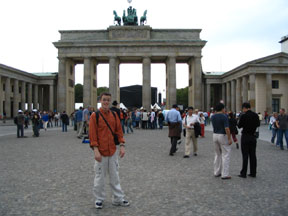
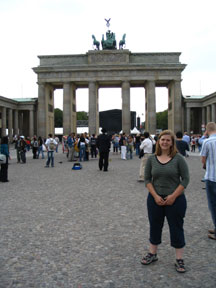
| The Brandenburg Gate surprised Marianne because it seemed much bigger in photos. This is partly because those photos showed a gate surrounded by barren no-mans-land, barbed wire and the wall. Now buildings are built tall and near to the gate, dwarfing it with their modern achitecture. |
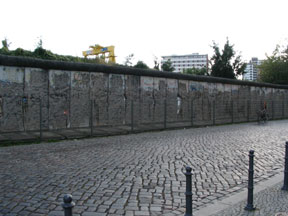
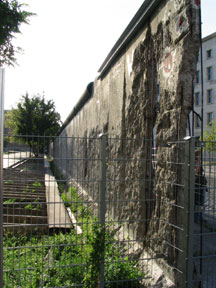
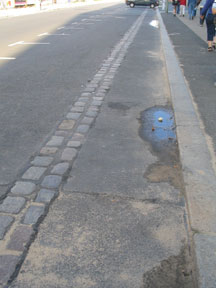
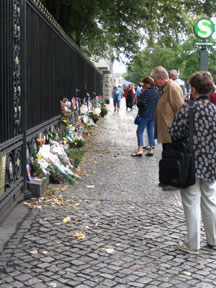
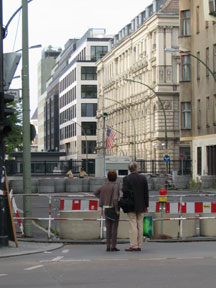
| It's hard to find any remnants of the Berlin wall in Berlin. Only a three-quarters-block section remains - a chipped-away cement stucture with exposed re-bar stands as a reminder of what once separated isolated west Berlin from the surrounding communist East Germany. Cobblestones in street pavement delineate the location of the former wall (above right). The American Enbassy (left) is an indication of current world unrest. The entire block surrounding the embassy has been barricaded since Sept. 11, 2001, as well as the British embassy a few blocks away. The Russian Embassy (right) was strewn with flowers and stuffed animals in memory of the recent atrocities at the rural school in Russia. |
 |
 |
 |
 |
 |
 |
 |
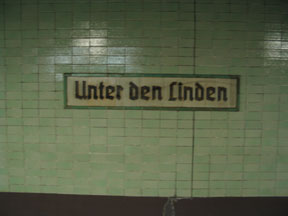
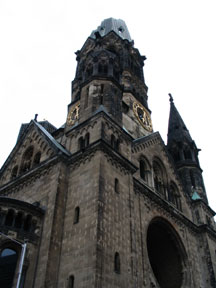
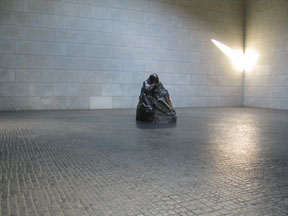
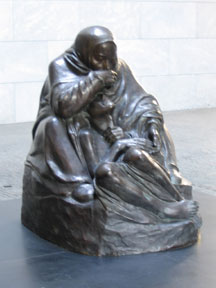
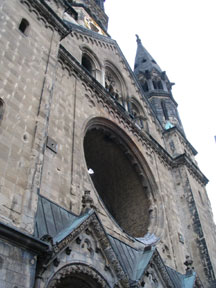
| The original Unter den Linden metro signs (left) are still on the wall, although the metro lines that ran from east to west Berlin were naturally sealed off upon Russian occupation. Much has changed since the wall came down. The east side has become the new center for a united Berlin, and efforts are finally being made to create a central train station. Everywhere you see reminders of how things used to be. The former guard house for the Hohensoller royalty of yesteryear now houses a memorial to the victims of war, a tomb for an unknown soldier and an unknown victim of a concetration camp. This sculpture (lower left) by Kathe Kolwitz represents a mother holding her dead soldier son, and it stands alone in a large cold room. One church stands unrestored as a memorial of the allied bombing. Only the bell tower remains (below) |
 |
 |
 |
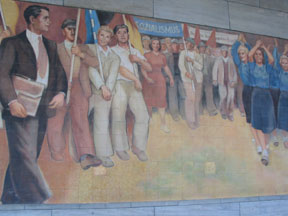
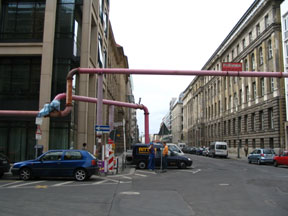
| Here are a couple of things that made us chuckle in Berlin. First, the painting on the right is found on the former ministry of the Luftwaffe. The mural depicts the 'people' as wholesome and happy citizens at a parade - farmers, workers, etc. are united in a parade with a large banner that reads "Socialism." We thought it was funny that it has not been defaced or changed since the wall has come down. The pink pipes to the right were prevalent in Berlin. At first, Doug thought it was some installation modern art, but our tour guide explained that, since Berlin was built upon a large swampy area (hey - just like Washington D.C.!), any construction sites needed constant pumping to prevent flooding. The pink, she said, was just to make the pipes looks (somewhat) attractive. |
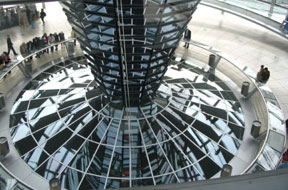
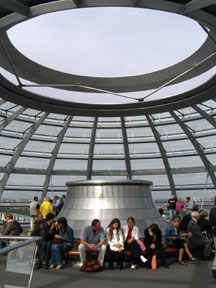
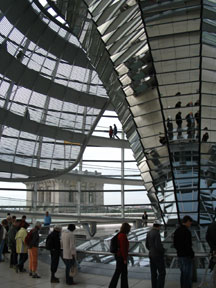
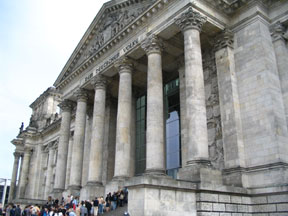
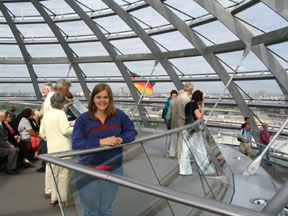
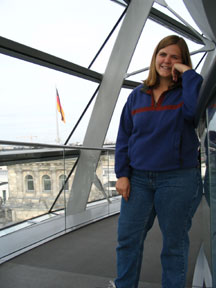
| The Reichstag (above) is the building in which the parliament meets. After being destroyed by a communist arsonist near the end of the Weimar Republic, is has been in various states of disrepair. It has been restored and modernized with a great glass dome on top. The public is free to enter (after waiting an hour in line) and view the city, but also to look down upon their goverment officials at work, symbolically 'keeping and eye' on theirgovernment. Architecturally stunning. |
| Sidewalk silliness. It could happen to you. |
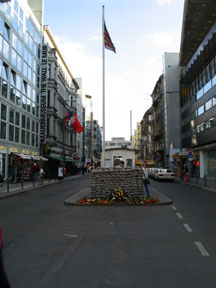
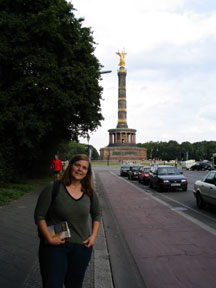
| Checkpoint Charlie (right) was an American-run guard station at one entrance through the wall. The checkpoint itself is tiny, but the meseum down the block is an expansive collection of apparatus us to escape from the east. The fascinating fact is that it existed at the time of the wall - such bold defiance to the communist state just a block away. This Siegsaule (left) is a victory column commemorating a German victory over France. At the center of a roundabout, it is accessed only through underground passages. |
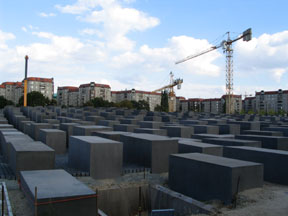
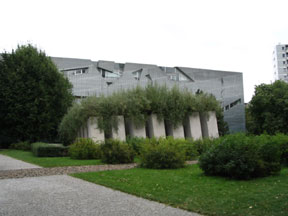
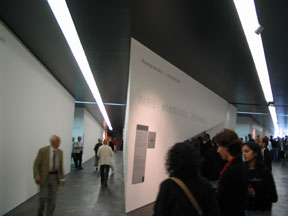
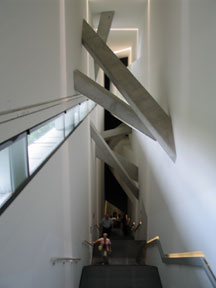
| Recent additions to the Berlin Topography include a memorial to the murdered jews of the holocaust (above), which is still under construction, and a Jewish museum diisplaying artifacts and interactive exhibits detailing the presence of Jews in Europe from before the time of Christ. The museum's architecture includes sharp angles and skewed surfaces, representing the precarious and troubles existence of the Jews in a land in which they were for so long unwelcome. |
| _____________________________________________________________ |
| Berlin |