|
Put MoreZest into your
life!
Good Foods
Healthy foods really are good for us.
Let us show you how to get a little more zest in your life!![[picture]](images/applebite.jpg)
-
You are what
you eat
-
Hard Facts
& The Food
Pyramid
-
Antioxidants vs Free Radicals
-
The
right & wrong foods
-
Folic Acid
& B Vitamins: reducing heart
disease & stroke
-
Micronutrients: we need variety
-
How to
get the right stuff!
“You are what you eat”
Age-related diseases such as heart failure, diabetes and many
types of cancer have increased significantly in the developed world
due to a dramatic decrease in the consumption of plant-based
food such as vegetables, fruits, herbs and spices.
"Food molecules enter our bodies and modulate
our genes - one's diet can be more powerful than drugs."
Food
molecules entering the body act as hormone-like messengers that
regulate pivotal body functions at the cell level, including the
division of cells implicated in cancer, heart disease and
inflammation. Most of the hormone-like food molecules are
synthesized by plants and cannot be manufactured by our
bodies.
In addition, some mental
imbalances (e.g. attention-deficit hyperactivity disorder,
schizophrenia and dyslexia) can be worsened by consuming particular
foods that contribute to mood and learning disorders.
Improvements are seen in diets rich in Omega-3 fatty acids
(contained in such foods as salmon). It is likely that fatty
acid imbalance is made worse by consuming foods high in Omega-6
fatty acids (such as those found in deep-fried foods) and,
ironically, patients diagnosed with severe mental disorders may be
institutionalised in places where they are fed fatty foods and a
nutritionally poor diet.
Reported in the journal Science by
Professors Barbara Demmig-Adams and William Adams, University
of Colorado,
2002.
"Hard Facts" (source: UK
Newspapers & Health websites, June-August 2002)
In the UK:
95%
of food advertising (which is seen by our children) promotes
fatty sugary or salty foods.
33% of British children are overweight and 13% are classed as
"obese".
26% of 15 year old girls are on a diet.
The diet food & drink market is expected to be worth £64
million by 2006.
Across the pond:
40%
of calories consumed in the US are attributed to fat (in
Japan it is only 20%).
A New Yorker is suing US fast food giants for making him obese (he
weighs 275 lbs, or 125 kg)
|
"If we all could increase our intake of
fruits & vegetables, it would substantially reduce heart
disease across the population" reports a 6-month,
randomised, controlled trial of 690 healthy participants, aged
25-64). Overall there was a decrease in blood pressure corresponding to
a significant decrease in hypertension, stroke and heart attack in
participants taking 5 portions of fruit & vegetables a
day.
|
|
Source: "Effects of fruit & vegetable
consumption on plasma antioxidant concentrations and blood
pressure", by J H John & others, University of Oxford,
Lancet (Vol. 359, 8th June)
|
"The
Food Pyramid" (source: most governments &
health agencies)
A blood cell lasts 60-120 days. In 3-4 months our entire blood supply is completely replaced
by new cells. Within a year, bones, tissues and even the enamel on our teeth is completely rebuilt.
The raw material to build and maintain the billions of cells
in our bodies comes from the nutrients in our food.
Furthermore, illness and ageing tend to shorten the life of our
cells if unchecked. This is why it is important to eat the
right foods and the right amounts of the right foods, as shown in
the Food Pyramid.
Every report, health advice & government campaign says the
same - we need to eat more of the foods that contain fibre,
antioxidants, vitamins & minerals & less of the high fat,
high sugar foods. Fruit & vegetables are especially
important.
|
 Eat most:
|
vegetables & fruit, grains, cereals, bread, pasta
|
|
 Eat some:
|
fish, yogurt, lean meat, poultry, dairy products (milk, cheese), nuts, eggs
|
|
 Eat least:
|
sugar & sweet things, oils & fats (butter, margarine, red meat)
|
"Antioxidants vs Free Radicals" (source:
Nature 1999 & 2000)
Free Radicals (reactive oxygenating compounds) vigorously attack our cell nucleus,
proteins & lipids & are linked to cancer, heart disease
& DNA damage.
(Source: Nature 1999:79-82, “Destruction of Cell membrane structure”; Nature 2000:408(6809):248-54, “The age of cancer” by
R.A. DePinho)
The main sources of
Free Radicals are:
Stress,
alcohol, smoking & smoke, pollution, smoked/grilled food,
preserved/seasoned food (incl. sausages, bacon, processed cheese*),
ultraviolet rays, X-rays, some medicines, intense muscle activity.
(*reacts with polyunsaturated fatty acids)
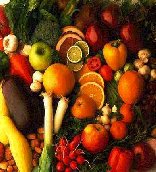 Antioxidants neutralise free radicals that
damage cells & also help with cell repair.
They can naturally be found in fresh fruits & vegetables. Antioxidants neutralise free radicals that
damage cells & also help with cell repair.
They can naturally be found in fresh fruits & vegetables.
However isolated vitamins
(e.g. beta-carotene, vit. E) are not protective
against cancer & heart disease and are now not recommended for
general consumption.
(Source: New England Journal of Medicine articles: 1990-1996).
"Fresh Fruit & vegetables: the key to healthy
cells"
Fruit & vegetables, especially when fresh
and raw, contains vitamins & minerals, antioxidants, fibre, complex carbohydrates,
phytochemicals, enzymes.
Fruit:
the original fast food -- "A varied selection of raw fruit gives
the body substances that it can easily draw goodness from" (The Times,
6.9.1999)
"So what if I eat the wrong things?"
Eating fatty or sweet foods causes negative effects:
- Sweet or fatty foods distort our sense of taste and we can loose our appetite for natural, fresh foods that do
us the
most good
– We allow oxygenating compounds to react with more poly-unsaturated
fats to produce harmful substances leading to cell damage that in
turn is linked to cancer and heart disease
- We don’t get the vital nutrients we need to rebuild our bodies
and protect our cells from damage, especially if we become ill and as we get older
- Our bodies gain more weight, become less fit and more prone to disease
- We do not receive nutrients that combat disease (see Folic Acid,
below)
Our dependents also suffer:
- We also teach our children bad habits that they will pass on in
the future, increasing obesity rates
- We tell our children that sweets are a reward or treat - ruining
our diets & teeth is some treat!
Journal of the Italian Nutritional Disorder Centre, 1998
65% of 30-60 year olds are
overweight and
28-35% of children aged 8-12 are overweight
"What are the right foods?"
KEY RECOMMENDATION:
To fight free radicals and provide our cells with sufficient
nutrients, the world-wide recommendation is to have 5-9 servings of fresh fruit &
veg. every day
(3-6 servings of vegetables & 2-4 servings of fruit).
Time and time again, the most natural foods turn out to be the best
- eat well and you will eat healthily.
ARTICLE: Folic Acid, B VITAMINS & Heart Disease
& Stroke
Folic Acid has long been associated with the prevention of
congenital (birth) problems such as spina bifida and other neural
tube birth defects in babies (NTDs), but new research suggests it
also may help ward off heart disease and strokes in adults.
Researchers at the University of Ulster reported that folic acid and
3 other related B vitamins can prevent the
accumulation of homocysteine in the blood (a new risk factor for
heart disease and strokes).
High homocysteine is like high cholesterol but homocysteine levels are much easier to lower
-
through increased intake of folic acid and B-12 and B-6
vitamins and riboflavin. About 12 percent of people have a
particular genetic make-up predisposing them to high homocysteine
levels. Riboflavin, found in dairy foods, prevents the build up of
homocysteine in these patients.
NOTE: Always consult your GP first - you may need to take
care in taking B vitamins
What are the best, natural sources of folic acid?
- Whole grain breads
- Fortified cereals
- Dried peas
- Dried beans
- Leafy vegetables
- Fruit
- Certain Supplements (see Juice Plus+(R), below)
Micronutrients: Why we need variety
There are many important "micronutrients" & it
seems to be the combined effect that is so healthy.
To get enough mivronutrients, we somply have to eat a good variety of fresh foods
...
|
“Agents”
|
What they do
|
Where found
|
|
Glucosinolates (Isothiocyanates, Indoles,
Sulforaphans);
Limonene
|
Stimulates production of anti-oxidant
enzymes
|
Broccoli, cabbage, kale
Citrus fruit peel
|
|
Glucarates
|
Anti-oxidants
|
Citrus fruits
|
|
Flavonoids
|
Polyphenol anti-oxidants
|
Orange peel and pulp
|
|
Allicin, Allin, Thiosulfinates, Gamma-glutamylcysteines
|
Source of sulphur; beneficial if eaten regularly
|
Fresh, strong-smelling garlic
|
|
Carotenoids (Alpha & beta
–carotene*, beta-cryptoxanthin, lutein, lycopene)
|
Highly effective antioxidants. * Body converts into vitamin A
|
Carrots, oranges, papaya, broccoli,
spinach, tomatoes
|
|
Coumaric acid, cloragenic acid
|
Defends cell membranes from free radical
attack
|
Carrots, pineapples, tomatoes
|
|
Genistein
|
Isoflavonoid compound; beneficial to health
|
Soybeans
|
|
Chlorphyllins, brassins
|
Defends against many environmental
pollutants
|
Spirulina (seaweed), cabbage
|
|
Polyphenolic acids
|
Powerful anti-oxidants
|
Garlic, soybeans
|
Getting the best food & best variety:
The best fruit &
veg. & foods you can eat, in order of nutritional value, are:
- Excellent:
Those
grown in your own garden & eaten fresh & raw when ripe
(although it is a lot of work to achieve a wide variety,
especially in cold climates)
- Good:
Freshly
picked, ripe from farms, markets etc. (although it may be
sprayed)
- Fair:
Organic
foods from supermarkets etc. (which may not be organic even if labeled
"organic" and may not be fresh or ripe due to delay between picking & buying;
may become over-ripe
quickly)
- Average:
Everyday
foods from supermarkets, shops etc. (will have been sprayed with
pesticides & may contain preservatives – e.g. carbon
tetrachloride on bananas; intensive
farming and shipping mean they are rarely as wholesome &
fresh as they should be)
- Poor:
Tinned
foods (if packaged soon after picking without excess
preservatives, sugars etc.)
- Very
poor: Preserved or pre-packaged foods are probably the least nutritious
"How to guarantee getting the right stuff"
Prevention is better than treatment:
Just like brushing teeth to avoid a painful trip to the dentist, we
should eat well, exercise more and learn to reduce excess stress.
However eating well is increasingly harder to do, as we are
more and more removed from a variety of fresh, natural foods.
Supermarket foods may not be as fresh and nutritious as home-grown
or farm-grown produce and are increasingly treated with chemicals
and pesticides.
Furthermore, intensive farming has actually reduced the amounts of
vitamins and minerals (and other agents) that occur naturally in
fruits and vegetables.
Source: Die Welt, 24 August 97 (comparing 1985 and 1996 nutrition
content of common foods)
A Natural Way
Since fruit and vegetables play such a vital role in fighting illness and
disease we can't afford to miss out, but isolated vitamins and minerals
are not the answer, so we have to do something to balance out our
needs for nutrition.
Following extensive research, we can recommend a 100% natural product
- in fact the only product that
repeatedly meets our criteria for being proven and practical as well
as natural.
It
contains 17 of
the most nutritional fruits & vegetable, with excellent
bio-availability in a convenient, pesticide free form, providing a
natural source of antioxidants, minerals & vitamins etc.
In peer-reviewed tests it increases
antioxidant levels in the body in just 7 days, reducing some free
radicals by as much as 75%. Contact us for more
information about these tests.
And the good news is that it works out less than buying, storing,
preparing enough fresh fruit and vegetables for the average city
dweller (to say nothing of the saving in better health ...) and
you don't need to buy any cosmetic vitamin pills, weird extracts or
peculiar potions.
Who is this for?
- Anyone
considering a diet or worried about their weight
- Anyone
trying to exercise or concerned with their health
- Anyone who des not eat a good variety of fruits &
vegetables
- Anyone
who is taking (or thinking of taking) vitamins, minerals,
exotic health products etc.
- Anyone
facing too much stress or feeling depressed
- Anyone
who smokes or is trying to give up
- Anyone
in a city environment (which increases pollution, smoke,
stress etc.)
- Anyone
who drinks a lot of alcohol (over 2 units a day)
- Everyone
over about 30 – 35 should consider taking it regularly for
the antioxidants
How do I start?
For more
information, email us:
morezest@yahoo.co.uk
It is never too late to start to live the life you want to live!
Visit the rest of our web-site ...
|