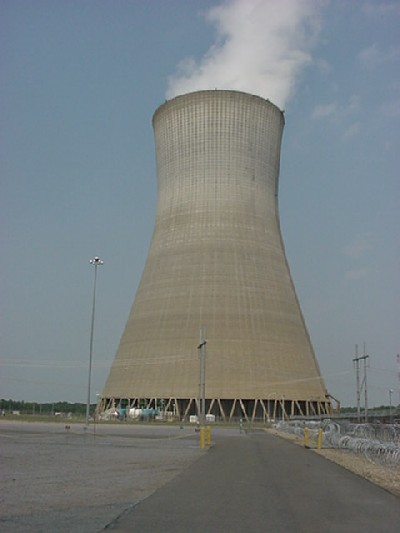
Example of a nuclear power plant cooling tower
Index of ChemX
Uranium is actually rather common on Earth. The planet was enriched with the element during its formation. Uranium is originally formed in stars. Stars that had come to the end of their life would come to an end in a violent explosion and eventually the dust from these stars would come together to form our planet. Uranium-238 (U-238) has an extremely long half-life> (4.5 billion years), and therefore is still present in fairly large quantities. U-238 makes up 99 percent of the uranium on the planet, due to its longer half life than U-235 and 234. U-235 makes up about 0.7 percent of the remaining uranium found naturally, while U-234 is even more rare and is formed by the decay of U-238.
Uranium-235 has an interesting property that makes it useful for both nuclear power production and for nuclear bomb production. U-235 decays naturally, just as U-238 does, by alpha radiation. Rarely, Uranium-235 will also have spontaneous combustion occur. And, U-235 is one of the few materials that can undergo induced fission. So, if a single neutron hits a U-235 nucleus, the nucleus will absorb the neutron immediately, become unstable and split.
Nuclear power plants use the energy created by fission to generate a large amount of steam, used to turn turbines. To do this, uranium is cut into small discs or pellets which are crammed together into long rods. The rods are then brought together into bundles. This bundle, acting as a very high-energy source of heat, turns the water to steam which powers the turbines, spinning a generator, and eventually producing power in the form of electricity.
Index of ChemX