| First Aid, Vaccination's, |
| Reaction's and Warnings |
 |
| Okay - No Laughing Matter here. As with anything, it's not an emergency until it occurs. Why do we bring this up? Well, until you are faced with an injured pet or animal, or sick or dying pet, usually one never thinks about a "Plan B", or even prepare for a "Plan A". Why do we prepare for those "human" injuries that we know a child or other person may encounter? Why should "Fido" or "Princess" be any different? Fact is, they shouldn't. And moreso, a quick reaction on your part as a "first responder" to your animal's demise could SAVE IT'S LIFE. The care that you provide and knowing where valuable items are is key to providing your animal with your utmost care and concern. Here are some ideas we came up with and some WARNINGS about Vaccinations, Shots, Reactions and limited medical advice. It's time to get organized and put together a 1st Aid Kit - For Doggy. |
| DISCLAIMER - The views, opinions, recommendations and "medical advice" herewith is NOT intended to replace or supercede the direct medical advice that is provided by a licensed Veterinarian. WE ARE NOT VET's. Our opinions are strictly based on actions or experiences that we have faced and are noted here as potential solutions and/or suggestions for others to consider or "model" their response and/or First Aid kits. Never take anyone's advice over your Vet's direct instructions. We will not be held liable for anyone's misinterpretation of this material as being sound medical advice. It is only here as a record of what works for us and our dogs. See Legal Disclaimer. |
| So, Where do you Start? I'm sure like you and your house, our house once upon a time was very similar. Doggy stuff here, doggy stuff there. Ointment here, toothpaste there, and so on. Not until you are faced with having to find that "elusive" medicine in an emergency that the Vet gave you who knows when, do you really begin to understand the importance of being organized. So, how do you get organized? Like you and many others, we first tried to live with just a drawer or two packed full of all kinds of "stuff", from medicine, to HeartGard, to flea & tick stuff. Mixed in with Q-Tips, swabs, cotton balls, clippers, shampoo, parfume, toothpaste & toothbrushes (don't laugh), and a myriad of other things associated with the family pet. So what to do? |
|
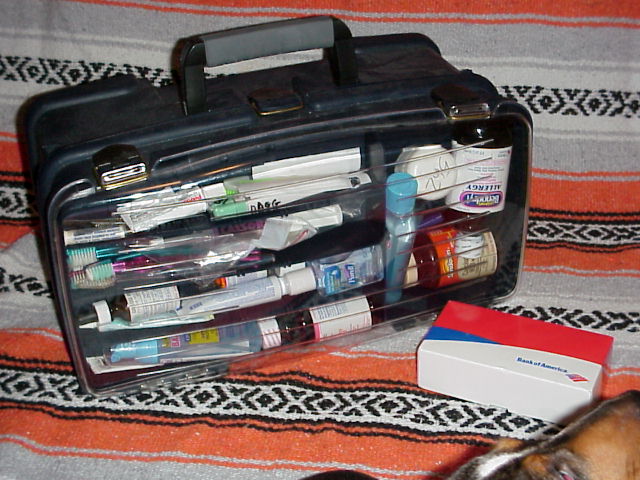 |
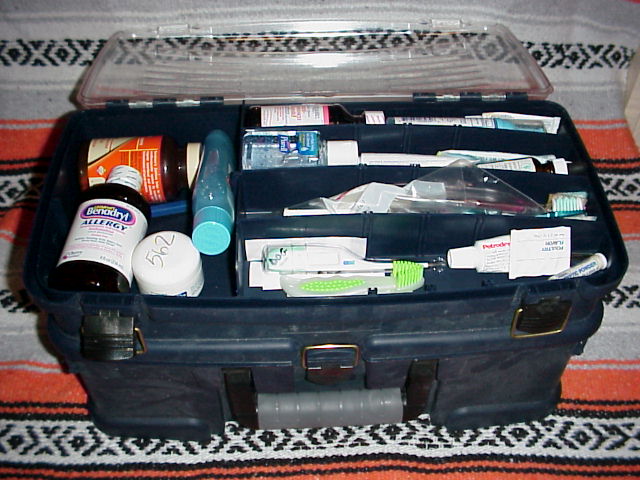
| What we have found to work well is what you see here. We decided to get organized and "build" a Canine First Aid Kit from scratch. We started with a larger regular fishing Tackle Box (men, get your own for fishing), then we packed it full of all the dog related junk we had and outfitted it with new medicines, drugs, gauze, ointments, solutions, etc. Maybe we overdid it to some degree, but I tell you, when you want it, you know exactly where it is, and if you have to leave home or run down the street or across a pasture, you're going to be REALLY happy you have it set up this way for mobility. Just think, if you take your pet with you on vacation, you can conveniently take the pet's First-Aid Kit too. This box has a see-thru lid so you can quickly see what you need and locks shut. It has compartments and dividers, shallow and deep storage and hinges away to reveal the larger lower-level or storage area. We stocked the top (quick access) with ointments, Benadryl, hand sanitizer, thermometer (dog only), antiseptic wash, Calcium Supplement and other stuff. The most needed products were located on top in full view. The box came with other divider strips and panels for the bottom to further sort stuff, but we chose not to use them as that is where we put our least used items, bottles and large boxes, etc. You can set yours up however you want in any size box you want. This box may be overkill for someone with only 1-dog, but you would be surprised how much stuff even 1-dog generates. Regardless, I would rather have any stuff I need in 1-place, rather than having to look for it when my pet is laying on the floor in full blown Calcium Shock, having seizures or worse. Be prepared. Be ready. |
| Checkbook Box is there for size comparison - and my little helper in the lower right-hand corner. You could fit 2-dogs in this box. The Kit measures 19"x9"x10". |
 |
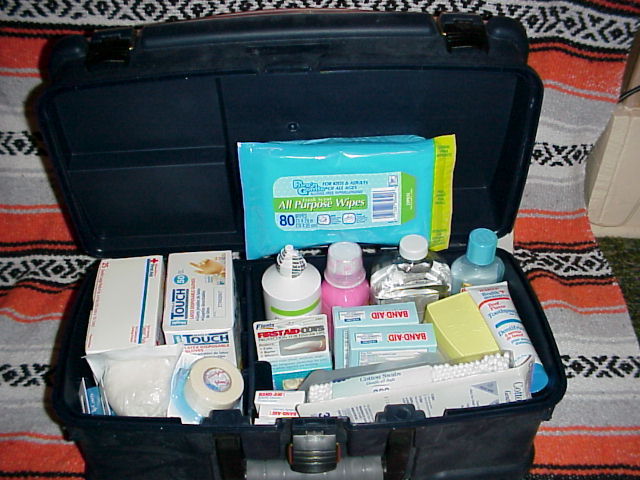 |
| In the bottom of the box, we put bandages, gauze, tape, wraps, flex-wrap (to hold bandages without tape - so hair is not pulled), latex gloves, Pepto-Bismol, Eye-wash, finger coverings/protectors, steri-strips / butterfly closures, razor, antiseptic wash, mineral oil, baby wipes, antiseptic wipes, alcohol, toothpaste, vaseline, Q-tips, Floss, Peroxide, etc. With this fire-power, you AND YOUR PET will stand a better chance. What about Cost? Well, including the box and lots of new 1st aid stuff, we spent about $120. Not including any Vet med's, prescriptions or left-over ointments or syringes. We chose to buy all new stuff and start fresh. You may just buy the box, begin adding bits and pieces to it as you get it - like you would for a people kit. The choice is yours. For us, when you have several dogs and each is more valuable than just a "price", it mattered for us to be ready to help our canine family members, 24 hours a day. |
|
| Vaccine's / Reaction's to Vaccination / Warnings |
| We bring these points up because we are finding that we are not alone and that no one ever told us about this stuff, and coincedentally caused the potential death of many of our Mini-Dachshunds. Our Vet never told us, and maybe just thought the vaccinations were "normal" and that if there were past problems, we would have spoke up. Wrong - our situation was this. We use to live in a large city where a particular vaccination was not readily given, nor readily required, since our animals would never come into contact with horses, farm animals, etc. The vet however neglected to ask his new patient's (i.e. us) where they came from and that since we were now in the country, this shot would be administered - except he never asked where we came from, and never announced that the dogs would be getting a brand new shot never given before. He just did the exam and "poof", the shots were done. The dogs were packed up and my wife went home. Less than 30-minutes later, 5 of 7 dogs were having reactions to whatever he just gave them. NOW WHAT? We are talking SEVERE reactions. One dog looked like he was stung by 100 bees. Another lost the look of his face due to the swelling. Another had a mixture of both. The others were "in-between"... Handling one or two dogs with these symptoms would be easy(er), but with nine (9) dogs, its like, who do you help first? Who's worse? And moreso, what do you do? And WHAT CAUSED IT IN THE FIRST PLACE? That's what we're going to talk about. SO WHAT CAUSED THE REACTION(s)? 1st Type - Was from the vaccination for what is called CANINE LEPTOSPIROSIS, or as coined in the country and medical world as just "LP". The link above is from a Labrador site, but it is chocked full of good info on this issue. Apparently, most of our dogs, and therefore puppies, are in the percentile that are allergic or show immediate signs of allergic reaction to the administered "LP" vaccine. DO NOT GIVE OR ALLOW THE "LP" SHOT TO BE GIVEN whether or not you get the animal from us - just to be safe. A reaction is not uncommon or a "defect" in our animals. Many canines are allergic. So we choose to NEVER give this shot again. And likewise advise you, the potential buyer of our pups to not give the shot to the pups either. IF YOU ELECT TO ALLOW THE SHOT OR ARE "REQUIRED" TO GIVE IT TO YOUR ANIMAL, MAKE SURE THE VET IS AWARE OF THIS WARNING FROM US AND MAKE SURE YOU ARE READY FOR A POTENTIAL REACTION. 2nd Type - Was from the general Vaccine that dogs get for Rabbies & Distemper. Something in the mish-mash of the vaccine cocktail is causing some of our dogs to react to even this "general" vaccine. The veterinarian world is somewhat like their human counterparts, whereas they combine several vaccine's into one-shot, so if there is a reaction, you can't tell what the person or pet is allergic to, without reducing the shot down to a series of single shots until you find the culprit. The reaction is about the same as the "LP" and treated the same way as below. |
| HOW DO YOU RECOGNIZE A REACTION TO A VACCINE? When our dogs had their reaction(s), here were the signs: 1) "Hives" (like bee stings) appearing over the entire coat, ears & tail. Depending upon severity, Light results from 10-20 bumps to severe and over 100 bumps with fur standing up on bumps (like a full-quill ostrich boot weiner dog...); 2) Puffy Lips, Puffy Face, Swolen Tongue, Puffy Eyebrows, swelling in general; 3) Excessive "licking of lips", lapping in thin-air, breathing through their mouth & cheeks causing the cheeks and lips to "flap" as dog exhales; 4) Labored breathing, panic (you can see it in their faces like, "what's happening to me"), listlessness, twitching of skin or muscles, itching, wobble-walk, balance or equalibrium control, and in more severe or time-extended reaction being seizures, convulsions, eye "twitch" or "spin"; 5) Uncommon coloration in the tongue or gums, and maybe a temperature. These are the most common occurences when our dogs or pups react to a vaccine. |
| HOW TO STOP THE REACTION - WHAT's THE ANTIDOTE? Mostly, what is given is what you and I take for allergies - a Hystamine blocker. Also known as Benadryl. ALWAYS KEEP A BOTTLE OF LIQUID BENADRYL AROUND for such an occasion. It has great shelf life and it could save your animal's life. We are sure that it saved our dogs. Now, the Vet also gave us "Vet approved" Benadryl, but the Vet says that the over-the-counter stuff is just as effective and is readily available. If the animal is going to REACT, it will occur within 8-hours, not to say that it couldn't happen in 10-12 hours, or later. If the animal is highly allergic, then the reaction can take a little as 30-minutes or less; about the time it takes to get home from the Vet. And if you are the last patient that day and go home, you and your pet could be in real trouble. And that's just what happened with us. But lucky for us, we had kids around from time to time and had some Benadryl in the cupboard. FOR GROWN DOGS: We gave 1-teaspoon every 2-hours for 6-hours (3 doses). For really, really bad cases, we would start with 2-teaspoonfuls, then go into the 2-hour plan. We would then watch through the night for further signs. By this time it was morning and we observed them for other signs. If signs returned, then we did the 1-teaspoon every 4-hours until we achieved results. EACH CASE IS DIFFERENT. ANY ANIMAL COULD "RELAPSE" - monitor, monitor, monitor - just like you would for a child. FOR PUPPIES: We gave 1/4-teaspoon (or 1ml) every 4-hours for 8-hours (2-doses). Afterward, we assess the need to continue on an hour-by-hour basis. Watch puppies like a hawk. Don't assume they are out of the woods just because they "look" better. The reaction is still there, it is only being "combatted" by the hystamine blocking agents. WORST CASE SCENARIO: GET THE ANIMAL BACK TO THE VET OR TO AN ANIMAL HOSPITAL IMMEDIATELY. BUT REMEMBER, THE TIME IT TAKES TO DRIVE TO THE HOSPITAL, YOUR ANIMAL COULD DIE. Have your emergency numbers to include your Vet, and TWO (2) ANIMAL HOSPITALS, just in case one is not taking patients. |
 |
 |
| 3rd Type - Is associated with females, after whelping (birth) a new litter and usually 1-3 weeks afterwards. This reaction is NOT to a vaccine, but to a natural occurance from feeding puppies - called CALCIUM DEFICIENCY SHOCK SYNDROME. Or, the pups literally suck the calcium nutrients out of mommy and mom can't produce them fast enough to EQUAL what feeding takes. Depending upon the number of pups, this could happen as fast as 1-week with 4,5 or 6 pups, to never at all with only 1-2 pups. This is one of those "little known facts" they don't tell you about when you think about getting into breeding small dogs. WHAT HAPPENS - HOW DOES IT START - WHAT DO I LOOK FOR? This starts and comes on rather fast, since you don't have a gauge to base it by, like going to the vet and getting a shot. No, this one creeps up on you and your pet. First signs of ours have been, the dog leaving the pups and wanting unusual attention from you, like they are trying to tell you something. Next would be noticing a fever. Next would be slight twitching or "vibrating" of the coat/skin. Next would be excessive panting for no reason - like they just ran a huge distance. Next would be staggering or "wobble-walk" - loss of motor skills. Next would be listlessness. Next would be a full collapse on their belly. Dehydration (but we can't "see" this symptom). Next would involve all the above symptoms going terminal and the animal loosing equalibrium, rolling on side and going into a full-blown seizure type reaction from the calcium deficiency. By this time, the dog is HOT (big fever); is panting uncontrollably; has its arms and legs sticking staight out and stiff as a board; Little to no control over tongue (hangs loosely); Excessive Salivation; Fixed eyes or "spinning" eyes; etc. By this time, they can't respond to you or commands. They can't stand or walk. YOU MUST REACT TO THIS IMMEDIATELY OR YOUR PET COULD DIE !!! WHAT DO YOU DO - HOW DO I RESPOND? No benadryl will work here. This is totally different. This is CALCIUM SHOCK and/or HYPOGLYCEMIA that is happening to your new mommy. IT CAN KILL. So, when/if you decide to breed your female, make sure you can find emergency numbers to your Vet and to two (2) animal hospitals in case you do not have the material to treat your pet. If it is daytime, during the week - CALL YOUR VET (any vet close) AND GET ADVICE. If it is night-time, after-hours or on a weekend - YOU'RE ON YOUR OWN (sort of), that is why we encourage you to be prepared like we have come to be. Also and in addition to any action on your part, CALL YOUR VET and advise him/her what is going on. If you have the medicine to give your pet, then do so. If you don't, the Vet will ask you, "do you think she (the pet) can wait till morning?" TELL THEM "NO". NO pet should have to go through this awful time for our, or the Vet's convenience. We're talking a SEIZURE here folks. If the fever gets too high, it will burn their brain just like humans, or worse, it could kill them. If you have no medicine, it's better to take them in and get them the CALCIUM they need. Our vet has administered it both by I.V. (interveneously) and by mouth. YOU MUST GET CALCIUM IN THE ANIMAL. WHAT WE USE - Since this has happened before, we get these syringes from our Vet that contain Calcium in a Gel base. Each has 12ml of the medicine with each "ml" containing 127mg of calcium. The usual dosage is 2ml's every 30 minutes until you see improvement. When we are awakened at 3-4 a.m. by an animal that is already in the FULL-BLOWN shock state, we have given the whole syringe to the pet. Most of it makes it in, but much is not taken in due to leakage/spillage and the dog can't swallow very well. Usually, within 15-20 minutes - we see marked results. 45min to 1-hour later, the animal returns to about a 90% state - BUT WE STILL TAKE IT TO THE VET, just in case. If we don't have the medicine, we are in the car and gone to the closest vet. |
| So, You think you may want to Breed Dachshunds? The above is only a slight sampling of some of the events when you choose to either have or breed your Dachshund. Not mentioned are sometimes required C-sections for birthing - mucho denero's, emergency hysterectomy, and more, which will/can quickly out value any income you would gain from the sale of the pups. It's a lot to consider. |
|