
Training Course Shots in Pilot Study Areas
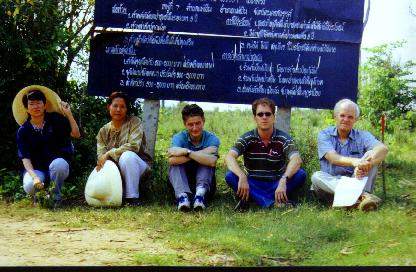
The FORGENMAP team at Khao Pasaan,
Nakhon Sawan
As part of a Pilot Study FORGENMAP recently organised, in cooperation with RECOFTC, a training course in order to build partnerships between villagers and government officials.All parties involved are concerned about the status of forest areas in various places in Thailand. To conserve these areas it is believed that by working together the forest areas used by local people have a better chance for survival. Keywords are partnership in decision making and shared responsibilities in forest genetic resources conservation.
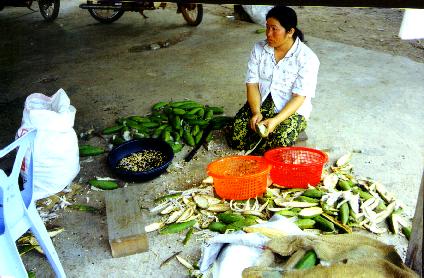
Bombax or Kapok is still used in Northeastern Thailand (Isaan), Khong Chiam, Ubon Ratchatani
Local knowledge in rural areas is still alive and kicking. During the economic crisis which hit Thailand and the Isaan people hard, many people could go back to their homes and use the natural supermarket instead of the ones in Bangkok. Here Bombax seeds are separated from the kapok used for cushion filling. The seeds and the kapok are for own use but also sold on small scale local markets.
All together 4 sites involved in a Pilot Study cover the west, north and northeast of Thailand. The diversity is high in nature and people, with Isaan people spread out to many parts in Thailand, but here in the north many Hilltribes still have close bonds with nature. Some nice pieces of forest are still present, but presure is building up and mouths have to be filled. In many cases the forestry officials face problems in how to justify the reserving of forests for nature instead for agricultural land. Sometimes it is a matter of misunderstanding. The training course and ongoing activities hope to clear at least that so that more effective management with improved attitudes may start.
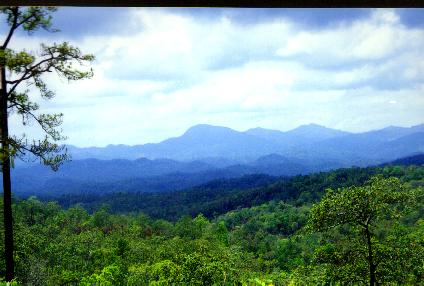
View at Mae Sanaam in Dry Dipterocarp Forest mixed with Pine in Chiang Mai, Northern Thailand
One of the outcomes of the training course was that villagers and government officials think similarly. Instead of community forestry or national park conservation the pilot study concept lies in between the both. The wish of villagers to use the forest in the future as before, and the wish of officials to conserve and rehabilitate it is not mutually exclusive. By conservation, it is meant here that management is needed to maintain the vegetation cover and restore it, with impact regulated by zoning the forest. The traditional harvesting of mushrooms, bamboo shoots, wild vegetables, insects, etc. is not threatening the forests' biodiversity. But, where timber is needed a different zone should be used, such as a buffezone with planted tree species identified by local people. Forest fires is a more complex issue, but it needs at least a cooperation of foresters and local people.
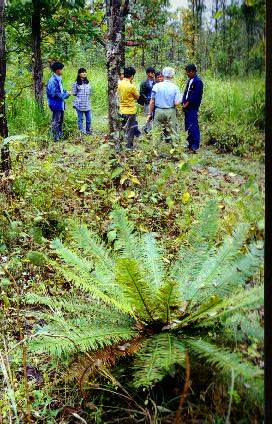
Discussions in the Forest with Village Leaders in Khao Pasaang, Nakhon Sawan in Western Thailand
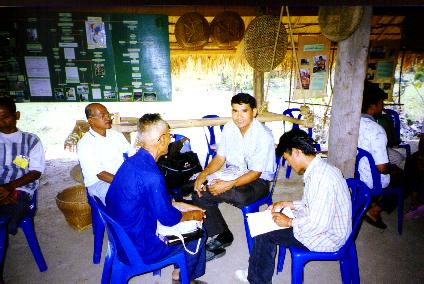
Discussions in small groups to create understanding and form respect for each other, foresters and villagers having their say.

To Be Continued
CLICK THE ARROW

