|
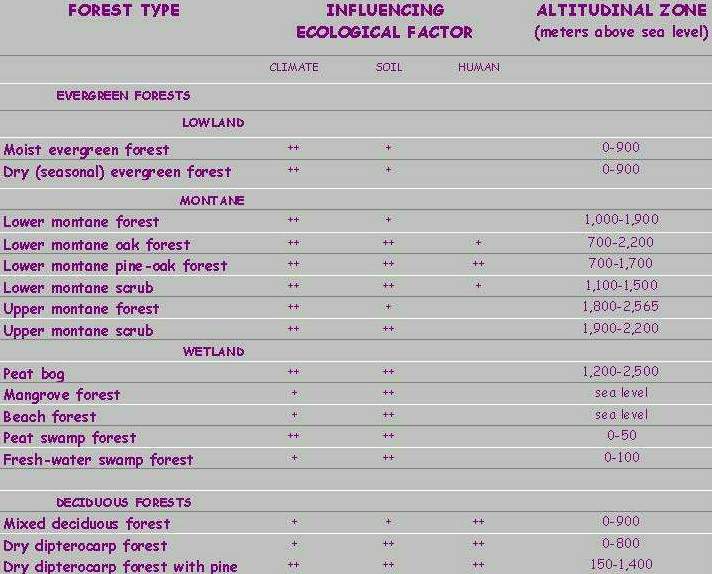
These observations become clear when strolling through an area, and at the same learning to recognise structural and floristic differences in the vegetation. When an investigation will be undertaken to describe the vegetation of an area, the area can be divided into distinguishable topographic features which are often related to the vegetation differences. Other clear distinguisable feautures in an area, such as the vegetation cover can also be used to stratify the area. Following from this more can be focussed on the identification of dominant species of a plant community, which are often good indicators in order to recognise a certain vegetation type. A plant community is a collection of plant species growing together in a particular location that shows a more or less definite association or affinity with each other. The reason for this affinity in a particular environment is normally because the plant species growing together have similar requirements for their existence (nutrients, light, temperature, water availability and drainage). Another reason could be because they share the same tolerance towards disturbances (fire, exploitation, trampling or grazing). Vegetation types are the result of a complex combination of ecological features, including climatic and edaphic factors, varied topography, as well as man. Through to various factors in their varying degrees, no two vegetation habitats are the same.
Recognition of a forest type is possible by studying a particular combination of vegetation structure (tree height, presence of epiphytes, crown layers, etc.) and physiognomy (buttressed trees, crown shape, nature of leaves, evergreen or deciduous, etc.) regardless of its flora. When environmental differences follow each other up in a rapid way the vegetation does too, through an ecotone or gradient, like a mosaic (from dry mountain ridges to wet gullies and from wetlands to deserts). Formations can be grouped for convenience according to the main physical characteristics of their habitats. Naming of a forest type conveniently can be done using site and structure and physiognomy of the formation resulting in easily recognised forest formations with memorable names that say something about the most distinctive characteristics of the formation.
Like the distribution of forest types the distribution of a species depends on its specific requirements, or better, its limitations. A species can still occur outside a preferred site, the optimal area with no limitations whatsoever, but a single limitation can exclude it from that area. These can be environmental factors, mans' influence, ways of dispersal of a species or a specific relationship with other species. |
|