|
|
|
|
|
|
|
|
|
|
|
|
|
|
|
|
|
|
|
|
|
|
|
|
|
|
|
|
|
|
|
|
|
|
|
|
|
|
|
FOREST TYPES IN THAILAND |
|
|
|
Deciduous forests |
|
|
|
Mixed deciduous forest 'paa phasom phlad baai' or 'paa ben dja pan' |
|
|
|
This type is occurring on all soil types but is best developed on soils derived from limestone and fertile alluvium soils (deep loamy soil or clay loam with accumulated organic matter). It occupies considerable areas on plains, along foothills and lower and middle slopes, where soil moisture is more favourable than on the heavily leached gravelly or sandy soils in deciduous dipterocarp forest. More xeric (lacking available moisture for organisms to utilise) phases are expected on shallow soils consisting of sandy loam, colluvium or laterite. The forest is more or less affected by seasonal drought (4-6 months, with 1,000-1,600 mm of rain), causing water stress in the soil and many deciduous species. Forest fires occur frequently in the dry season. Few dipterocarp species occur in this type, however, tall bamboo species are noteworthy (Thyrsostachys siamensis or phai ruak). No single dominance of species occurs in this type, but notable species are Afzelia xylocarpa (makhamong), Xylia kerrii (daeng), Pterocarpus macrocarpus (pradu) (all Leguminosae), Premna species, Tectona grandis (mai sak), Vitex species (Verbenaceae), Terminalia mucronata (tabaek leuat) and T. tomentosa (salao) (Combretaceae), and Lagerstroemia species (Lythraceae). Based on human impact and terrain characteristics two subtypes are sometimes recognised, one dominated by bamboos the other dominated by Teak. The dominance of tall bamboos is related to varying degree of human activities (logging and shifting cultivation) and drier xeric sites, a dominance of Teak displays a richer site and mesic (environment with moderate rainfall and moderately moist, well draining soils) conditions. |
|
|
|
Mixed deciduous forest with Teak 'paa ben dja pan saamat djam nekh ben paa ben dja pan ti mi mai sak' |
|
|
|
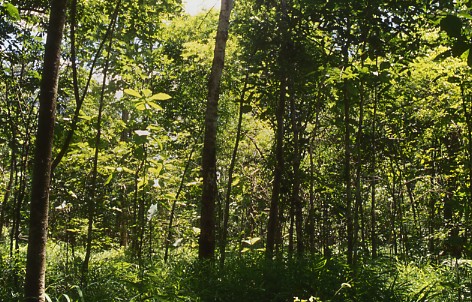
This mesic type is characterised by a high Teak forest with 20-30 m tall trees, three layered with upper canopy trees more or less touching but not densely packed. The middle storey is unevenly distributed with medium sized trees (10-20 m), the lower storey (less than 10 m) has more evergreen species, the undergrowth layer is including shrubs and bamboos. Woody climbers are abundant, where more sunlight enters the forest grass is common. In the rainy season this type appears similar as a evergreen forest, however, in the dry season many species are wilted and leaves are dropped. |
|
|
|
Mixed deciduous forest without Teak (with bamboos) 'paa ben dja pan saamaat tachamnek ben paa ben dja pan ti mai mi mai sak' |
|
|
|
The xeric type is a more or less open forest, with regular ground fires in the dry season promoting extensive grass vegetation. The main canopy consists of medium sized trees (12-20 m) and the lower canopy of denser small trees (4-10 m). Characteristic species are Strychnos nux-blunda, Lagerstroemia species, Bombax ceiba and Pterocarpus macrocarpus. Most canopy trees are lower branched and smaller trees are stunted. Dendrocalamusstrictus (mai sang) replaces other tall bamboos here. |
|
|
|
Deciduous or dry dipterocarp forest 'paa teng rang', 'paa pae', 'paa kok' or 'paa deng' |
|
|
|
Soils derived from sandstone and quartzite support this type since it is unsuitable for the mixed deciduous forest. These poor acidic, shallow, stony sites are not suitable for agriculture and are subject to leaching, burning and erosion. This most xeric vegetation type in Thailand is developed in dry habitats on slopes and along ridges, it does not occur on limestone, with Shorea siamensis the only exception among Dipterocarps. Edaphic conditions and fire play an important role in the development and distribution of this type. Annual rainfall is below 1,250 mm and the dry season accounts for 6 months. Almost all deciduous species can withstand annual ground fires and saplings are capable of coppicing following fire disturbance. Almost all canopy trees shed their leaves in the dry season and flush their leaves accompanied by blooms before the rainy season. This type is dominated by few species Dipterocarp species like Dipterocarpus obtusifolius (hiang), D. tuberculatus (phluang), Shorea siamensis (rang) and S. obtusa (teng). The open canopy enables a graminoid layer including dwarf bamboos. Medium sized trees (less than 18 m) or less in the scrub type of the extreme habitat, in more mesic sites a height to 30 m can be reached. Trees have clear boles to stunted forms, and dominance is variable in accordance with topographic and edaphic conditions. Shorea siamensis is dominant at lower elevations and more scattered at higher altitude. In the most xeric sites (dry, southern slopes) a scrub type consisting mainly of dense, small, crooked Shorea siamensis trees exists. In more favourable conditions these trees are of greater height. At higher elevations Dipterocarpus obtusifolius and D. tuberculatus are locally dominant on better soils richer in organic matter. Two or three canopy strata exist, the upper layer of medium-sized trees and lower strata are hardly distinguishable from each other, the shrub layer includes many seedlings of the dominant canopy species. Grasses are common, dwarf bamboos are Arundinaria species, climbers and epiphytes are rare. |
|
|
|
Dry dipterocarp forest with pine 'paa son phasom teng rang' |
|
|
|
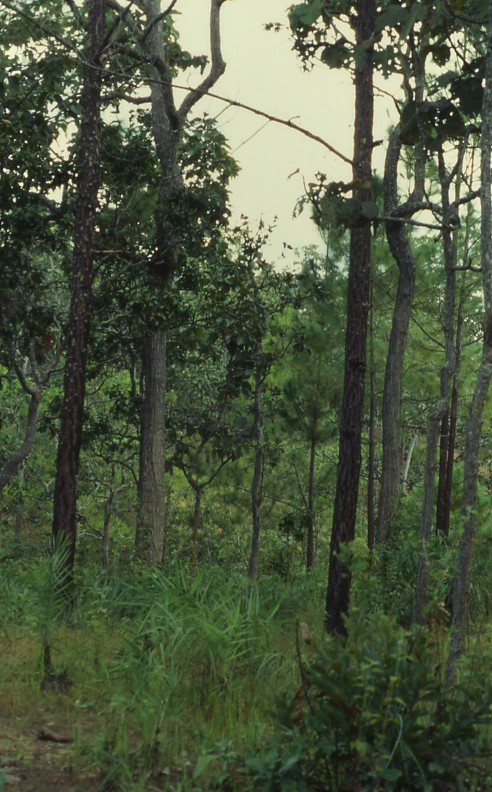
In fact this type is the advance of deciduous dipterocarp forest into the lower montane zone, with Pinus kesiya and P. merkusii mixed. The latter pine species is accompanied by some fagaceous and theaceous species in deciduous dipterocarp forest. The first pine species is associated with lower montane forest. P. merkusii is more fire resistant than P. kesiya making it more obvious why P. kesiya does not occur in deciduous dipterocarp forest where fires are frequent. High humidity and regular cool breezes the upper branches of tall trees are often loaded with epiphytic lichens, mosses and orchids. Pine deciduous dipterocarp forest is three layered and of open nature, with prominent grass layer. The upper canopy (emergents) is composed of Pinus merkusii trees, and sporadic with P. kesiya trees. P. merkusii is replaced by P. kesiya on moderate to steep slopes of moister gullies. Pine trees can reach 35-40 m, but generally 25-30 m. The middle or main canopy layer consists of Dipterocarp species, Gluta usitata and Fagaceae members. The lower storey comprises of small trees similar to the main canopy, unevenly distributed, with Tristiana rufescens, Apurosa villosa and Symplocos racemosa. Similarly this is the case for the shrub layer. The dwarf palm Phoenix acaulis is typical for this forest type. No bamboos are present and climbers uncommon. |
|
|
|
Other types (not included in the table) |
|
|
|
Pine forest 'paa son khao' |
|
|
|
A lofty forest type with Pinus kesiya trees up to 30-40 m high are remarkable on exposed ridges and steep slopes on which soils are excessively eroded and become too xeric to support the growth of other broad-leaved trees. Pines do never grow on limestone or calcareous soils. Pine forests similar to temperate regions never occur in Thailand, except for Pine oak savannah on level-topped sandstone mountains in northern and north-eastern Thailand (above 1,000 m). Both pines are more or less scattered with a few fagaceous, lauraceous and theaceous trees, no deciduous dipterocarp species occur here. |
|
|
|
Savannah forest 'thung jah', 'paa thung', 'rai rang' or 'ti rab thung jah kanaad jai nai ket rhon'; (vast area with tall grass in a hot area) |
|
|
|
These areas are the effect of man, mostly totally cleared of trees. As a result of this and frequent burning extensive grass areas exist. Imperata cylindrica and Neyraudia reynadiana are tall grasses, mixed with ferns and secondary growth species like Macaranga denticulata and Betula alnoides etc. Also some scattered Dipterocarps, remnants of a former forest are found here. |
|
|
|
Bamboo forest |
|
|
|
Bamboo species constitute the natural undergrowth in deciduous forests. They are favoured by fires and other disturbances and can become the dominant vegetation. Main species are Oxytenathera albociliata and O. nigrociliata, Dendrocalamus species (mai sang) and mai dong (Bambusa tulda). |
|
|
|
Limestone vegetation 'paa khao hin phun' |
|
|
|
This type occurs in forms likely to be included in above described types. Basically it represents the more xeric scrub varieties growing on poor calcareous surfaces, with little water and eroded grounds in exposed habitats. |
|
|
|
 |
|
|
|
 |
|
|
|
 |
|
|
|
go back to introduction forest types |
|
|
|
|
|
go to evergreen forest types |
|
|
|
|
|
|
|
|
|
|
|
 |
|
|
|

|
|