|
|
|
|
|
|
|
|
|
|
|
|
|
|
|
|
|
|
|
|
|
|
|
|
|
|
|
|
|
|
|
|
|
|
|
|
|
|
|
|
|
|
|
|
|
|
|
|
|
|
|
Forest Types in Thailand |
|
|
|
Evergreen forests |
|
|
|
('paa dong dib cheun') |
|
|
|
Tropical' evergreen 'rain' forest', 'paa dib cheun' |
|
|
|
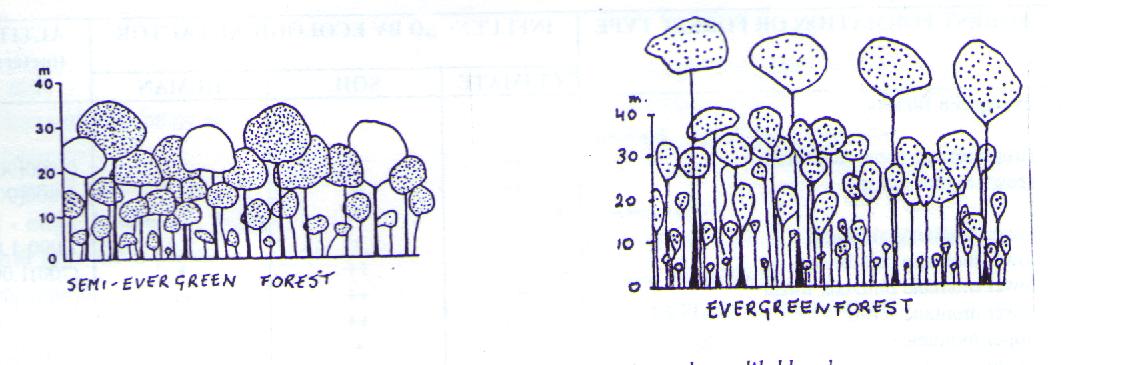
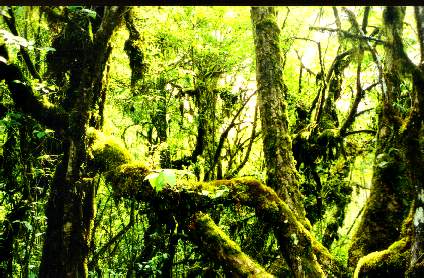
The name is somewhat misleading because tropical rain forest as sometimes used is not present in Thailand. A better name would be evergreen forest. A three layered dense forest, with a divers upper layer of emergent trees about 25-40 m high, with long, straight boles and crowns branching near the top. This type is the most luxuriant vegetation type, with even rainfall distribution (more than 2,000 mm) and hardly any dry months. Dominating families are Dipterocarpaceae, Annonaceae, Meliaceae and Sapindaceae. Some species occurring are Cedrela toona, Dyera costulata (tin pet daeng), Balanocarpus heimii (thakhian chan), red meranti species (saya) Shorea curtissii, S. parviflora and S. leprosula. Many species have buttresses. The middle continuous layer 10-20 m with medium sized trees, more or less shade tolerant consists of Artocarpuslakoocha (mahat), Hydnocarpus ilicifolius, Ficus species and Garcia species, palms (Eugeissona tristis, Caryota mitis), tree ferns (Cyathea species), bamboos are rare except the climbing species. The lower layer to 7 m consists of small trees, shrubs and rattan species (Calamus species, wai), with thick litter layer with sparse ground vegetation. Vines and epiphytes are abundant with trees heavily covered with mosses, ferns and orchids. Buttresses are usually frequent in species and large. This type occurs in areas in the south. |
|
|
|
Semi-evergreen forest or seasonal rain forest or dry evergreen forest', 'paa dib leng' |
|
|
|
Some people believe that semi-evergreen is a better name, especially when the former type is called evergreen forest. Closed, high evergreen forest, with dominating evergreen trees in the main canopy in addition to some scattered isolated deciduous trees. The amount of deciduous trees in this type is related to the soil moisture content. This forest type look 'dry' or more precise 'wilted' in response to seasonal drought. Located in sheltered moist valleys, along riverbanks, on gentle to moderate slopes, along mountain ravines, moist foothills or depressions of a plain. Frequently found on granite loamy soil, usually deep and moisture-retaining capacity is high. Shifting cultivation and other agricultural activities cleared most of these forests because of its favourable edaphic condition. Seasonal evergreen forest (1,000-2,000 mm) is less lofty and of lesser stature as tropical evergreen 'rain' forest, with lesser species of Dipterocarpaceae, structurally three tree layered and with fewer emergent trees. Less than one third of the main canopy species is deciduous and buttressed trees are frequent. The shrub layer is well developed and woody climbers are abundant, palms more frequent in moister places, bamboos are uncommon and considered as secondary vegetation since they grow where sunlight is abundant, the ginger family and Araceae family are common, epiphytes including orchids and ferns are occurring too. Common tree species are: Dipterocarpus alatus (yang na), Hopea odorata (thakian thong), Ficus species, Lagerstroemia calyculata (tabaek yai), Walsura robusta, etc. Tree buttresses are less common than in evergreen rain forest and also smaller. |
|
|
|
Lower montane evergreen 'rain' forest or hill evergreen forest, 'paa dong dib khao' |
|
|
|
A high, dense, continuously closed canopy forest, similar to tropical evergreen 'rain' forest or seasonal evergreen forest. However, with lower stature and the floristic composition is different, with dominating families as Fagaceae (oak and chestnut), Rosaceae (rose), Lauraceae (laurels), Magnoliaceae and Theaceae. Localities are moist valley slopes and valley basins with an average rainfall of 1,300-2,000 mm, and constant humidity. Often found on red granite or brown-black calcareous soil types with accumulated organic matter. Shifting cultivation and other practices degraded these forests into secondary growths, woodlands and savannas. Structurally three layered and rather poor in undergrowth and woody lianas, tall bamboos are uncommon, the herb layer is rich and epiphytic orchids and ferns are very abundant in upper strata of the canopy. Emergents are becoming rare compared to the two earlier mentioned forest types. Typical tree species are: Castanopsis species (chestnuts), Quercus species (oaks), Lithocarpus species, Michelia champaca (champa), Schima wallichii (thalo), Podocarpus species, Litsea species, etc. Buttressed trees are usually absent here. |
|
|
|
Lower montane oak forest |
|
|
|
This forest type is a result of human interference creating a mosaic of succesional stages. The secondary growth needs some considerable time to develop into lower montane Oak Forest. Therefore structurally and floristically this type is poorer than the previous type. Dominating trees belong to the Fagaceae family, birch (Betula alnoides), hornbeam (Carpinus viminea) and Engelhardtia spicata (kha tot) are all indicators of human impact. The more closed type is recognised by a medium high canopy (12-20 m) with tree crowns almost touching, branches of tall trees are exposed to prevalent cool breeze and are usually covered with ?beard lichens?, epiphytic orchids and ferns are also common on upper branches. The grass layer is poorly developed, but shrubs and forbs are dominantly present. The more open type is of lower stature with more spacing, lower branching trees as a consequence of burning or cutting. The grass layer is better developed here. |
|
|
|
Lower montane pine-oak forest; 'paa son phasom koh' |
|
|
|
Floristically this type is similar to lower montane forest, but includes the three-needled pine, Pinus kesiya, as a result of severe destruction. This type is best-developed on ridges, moderate to steep slopes. Burning in the dry season is a common phenomenon, when fire is more frequent these types gives away to more pine trees. This type and pine-deciduous dipterocarp forest are often referred to as 'coniferous forest' or 'pine forest'. However, they represent two distinct edaphic types on different soils. Pinus kesiya the only pine species of lower montane oak forest thrives well on mountain ridges and on moderate to steep slopes mostly characterised by red to yellow granitic soils. On the other hand Pinus merkussii is closely related to pine-deciduous dipterocarp forest in undulating hills on gentle slopes dominated by grayish sandy, brownish gravelly, or lateritic soils with varying degrees of stoniness. Emergent trees are Pinus kesiya, Fagaceae members, Litsea speciesand Eurya species. |
|
|
|
Upper montane evergreen 'rain' forest |
|
|
|
Only few areas in Thailand carry this type. The soil is high in moisture content and rich in organic matter and humus, thus suspect to human use leaving many areas degraded. This forest type is medium tall and dense in structure with a continuous, flat crown canopy (16-22 m). Almost single storied with a poor lower tree layer, shapes of crowns appear dome shaped with crooked branches supporting epiphytic flowering plants, ferns, mosses and lichens. Undergrowth is almost absent and a thin moss layer is developed on the forest floor, on stems and branches. Small areas of sphagnum bog are developed in ever-wet lower areas. High humidity and cool climate are responsible for these characteristic structures. Floristically this type differs from lower montane rain forest with fewer Fagaceae members, but with Acer species and Rosaceae members as Prunus cerasoides. |
|
|
|
Lower and Upper montane scrub |
|
|
|
This type is dominated by herbaceous plants and many low shrubs thriving in mossy cracks of limestone rocks, and looks like a rock garden. Harsh environment, frequent clouds, occasional showers, heavy dews, regular cold winds and barren, extremely exposed ground surfaces, favour a typical sub-alpine vegetation (Delphinium, Gentiana, Geranium, Primula, Saxifraga and Silene). Prominent palms scattered along the crests and ridge tops are represented by Trachycarpus martianus. Gnarled oak trees occur here as a transition with lower montane oak forest. The endemic Rhododendron ludwigianum also occurs here with Rosaceae members (Rosa helenae, Cotoneaster franchetti). |
|
|
|
Peat bog |
|
|
|
To date no description of this vegetation is available, but bog moss Sphagnum is developed within a depression where water accumulates, either rainfed or fed by ground water. The typical dome growth, like a huge sponge, is very sensible to disturbances, which effect the water balance. Its size increases because no bacterial breakdown of died organic parts takes place in this acid environment. Some species occurring here are Iris collettii, Ranunculus siamemsis, and Rhododendron arboreum. |
|
|
|
Mangrove forest 'paa chai len' |
|
|
|
This type receives 1,500-3,000 mm of rain year round and is found along sea and lagoon borders. Up to where the water is saline (brackish) in rivers this coastal formation is growing in muddy clays and partly covered by seawater during high tide. All species have similar physiological characteristics and structural adaptations, like stilt roots (Rhizophora species, kongkang), knee roots (Bruguiera species) and peg-like pointed pneumatophores like Sonneratia (lam phu), Avicennia (samae) and Xylocarpus species. On edges of creeks Nypa fruticans a palm (chak) is common. The forests are composed of a single stratum, varying from 5 to 15 m high. Normally two sub types are recognised, the true mangrove zone and back mangrove zone. The first is inundated by normal high tides with species bound to salt or brackish water, the second is inundated by abnormally high tides, and vegetation is related to the inland vegetation. Major parts are used for charcoal production. |
|
|
|
Beach forest 'paa chai haad' |
|
|
|
Confined to narrow coastal areas and islands the soil is characteristically sandy, poor in nutrients, saline and constantly exposed to the sun and wind. Rainfall is averaging between 1,500-3,000 mm. Species richness is low thriving on salt such as creepers and shrubs with short roots like Ipoema pes-caprae, Vitex trifolia and hard spiny grass Spinifex littoreus. Few trees occur here like Casuarina equisetifolia (son thale), Cocos nusifera (ma prao), Terminalia catappa (hu kwang) and are good wind breakers. Further from the sea shore a more inland type appears with herbs, shrubs and small to medium sized trees, mostly deciduous. These area also cover Imperatacylindrica (ya ka) or elephant grass. Trees occurring here are Spondias bipinnata, Sindora siamensis, Hibiscus tiliaceus (pho tale). Most tree species have good firewood so many areas are cleared for these purposes. |
|
|
|
Peat swamp forest 'paa pru' |
|
|
|
Peat swamp is a special kind of rainforest occurring in fresh-water marshy land with a thick layer of acid peat (0.5-5 m). The area is subject to flooding during the rainy season. It is developed near the coast as it is believed to be a remnant inland sea. Mixed evergreen trees and shrubs are represented in a three storied formation. The upper canopy layer consists of tree species (35-40 m) as Alstonia pneumatophora, Neesia altissima and Parishia insignis. The middle story is composed of Archidendron clypearia, Baccaurea bracteata and Eugenia caudata, etc. The shrub layer consists of palms as Eleiodoxa conferta and Licuala longecalycata, climbers and ground flora are rare, and epiphytes are common on trees. Slender trees have high buttresses, large pneumatophores and high stilt roots and narrow crowns. This forest type is uniformly dense with an average height of 15 m. A typical indicator of disturbance is the pioneer species Macaranga pruinosa. |
|
|
|
Fresh-water swamp forest 'paa beung namdjut' or 'paa bung paa taan' |
|
|
|
Normally found in depressions where soil is muddy or sandy and without peat deposited. Vegetation is more or less inundated, according to which they developed special rooting systems. Water plants are either floating (Ipoema stratiotes), submerged (Hydrilla verticillata) or anchored in mud (Nymphaea lotus). Trees are usually buttressed and have pneumatophores, The forest in central Thailand is two storied, the top storey with Hydnocarpus anthelminticus (kraboa), Xanthophyllumglaucum (chum sang), Barringtonia species and Nauclea species. Species in the south are Fragraca fragrans (kan krao) and Cratoxylum arborescens. The second story is composed of Nephelium maingayi,Eugenia and Aglaia species. Palms are common and consisting of thorny climbing rattans. This forest type is suspect to drainage and clearance for wet rice cultivation. |
|
|
|
 |
|
|
|
 |
|
|
|
go back to introduction forest types |
|
|
|
|
 |
|
|
|
|
|
|
|
|
|
|
|
|

|
|
|
|
go to deciduous forest types |
|
|
|
|
|
|
|