 |
 |
|
|
|
|
|
|
|
| <<Home | Lab 8 (Windows and Design of FIR Filters) | |||
|
Introduction:- For designing linear phase FIR filters based on the windows Fourier Series approach, MATLAB includes the following functions for generating the windows. W=boxcar(N) % Rectangular window W=hamming(N) % Hamming window W=hanning(N) % Von Hann window W=kaiser(N,alpha) % Kaiser windows W=blackman(N) %Blackman window Hamming, Hann , Kaiser and Rectangular window
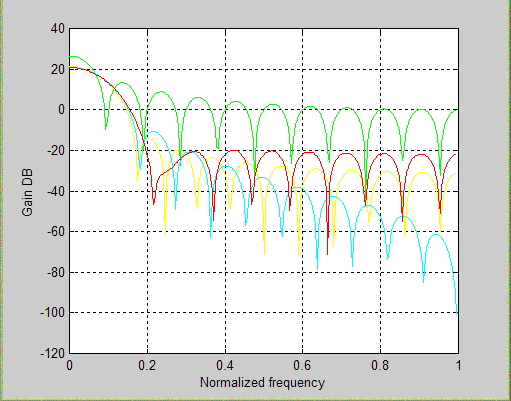
Exercise 1a Generate the following windows on the same graph paper. The length of each window should be 21. Hamming, Hann, Kaiser and Rectangular windows with α = 4.5, Also sketch the magnitude responses of the above windows. Solution %kaisar N=21; alpha=4.5; kw=kaiser(N,alpha); disp( 'window coefficient = ');disp(kw)[h,omega]=freqz(kw,1,256); % frequency response of the windowmag=20*log10(abs(h)); %DB magnitude% Rect window N=21; alpha=4.5; kw=boxcar(N); disp( 'window coefficient = ');disp(kw)[h,omega2]=freqz(kw,1,256); % frequency response of the windowmag2=20*log10(abs(h)); %DB magnitude% hanning window N=21; alpha=4.5; kw=hanning(N); disp( 'window coefficient = ');disp(kw)[h,omega3]=freqz(kw,1,256); % frequency response of the windowmag3=20*log10(abs(h)); %DB magnitude% hamming window N=21; alpha=4.5; kw=hamming(N); disp( 'window coefficient = ');disp(kw)[h,omega4]=freqz(kw,1,256); % frequency response of the windowmag4=20*log10(abs(h)); %DB magnitudeplot(omega/pi,mag, 'y',omega2/pi,mag2,'g',omega3/pi,mag3,'c',omega4/pi,mag4,'r'); gridxlabel( 'Normalized frequency')ylabel( 'Gain DB')Result
window coefficient = (Kaiser Window)
window coefficient = (Rectangular window) Kaiser window
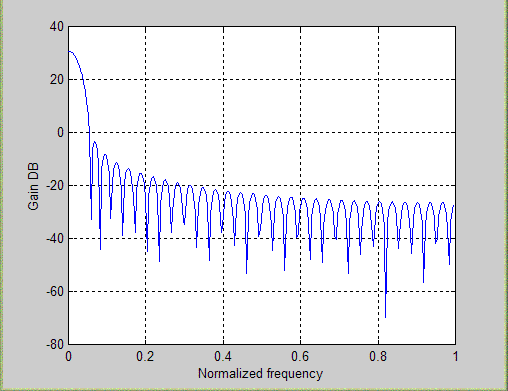
Exercise 1b .Generate coefficients of the Kaiser window having α = 4.5, and length 61. Also plot the dB magnitude response of the window... Solution N=61; alpha=4.5; kw=kaiser(N,alpha); disp( 'window coefficient = ');disp(kw)[h,omega]=freqz(kw,1,256); % frequency response of the windowmag=20*log10(abs(h)); %DB magnitudeplot(omega/pi,mag); grid xlabel( 'Normalized frequency')ylabel( 'Gain DB')Result
Low-pass filter using Kaiser window
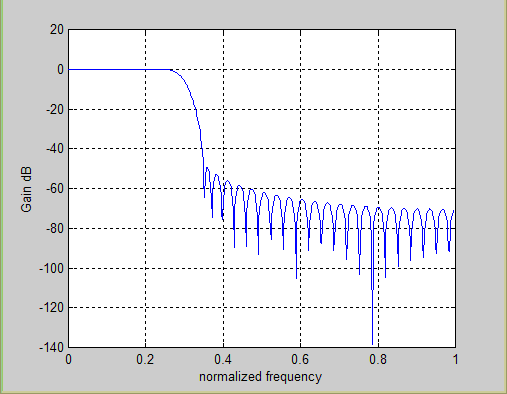
Exercise 1c Design a low-pass filter using the Kaiser window given above. The cutoff frequency is 0.3л Solution format long kw=kaiser(61,4.5); b=fir1(60,0.3,kw); [h,omega]=freqz(b,1,512); mag=20*log10(abs(h)); plot(omega/pi,mag); grid xlabel( 'normalized frequency')ylabel( 'Gain dB')Result
window coefficient = Assignment
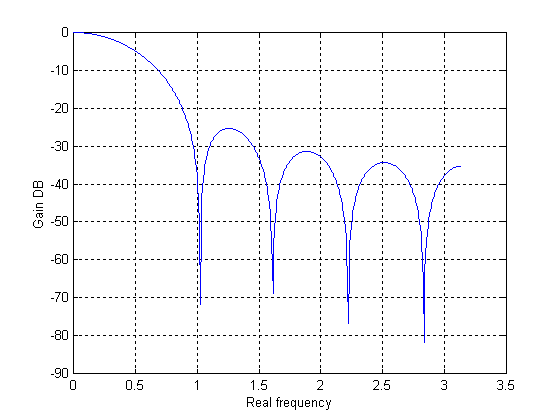
Records of this assignment are to be submitted by October 20,2003. The record should comprise MATLAB documents, filter coefficients, plots and any separate sheets showing hand calculations etc. Design the following FIR filters for a sampling frequency of 50 kHz. a) low-pass, cut-off frequency = 5 kHz, length =11, rectangular window b) low-pass, cut-off frequency = 5 kHz, length =21, rectangular window c) low-pass, cut-off frequency = 5 kHz, length =11, Hamming window d) low-pass, cut-off frequency = 2 kHz, length =21, rectangular window or Hamming window In each case find the filter coefficients, measure the magnitude and phase responses and comment. Plot the magnitude and phase versus real frequency f in Hz. Solution % rectangular window N=11; kw=boxcar(N); b=fir1(10,0.2,kw) disp('window coefficient = ');disp(kw) [h,f]=freqz(b,1,512);% frequency response of the window mag=20*log10(abs(h)); %DB magnitude plot(f,mag); grid xlabel('Real frequency') ylabel('Gain DB') % Phase response phase = angle(h); figure; plot(f,phase); title(‘Phase response’); grid Result Filter coefficient b = 0.00000000000000 0.03989988227886 0.08607915423243 0.12911873134864 0.15959952911546 0.17060540604922 0.15959952911546 0.12911873134864 0.08607915423243 0.03989988227886 0.00000000000000
Window coefficient
1 1 1 1 1 1 1 1 1 1 1
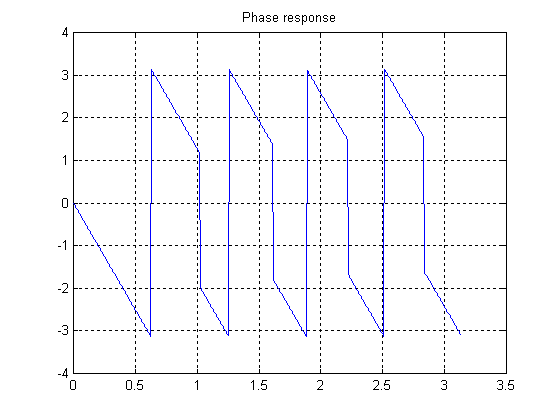
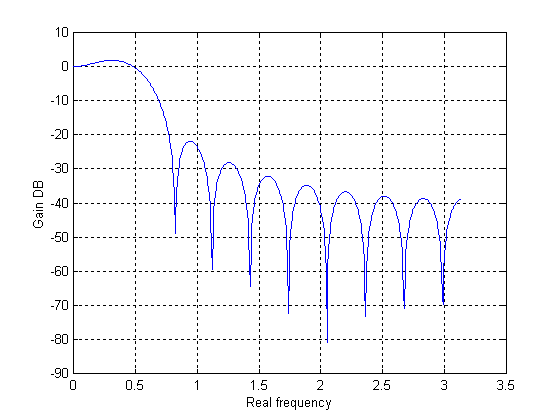
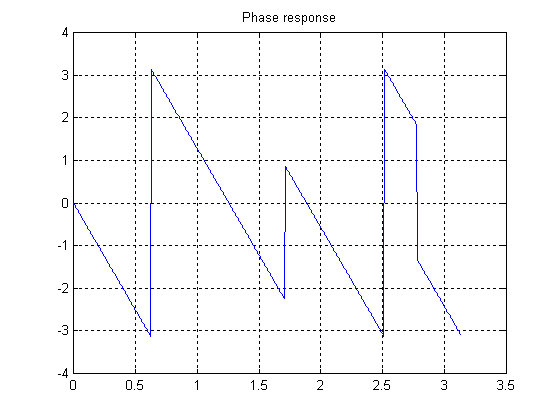
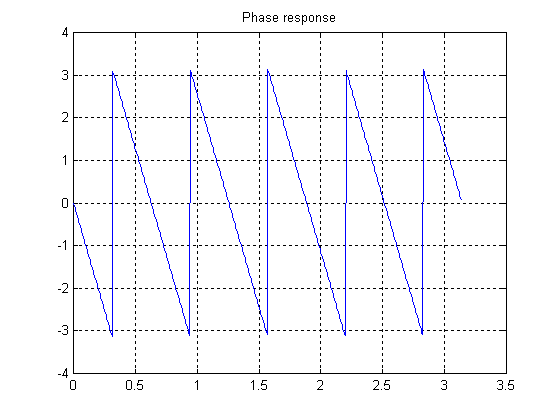
Comments: Cut-off frequency given is 5kHz = 0.2 radians/sec (shown in freq. response figure)...................ok Ripples are observed at less than -20dB....................................ok In Phase response we observe linear responses......................ok Which show that overall response is satisfactory. Solution % b) Low-pass, cut-off frequency=5kHz, length=21, rectangular window N=21; kw=boxcar(N); b=fir1(20,0.2,kw) disp('window coefficient = ');disp(kw) [h,f]=freqz(b,1,512);% frequency response of the window mag=20*log10(abs(h)); %DB magnitude plot(f,mag); grid xlabel('Real frequency') ylabel('Gain DB') % Phase response phase = angle(h); figure; plot(f,phase); title(‘Phase response’); grid Result Filter coefficient b = -0.00000000000000 -0.02294108966990 -0.04175939567796 -0.04772502363195 -0.03441163450485 0.00000000000000 0.05161745175727 0.11135838847456 0.16703758271184 0.20646980702907 0.22070782702384 0.20646980702907 0.16703758271184 0.11135838847456 0.05161745175727 0.00000000000000 -0.03441163450485 -0.04772502363195 -0.04175939567796 -0.02294108966990 -0.00000000000000
Window coefficient 1 1 1 1 1 1 1 1 1 1 1 1 1 1 1 1 1 1 1 1 1
Comments: Cut-off frequency given is 5kHz = 0.2 radians/sec (shown in freq. response figure)...................ok Ripples are observed at less than -20dB....................................ok In Phase response we observe linear responses......................ok Which show that overall response is satisfactory. Solution % c) Low-pass, cut-off frequency=5kHz, length=11, Hamming window N=11; kw=hamming(N); b=fir1(10,0.2,kw) disp('window coefficient = ');disp(kw) [h,f]=freqz(b,1,512);% frequency response of the window mag=20*log10(abs(h)); %DB magnitude plot(f,mag); grid xlabel('Real frequency') ylabel('Gain DB') % Phase response phase = angle(h); figure; plot(f,phase); title(‘Phase response’); grid Result Filter coefficient
b = 0.00000000000000 0.00930428314502 0.04757776613442 0.12236354636114 0.20224655842984 0.23701569185916 0.20224655842984 0.12236354636114 04757776613442 0.00930428314502 0.00000000000000
Window coefficient
0.08000000000000 0.16785218258752 0.39785218258752 0.68214781741248 0.91214781741248 1.00000000000000 0.91214781741248 0.68214781741248 0.39785218258752 0.16785218258752 0.08000000000000
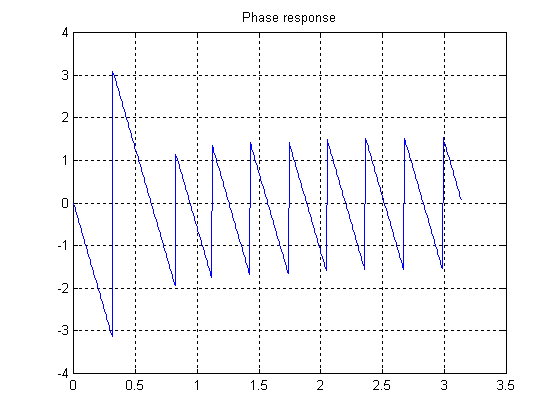
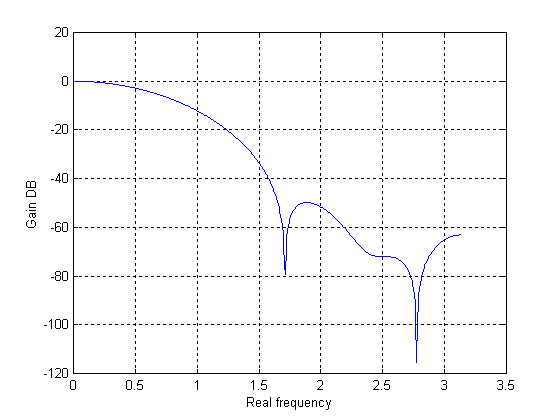
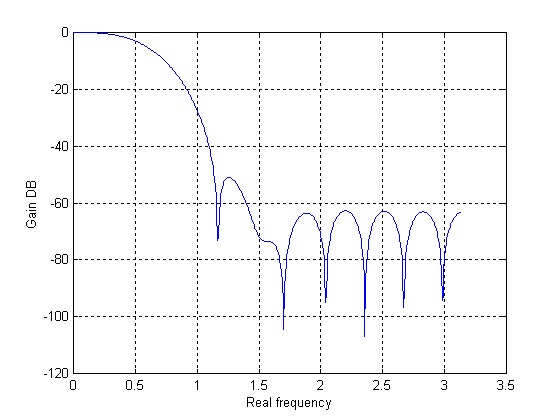
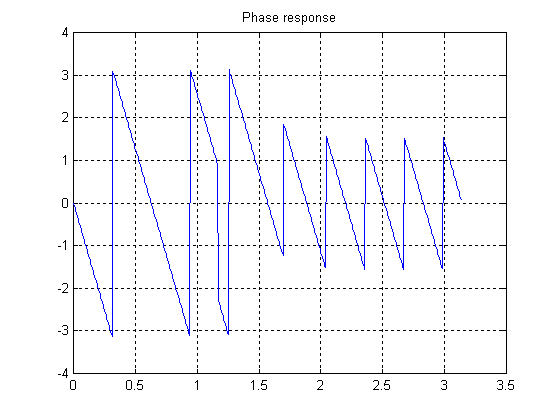
Comments: Cut-off frequency given is 5kHz = 0.2 radians/sec (shown in freq. response figure)...................ok Ripples are observed at less than -45dB....................................ok In Phase response we observe linear responses......................ok Which show that overall response is satisfactory. Solution % d) Low-pass, cut-off frequency=5kHz, length=21, Hamming window N=21; kw=hamming(N); b=fir1(20,0.2,kw) disp('window coefficient = ');disp(kw) [h,f]=freqz(b,1,512);% frequency response of the window mag=20*log10(abs(h)); %DB magnitude plot(f,mag); grid xlabel('Real frequency') ylabel('Gain DB') % Phase response phase = angle(h); figure; plot(f,phase); title(‘Phase response’); grid Result Filter coefficient
b = -0.00000000000000 -0.00212227114883 -0.00632535399151 -0.01161181037762 -0.01235465674898 0.00000000000000 0.03177449755857 0.08143590756422 0.13749378170194 0.18212549038873 0.19916883010696 0.18212549038873 0.13749378170194 0.08143590756422 0.03177449755857 0.00000000000000 -0.01235465674898 -0.01161181037762 -0.00632535399151 -0.00212227114883 -0.00000000000000
Window coefficient
0.08000000000000 0.10251400250423 0.16785218258752 0.26961878394546 0.39785218258752 0.54000000000000 0.68214781741248 0.81038121605454 0.91214781741248 0.97748599749577 1.00000000000000 0.97748599749577 0.91214781741248 0.81038121605454 0.68214781741248 0.54000000000000 0.39785218258752 0.26961878394546 0.16785218258752 0.10251400250423 0.08000000000000
Comments: Cut-off frequency given is 5kHz = 0.2 radians/sec (shown in freq. response figure)....................ok Ripples are observed at less than -45dB....................................ok In Phase response we observe linear responses......................ok Which show that overall response is satisfactory. Solution % e) High-pass, cut-off frequency=2kHz, length=21, rectangular or Hamming windowN=21; K=hamming(N); b=fir1(20,0.08,'high',K) disp('window coefficient = ');disp(K) [h,f]=freqz(b,1,512);% frequency response of the window mag=20*log10(abs(h)); %DB magnitude plot(f,mag); grid xlabel('Real frequency') ylabel('Gain DB') % Phase response phase = angle(h); figure; plot(f,phase); title(‘Phase response’); grid Result Filter coefficient b = -0.00149859740898 -0.00279702979844 -0.00605032755780 -0.01205776784693 -0.02109060179694 -0.03273455083304 -0.04588872182864 -0.05893153521827 -0.07002233166961 -0.07747203700778 0.92111531911503 -0.07747203700778 -0.07002233166961 -0.05893153521827 -0.04588872182864 -0.03273455083304 -0.02109060179694 -0.01205776784693 -0.00605032755780 -0.00279702979844 -0.00149859740898
Window coefficient
0.08000000000000 0.10251400250423 0.16785218258752 0.26961878394546 0.39785218258752 0.54000000000000 0.68214781741248 0.81038121605454 0.91214781741248 0.97748599749577 1.00000000000000 0.97748599749577 0.91214781741248 0.81038121605454 0.68214781741248 0.54000000000000 0.39785218258752 0.26961878394546 0.16785218258752 0.10251400250423 0.08000000000000
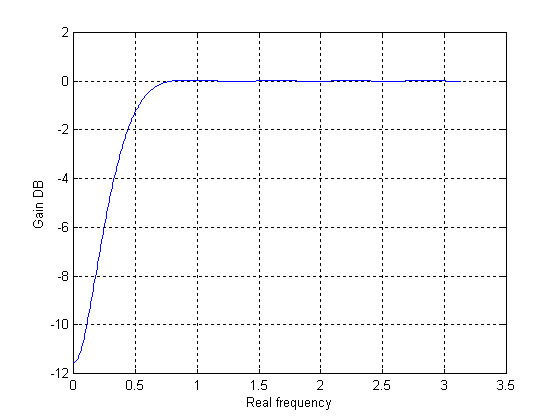
Comments: Cut-off frequency given is 2kHz = 0.08 radians/sec (shown in freq. response figure).............ok Ripples are observed are negligible ............................................ok In Phase response we observe linear responses......................ok Which show that overall response is satisfactory. HELP KAISER
KAISER Kaiser window. HAMMING
HAMMING Hamming window. HANNING
HANNING Hanning window. BLACKMAN
BLACKMAN Blackman window. BOXCAR
BOXCAR Boxcar window. DSP Lab 1 DSP Lab2 DSP Lab 3 DSP Lab4 DSP Lab 5 DSP Lab 6 DSP Lab7 DSP Lab8 DSP Lab9 DSP Lab10 Other material |
||||
| <<Home | ||||
|
||||||