Welcome once again to the Mango Bite Interview Box managed by [email protected]. Please be in touch if you have an idea for the next interview.
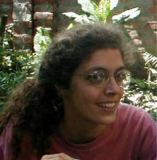
Lots of kinds of people end up staying at Maura Aunty and Gautam Uncle's place as they pass through Calcutta, and if you happen to be a frequent library visitor (as I am) you will get to talk to people from all over the world who have come to explore India. This time I spoke to Marguerite Shaddy who is traveling through India and learning about the organic agriculture movement here.
 H: I heard that you met Maura Aunty in Japan, what were you doing in Japan?
M: In the English program I was teaching in, I taught a course on social issues. Students studied about the environment, education, women's issues, globalization, etc. Maura worked with an organization called the Japan Environmental Exchange and I often took my students to some of the activities they planned. We found out we had a lot in common and became good friends.
H: What you are doing is something quite foreign to many of us readers, some who have never done any sort of farm work or even thought about life on a farm. Did you grow up on a farm? What made you so interested in farming?
M: No, I am from a city just like you! I had loved being in nature but when I started reading about what is happening to the world of agriculture I really became interested in how food is grown and how this affects the environment and ourselves. I realized that food is one of the most basic human needs, and I began to see food as a way to take care of myself. In Japan, I started to buy organic vegetables and then decided to take this interest in healthy food one step further, by going to some farms and trying to ask questions and work there myself.
The other simple and important thing is that I just love the work. To put my hands in the earth, and plant a seed, the wonder of it sprouting into something that grows tall--or creeping, spreading itself out--and becoming strong and bearing fruit, so many different kinds. Right now on the farm in Auroville that I'm working on we are harvesting peanuts. Do you know how peanuts grow? The nuts are actually underground--with the roots! We harvest in the morning as it's cooler and the earth may be a little damp with dew. In the afternoon we sit in the shade and pull the peanuts from the plant. They will dry in the sun and then we have to open all the shells. Piles and piles of them! I also help to milk the cows some days. I have one favorite cow, Kali, that I've become good friends with. There are chickens on the farm, too that get to run free in the afternoons, and goats from the village sometimes sneak through the fence to visit, but we have to escort them out as they eat the vegetables!
H: It's fascinating. What is the problem with agriculture today?
M: I learned that much of what we eat is sprayed with dangerous chemicals that damage the life of the soil. All these chemicals go into our body, the soil, and also into our water system. Does it make sense to eat food that hurts us and the very ground it is grown in? With natural farming techniques, you can replenish the soil naturally with what nature provides us with instead of using harmful chemicals. Growing organically is not only good for our health and the health of the planet but also connects us to the Earth and the life that sustains us. If we care about what we eat, we should ask farmers not to use pesticides and chemical fertilizers, and support them in changes they make. Also, people can try growing their own food; even in cities, people can grow some.
H: Is it difficult to move away from a city and do such labor-intensive work? I don't know if I could do something like that no matter how much I like to eat!!
M:I really think that the times we learn and gain the most are when we work hard! I really like working with the soil and doing physical work. It is actually quite peaceful and relaxing; it provides me with a sense of well-being and joy too. The more I work with nature, the more I find out about myself. We too are animals and creatures of the ecosystem though as modern people we often try to live outside the plant-animal system. Working close to nature, I can appreciate the natural systems more and feel more a part of these.
H: Do you have any special plans for the future?
M: Now I will continue to meet people and work on different farms in India and perhaps other parts of the world. One day I would like to own some land and experiment with natural farming techniques for myself. I also hope to start a learning center where people can come to study in much the same way I am going around and studying. I am a book lover and have collected books from small bookshops and citizen groups around the world. I feel that these are a great resource and want to some day set up a library that is open to the public where I can share all the information, both written and experiential, that I have accumulated.
H: What is your message to young people?
M: Think about the fact that although we have access to so much information (we watch TV, read newspapers and books, etc.) there is still so much that we don't know or experience in our own daily lives. Young people have an opportunity. By taking the time to think about their choices and actions, they can use their power and their capability to make some important changes in society if they really want to. And helping to make these changes benefits not only society, but oneself as well. I think more and more people are realizing that "living simple" is a good and satisfying way to live.
Sometimes people think the problems in the world are too big to do anything about, but I feel the small things we do in this world often have the biggest impact - on others and ourselves. Many people involved in education and community work, even if on a small scale, inspire me most and give me hope. Mustard Seeds Library is an example. It's small but important just the same -- it is not just a place to get information; it is a place to come together, share ideas, discuss books, and think about what we can all do for other people. I wonder what wonders your library seeds will grow into?!
Go to:
Front cover
Mango Bite: An interview with Marguerite Shaddy by Hia Mookherjee
Young Bean Garden by Saantonu and Manasi Chatterjee
Hunting and Gathering by Maura Hurley
Mexico, I'm Here by Jillian Marcie Molina
"Bag It" by Devashis Mukherjee
Tiger Talk by Saptak Mohanta
Mustard Seeds Poetry
Hoop-Shoot Hooplah ! by Alyssa Molina
A Mela to Remember by Anomita Mookherjee
Off to Japan ... by Maura Hurley
Raindrops Keep Falling on My Head by Doc. Basu
A Big Thank You
Book Review - TRASH !! ... by Chottu
The Litterbug Quiz
mustard seeds Hobby Stop by Chottu
mustard seeds library by Debasis Mukherjee