|
Coláiste De La Salle School History
The School in 1948
When I first saw the school, it was exactly as it had been when it left the builder's hands in 1933; not even a coat of paint had been added. For this was 1948; the period of slack tide after the war, when the papers told us that the conflict was over, but the shortages it had brought persisted and even intensified. Paint was not the only thing that was unavailable; indeed, it was hardly missed for we had long got used to shabbiness and dinginess that had begun nine years before. Whiskey was unknown in the pubs, though there was plenty of rum and a form of bathtub gin that put me off that drink for life. Beer was almost undrinkable because the publicans did not really know how to handle that exotic drink, but the stouts both native and Dublin were up to standard. Cigarettes were the subject of much Oriental bargaining, as the floods of unsmokeable and obscure American brands had disappeared suddenly from the market and the local supplies were insufficient, due probably to a shortage of dollars. (This was the period when a pack of cigarettes and a pair of nylons were the only negotiable currency in Germany.) Fruit such as grapes or oranges seldom appeared on the counters and children still had to be taught how to eat a banana (remove skin first). Clothes, tea and butter were still rationed and shop shelves were lined with empty cartons dating from 1939, great breeding-grounds for spiders.
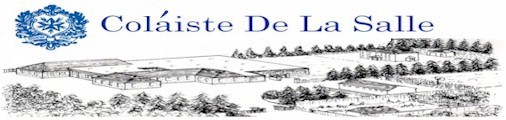
The building, therefore, was untouched and unchanged. It had begun life, I was told as an Exhibition Hall in Cork and had been reerected in Macroom, after an agreement had been made between Canon Barret and the De La Salle order to open a secondary college in the town. It was a simple, functional building. On either side were two wings. The one to the left, as you stood in front, contained the Headmaster's office and three classrooms, the one on the right, the science room. The block which joined them contained a very big hall, which was divided by moveable partitions into a classroom, a wide corridor and another classroom, at the back of which was a large and well fitted stage. When the partitions were moved back, you had a bid auditorium, seating about 400, facing the stage. From the very beginning of the school until 1950, shows were put on, Gilbert and Sullivan, plays and just plain concerts, for the benefit of the school and the parish. Then the insurance companies came to regard the audience as a bunch of arsonists and the events had to be abandoned.
In 1948, there were about 75 to 80 pupils in the school, a few more than the school catered for in the thirties and early forties. Nowadays, so small a school would be considered unviable, a word that did not then exist. I suspect that it was allowed to continue because it did not cost much. The staff consisted of three brothers and two laymen, the late Séan McSweeney and myself. We were paid 200 punts a year by the school and the Department paid much less in increments. Séan vividly remembers the conditions of service that existed when he began teaching. He had to serve three years before he got any incremental salary and his first increment amounted to 30 punts a year. It was paid quarterly. The Department found it impossible to devise a scheme whereby that quarterly increment could be paid on time. With a bit of luck the September payment might turn up at Christmas, and the January one in time for Easter. It took the genius of De Valera to devise a scheme in 1946 whereby the increment was paid monthly, on the 12th. The same plan is in operation today. No wonder the Department acquired a notoriety for its lack of organisation and its inability to count.
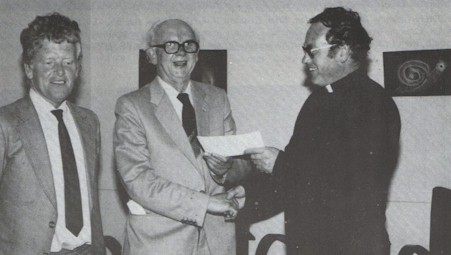
Mr. P.J. Fitzgerald being presented with a cheque by Bro. Jerome on behalf of the school and
staff. Mr. Fitgerald has spent over 35 years teaching in De La Salle. On the left is Mr. P.J. Horgan.
The boys came from the same areas as they do today, and in roughly the same percentages, 40% from the town and 60% from the country, but they had to make their own way to school as best they could. There were bus services through Coachford and Crookstown, but they had to pay their own fares themselves. There was no transport from the west, north or south, and the pupils had to walk or cycle. Getting a bicycle was almost as difficult as getting a car, and getting replacements for anything that could break or wear out was nearly impossible. The hardship did not appear to affect them too much. T.B. was the great killer of these times
but I cannot recollect that we had any casualties from this through school. Schools in other parts of the country could reckon on losing 10% of their strength from this cause. It must be the good country air that did it.
The school like all secondary schools at the time charged fees, $3-0-0 per term (the English equivalent charged 70 pounds). $3-0-0 is below average for a boys weekly allowance now - some seem to spend that amount per day - but, at that time, the average salary for a working man was $2-10-0 a week. In Macroom, unemployment was high and the mass exodus to Britain had already begun. Although the Brothers were quite careless about collecting the fees, this fact did not keep the children of more independent-minded out of the school.
Another thing that kept the numbers down was the very low marriage rate. I often heard the P.P. of the time, Canon Fox, grumble from the pulpit that he was lucky if he had one marriage and one baptism a year in the parish. It was at this time that an American sociologist published a book in which he proved scientifically that the Irish race would be extinct at the turn of the century.
These clouds on the horizon did not greatly concern the boys. Then, as now, one of their main
preoccupations was sport. Their hopes in football were not high because it was quite a feat to
field a team out of such small numbers. But in Br. Athanasius, the Headmaster, they had an ace
up their sleeve. He concentrated on athletics, especially the pole-vault and as there was little
informed opposition, the school swept the boards at county, provincial and national level. He
had good material: Niall Fitzgerald and his brothers who were top class in any company. The best
athlete of the lot was James Sheehy who was the best all rounder that
Macroom ever produced. Any distance on the track, any event on the field, he could, and did win.
On one occasion, he brought the national shield to the school by winning at least six events.
With that unerring eye for the destruction of excellence with which we are so richly endowed,
a rule was immediately passed forbidding such unwholesome and
morale-shattering triumphs. Macroom does seem to specialise in such one-man victories. Witness
Tim Hickey's win in the Aer Lingus Young Scientist competition in 1983, and we also have the
distinction of producing the youngest M.R.C.P.I. in history.
What careers were the boys aiming for in those years? The Civil Service, the Post Office,
the E.S.B. and even C.I.E. were favourite objectives. Among the Leaving Certs, Dairy Science
was the aim of the most ambitious. Teaching was ignored. The reason probably was the defeat of
the I.N.T.O. strike in 1947; that failure seem to prove that prospects for the profession would
not improve for a lifetime. Quite a number went on for the Church.
Classes were quite big in the three Inter Cert. years, but there was a big drop in the numbers
when the Leaving Cert. level was reached. Fifth and Sixth years had to be combined and together
the two classes amounted to only 12 or 15. The advantage of this for the L.C. pupil was that he
got almost individual attention.
Textbooks were an insufferable problem. None had been printed in Ireland since 1939 and paper
was still rationed. Texts printed in England had been destroyed in the air-raids on London in
1940 and they had the same shortage of paper. Publishers dithered, not knowing what to produce
for the brave new world of 1948, and not prepared to offer any great sums of money to anyone
who volunteered to write a textbook. (One author of a very successful textbook in Irish got
20 pounds in all for his work; he never wrote another one.) The whole problem was too much for
the Department which behaved like a rabbit fascinated by a snake and faced the situation without
moving a muscle. It probably lost the battle of the A-schools then because there was no textbooks
in Irish, no dictionaries, not even a glossary of technical terms in Science, Maths or
Geography.
So it was an era of note-taking, as the few remaining texts disintegrated through use and
sheer old age. The paper in the notebooks was either the thick gray paper of wartime, somewhat
like the recycled paper now used by the enthusiastic environmentalists, or a newer paper, the
colour of a business envelope, liberally sprinkled with dark brown flaked over which the pen
skidded without leaving a mark. The pen. Biros were scarce and expensive, a proof that you had
a cousin in the American army; condemned by bankers as an aid to forgery and by school masters
as a cause of bad handwriting. If you wanted a colour you had a choice of red or blue pencil,
thick and crumbling, and more awkward implements it would be hard to find. Tippex had not yet
been invented and the only thing to do with a blot was to leave it there; rubber had disappeared
with the Japanese invasion of the Dutch East Indies in 1941.
In retrospect, the late cuts in education seem trivial in comparison with what we had to face
in 1948. Still we struggled on, helped no doubt by the fact that we had been living in hardship
since 1932. I hope the present crisis does not last as long as the one that we had to live
through.
P.J. Fitzgerald, 1983
Back to top...
|