
Monty Python
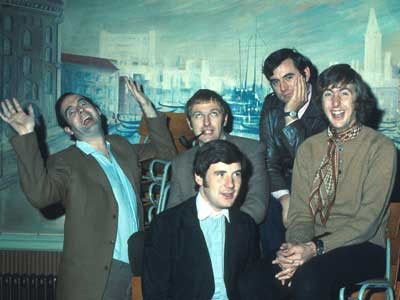
The six men who would become the Pythons were born the earlier portion of the Twentieth Century in the United Kingdom (except for one, who was born in the United States of America just to be different). John Cleese was born in 1939 in Western-Super-Mare. His later-to-be writing partner Graham Chapman, who would also grow to become a doctor, rugby player and homosexual pipe smoker, was born in Leicester in 1941. Over in Wales , Terry Jones was born in 1942 in Colwyn Bay , while elsewhere Eric Idle and Michael Palin were both born in 1943, in South Shields and Sheffield respectively. Across the Atlantic, the sole American and sole Animator of the group, Terry Gilliam, was born in 1940 in Medicine Lake , Minnesota .
The majority of the Men Who Would Be Python met while attending the universities of Cambridge and Oxford . At Cambridge , John Cleese was studying law, Graham Chapman medicine, and Eric Idle English. Messer’s Cleese and Chapman began writing, and occasionally performing, sketches together for the famed Footlights club. This lead to the two having the pleasure of touring the world as part of the Cambridge Circus show. During their absence, Eric Idle became President of the Footlights in 1965. Meanwhile, over at Oxford, Terry Jones and Michael Palin, who were studying history, made acquaintances of each other and began writing both comedy and drama for the stage. Terry Gilliam, meanwhile, had made a hash of his university years, studying everything from classical art to social sciences.
Early successes on the boards lead to the pre-Pythons being invited to take up positions at the BBC, initially as writers. David Frost's series The Frost Report saw five of the six future Pythons meet up, sitting around the writing table amongst a veritable horde of comedy talent. John Cleese became a familiar face on the show, starring in sketches alongside Ronnie Barker and Ronnie Corbett. This lead to John being offered his own show, which eventuated as a precursor to Python - At Last The 1948 Show, also starring Graham Chapman, Marty Feldman and Tim Brooke-Taylor. During the same time, Terry Jones, Michael Palin and Eric Idle were working on their own show, a so-called children's programme called Do Not Adjust Your Set, also starring David Jason. Later series of this show were also blessed with animated sequence from a certain American immigrant named Terry Gilliam.
In 1969, BBC executive Barry Took had the brainwave of combining the two schools of comedy into one show - a possibility further enhanced by John Cleese's desire to work with Michael Palin, who had appeared as an actor on John's 1968 one-off show How To Irritate People. And so the six talented young men, flush with the prospect of a new window of opportunity being opened, created a show called Bunn, Wackett, Buzzard, Stubble and Boot. This title was revised at the last moment, when the BBC insisted it had to be something less silly - hence the complete nonsense that is Monty Python's Flying Circus.
The first series of Monty Python's Flying Circus was first broadcast on the 5th of October, 1969. Inspired material such as a classical composer improbably being nicknamed 'Two-Sheds' and Nazi soldiers being wiped out by a fatally funny joke was greeted with both critical and public disinterest. Indeed, the programme was often not shown outside the London area, where local programmes were substituted. However, half-way through the initial series of thirteen episodes, a groundswell of support began to blossom. By the end of the first series, deceased Norwegian Blue parrots, transvestive lumberjacks, albatross-flavoured albatrosses, indigestible frog confectionary and a man with a tape recorder up his nose had all been unleashed upon the Great British Public.
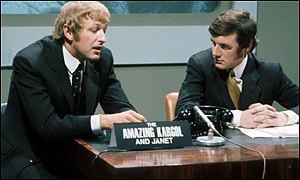
The second series of Monty Python's Flying Circus was broadcast in 1971. The series is still seen as the high water mark of the Pythons. John Cleese's classic Minister for Silly Walks displayed his bizarre gait, the Spanish Inquisition brought forth the comfy chair, Michael Palin's greasy TV host Blackmailed his viewers, penguins exploded, and viewers met a clan of stereotypical Australians all named Bruce (to avoid confusion). A third series followed, and if the inventiveness of the writing was beginning to fail, the absurdity of the material grew. But this began to pall on the ever-restless John Cleese, who no longer desired to continue with Monty Python on the television. Although he consented to remain after much encouragement from the rest of the group, his dedication to Python waned.
During these years, Python was not solely a creature of the televisual world. The first spin-off came with the release of a record of the best of their first series, commissioned by the BBC. Unhappy with the constraints of the beeb, the Pythons soon found themselves a separate record company, Charisma, and released more than half-a-dozen records, containing both highlights of their television shows, and new items recorded especially for the records. Python also found its way into bookstores with the publication of Monty Python's Big Red Book (with a bright blue cover), and the follow-up The Brand New Monty Python Book. All this Pythonesque activity culminated in Monty Python's First Farewell Tour, which toured throughout the UK , climaxing with their appearances at Drury Lane in 1973.
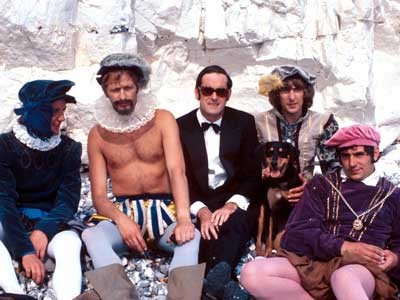
In 1974, a fourth series was broadcast, this time with an incomplete group, as John Cleese had left to create his own sitcom Fawlty Towers with his then-wife Connie Booth. The fourth series, this time entitled simply 'Monty Python' is a mixed affair, some episodes being as good as any Python material, while others are somewhat unsatisfying. However, Cleese's departure from Python was solely limited to television work, and by 1974 the Python's first major film, Monty Python And The Holy Grail, was unleashed. Filmed in appallingly uncomfortable conditions on a shoe-string budget in Scotland, the story of King Arthur and his gallant knights of Camelot was completely mucked up by the inclusion of downtrodden peasants being boned up on their constitutional rights and mysterious enchanters being improbably named 'Tim.' The greatest moments of the film, such as Cleese's endlessly-quoted French Taunter and the truly unhinged Knights Who Say Ni! stand as some of the Python's major contributions to popular culture. The film was widely successful, both in Britain and elsewhere, much to the Python's amazement. This lead to their decision to make a second film. When Eric Idle was asked by a journalist what their next movie would be, he ad-libbed the response "Jesus Christ: Lust For Glory". Little did he know then that their next film would be as controversial a caper as that title would suggest.
Monty Python's Life of Brian is considered by most of the Pythons to be their finest work. After a writing period that largely took place in the Caribbean, the story of Brian, the unwilling messiah, was filmed on location in Tunisia . After his 'straight man' role as King Arthur, Graham Chapman once again played Brian, the sane one against which the lunatics of the period played - characters such as Palin's lisping Pontius Pilate, Cleese's militant rebel leader Reg, and Idle's insanely optimistic Mr Cheeky. The film was financed by ex-Beatle George Harrison, after the original deal with EMI fell through - Harrison claims to have financed the film solely because he wanted to see it made. The film was another enormous success for the Pythons, in most part due to the controversy that surrounded it. Religious figures on both sides of the Atlantic attacked the film, equating the Python of the group's name with the Devil himself. The final scene, in which Brian and his fellow crufixees sing Idle's jaunty 'Always Look On The Bright Side Of Life' while on the crosses, drew particular condemnation. All this only boosted interest in the film, and the Pythons claim they didn't have to do any advertising for the film - the protesters did it all for them!
The period of gestation for their next film was less easy. Monty Python's The Meaning Of Life, released in 1983 is therefore widely seen as their patchiest film. However, it easily contains what is probably some of their finest material. With a budget many times bigger than their previous films, due to the financing from a Hollywood studio for the first time in the shape of Universal, the production values were high and impressive, flamboyant scenes were possible for the first time. Examples of this include the Every Sperm Is Sacred musical number, as good as any Hollywood musical, and the unforgettable Mr Creosote, a monstrously obese grotesque who vomits his way through an elegant restaurant before scoffing the entire menu (twice) and exploding, showering his fellow patrons in a revolting mix of entrails and half-digested food. This was no-holds-barred Python. The final moment of the film, with Palin's lady presenter resorting to some cheap entertainment and bringing on a television set showing the grainy old titles to Monty Python's Flying Circus would seem to have brought the team full circle.
After The Meaning of Life, the Pythons were unwilling to rejoin to make any more films. New material was occasionally written and performed for various spin-off items, the most important being the three CD-ROM games, the last of which - The Meaning Of Life - contained literally hours of new material from all five surviving Pythons. To mark the twentieth anniversary of Python, a retrospective hosted by Steve Martin was produced for American television in 1989, called Parrot Sketch Not Included. However, Graham Chapman's health was quickly deteriorating - his long years of pipe smoking had lead to throat cancer. Tragically, Chapman died only a day before the anniversary of the first screening of Monty Python's Flying Circus. The team's final full-strength appearance is at the conclusion of the retrospective, where Steve Martin opens a cupboard containing all six Pythons, before swiftly closing it again.
Since Graham Chapman's death, there have been a number of semi-reunions for the Python team. In 1997 the team appeared on stage at the Aspen Comedy Festival, complete with an urn containing the ashes of the late Dr Chapman. Two years later, to mark the 30th anniversary of Python, the team created new material for a special BBC2 Python Night. Cleese, Jones, Palin and Gilliam performed a number of new sketches, and Idle contributed video footage from America . The night also included a documentary on the group's history hosted by stand-up comedian and Pythonphile Eddie Izzard, and the first BBC screening of the Life of Brian. In 2004, the Pythons collaborated for (so they claim) the final time, on The Pythons Autobiography, a lavish fully-illustrated volume, the full story told by the Pythons themselves, with Graham Chapman's 'widow' David Sherlock and his brother John Chapman filling in the gaps for the dearly departed doctor. A fitting conclusion for the men who changed the face of comedy and made spam a concept that could never be taken seriously again.