The
people of Cabuynan are members of the Waray speaking
group of people who live on Samar, Biliran, and
North-Eastern Leyte. Warays today are predominantly Roman
Catholic, many practicing with a blend of pre-Hispanic
animistic elements. They are the most culturally
conservative of the Visayans.
The pre-Hispanic belief system of Filipinos
consisted of a pantheon of gods, spirits, creatures,
and men that guarded the streams, fields, trees,
mountains, forests, and houses. Bathala, who created
earth and man, was superior to these other gods and
spirits. Regular sacrifices and prayers were offered
to placate these deities and spirits--some of which
were benevolent, some malevolent. Wood and metal
images represented ancestral spirits, and no
distinction was made between the spirits and their
physical symbol. Reward or punishment after death was
dependent upon behavior in this life.
Anyone who had reputed power over the supernatural
and natural was automatically elevated to a position
of prominence. Every village had its share of shamans
and priests who competitively plied their talents and
carried on ritual curing. Many gained renown for
their ability to develop anting-anting, a charm
guaranteed to make a person invincible in the face of
human enemies. Other sorcerers concocted love potions
or produced amulets that made their owners invisible.
Religion
in the Philippines by Jack Miller
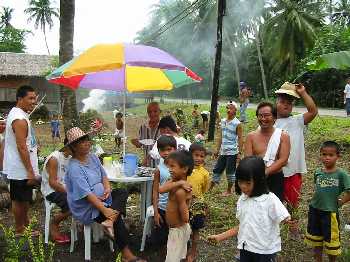
The people of Zone 1,
Barangay Cabuynan preparing for Christmas festivities.
Filipino hospitality,
friendship, strong family ties and respect for the
elderly are renowned and this is no different among the
Warays of North East Leyte.
Guests are plied with food and
drink, and often, a place in the host’s own
home. It may be generosity to a fault, but there is
nothing more pleasing to Filipinos than knowing that
their guest is never wanting for anything.
Filipinos have a strong sense of
family. Three generations often come together. Aunts
and uncles help raise and discipline the children as
secondary parents. In turn, cousins grow up as
informal siblings. The grandparents and elderly
members of the family are the family’s source of
history and stories and are taken care of until their
last days. Taking the elder person’s right hand
and bringing it to your forehead, is a great sign of
respect. Similarly, calling them apoy (grandparent in
waray) or lolo (grandfather in tagalog) and
lola (grandmother in tagalog) denotes your
recognition of their age and rank in the clan
structure .
The importance of "keeping
one’s face", meant as pride and
self-esteem, is very important to Filipinos.
Sensitive and delicate topics are often avoided to
prevent misunderstandings, criticisms, or fights.
"Losing face" is the worst thing that a
Filipino can think of happening to him. Thus, the
sense of hiya or being sensitive to the pride and
self-esteem of others is a quality learned early on.
Sociologists have come up with a term defining this
quality — smooth interpersonal relationships or
pakikisama. By trying to "get along,"
Filipinos adopt a group mindset, thinking and doing
what everyone in the group decides. This is not
indecision or passivity, but Filipinos do not care to
be the odd one out.
Filipinos dislike upsetting anyone
and that’s why they make it a point never to
ruffle any feathers, whether directly or indirectly.
If forced to give a negative answer, the Filipino
will say something without explicitly saying
"no." Pakiramdaman or the sensitivity
afforded by one to another comes in. Simply, this is
feeling each other out or, more concretely, sensing
what is not said. This aids in completing the gaps or
the omissions in the conversation because every
Filipino knows that much of what is not said in any
conversation is as weighty as words that are spoken.
Another Filipino trait is utang na
loob or recognizing a personal indebtedness owed to
the one who has bestowed favors. It’s quite
simple: favors long past are never forgotten and are
always remembered to be reciprocated with similar or
greater kindness. Something like a gracious quid pro
quo, but it is not a forced reciprocation. Because of
hiya and smooth interpersonal relationships,
returning the favor is almost an unspoken,
unasked-for given.
Resilient and optimistic in the
face of adversity, Filipinos are spontaneous and
convivial in their celebration of life, best
exemplified in festivals and fiestas.
Source: http://www.yehey.com/history/
traits.asp#top
|
Fiesta and other
Celebrations Cabuynan Fiesta 24 May
The Fiesta is
celebrated with prayer, a parade for the patron Saint
Francis copious amounts of food, tuba drinking, dancing
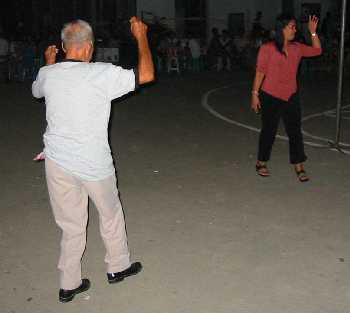
and music. The kuratsa - a courtship dance drama
- which is also a way of raising funds to finance the
fiesta highlights every occasion.
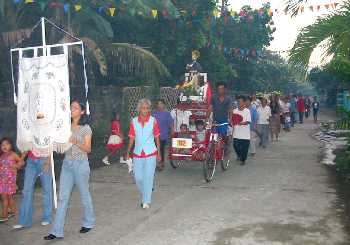
Fiesta parade 24 May
2003
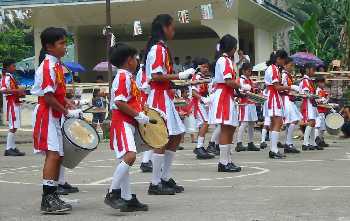
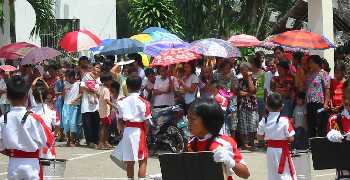
School band performing on the Plaza, Fiesta 24 May 2003
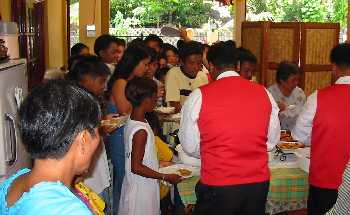
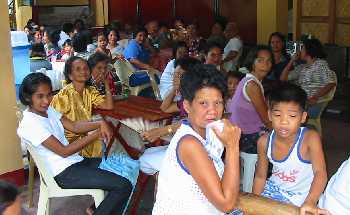
Fiesta hospitality
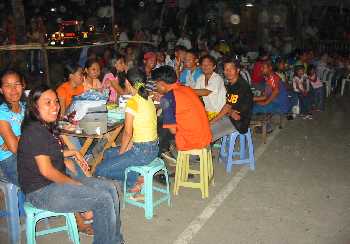
"Balik Bayan" night Cabuynan Plaza, Fiesta 2004
Santacruzan May 31
The Santacruzan is a procession commemmorating St.
Helena's finding the "True Cross"; preceded by
a nine-day Novena in honor of the Holy Cross. On the
ninth day the Santacruzan is held. This again is an
opportunity for eating, drinking, singing and dancing.
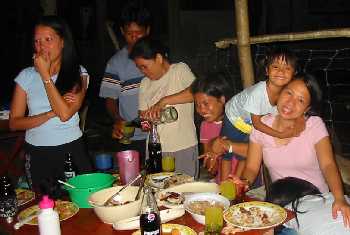
Santacruzan Cabuynan
PLaza, May 31 2004
Kuratsa
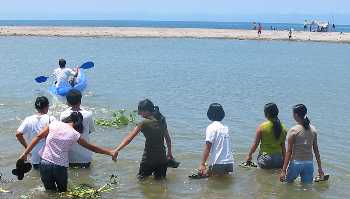
San Juan 24 June
Celebration of John the Baptist. Go
to the dagat (beach) and get wet both outside
and in.
.
|