(a) The energetically unstable molecular ions can break up into smaller pieces.
The simplest case that a molecular ion breaks into 2 parts – one which is another positive ion, and the other is an uncharged free radical. This is known as fragmentation.

The uncharged free radical will not produce a line on the mass spectrum as only charged particles will be accelerated, deflected and detected by the mass spectrometer.
The uncharged particles will be removed by the vacuum pump.

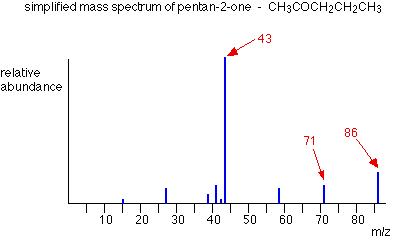
CH3CH2CH2COCH3+ - m/e = 86

CH3CH2CH2COCH3+• --> CH3CH2CH2CO+ + CH3

CH3CH2CH2CO+ - m/e = 71

CH3CH2CH2CO+ --> CH3CH2CH2+• + CO•

CH3CH2CH2+ - m/e = 43


b) Since different substances have different fragmentation pattern, it is possible to identify 2 different substances with the same Mr.

E.g.
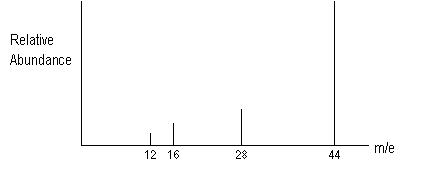
Which one of the following gives the complete mass spectrum illustrated on the left?

A CO2
B C3H8
C N2O
D a mixture of CH4 and N2

m/e
Possible Spiecies
Remark
44
CO2+, C3H8+ or N2O+
Choice D is out
28
CO+ or N2+
Choice B is out
16
O+
12
C+
Choice C is out

Answer: Choice A

Remark:
Why do we eleminate Choice B?

Although C2H4+ has m/e = 28, we will never get this ion as we cannot loose a CH4• radical from C3H8+• molecular ion (CH3CH2CH3+•).

Mass Spectroscopy
Introduction Characterisitics of Mass Spectrum Determination of Isotopic Composition
Determination of Mr Identification of Substances Identification of Fragments
Quiz Reference Materials Home
Hosted by www.Geocities.ws

1