 |
In
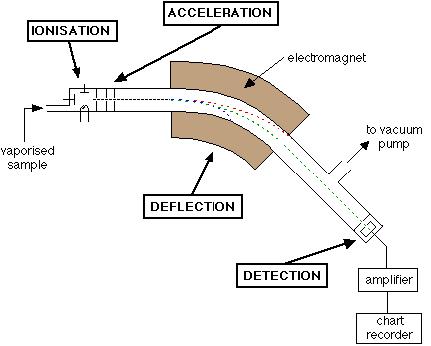
a mass spectrometer, the five processes involved are described as follows:
(a) Vaporisation:
Sample is vaporised under low pressure.
(b) Ionisation:
A high energy beam of electrons is used to displace (knock) an electron
from the molecule to form a radical cation known as the molecular ion.
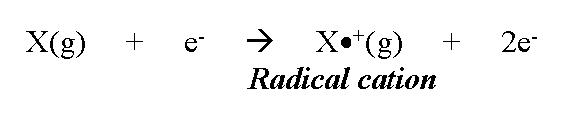
If the molecular ion is too unstable then it can fragment to give other
smaller ions.

(c) Acceleration
in an external electric field:
The collection
of ions is then focused into a beam and accelerated into the magnetic
field.
(d) Deflection in an external magnetic field:
The ions are
deflected along circular paths according to the masses of the ions.
The smaller the mass-to-charge (m/e) ratio, the greater the deflection.
By adjusting the magnetic field, the ions can be focused on the detector
and recorded.
(e) Detection of ions is registered and recorded as
a mass spectrum.
|