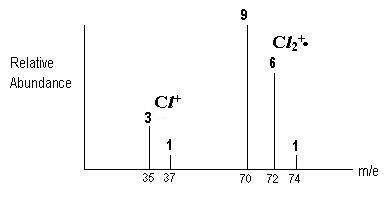
The mass spectrum of Chlorine
Chlorine
has 2 isotopes, 35Cl and 37Cl, in the approximate ratio
of 3 : 1 respectively. When chlorine is passed into the ionisation chamber,
molecular ions, Cl2+• are formed. These ions are
not stable and can fragment to form Cl+ ion. The Cl+
ions will pass through the machine and will give lines at m/e = 35 and 37
with a ratio of 3 : 1 respectively.
For the
molecular ion, Cl2+•, it could be a 35Cl2+•,
37Cl2+• or 35Cl37Cl+•
as Cl2 could be make up of 2 35Cl atoms, 2 37Cl
atoms or one of each isotope. Thus, there will be a group of 3 peaks between
m/e = 70 and 74. The relative abundance ratio of the 3 peaks is 9 : 6 : 1.
This calculation of this ratio can be shown below:
m/e |
35
+ 35 = 70 |
35
+ 37 = 72 |
37
+ 37 = 74 |
Ions |
35Cl2+• |
35Cl37Cl+•
or 37Cl35Cl+• |
37Cl2+• |
Probability |
3/4
x 3/4 = 9/16 |
(3/4
x 1/4) + (1/4 + 3/4)
= 6/16 |
1/4
x 1/4 = 1/16 |
Ratio |
9 |
6 |
1 |
Total
probability = 9/16 + 6/16 + 1/16
= 1 (3/4 is the probability of choosing 35Cl
while 1/4 is the probability of choosing 37Cl)
Note:
It is not possible to predict the relative ratio between the 2 groups of peaks,
Cl+ and Cl2+.
Mass
spectrum of Cl2 gas
E.g.
Mass spectrum of BrCl3 consists of a total of 9
peaks in 3 groups from m/e = 114 to 190.
There are 2 peaks in group A,
3 peaks in group B and
4 peaks in group C.
[Assume only 79Br, 35Cl and 37Cl exist.]
(a) Identify the
molecular ion for each group of peaks.
Group A:
BrCl+ from m/e = 114 to 116
Group B: BrCl2+ from m/e =
149 to 153
Group C: BrCl3+
from m/e = 184 to 190
(b) For each group of
peaks, state the m/e values, identify the corresponding species and calculate
the relative intensities of these peaks.
Group A:
BrCl+
m/e |
79
+ 35 = 114 |
79
+ 37 = 116 |
Ions |
Br35Cl+• |
Br37Cl+• |
Probability |
3/4 |
1/4 |
Ratio |
3 |
1 |
Total probability = 3/4
+ 1/4 = 1
Group B:
BrCl2+
m/e |
79
+ 35 + 35 = 149 |
79
+ 35 + 37 = 151 |
79
+ 37 + 37 = 153 |
Ions |
Br35Cl2+ |
Br35Cl37Cl+
or Br37Cl35Cl+ |
Br37Cl2+ |
Probability |
3/4
x 3/4 = 9/16 |
(3/4
x 1/4) + (1/4 + 3/4)
= 6/16 |
1/4
x 1/4 = 1/16 |
Ratio |
9 |
6 |
1 |
Total probability = 9/16
+ 6/16 + 1/16 = 1 (Since there
is only 1 Br isotope, we do not need to consisder its probability)
Group C:
BrCl3+
m/e |
79
+ 35 + 35 + 35 = 184 |
79
+ 35 + 35 + 37 = 186 |
79
+ 35 + 37 + 37 = 188 |
79
+ 37 + 37 + 37 = 190 |
Ions |
Br35Cl3+• |
Br35Cl35Cl37Cl+•,
Br35Cl37Cl35Cl+•
or Br37Cl35Cl35Cl+• |
Br35Cl37Cl37Cl+•,
Br37Cl35Cl37Cl+•
or Br37Cl37Cl35Cl+• |
Br37Cl3+• |
Probability |
3/4
x 3/4
x 3/4 = 27/64 |
(3/4
x 3/4
x 1/4) +
(3/4 x 1/4
x 3/4) +
(1/4 x 3/4
x 3/4)
= 27/64 |
(3/4
x 1/4
x 1/4) +
(1/4 x 3/4
x 1/4) +
(1/4 x 1/4
x 3/4)
=9/64 |
1/4
x 1/4
x 1/4 = 1/16 |
Ratio |
27 |
27 |
9 |
1 |
Total probability = 27/64
+ 27/64 + 9/64
+ 1/64
= 1