|
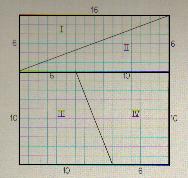
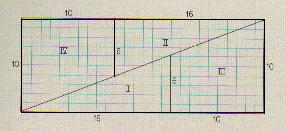
This puzzle is similar to quiz #6. Careful examination of the figure
on the right will convince you that it is not a rectangle and its area,
therefore, is not 10 cm x 26 cm.
If the figure was a rectangle, the triangle formed by the diagonal (area
I and III) would be congruent to the triangle denoted by area I. The ratio
of the two vertical sides of triangle I is 6/16 or 3/8 while the two vertical
sides of the area formed by area I and III has a ratio of 10/26 or 5/13.
Since it is given that area I is a triangle, the area formed by area I and
III cannot be a triangle and the whole figure is not a rectangle.
|