This is Sebastian's Grade 7 social studies project: India travel brochure.
General
India is a vast and very diverse country. The north and the south
of India are so different that they seem like two different countries
on different sides of the world. Yet the many similarities in the
elements of this unique culture will remind you are right here in
India, one of the most fascinating countries in Asia.
India is a federal republic, with New Delhi as its capital. It gained
independence from Britain on January 6th, 1947. Located in southern
Asia and the 7th largest country in the world, India has an area of
3,287,590 km² and a population of nearly a billion people. It consists
of 25 states and 7 territories. The currency of India is the rupee,
which is divided into a hundred paise. The Bengal Tiger is its
national animal.
There is no single "Indian" language, but Hindi and English are
commonplace. Besides these two languages, there are also 17 other
"official" languages recognized by the government: Assamese, Bengali,
Gujarati, Kannada, Kashmiri, Konkani, Malayalam, Manipurir, Marathi,
Nepali, Oriya, Punjabi, Sanskrit, Sindhi, Tamil, Telugu, and Urdu.
Then, there are thousands of "unofficial" local languages.
The main religion is Hinduism, which is practised by 80% of the
population. Other religions include Buddhism, Christianity, Islam,
Sikhism, Jainism, and Zoroastrianism.
Geography
India looks like a roughly drawn triangle on a map.
It has many different geographic regions, which are distinct and
easily recognizable.
The Himalayas, where the highest mountains on this planet are found,
sweeps across India's northern border. The Himalayas consists of
a series of mountain ranges with valleys in between. It is also
one of the youngest ranges in the world, dating from the Jurassic
era (80 million years ago). At that time the land mass that would
eventually become India was moving towards the Laurasia land mass,
which later became China and its neighbouring countries. When the
two land masses collided, the crust was forced up, creating the
Himalayas. Even today, the Himalayas are still rising at the rate
of 8mm every year.
The Himalayas end suddenly in the Indo-Gangetic Plain, which is
generally on the northern part of India. It is so flat that the
altitude drops only 200m while extending for 3000km! The plain is
very fertile, and a major percentage of crops are grown here.
The Thar Desert is in western India. It is the hottest place in
India, with temperatures exceeding 45ºC during the hot season.
South of the Indo-Gangetic is the Deccan Plateau. It is high up
above the Indo-Gangetic Plain, but still flat. The Deccan Plateau
is flanked by two mountain ranges, the Western Ghats and the
Eastern Ghats. These mountain ranges meet in the extreme south of India.
The Ganges River flows from the Himalayas, through the Indo-Gangetic
Plain and into the Bay of Bengal. It is 2500km long and considered
holy by Hindus. There are also some other major rivers such as the
Brahmaputra River and the Indus River. In the south the important
rivers are the Godavari River and the Krishna River.
The Indian Ocean splashes against India's coastline. The Arabian Sea
is on the western coast of India and the Bay of Bengal lies along
the eastern coast.
Climate & Weather
India is a tropical country, which means it has weather patterns
that are very different from ours in Canada. It has only three
seasons, the hot season, the wet season, and the cool season. The
hot season starts in February and lasts until May, the wet season
begins in June and ends in November, and the cool season offers
relief from the heat from December to mid-February.
During the wet season, the monsoon brings rain to all of India.
It is very important to farmers as it is their most important
source of water for their crops. In times of drought, the harvest
fails and the farmers have to rely on the government's supply of
grain for food. However, if there is too much rain it will cause
floods that will drown the crops. The monsoon rain does not fall
continuously; instead it usually comes in a sudden burst of
precipitation in the afternoon everyday.
May is the hottest month throughout most of India, while December
and January are the coolest. However, areas near the Equator are
always hot no matter what time of the year it is. During the hot
season, temperatures can reach 40ºC in most of India. It is still
very warm in the wet season; the temperature is about 35ºC. The
cool season provides a break from the heat as temperatures fall
to a comfortable 22ºC.
Economy & Industry
India has three major industries: agriculture, manufacturing/processing,
and mining. Other important industries are movie-making and tourism.
Since gaining independence, India's economy boomed and prospered,
but recent investments in industrial expansion has put the country
in great debt.
Two-thirds of the people in India depend on agriculture for their
livelihood. The main crops are rice and wheat, but tea, jute (used
to make ropes and sacks) and cotton are also important. India is
the largest producer of tea and jute in the world. These two crops
are very crucial to India's economy as they are exported worldwide.
Some other crops are: bananas, beans and pulses, chickpeas, coconuts,
mangoes, onions, oranges and tangerines, peanuts, pepper, potatoes,
sesame seeds, sorghum, and sugar cane.
Mining plays a vital role in India's economy, too. Iron ore is
mined all over India, with the largest deposits in the east.
Coal, limestone, petroleum, gold, silver, and precious stones
(especially diamonds) are also mined.
Manufacturing and processing is becoming more and more important
today. Traditional leather products and textiles are important
exports, and electronic equipment and chemicals are becoming
significant as technology advances. Processing the materials
that are produced by agriculture and mining is also a major part
of this industry. Other goods include bicycles, brassware/silverware,
cement, clothing, fertilizer, steel, medicine, motor vehicles
(such as cars and trucks), paper, sewing machines, and wood products.
Hundreds of movies are filmed in India every year. It produces
even more movies than Hollywood! Most of them are filmed in Mumbai
(Bombay), which is also nicknamed "Bollywood". Indian movies are
laden with action, romance, songs, and dancing.
Like manufacturing/processing, tourism is gradually becoming a
significant industry. There are many things to see and learn
about in India. Thousands of tourists visit India every year to
see the sights, listen to the sounds, taste the different foods,
and to feel the pulse of life that flows throughout India.
Tourism
There are many, many great places to visit in India. Below are some
recommendations of interesting and spectacular places to visit. They
all have international airports, so you don't have to be doing any
long-distance traveling within India.
Delhi
Delhi is the capital of India. It is split into two parts, New Delhi
and Old Delhi. Delhi has a population of 11.3 million people who speak
mainly in Hindi, Urdu, Punjabi, or English. The best time to visit is
between October and March, when the cool season brings temperatures
down to comfortable levels.
One of the star attractions is the Red Fort in Old Delhi. The Mughal
ruler Shah Jahan finished the fort in 1648. It was used as a headquarters
when the British ruled India. Inside the fort there are magnificent
halls, beautiful gardens, and historic sites. The Lahore Gate is
called the "symbolic heart" of modern India. During the fight for
independence, one of the nationalists' speeches was that the Indian
flag would fly over the Lahore Gate someday.
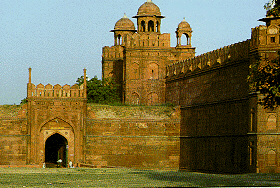
Red Fort
The Connaught Place in New Delhi is much newer than Red Fort. It is a
business and tourist centre and a busy place with shops, restaurants
and banks. Shopping here is definitely part of the experience of Delhi.
Mumbai (Bombay)
Bombay, recently renamed Mumbai, is a city with spirit and personality.
Contrary to popular belief, it is a relatively safe city, although it is
the most crowded city in India with a population of 15 million. The main
languages here are Hindi and Marathi. Visit Mumbai between September
and April, when it is coolest.
Chowpatty Beach is not a place to have fun in the sun! The real excitement
starts at night, when it seems like there is a carnival going on and
there are all sorts of people such as monkey trainers, gamblers, and
balloon sculptors who will entertain and delight the tourists and local
people. There are a group of food stalls at the edge of the beach;
sampling authentic Indian snacks there is a unique experience that can't
be missed.
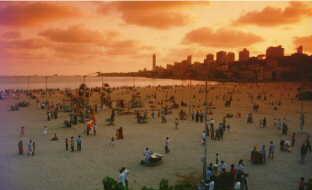
Chowpatty Beach
The Gateway of India is another interesting place to visit. In 1947,
the last British regiment left India through this gateway. Although it
is not a famous tourist attraction anymore, it is a favourite meeting
place for the people who live in the surrounding area.
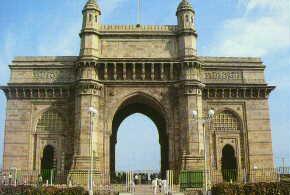
The Gateway of India
Calcutta
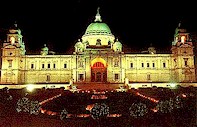
Unlike Delhi and Mumbai, Calcutta is a relatively modern place. Created
by the British as the capital of what was then a British colony, it has
many reminders of the Raj, which was the time period when the British
ruled India. Calcutta has some of the worst slums in the world. Most of
the 12 million people who live there speak in Bengali. It is best to visit
Calcutta between November and March.
The Victoria Memorial in Calcutta is filled with objects from the Raj.
It is a large museum built from white marble. Inside, there are portraits,
statues and busts of people who were important to British-Indian history.
There are also some other "miscellaneous" items inside.
Transportation
There are many different forms of transportation in India. Some kinds of
transportation might not be very fun, but they are part of the unique
experience of India.
61850km of rails runs throughout India. These trains carry 10 million
passengers every day! There are several different stages of classifying
the trains. At the highest level, they are divided into express and
passenger trains. Next, the trains are grouped into broad gauge, metre
gauge, and narrow gauge. Gauge is the distance between the two rails. Then,
the carriages are divided into first class and second class. Finally, the
classes are split into air-conditioned and non-air-conditioned, with the
former costing twice as much as the latter.
The safest (and most expensive) way to travel is by air. Air India is the
national airline of India. There are international airports in four of the
major cities: Delhi, Bombay, Calcutta, and Madras. In smaller cities, there
are domestic airports that handle flights within India.
India has over 700 000km of road. There are not many vehicles on highways,
but city streets are literally jammed with cars, trucks, buses, taxis,
motorcycles, and auto-rickshaws. Larger vehicles have the right of way over
smaller vehicles, and all vehicles have the right of way over pedestrians.
It is also legal to do many things that are illegal in Canada. Needless to
say, there are many serious accidents every year.
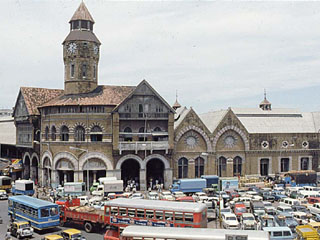
Busy streets at Crawford Market, Mumbai
Another way of getting around is by bus. Like the trains, the buses are very
crowded and slow. Baggage is carried on the roof to maximize room, but even
then, some people have to ride on the roof. If you can't stand loud noises,
don't take the bus; Indian "music" blares at a deafening volume inside!
In cities, it is possible to ride on auto-rickshaws. They look like motorcycles
with an extra wheel and seats attached to one side. Auto-rickshaws can weave
in and out of traffic, allowing them to quickly reach their destination.
Unfortunately, they bounce up and down on every single bump and sitting in
one puts you at the same height as the exhaust pipes of buses and trucks!


)