Saturn and its Rings
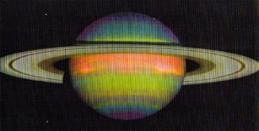
Few sights match the beauty of Saturn's ring system, although Saturn
itself, the sixth planet from the sun, is almost featureless. The
rings do not touch Saturn. The rings look solid, but in fact, they
are made of numerous ringlets that blend together. The ringlets are
made of billions of ice particles. Each particle has its own orbit
around Saturn, like a moon. Due to the planet's distance from the sun
(1,426,980,000 km!) the ice particles never melt. The beautiful rings
of Saturn are the thinnest structure in nature when width is compared
to thickness. The rings are about 1,000,000 km wide, but they are only
a few tens of metres thick. Gaps between the rings are caused by the
gravity of the moons.
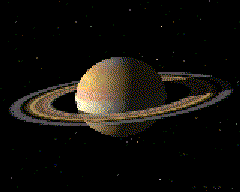
The rings are named as follows: A, B, C, D, E, F, and G. The A ring
is the outermost ring visible from Earth. The B ring is the broadest
and brightest ring. The C ring is nicknamed the "Crepe ring" and is
the faintest and bluest ring visible to people on Earth, looking at
the night sky. The D ring is the closest ring to Saturn and is very
faint. The E ring, the widest of the rings, is 600,000 km wide, but
it is also very faint. The F ring, discovered by Pioneer 11 in 1979,
is the outermost of the bright rings and is very narrow. The G ring
is another narrow ring, beside the F ring. The Cassini Division,
discovered by Italian Giovanni Cassini in 1675, between rings A and B,
appears to be a gap between the rings, but it is made of at least 100
faint ringlets. No one is sure how the rings were formed, but some
people think that if a moon gets too close to a planet, the planet's
gravity will tear the unfortunate moon and the fragments simply orbit it.
Although all the gas giants (Jupiter, Saturn, Uranus, and Neptune) have
rings, Saturn will always be known as the planet with rings!
Facts about Saturn
| Tilt: 26.7 degrees |
Ring tilt: 29 degrees |
|
Equatorial diameter: 120,536 km |
Polar diameter; 108,728 km |
|
Time taken to orbit the sun: 29.46 Earth years |
Time taken to complete a rotation: 10h 40min |
|
Average distance from the sun: 1,426,980,000 km |
Moons: 18 |
Black Holes
Black holes are among the weirdest things in the Universe. If a star
quickly grows, then it will become very big and eventually blow itself
apart in a supernova. The remains will either be a very dense neutron
star, where only a part of it the size of a pinhead weighs as much as
3 Empire State Buildings, or a black hole. Whether the star will become
a neutron star or a black hole depends on the star's weight. If the
exploding star is more than 30 times the mass of our Sun, the remains
do not stop compressing. Instead, it's own gravity crushes itself out
of existence, leaving a gravity field; that is what a black hole is.
A black hole has an event horizon, where anything in it gets swallowed up
and out of the Universe for good. Not even light can escape. Fortunately,
the reach of the event horizon is short. But if you're one of those people
who actually want to go into a black hole, don't even think about it. No
one can get close to one right now. A black hole is the ultimate trash can.
Anything that falls in will never get out. Black holes are also the most
invisible trash cans. Since no light can escape, black holes cannot be seen.
But if a star is close to a black hole, then gas will drag to the hole.
Just before the gas is sucked in, it releases a burst of X-rays (so maybe
strong X-ray sources are black holes).
The best candidate so far for a possible black hole is in the constellation
of Cygnus, the Swan. The black hole (if there is one) weighs 10 suns and
gives out X-rays, as expected. In a few million years, the black hole may
have sucked in most of Cygnus X-1, its companion star.
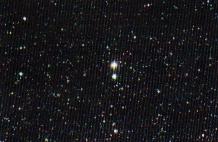
The brighter of the two stars near the centre of the photograph is
Cygnus X-1, which is thought to consist of a black hole and a normal
star, orbiting each other.
Super-massive black holes are usually in the middle of galaxies. There
may be a black hole in the centre of the Milky Way weighing as much as
4 million suns. Centaurus A galaxy, located 16 light-years away, is
thought to have a black hole in its core. M87, the biggest known galaxy,
is believed to have a gigantic black hole with the mass of 5 billion suns,
located in its centre. In April 1991, scientists discovered a galaxy
called NGC 6240, which may contain a black hole with the mass of 100
billion suns! This black hole is about as massive as half of the whole
Milky Way, but only one-thirteenth the diameter.
If the sun somehow became a black hole (it never will) it would have to
collapse to a radius of 3km, with an event horizon of 9 km. Since even
Mercury, the Sun's closest satellite, is not that close, the planets
would orbit the black hole normally, with the only side effect being
darkness. The Earth would have to be squeezed to a radius of 9 mm to form
a black hole.
Time slows down near a black hole, and inside it stops completely, which
means nobody can see you going inside the black hole. So now do you think
a black hole is the weirdest thing in the Universe? Why or why not?
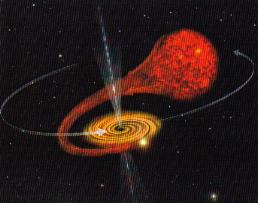
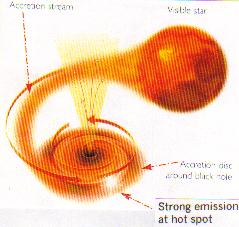
The intense gravitational field of an orbiting black hole rips matter
from the companion star, creating an accretion disc which spirals in
towards the event horizon... the incredible energies released, in the
form of X-rays, are one of the signatures of a black hole.
Mars: The Red Planet
Mars, the fourth planet from the sun, is also the planet that most
resembles Earth. In some ways it is similar to our planet. It has
mountains, deserts, polar caps, volcanoes, canyons, and dry riverbeds
indicate that water once flowed on Mars. It is the only extra-terrestrial
planet that scientists have considered a possible site for life. A
century ago, astronomers saw "canals" crisscrossing the planet's surface.
They thought that Martians had dug them to preserve their dwindling water
supply. In fact, the "canals" are actually optical illusions! Billions
of years ago, Mars might have had an atmosphere that could have sustained
life. But over time, the atmosphere escaped into space, and Mars grew cold.
Today, Mars is a freezing desert.
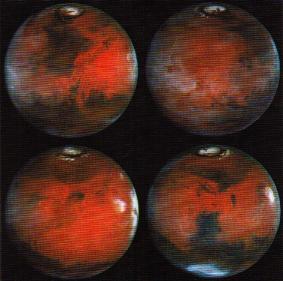
You can see Mars as a bright red "star" on clear nights. The color
reminded the Romans of blood spilled in battle, so they named it after
their god of war, Mars. In fact, Mars gets its red color from iron oxide
rust in rocks and dust that cover the planet. Astronomers mistook the darker
parts of Mars as vegetation because it changed shape with the seasons.
These areas are actually rocks and windblown dust. The air on Mars is
100 times thinner than the air on Earth and contains dust that makes the
sky orange-red during the Martian day. The sky around the Sun turns blue
in the Martian sunset. Because there is so much dust, the sky glows for
more than an hour after sunset. Violent storms can sometimes whip up clouds
of dust, forming dust storms. The wind speed can sometimes reach 400 km/h.
The Martian atmosphere is 95% carbon dioxide, which is poisonous.
Olympus Mons, the biggest and tallest volcano in the solar system is on
Mars and is a shield volcano, which means is base is very wide. In fact,
the base of Olympus Mons could cover England or Arizona, and its crater
could swallow New York two times over! Olympus Mons is 26.4 km tall,
three times taller than Mount Everest, the highest peak on Earth. It
stopped erupting billions of years ago, but it was probably not a
terrifying sight while it was alive. All of Mars' volcanoes are thought
to be extinct by now.
Mars has a small iron core, which is probably solid, because if it were
liquid, it would have a magnetic field, and there is no detectable
magnetism on Mars.
Mars' two tiny moons, Phobos and Deimos, were not discovered until 1877.
They were probably both asteroids Mars managed to capture from the
asteroid belt. Phobos is only 28km at its widest point, while Deimos is
only 14km wide, making it the smallest moon in the Solar System. Deimos
is also made of extremely dark rock, with fewer craters than Phobos and
a smoother surface. Phobos orbits 9380km from Mars, while Deimos orbits
from a distance of 23460km from Mars. Phobos only takes 40 min to orbit
Mars while Deimos takes 30 hours. Phobos should collide with Mars in 50
million years' time, due to gravity.
Astronomers have always wanted to send people to Mars, but so far only
space probes have visited our neighboring planet. The first mission to
the surface of Mars took place in 1976, when two Viking landers, the most
sophisticated probes to be sent to another planet, made a successful
landing after an year-long trip on two specially chosen locations. The
Viking landers both had a robotic arm for scooping soil and an onboard
laboratory analyzed the soil for organic chemicals that living organisms
produce. But neither lander found evidence of life on Mars. The landers
also beamed back the first pictures of Mars' surface. They revealed a
dusty, rock-strewn landscape and orange sky. The Viking landers took about
4,500 pictures of Mars' surface. They also studied how the Martian weather
changes with the seasons. Viking 1 continued to operate for more than 6
years. Pathfinder, another space probe, landed more recently, on a
bouncing air bag. It bounced 15 times before it stopped. Pathfinder
landed close to two hills, nicknamed Twin Peaks. They proved to be an
important landmark, enabling scientists to work out Pathfinder's exact
location. The hills were only 1km away, but they were still too far away
for Pathfinder's rover vehicle, Sojourner, to reach. Sojourner, about the
size of a microwave oven, explored the area around the landing spot of
Pathfinder. Its six wheels could move up or down separately to move over
rocks. Scientists on Earth used the camera on Pathfinder to monitor
Sojourner's movements. But the rover could also use its own cameras to
find its way. Do you think that there was once life on Mars? Why or why not?
Facts about Mars
|
Time taken to orbit the sun: 687 Earth days |
Time taken to complete a rotation: 24.6 Earth hours |
|
Diameter: 6786 km |
Average distance from the sun: 227,940,000 km |
|
Mass: (Earth = 1) 0.11 |
Density: (water = 1) 3.95 |
|
Surface temperature: -120 degrees Celsius to 25 degrees Celsius |
Surface gravity: (Earth = 1) 0.38 |