This is Sebastian's Grade 7 music project on the life of Haydn.
Franz Joseph Haydn
(1732 - 1809)
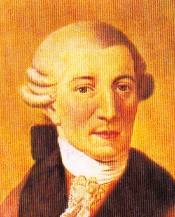
(1732 - 1809)
Table Of Content
Introduction
Haydn's First Years
Vienna
Eisenstadt
Eszterhaza
A Sort of Freedom
London
Haydn's Final Years
Conclusion
Slow Movement of "Surprise" Symphony (No. 94)
Glossary
Bibliography
Introduction
I chose to write about Haydn because he was a famous composer,
yet I did not know much about him. Haydn was of middle height,
with very short legs. His complexion was dark, marked by smallpox,
his nose aquiline, the expression of his eyes soft and generous.
He always wore a wig. Underneath his humble appearance, Haydn
was a generous and warmhearted man. Haydn composed 106 symphonies
in addition to numerous sonatas, string quartets, and other forms
of music. It was very rare when someone could compose so many
pieces of music, each one distinctively different from the rest.
Haydn's First Years
On March 31, 1732, Haydn was born in the village of Rohrau. Rohrau
was around fifty kilometres southeast of Vienna, the capital of the
Austrian empire. Haydn had twelve siblings, however, six died in
infancy. Haydn's father, Mathias Haydn, was a wheelwright. He liked
to sing folksongs while playing his harp. When Joseph (whose
nickname was "Sepperl") was five years old, he too was able to
sing the songs his father sang. Joseph amazed everyone with his
remarkable singing, but there were very few opportunities to make
use of such a talent in a small, unimportant village. That was why
when Joseph's uncle, Johann Mathias Franck, who was a headmaster
of a school at Hainburg, offered to take Joseph to his school to
teach him, his family agreed. So, Joseph found himself in his
uncle's school at Hainburg.
Franck was a very strict man. When his students made a mistake, they were beaten. His wife's standards of cleanliness were not even close to Joseph's mother's standards. As a result, Joseph and his classmates were often unwashed and dirty.
The daily schedule at Franck's school was very rigorous. Lessons started form seven in the morning until ten. After the lessons, there was Mass at the church. The boys continued their schoolwork after lunch at noon. Then, there were music lessons on the violin and the clavier (a kind of keyboard instrument). All this for a boy who was only six years old!
After two difficult years at Franck's school, the new choirmaster of St. Stephen's Cathedral, Karl Georg Reutter journeyed form Vienna in search of gifted children to sing in his choir. Joseph was chosen to go. The thought of going to Vienna must have been a very exciting one indeed to a child who had only lived in quiet villages.
Franck was a very strict man. When his students made a mistake, they were beaten. His wife's standards of cleanliness were not even close to Joseph's mother's standards. As a result, Joseph and his classmates were often unwashed and dirty.
The daily schedule at Franck's school was very rigorous. Lessons started form seven in the morning until ten. After the lessons, there was Mass at the church. The boys continued their schoolwork after lunch at noon. Then, there were music lessons on the violin and the clavier (a kind of keyboard instrument). All this for a boy who was only six years old!
After two difficult years at Franck's school, the new choirmaster of St. Stephen's Cathedral, Karl Georg Reutter journeyed form Vienna in search of gifted children to sing in his choir. Joseph was chosen to go. The thought of going to Vienna must have been a very exciting one indeed to a child who had only lived in quiet villages.
Vienna
Joseph arrived at the mighty city of Vienna in 1740. At that time,
Vienna was a city of broad streets, magnificent gardens, luxurious
palaces, and mighty cathedrals. But inside the fine houses, in dusty
attics and chilly basements, the poor lived crowded together, trying
to earn enough money to pay the rent and to buy food.
If Franck's school was difficult, then Reutter's school was a nightmare. The only lessons were of religious instruction, Latin, mathematics, and writing. On the musical side, there were lessons on singing, playing the violin, and playing the clavier, but none on composition. There was actually very little time for music lessons because church services took up most of the time. Reutter was given 700 gulden a year per student to pay for expenses, but it seems that he kept most of the money and spent only a tiny fraction of it on his charges. The boys were half starved, and the only chance they had of getting a proper meal was when they sang at occasions for other people.
In his mid-teens, Joseph's voice started to deteriorate. His younger brother, Michael, now sang solo parts that were once sung by Joseph. Joseph's time in the choir was almost over. In 1749, he was abruptly expelled from the choir after cutting off a fellow chorister's pigtail. Joseph found himself on the street with nothing but the clothes on his back.
Joseph met good fortune as he met Johann Michael Spangler, a music teacher Joseph was acquainted with. Spangler offered Joseph to share his small lodging. Joseph accepted the offer gratefully and lived with Spangler, his wife, and his child for several months. Then, Joseph had another stroke of luck. A friend of his father, Anton Buchholz, lent him 150 florins (about $576). Joseph used the money to rent a small attic room in St. Michael's House. He also bought several books about composition and a harpsichord, and began studying. Joseph was able to earn a living by singing in the cathedral choir and teaching music. During this time, he began writing his own compositions.
In 1754, Haydn met the famous Italian singing teacher, Niccolo Porpora. Haydn became his assistant and also received lessons from Porpora in composition, singing, and speaking Italian.
In 1759, Haydn attained his first permanent job. He became the music director of the orchestra that Count Karl Joseph Franz Morzin owned. Haydn wrote the first of his 106 symphonies for the Count's orchestra of sixteen musicians. His salary was 200 florins per year (around $810), along with free board and lodging.
On November 26, 1760, Haydn married Maria Anna Keller. Haydn regretted his decision soon after, however. The marriage was bitter, and there were constant quarrels.
If Franck's school was difficult, then Reutter's school was a nightmare. The only lessons were of religious instruction, Latin, mathematics, and writing. On the musical side, there were lessons on singing, playing the violin, and playing the clavier, but none on composition. There was actually very little time for music lessons because church services took up most of the time. Reutter was given 700 gulden a year per student to pay for expenses, but it seems that he kept most of the money and spent only a tiny fraction of it on his charges. The boys were half starved, and the only chance they had of getting a proper meal was when they sang at occasions for other people.
In his mid-teens, Joseph's voice started to deteriorate. His younger brother, Michael, now sang solo parts that were once sung by Joseph. Joseph's time in the choir was almost over. In 1749, he was abruptly expelled from the choir after cutting off a fellow chorister's pigtail. Joseph found himself on the street with nothing but the clothes on his back.
Joseph met good fortune as he met Johann Michael Spangler, a music teacher Joseph was acquainted with. Spangler offered Joseph to share his small lodging. Joseph accepted the offer gratefully and lived with Spangler, his wife, and his child for several months. Then, Joseph had another stroke of luck. A friend of his father, Anton Buchholz, lent him 150 florins (about $576). Joseph used the money to rent a small attic room in St. Michael's House. He also bought several books about composition and a harpsichord, and began studying. Joseph was able to earn a living by singing in the cathedral choir and teaching music. During this time, he began writing his own compositions.
In 1754, Haydn met the famous Italian singing teacher, Niccolo Porpora. Haydn became his assistant and also received lessons from Porpora in composition, singing, and speaking Italian.
In 1759, Haydn attained his first permanent job. He became the music director of the orchestra that Count Karl Joseph Franz Morzin owned. Haydn wrote the first of his 106 symphonies for the Count's orchestra of sixteen musicians. His salary was 200 florins per year (around $810), along with free board and lodging.
On November 26, 1760, Haydn married Maria Anna Keller. Haydn regretted his decision soon after, however. The marriage was bitter, and there were constant quarrels.
Eisenstadt
Haydn signed a contract with Prince Paul Anton Esterhazy, one of
Hungary's most prosperous and dominant noblemen, on May 1, 1761. At
the time Haydn signed the contract, the Esterhazy family owned
twenty-five palaces and vast expanses of land. Prince Esterhazy was
very fond of music, and owned a private orchestra at the castle of
Eisenstadt. The contract would be judged very restraining and harsh
by today's standards, but it was acceptable in the eighteenth century.
Here is a summary of the contract:
"Every day, Haydn was to appear before the Prince, who would then tell him what music was required for the day. Haydn must also keep the orchestra in top shape. Everything that he composed would be the property of the Prince and he could not compose for anyone else except with special permission. If Haydn broke any of the rules or did not satisfy the Prince, he (Haydn) could be fired immediately, but if Haydn wished to leave, he had to give six month's notice. Haydn was to be paid 400 florins (roughly $1530) annually, and he would also receive food and lodging. When the old Kapellmeister, or musical director, Gregor Joseph Werner, retired of died, Haydn would take his post."
Prince Esterhazy's orchestra was tiny compared to today's. It consisted of five violins, a cello, a double bass, a flute, two each of oboes, bassoons and horns, and one timpani. The choir was even smaller: two sopranos, one alto, two tenors, and one bass singer. Although there were many restrictions, Haydn was very pleased that he was able to compose and experiment with all kinds of music and then listen to it.
Unfortunately, Prince Anton Esterhazy died just one year after the contract was signed. He was succeeded by his brother, Price Nicholas. Prince Nicholas soon acquired the title "Magnificent" because he had even more magnificent plans than his brother. He too was very fond of music and he played an instrument called the baryton. The baryton had six "main" strings at the front and other "resonator" strings that were either left free or were plucked as well. In order to compose for this tricky instrument, Haydn had to learn to play it. He played it even better than the Prince (a bad idea), who became annoyed. Haydn quickly learned his lesson and went back to composing.
Prince Nicholas was not satisfied with... not Haydn, but his palaces. He longed for something more splendid. So, in just two years, the fabulous palace of Eszterhaza was built from a little hunting lodge in a marsh beside Lake Neusiedler in Eisenstadt.
"Every day, Haydn was to appear before the Prince, who would then tell him what music was required for the day. Haydn must also keep the orchestra in top shape. Everything that he composed would be the property of the Prince and he could not compose for anyone else except with special permission. If Haydn broke any of the rules or did not satisfy the Prince, he (Haydn) could be fired immediately, but if Haydn wished to leave, he had to give six month's notice. Haydn was to be paid 400 florins (roughly $1530) annually, and he would also receive food and lodging. When the old Kapellmeister, or musical director, Gregor Joseph Werner, retired of died, Haydn would take his post."
Prince Esterhazy's orchestra was tiny compared to today's. It consisted of five violins, a cello, a double bass, a flute, two each of oboes, bassoons and horns, and one timpani. The choir was even smaller: two sopranos, one alto, two tenors, and one bass singer. Although there were many restrictions, Haydn was very pleased that he was able to compose and experiment with all kinds of music and then listen to it.
Unfortunately, Prince Anton Esterhazy died just one year after the contract was signed. He was succeeded by his brother, Price Nicholas. Prince Nicholas soon acquired the title "Magnificent" because he had even more magnificent plans than his brother. He too was very fond of music and he played an instrument called the baryton. The baryton had six "main" strings at the front and other "resonator" strings that were either left free or were plucked as well. In order to compose for this tricky instrument, Haydn had to learn to play it. He played it even better than the Prince (a bad idea), who became annoyed. Haydn quickly learned his lesson and went back to composing.
Prince Nicholas was not satisfied with... not Haydn, but his palaces. He longed for something more splendid. So, in just two years, the fabulous palace of Eszterhaza was built from a little hunting lodge in a marsh beside Lake Neusiedler in Eisenstadt.
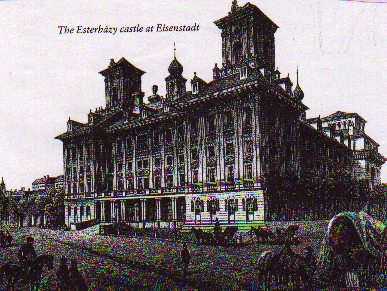
Eszterhaza
Eszterhaza was one of the finest palaces in Europe, costing 11 million florins
(about $414,000,000 today). It was built on a marsh, which had to be drained
before the palace could be built. There were 126 guest rooms, a library with
75,000 books, an art gallery, a concert hall, a ballroom, and other buildings
and gardens. The theater where operas were performed was two stories high,
heated, and the stage was equipped with advanced machinery for rapid scene
transformations. A puppet theater was added in 1773. It was built to look like
a grotto, with the walls being decorated with coloured stones and shells. The
performances in both theaters were free, or so the official guidebook (which
was written by Prince Nicholas Esterhazy himself!) stated.
The Prince began to spend most of his time at Eszterhaza, even though it was meant to be a summer residence. As a result, Haydn and the other musicians spent most of the year breathing unhealthy air and living in damp conditions, even though the marsh was already drained. Also, most of the musicians had to separate from their families as they were not allowed extra room to accommodate their families.
It was during this time that Haydn exploited the "Sturm and Drang" style, which focused on gloom and doom. He wrote three sets of string quartets and some piano sonatas based on this fashion. The last piece of music that Haydn wrote in this manner was a symphony composed in 1772.
In 1772, Prince Nicholas did not seem to want to leave Eszterhaza to spend the winter in Vienna. Horrified at the prospect of not seeing their families and relatives for an entire year, the musicians asked Haydn, who was by then the new Kapellmeister, to appeal to the Prince. Haydn had the idea of conveying the message with a musical joke. He wrote the Farewell Symphony with the last movement in the unusual key of F sharp major. At the end, the musicians, instrument group by instrument group, crept out of the room until only Haydn and Tomasini, who was the leader of the orchestra, were left. Luckily (for the musicians anyway), Prince Nicholas understood the joke without getting all steamed up and went to Vienna the next day.
In 1779, Haydn signed a new contract with his employer. An important change was that he could compose for other people.
In 1789, a publisher from London, John Bland, visited Haydn, looking for new pieces of music. Haydn at that time was having difficulty shaving as his razor was blunt. The story goes that Haydn exclaimed "I would give my best quartet for a new razor." Then, Bland gave him a set of English steel razors, and Haydn gave him the manuscript of String Quartet in F minor, Op. 55, No. 2. This string quartet had since been nicknames 'Razor', for obvious reasons.
The Prince began to spend most of his time at Eszterhaza, even though it was meant to be a summer residence. As a result, Haydn and the other musicians spent most of the year breathing unhealthy air and living in damp conditions, even though the marsh was already drained. Also, most of the musicians had to separate from their families as they were not allowed extra room to accommodate their families.
It was during this time that Haydn exploited the "Sturm and Drang" style, which focused on gloom and doom. He wrote three sets of string quartets and some piano sonatas based on this fashion. The last piece of music that Haydn wrote in this manner was a symphony composed in 1772.
In 1772, Prince Nicholas did not seem to want to leave Eszterhaza to spend the winter in Vienna. Horrified at the prospect of not seeing their families and relatives for an entire year, the musicians asked Haydn, who was by then the new Kapellmeister, to appeal to the Prince. Haydn had the idea of conveying the message with a musical joke. He wrote the Farewell Symphony with the last movement in the unusual key of F sharp major. At the end, the musicians, instrument group by instrument group, crept out of the room until only Haydn and Tomasini, who was the leader of the orchestra, were left. Luckily (for the musicians anyway), Prince Nicholas understood the joke without getting all steamed up and went to Vienna the next day.
In 1779, Haydn signed a new contract with his employer. An important change was that he could compose for other people.
In 1789, a publisher from London, John Bland, visited Haydn, looking for new pieces of music. Haydn at that time was having difficulty shaving as his razor was blunt. The story goes that Haydn exclaimed "I would give my best quartet for a new razor." Then, Bland gave him a set of English steel razors, and Haydn gave him the manuscript of String Quartet in F minor, Op. 55, No. 2. This string quartet had since been nicknames 'Razor', for obvious reasons.
A Sort of Freedom
On September 28, 1790, Prince Nicholas Esterhazy died and was succeeded by his son,
Prince Anton Esterhazy. The new Prince had no interest in the arts. He dismissed
the orchestra and the choir at once, keeping only the military band. Haydn was
given an annual pension of 1400 florins ($5580), but he was still technically a
servant of the Prince and had to seek consent before he could work for other people.
After arriving in Vienna, Haydn was offered a job as court composer by the King of Naples. Haydn, having just "escaped" from Eszterhaza, was reluctant to get into another confinement again and he declined the offer rather hastily. Not too long after that, a vio-linist, Johann Peter Salomon, offered Haydn $2160 to go to London and compose some music. Haydn signed the contract without hesitation. A similar offer was made to Mozart (who was Haydn's good friend) too, but he was not well enough to go. So, Haydn and Salomon set out to the port of Calais on the shore of France, then embarked the next morning on a boat to Dover. In a letter to his friend, Marianne von Genzinger, Haydn wrote:
"During the first four hours there was hardly any wind and the ship made very little progress. Fortunately about 11:30 a.m. a strong wind blew us the remaining twenty-two miles and we arrived at 4:00 p.m. I stayed on deck throughout the voyage so that I could gaze at the huge monster, the ocean. While there was calm, I had no fear, but when the strong wind blew, increasing every minute, and I saw the violent waves rushing on, I grew alarmed and a little discomposed. But I overcame it and arrived safely without actually being sick."
After arriving in Vienna, Haydn was offered a job as court composer by the King of Naples. Haydn, having just "escaped" from Eszterhaza, was reluctant to get into another confinement again and he declined the offer rather hastily. Not too long after that, a vio-linist, Johann Peter Salomon, offered Haydn $2160 to go to London and compose some music. Haydn signed the contract without hesitation. A similar offer was made to Mozart (who was Haydn's good friend) too, but he was not well enough to go. So, Haydn and Salomon set out to the port of Calais on the shore of France, then embarked the next morning on a boat to Dover. In a letter to his friend, Marianne von Genzinger, Haydn wrote:
"During the first four hours there was hardly any wind and the ship made very little progress. Fortunately about 11:30 a.m. a strong wind blew us the remaining twenty-two miles and we arrived at 4:00 p.m. I stayed on deck throughout the voyage so that I could gaze at the huge monster, the ocean. While there was calm, I had no fear, but when the strong wind blew, increasing every minute, and I saw the violent waves rushing on, I grew alarmed and a little discomposed. But I overcame it and arrived safely without actually being sick."
London
On January 2, 1791, Haydn and Salomon reached London. There was great commotion
when people learned that Haydn had arrived. London, which was very different
from Vienna, fascinated him. Haydn was introduced to the aristocrats and the
Royal Family. His music was loved by the crowds. Later in the year, Haydn was
invited to Oxford to receive the degree of Doctor of Music. Many of the
symphonies he wrote in London were given nicknames. Symphony No. 102 was
nicknamed 'Miracle' because as it was being played, a chandelier plunged down
onto where the audience sat. Fortunately, no one was injured because they had
all pressed to the front of the hall to cheer Haydn! No. 100, 101 and 103 were
nicknamed 'Military', 'Clock', and 'Drumroll' respectively.
Haydn's Final Years
Following the visit to London, Haydn returned to Eisenstadt, where Prince
Nicholas Esterhazy's grandson, Prince Nicholas II, reestablished his court.
The Prince was not interested in instrumental music and only required his
Kapellmeister to compose a mass once a year for his wife, Princess Maria
Hermenegild. In 1797 and 1798, Haydn composed the oratorio 'The Creation'.
Even Napoleon would have gone to listen to it had not someone tried to
assassinate him on the way to the theater. At that time, Haydn also wrote
'The Emperor's Hymn', which was soon taken up as the Austrian National Anthem
until the First World War.
In 1800, Haydn's wife died, releasing him from his unhappy marriage. In 1801, he had finished another oratorio, 'The Seasons'. It was very popular, but it wore Haydn out. In 1804, he officially resigned from his job and was truly free. In 1809, Vienna was captured by Napoleon. Haydn, in spite of his old age, played 'The Emperor's Hymn' in defiance against the French soldiers.
On May 31, 1809, Haydn passed away quietly at the age of 77. He was buried in the local cemetery. In 1820, his body was moved to Eisenstadt, where it lies today.
In 1800, Haydn's wife died, releasing him from his unhappy marriage. In 1801, he had finished another oratorio, 'The Seasons'. It was very popular, but it wore Haydn out. In 1804, he officially resigned from his job and was truly free. In 1809, Vienna was captured by Napoleon. Haydn, in spite of his old age, played 'The Emperor's Hymn' in defiance against the French soldiers.
On May 31, 1809, Haydn passed away quietly at the age of 77. He was buried in the local cemetery. In 1820, his body was moved to Eisenstadt, where it lies today.
Conclusion
Haydn left behind him a legacy of music. He developed the string quartet from
a form of music where the instrument that played the main melody got the
best part, to a form of music where all four of the instruments played an
equal part. He was also a close friend of Mozart. Haydn's music was like his
character. It was clear and uncomplicated, without the least trace of quirks.
Simplicity, fluency, and the beauty of the melody are some of the qualities
which mark the style of Franz Joseph Haydn
Slow Movement of "Surprise" Symphony (No. 94)
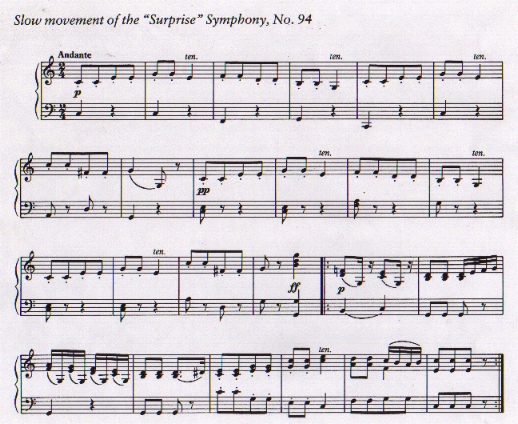
Description
The "Surprise" Symphony was composed by Haydn while he was visiting London. In order to understand why he wrote it, one must know what was happening at the time. In the slow movement of Haydn's symphonies, the audience seemed to fall asleep all the time. Haydn was so annoyed that he decided to take drastic action. This is what a fictitious member of the audience might have said about the "Surprise" Symphony:
"Symphony No. 94 was an admirable piece of music. What distinguished it from the other symphonies? Let me think... hmm... ah, I know. In the second movement, as the audience was getting drowsy, there was a great clash on all the instruments! Everyone was jolted awake, and many wondered what happened. However, the ochestra continued playing as if nothing had occurred. I think Haydn played an excellent musical joke on us."
Analysis
The slow movement in the "Surprise" Symphony is slow and easygoing. The word "Andante" at the top left of the music means "play the music slowly". The "p" and "pp" signs scattered throughout the music stand for "play softly". Another important sign is "ff" (on the third line). It represents "play very loudly". The notes above and below that sign were played with full force. Notice, that immediately to the right of the "ff" sign, there is a "p" sign. When played, the music would suddenly increase in volume, but then quiet down right away. This would create the effect of "...here was a great clash on all the instruments! Everyone was jolted awake, and many wondered what happened. However, the ochertra continued playing as if nothing had occurred..." The tune itself is nice and quiet, except for the clash, of course. The "ten." sign at the top of certain notes extends the note's length, but it is not critical to the "BAM!" effect.
My Views
I understand Haydn's frustration; if people don't listen when I play some music, I will get very upset. Haydn must have been grinning when he wrote the "Surprise" Symphony. It was a creative idea to wake up the audience. I think that this piece of music signifies Haydn's style: simple and beautiful, with a touch of humor.
The "Surprise" Symphony was composed by Haydn while he was visiting London. In order to understand why he wrote it, one must know what was happening at the time. In the slow movement of Haydn's symphonies, the audience seemed to fall asleep all the time. Haydn was so annoyed that he decided to take drastic action. This is what a fictitious member of the audience might have said about the "Surprise" Symphony:
"Symphony No. 94 was an admirable piece of music. What distinguished it from the other symphonies? Let me think... hmm... ah, I know. In the second movement, as the audience was getting drowsy, there was a great clash on all the instruments! Everyone was jolted awake, and many wondered what happened. However, the ochestra continued playing as if nothing had occurred. I think Haydn played an excellent musical joke on us."
Analysis
The slow movement in the "Surprise" Symphony is slow and easygoing. The word "Andante" at the top left of the music means "play the music slowly". The "p" and "pp" signs scattered throughout the music stand for "play softly". Another important sign is "ff" (on the third line). It represents "play very loudly". The notes above and below that sign were played with full force. Notice, that immediately to the right of the "ff" sign, there is a "p" sign. When played, the music would suddenly increase in volume, but then quiet down right away. This would create the effect of "...here was a great clash on all the instruments! Everyone was jolted awake, and many wondered what happened. However, the ochertra continued playing as if nothing had occurred..." The tune itself is nice and quiet, except for the clash, of course. The "ten." sign at the top of certain notes extends the note's length, but it is not critical to the "BAM!" effect.
My Views
I understand Haydn's frustration; if people don't listen when I play some music, I will get very upset. Haydn must have been grinning when he wrote the "Surprise" Symphony. It was a creative idea to wake up the audience. I think that this piece of music signifies Haydn's style: simple and beautiful, with a touch of humor.
Glossary
| Baryton | An oldfashioned instrument related to the viol family. It has six strings and is played with a bow. | |
| Clavier | See "Harpsichord" | |
| Harpsichord | Also known as a clavier, the harpsichord is a kind of keyboard instrument similar to the piano. The main difference is that the strings are plucked instead of struck. | |
| Military Band | Since the late 18th century, military bands with portable brass instruments, such as trumpets and tubas, have been popular. Bagpipes are also used all over the world. The player blows air into a bag held under the arm. The air is squeezed by the arm through the pipes. As it is forced out, the air makes the reeds inside the pipes vibrate, creating a wailing sound. | |
| Opera | A musical drama where singing takes the place of speech. Opera originated in late 16th century Florence, Italy, when a group of poets and musicians started setting Greek and roman myths to music. Many classical musicians wrote opera scores, including Mozart ('The Magic Flute'), Beethoven ('Fidelio') and Bizet ('Carmen'). Most eighteenth-century Operas were sung in Italian. Haydn composed 25 operas. | |
| Oratorio | Religious stories set to orchestral music. In the 17th century, composers began writing dramatic music based on Bible stories. Singers took the roles of the characters, and they were accompanied by a chorus and orchestra. Oratorios include 'The Creation' by Haydn, 'Christmas Oratorio' by Bach, 'Elijah' by Mendelssohn and Messiah by Handel. | |
| Sonata | A piece for one or two instruments in several sections (called 'movements'). | |
| String Quartet | This classical combination of chamber music consists of two violins, a viola and a cello. Haydn composed 68 string quartets. | |
| Symphony | A large-scale orchestral piece, usually in four separate parts called movements. The first and last were usually quick; the second slow, and the third was often a minuet. Haydn composed 106 symphonies. | |
| Wheelwright | A person who makes and repairs wheels, especially wooden ones. |
Bibliography
Ardley, Neil. Eyewitness Books - Music. Dorling Kindersley Limited, 1989.
Butterworth, Neil. Haydn - his Life and Times. Paganiniana Publications, Inc., 1980.
Grimshaw, Caroline. Connections! - Music. World Book, Inc., 1996.
Rosen, Charles. The Classical Style - Haydn, Mozart, Beethoven. The Viking Press, Inc., 1971.
Thompson, Wendy. Joseph Haydn. Penguin Books USA Inc., 1991.
Young, Percy M. Masters of Music - Haydn. Ernest Benn Limited, 1969.
Butterworth, Neil. Haydn - his Life and Times. Paganiniana Publications, Inc., 1980.
Grimshaw, Caroline. Connections! - Music. World Book, Inc., 1996.
Rosen, Charles. The Classical Style - Haydn, Mozart, Beethoven. The Viking Press, Inc., 1971.
Thompson, Wendy. Joseph Haydn. Penguin Books USA Inc., 1991.
Young, Percy M. Masters of Music - Haydn. Ernest Benn Limited, 1969.


[Home] Music Project [India Travel Brochure] [Space Magazine]
[Photo Gallery] [Puzzles] [Jokes] [My Links]