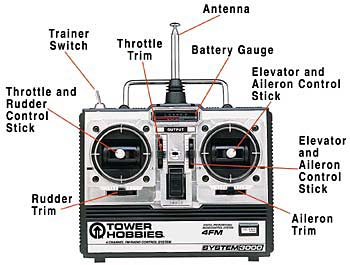
The transmitter is a control box that the operator uses to control the airplane. The transmitter uses a potentiometer to convert the positions of the controls into voltages. These voltage levels a encoded into signals that it sends to the airplane using radio waves. There are different types of modulation that are used to send the radio waves. Originally Amplitude modulation (AM) was used, but today almost all airplane transmitters use frequency modulation (FM). This change was made because FM is much less vulnerable to interferance then AM. When using FM the frequency of the signal is varied in order to send the control information. Pulse Code Modulation (PCM) is the lastest advancement in modulation technology for RC airplanes. PCM still uses FM but it sends a digital signal instead of varying the pulse width the way FM does. PCM is less vulnerable to interferance than FM but it is quite a bit more expensive so both technologies are in common use today. To learn more about FM or PCM click on one of the links below.
Transmitters come in many different models and can come with anything from 2 to 10 channels. These channels are used to control different functions of the airplane. Most RC airplanes require at least 3 to 4 channels, one each for the rudder, alerions, throttle, and elevator. Addtional channels can be used to control retractable landing gear, flaps, bomb drops, or other advanced functions. These channels should not be confused with the frequency channel that the system is operating on. Several frequencies in the 75MHz band have been set aside for RC airplanes and have been mapped to different channel numbers. Several different channels are available so that multiple airplanes can be active at one time without interfering with each other. To see the list of available frequencies and there channel mapping click on the link below. |