 Our
Lady of
Our
Lady of
NCM101 –
Human Behavior
Definition of Communication
This is the basic element of human interaction; the act or
action of imparting or transmitting; non-verbal or verbal behavior in a social context;
according to Reusch,
it comprises all modes of human behavior.
This is the reason why the communication topic is included
in Human Behavior Subject: 1) by communication, a person can tell one’s
emotion. A person can tell if one is happy, sad, afraid and etc. 2) a person
can also tell one’s intelligence or level of intelligence. This is the reason
why there’s a question and answer portion in a beauty pageant. The real beauty
of a person not only lies by the fairness of our skin, how tall are the persons
and how attractive are their face and body, but on how a person think
rationally. 3) a person can tell one’s motivations and desires consciously or
unconsciously.
Modes of
Communication
A person can communicate by 2 modes. 1) Verbal communication is the use of spoken words or languages.
Examples of these are talking with your seatmate, conducting
lectures, talking via phone or cellular phone or speaking thru a videophone.
With today’s technology, we can make our world a small place to live in. We can
get connected with our love one in any part of the world because of the availability
of the communication technology.
Another means of verbal communication is in the form of
writings.
Examples of these are jotting notes, writing love letters to
your sweetheart, texting SMS messages to other people
thru your cellular phone, typing and sending e-mail. Sound produced by the moorse code is also a verbal type of communication because
the sounds that it produced convey a meaning, which are letters.
Another mode of communication is non-verbal communication. Action speaks louder than words. They add
meaning to what are said. These non-verbal type are grouped into 3 main
categories: kinesics, proxemics and paralanguages.
Kinesics are bodily actions or movement.
Examples are bodily languages movements, postures, gestures,
eye contacts and facial expression.
Proxemics pertains to the distance between person communicating. We have different distances.
From 0-½ ft is the intimate distance.
Examples are whispering, kissing, cuddling a child or
infant, taking vital signs, administering medications, assisting patient to
stand or turning patient side-to-side are examples of these.
From 1½-4 ft is the personal
distance. This is ideal for nurse-patient relationship.
From 4-12 ft is the social
distance. Examples are taking to a small group of friends, conducting
nurses’ rounds, waving ‘hi’ to a person met.
The last is the public
distance, which is >12 ft.
Paralanguages ate the quality of the spoken words
delivered. It may be soft, loud, with impact, the pitch of the voice varies, or
a person may have stuttered voice.
These verbal and non-verbal communication are closely bound
together. We speak not in a monotonous voice and talk without an action. The
nurse should be aware of the verbal and non-verbal messages made by the client.
Levels of Communication:
Intrapersonal communication
occurs within an individual. These only involves an person speaking with
himself, either thru ones mind or speak it out. But we seldom communicate with
ourselves loudly, because of the reason that other persons might misinterpret
what we are doing.
Interpersonal communication
is face to face interaction between 2 people or small group.
Examples are having a chit-chat with your seatmate or within
peers. Joining a group of chatters in a chat room via mIRC
or Yahoo! Messenger, conducting nurses rounds is also an interpersonal
communication. So, interpersonal communication is the heart of the nursing
practice. By taking a simple vital sign. Before we insert the thermometer to
the patient we have to communicate with your patient. Referring results to the
doctor also an example of interpersonal communication.
Public communication is interaction with large group of
people.
Examples are conducting lectures, symposium, seminars, reporting in front of the class or conducting
health teaching among group of pregnant women.
Before you talk to your seatmate, you first talk within
yourself on what you are going to say. Before I enter your class, is speak
within myself on what topic I’m going to discuss to you. The prerequisite to
interpersonal and public communication is the intrapersonal communication.
Elements of Communications:
Referent is what motivates a person to communicate
with one another. This is the purpose or the objective of a person why a person is communicating.
The sender is
person who initiates the interpersonal communication. The sender is the encoder
of messages.
The message is the
information that is sent or expressed by the sender.
These information runs thru channels. Channels are conveying messages such as through visual,
auditory and tactile senses on how we receiver or perceive messages.
The receiver is
the person whom the message is sent. The receiver is the decoder of messages.
Now, what are these codes? During exams a student thump his
ball pen on his desk in various of times. Without the idea of the proctor, the
student is already relaying messages to the other student the answer to the exams
by means of sounds that it produced. The receiver can decode the messages sent
by the encoder, which is the sender. Language are defined as the sounds produce
that convey a meaning. If a person talked to me in Spanish or in French, I
cannot decode his messages. We are communicating, Yes! But we are communicating
ineffectively.
The feedback is
the response or reaction made by the receiver.
The interpersonal
Variables pertains to perception, values, cultural backgrounds, knowledge,
and roles and the setting of interaction come into play to influence the content of message and manner in which it is
shared. So the whole communication process is influenced by the variables. For example, persons are
communicating in a very noisy environment. It’s very difficult to communicate
in that kind of place.
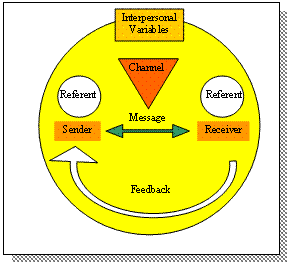
Factors influencing Communications:
The level of
development influence the manner of communication because the approach on different
age group varies. If we are talking to a child, we should talk in a slow paced,
the choice of words should be easily comprehended by the person you are talking
to. The values & socio-cultural
background of person also affect your communication. There are certain
group of people that are very sensitive. There are certain topics that are
taboo in their community, so, be careful. The emotions may it be the sender or the receiver can affect the
quality of the communication. If the sender is depressed, the delivery of the
message will be affected. Same thing is true if the receiver is angry. Its easy
to talk to a person who is happy or jolly rather to a person who is angry or
mad. Persons level of knowledge is
also influence the manner of communication. In the use of vocabulary, we must
consider the level of intellect of the person we are communicating with. Rather
than we say to our patient “I will auscultate your
lungs” it is better to use “I will listen to your lungs”. Because not all
patient understand the meaning of the word auscultate.
Based on roles and relationship examples
are student to teacher, child to parents, student to student or sibling to
sibling. The manner of delivery of messages change if a person have a role or
authority, rather than persons who are in the same level, in which they are
communicating casually. Environment examples
are noisy environment can affect the understanding between persons talking.
There are certain topics that need special environment, like proposing to
someone. He want it to be done in a romantic place.
Course Outline: prelims
| midterm
| finals
Handouts: week1 | week2 | week3
| week4 | week5 | week6 | week7 | week8 | week9 | week10 | week11 | week12 | week 13 | week 14
Grades: Monday
| Tuesday
| Wednesday
| Thursday
| Friday
| Saturday