 Our Lady
of
Our Lady
of
NCM101 –
Human Behavior
Interpersonal
Theory
Karen
Horney - investigated these
neurotic needs, she began to recognize that they can be clustered into three
broad coping strategies:
I. Compliance, which includes needs
one, two, and three. She referred as the moving-toward strategy and the self-effacing
solution.
II. Aggression, including needs four
through eight. Referred to as moving-against and the expansive
solution.
III. Withdrawal, including needs
nine, ten, and three. called the third moving-away-from and the resigning
solution.
The neurotic needs are as follows:
I. Compliance
1. The neurotic need for affection and
approval, the indiscriminate need to please others and be liked by them.
2. The neurotic need for a partner, for
someone who will take over one's life. This includes the idea that love will
solve all of one's problems. Again, we all would like a partner to share life
with, but the neurotic goes a step or two too far.
3. The neurotic need to restrict one's life
to narrow borders, to be undemanding, satisfied with little, to be
inconspicuous. Even this has its normal counterpart. Who hasn't felt the need
to simplify life when it gets too stressful, to join a monastic order,
disappear into routine, or to return to the womb?
II. Aggression
4. The neurotic need for power, for control
over others, for a facade of omnipotence. We all seek strength, but the
neurotic may be desperate for it. This is dominance for its own sake, often
accompanied by a contempt for the weak and a strong belief in one's own
rational powers.
5. The neurotic need to exploit others and
get the better of them. In the ordinary person, this might be the need to have
an effect, to have impact, to be heard. In the neurotic, it can become
manipulation and the belief that people are there to be used. It may also
involve a fear of being used, of looking stupid. You may have noticed that the
people who love practical jokes more often than not cannot take being the butt
of such a joke themselves!
6. The neurotic need for social recognition
or prestige. We are social creatures, and sexual ones, and like to be
appreciated. But these people are overwhelmingly concerned with appearances and
popularity. They fear being ignored, be thought plain, "uncool," or
"out of it."
7. The neurotic need for personal
admiration. We need to be admired for inner qualities as well as outer ones. We
need to feel important and valued. But some people are more desperate, and need
to remind everyone of their importance -- "Nobody recognizes genius,"
"I'm the real power behind the scenes, you know," and so on. Their
fear is of being thought nobodies, unimportant and meaningless.
8. The neurotic need for personal
achievement. Again, there is nothing intrinsically wrong with achievement --
far from it! But some people are obsessed with it. They have to be number one
at everything they do. Since this is, of course, quite a difficult task, you will
find these people devaluing anything they cannot be number one in! If they are
good runners, then the discus and the hammer are "side shows." If
academic abilities are their strength, physical abilities are of no importance,
and so on.
III. Withdrawal
9. The neurotic need for self-sufficiency
and independence. We should all cultivate some autonomy, but some people feel
that they shouldn't ever need anybody. They tend to refuse help and are often
reluctant to commit to a relationship.
10. The neurotic need for perfection and
unassailability. To become better and better at life and our special interests
is hardly neurotic, but some people are driven to be perfect and scared of
being flawed. They can't be caught making a mistake and need to be in control at
all times.
It is true that some people who are abused
or neglected as children suffer from neuroses as adults. What we often forget
is that most do not. If you have a violent father, or a schizophrenic mother,
or are sexually molested by a strange uncle, you may nevertheless have other
family members that love you, take care of you, and work to protect you from
further injury, and you will grow up to be a healthy, happy adult. It is even
more true that the great majority of adult neurotics did not in fact suffer
from childhood neglect or abuse! So the question becomes, if it is not neglect
or abuse that causes neurosis, what does?
Horney's answer, which she called the
"basic evil," is parental indifference, a lack of warmth and
affection in childhood. Even occasional beatings or an early sexual experience
can be overcome, if the child feels wanted
and loved.
Self theory
3 Concepts of the Self:
1.
actual self – consist of the sum
total of experience
2.
real self – is the harmonious healthy
person
3. idealized
self – neurotic expectation or glorified image of what the person feels he
or she should be
Horney had one more way of looking at
neurosis -- in terms of self images. For Horney, the self is the core of
your being, your potential. If you were healthy, you would have an accurate
conception of who you are, and you would then be free to realize that potential
(self-realization).
The neurotic has a different view of
things. The neurotics self is "split" into a despised self and
an ideal self. Other theorists postulate a "looking-glass"
self, the you think others see. If you look around and see (accurately or not)
others despising you, then you take that inside you as what you assume is the
real you. On the other hand, if you are lacking in some way, that implies there
are certain ideals you should be living up to. You create an ideal self out of
these "shoulds." Understand that the ideal self is not a positive
goal; it is unrealistic and ultimately impossible. So the neurotic swings back
and forth between hating themselves and pretending to be perfect.
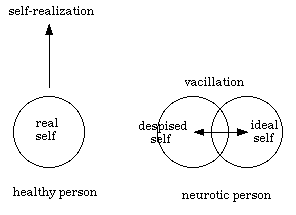
Horney described this stretching between
the despised and ideal selves as "the tyranny of the shoulds" and
neurotic "striving for glory:"
The compliant person
believes "I should be sweet, self-sacrificing, saintly."
The aggressive person says "I should be powerful, recognized, a
winner."
The withdrawing person believes "I should be independent, aloof,
perfect."
And while vacillating
between these two impossible selves, the neurotic is alienated from their true
core and prevented from actualizing their potentials.
Cognitive Theory:
Jean Piaget
Genetic
Epistomology – development of knowledge
-
study of the
acquisition, modification and growth of abstract ideas & abilities on the
basis of an inherited or biological substrate
Epigenesis – growth and development occur in series of stages
Adaptation – major process involved in cognitive organization.
-
ability of the person
to adjust to environment and adjust with it.
2
Complementary Process of Adaptation:
1.
assimilation – taking new experiences through one’s own system or knowledge
2. accommodation
– adjustment of owns system knowledge to the reality demands of the environment
Together
they are in dynamic equilibrium, create schemata.
Schema
– specific cognitive structure that has a behavior pattern. Early schema,
sucking, grasping, seeing – becomes more complex as a person grows.
Stages
of Cognitive Development:
1. Sensorimotor
– birth to 2 yrs; uses senses and
motor to understand the world
Stages
of sensorimotor:
a. primary
circular reaction – 1 – 4 mo;
coordinates activities of own body and 5 senses (ex. Sucking thumb); displays
curiosity; does not seek stimuli outside of its visual field or environment.
b. Secondary
circular reaction – 4 – 12 mo; acts
that extends out to the environment; starts both to anticipate consequences of own
behavior and to act purposefully to change the environment; beginning of
intentional behavior (ex. Squeeze rubber ducky)
c. Tertiary
circular reaction – 12 – 24 mo;
seeks out new experience or making interesting things last (ex. Using drumstick
and stomp on different objects)
Object permanence – child’s ability to understand that the object
have existed independent of the child’s involvement with them. Infants learn to
differentiate themselves from the world and maintain mental image of the world.
Symbolization – develop about 18 months; begin to develop mental
symbols and use of words.
Attainment
of object permanence marks the transition from sensorimotor to pre operational
stage.
2. Pre
operational thought – 2 – 7 years;
uses symbols and language more expensively; unable to deal with moral dilemma
Characteristic
of children
Immanent
justice – the belief that punishment for bad deeds is inevitable
Egocentric
behavior/centrism – sees things from his point of view
Semiotic
function – child represents something, object or event with a signifier
which serves a representative function. Ex. Drawing.
Magical thinking:
Phenomalistic causality – events occur together are thought to
cause one another (bad thoughts cause accidents)
Animistic thinking – tendency to endow physical events and objects
with lifelike psychological attributes, such as feelings and intentions
3. stage of
concrete operations – 7 – 11 years;
child operates and act concrete, real, perceivable world of objects and events;
egocentric thoughts is now replaced by operational thought which involves
attending & dealing with wide array of information outside the child. Ergo
a child can see someone else’s perspective.
Characteristics:
Syllogistic
reasoning – logical conclusion is formed from 2 premises
Conservation
– ability to recognize that even though the shape and form of objects may
change, the object still maintain or conserve other characteristics that enable
them to be recognized as the same.
Reversibility
– capacity to understand the relation between things, to understand that
one thing can turn into another and back again. Ex. Water and ice.
The
most important sign that children are still in the pre operational stage is
that they have not achieved conservation or reversibility.
4. stage of formal
operation – 11 – end of
adolescence; person’s thinking operates in formal, highly logical, systematic
and symbolic manner; characterized by skills dealing with premonitions and
combinations; language use is complex, follows formal rules of logic and
grammatically correct.
Abstract thinking – interest in variety
of issue such as philosophy, religion, ethics, politics
Hypothetico-deductive thinking – highest organization in cognition
Hypothesis
– proposition and test it against reality
Deductive
reasoning – going from general to particular
Inductive
reasoning – particular to general
Behavior and Learning Theory:
Classical
conditioning – Ivan Pavlov; it is passive or restrained
Before conditioning
 Food(UCS) salivation(UCR)

After conditioning

Extinction
– occurs when the conditioned stimulus is constantly repeated without the
unconditioned stimulus until the response evoked by the conditioned stimulus
gradually weakens and eventually disappear.
Operant
conditioning – B.F. Skinner;
instrumental conditioning; related to trial and error learning as described by
Thorndike
4
kinds of operant or instrumental conditioning.
1.
primary reward conditioning – simplest kind of conditioning. The learned
response is instrumental in obtaining a biologically significant reward, such
as pellet of food or drink of water.
2.
escape conditioning – the organism learns a response that is instrumental in
getting out of some place it prefers not to be.
3.
avoidance conditioning – the kind of learning I which response to a cue is
instrumental in avoiding a painful experience, may avoid a shock if it quickly
pushes the lever when the light signal goes on.
4.
secondary reward conditioning – the kind of learning in which instrumental
behavior to get a stimulus has no biological usefulness itself but has in the
past been associated with biologically significant stimulus. For example,
chimpanzees learn to press a lever to obtain poker chips, which may insert into
a slot to secure grapes. Later they work to accumulate poker chips even when
they are not interested in grapes.
2 types of behavior:
1. respondent behavior – results
from known stimuli (ex. Knee jerk reflex to patellar stimulation, pupillary
constriction to light)
2. operant behavior –
independent of stimulus (ex. Random movements of an infant or aimless movements
of laboratory rat in a cage)
Aversive
control – the organism changes its behavior to avoid painful, noxious, or
aversive stimulus.
Shaping
Behavior – involves changing behavior in a deliberate and predetermined way.
Course Outline: prelims | midterm | finals
Handouts: week1 | week2 | week3 | week4
| week5 | week6 | week7 | week8 | week9 | week10 | week11 | week12 | week 13 |
week 14
Grades: Monday |
Tuesday | Wednesday | Thursday | Friday | Saturday