|
|
 |
 |
 |
 | ||||||||||
|
||||||||||||||
 |
|
April 2005 |
||
| Who is the oppressor and who is the slave? | ||||
| Wednesday April 6 |
It occurred to me this weekend that they are one and the same. There are so many examples every where you look of Caribbean people holding their own people back, disrespecting and degrading others, taking advantage of one another, condemning others, and on and on... And they're all guilty of putting up with so very much crap. I sat in the office today listening to one of the instructors complain about another one, about how she doesn't show up for class, about how her students are complaining, and how she has another business and spends her time on that when she should be taking care of things at the school, and how she doesn't want to do any work, but still collect her paycheck. And this instructor commented to me about how she doesn't understand how people can be like that. And I responded that I didn't understand how she gets away with it. Then she said, well, that's how it is here. That is so common it's endemic. People complain and complain, but no one ever does anything to correct the situation. I have stood for hours in line to pay my utility bill (well, not any more since I discovered that nothing happens if you pay your bill late), while 5 or 6 clerks sat behind their counter (doing Lord knows what) ignoring the long line of people, and only 1 or 2 grudgingly consented to attend to the customers. You can bet everyone in line was complaining up a storm to the rest of us poor fools standing alongside of them, but not one said a word to the clerks or asked to speak with the manager.
Prior to the election last year, government workers were routinely being paid late… not a few days, we're talking months would go by with no paycheck. Children didn't have enough money for bus fare to get to school because their parents hadn't been paid in months. What was really amazing was that people kept going to work! Everyday they would get up and go into their jobs and come home at the end of the day, and everyday it was the same story, no money. Eventually the postal workers went on strike for a few days, but that was the only tangible dissent that I heard of. The government was notoriously corrupt and there was no money for the basic infrastructure of the country. (To their defense though, Antiguan's did eventually vote the ruling party out of office.) The roads are terrible, the sidewalks in town are broken and dangerous, trash is everywhere, and town (meaning St. John's - where the banks and businesses are and the cruise ships dock) reeks from sewer smell. But people have lived with it for so long that it's just status quo. Gandhi wrote that you could never enslave the Indian people because they would die before they would be willing to do the work of slaves. People here don't even rise up against the injustices that they do to themselves. |
|||
| Black sand, volcanoes, and waterfalls - all in one day | ||||
| Thursday April 7 |
Have just returned from a long weekend in St. Vincent, this time staying in the home of fellow PCVs Amber and Brian, a married couple who arrived at the same time that we did. George and I arrived Wednesday evening and very quickly discovered what we had suspected all along - that PCVs in Antigua are robbed of the village experience that Peace Corps so highly stresses. Antigua is basically an island of commuters - people get up in the morning and jump in their cars or hop on the bus and head off to work, then head back home at the end of the day. Except for a few snackettes, people don't work or even socialize in the same community that they live in. Many of the children travel to town where the best schools are rather than attend schools in the country, closer to home, and on weekends, many people even commute to church, bypassing several others on their way to attend the church that they've been going to for years. Although everyone knows their neighbors (someone once told me that he knew half the people on the island and the other half knew him), there really are no communities here that I know of where you can get the true "village" experience. Not true on some of the more mountainous islands where the villages tend to be remote and secluded. Both Brian and Amber work in the village where they live and both work in the school system, so as Amber says, although she doesn't know all of the children, they all know her (I didn't specifically ask, but it's highly likely that there are no other blonde white women in their village). As we walked through the village after dinner on our way to a small bar there, they knew and spoke to just about everyone, and although it was dark and getting late, they had no problems with being out on foot at night. I was quite envious to see how well they had adapted to their life there and had been accepted into their community. The following day George and I caught a bus into Kingstown, then hopped
on a ferry to Bequia, the nearest of the Grenadine islands. There we checked
into a modest guest house (kind of reminded me of a youth hostel), unpacked
our bags and went in search of food and the local dive shop where we confirmed
our reservations for diving the following morning.
The path back down the mountain was quicker, but harder on the knees
and feet. The sun came out to warm our way and as the temperature began
to rise, |
|||
| The breath of God | ||||
| Monday April 18 |
God’s love and abundance are like the air that we breathe – an essential part of life. We breathe the air in, it fills us, traveling to all extremities of the body, sustaining us, giving us life, then is transformed, converted in chemical makeup and released, not as waste but as life-sustenance for others to take in and absorb, then transform and release back out again. The air, our breath begins the cycle of life. God’s love fills us and nurtures us, giving us the strength and passion to continue living. God’s abundance provides for us, bringing to us the people and opportunities necessary to move us forward through each step along our path of life. Through God we are supported, never lacking, never alone. These gifts are ours to appreciate, to utilize but not use up, but rather to grow and mature. They are transformed in us, developing new facets and intricacies uniquely through the contributions of our soul. Then they are released, absorbed in and then let go so that they can touch others and fill them with God’s love and abundance as exemplified by us, changed and forever altered by having known us, danced with us, played with us. |
|||
| Counting the weeks | ||||
| Thursday April 21 |
The semester is coming to a close with my 2 college classes having their final exams next week. After that, I'm teaching one more class at the college in Intermediate Word Processing which starts the first week of May and goes for 7 weeks. My Ministry of Education teachers' class will finish at about the same time in mid-June. Then I'm done. That's it. No more classes. No more students. No more Peace Corps. I get to go home. Our Close-of-Service conference will be held late May in (drat!) Antigua (the 5 of us here won't get to travel). There we'll wrap up and talk about our final few months and about life after Peace Corps. The official COS date for our group is August 31, however you can get permission to leave earlier for reasons such as your job being finished. I'm targeting July 15. I had considered requesting July 1st, but there is a regatta to Barbuda (the other half of Antigua & Barbuda) that weekend and I'm hoping to get on a boat. Either way, it won't be long now. I can't even begin to say how much I'm looking forward to going home. |
|||
| << back next >> |

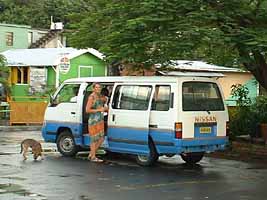 This weekend while visiting St. Vincent I had the opportunity to ride
their public bus system. It is very similar to Antigua's, with most of
the buses being 14 passenger (plus the driver) vans - they consist of
a back seat that sits 3 adults, 3 more rows with a fixed seat for 2 and
a fold down seat in the aisle, and the passenger and console seats next
to the driver. We had 20 people in one van on a winding mountain road
above steep cliffs, at high speeds, for about a 45-minute ride. This is
the type of ride that when you reach your destination, the old women on
the bus exclaim, "Thank you Jesus!" I don't know if Antigua
has a more powerful Transport Board, or if the drivers here just haven't
figured out that they can get away with it, but we generally only put
3 adults in seats designed for 3 adults (kids are squishable and stackable
and don't figure in the equation). When I approached the bus at the bus
station, I looked in and saw that the back seat was full and so attempted
to fold down the aisle seat in the row ahead of it, but the driver insisted
that I go in the back. I looked again, shook my head and said, "Four?
No." He said, "Yes." Someone else got in the back and then
I had to squeeze along with 3 others in the next row. The hip width of
4 adults side-by-side is greater than the width of the van. I could not
sit fully back against the seat and had to turn sideways to wedge in.
It was truly uncomfortable. The friends we were visiting told us later
that it's always 4 in every row. Why do they put up with this? People
are literally sitting on top of one another. Why don't they just start
refusing to squeeze into these degrading positions? Not to mention that
the weight of all those people far exceeds the load-bearing capacity of
the vehicle and tires, and on those roads…. It was a frightening
experience.
This weekend while visiting St. Vincent I had the opportunity to ride
their public bus system. It is very similar to Antigua's, with most of
the buses being 14 passenger (plus the driver) vans - they consist of
a back seat that sits 3 adults, 3 more rows with a fixed seat for 2 and
a fold down seat in the aisle, and the passenger and console seats next
to the driver. We had 20 people in one van on a winding mountain road
above steep cliffs, at high speeds, for about a 45-minute ride. This is
the type of ride that when you reach your destination, the old women on
the bus exclaim, "Thank you Jesus!" I don't know if Antigua
has a more powerful Transport Board, or if the drivers here just haven't
figured out that they can get away with it, but we generally only put
3 adults in seats designed for 3 adults (kids are squishable and stackable
and don't figure in the equation). When I approached the bus at the bus
station, I looked in and saw that the back seat was full and so attempted
to fold down the aisle seat in the row ahead of it, but the driver insisted
that I go in the back. I looked again, shook my head and said, "Four?
No." He said, "Yes." Someone else got in the back and then
I had to squeeze along with 3 others in the next row. The hip width of
4 adults side-by-side is greater than the width of the van. I could not
sit fully back against the seat and had to turn sideways to wedge in.
It was truly uncomfortable. The friends we were visiting told us later
that it's always 4 in every row. Why do they put up with this? People
are literally sitting on top of one another. Why don't they just start
refusing to squeeze into these degrading positions? Not to mention that
the weight of all those people far exceeds the load-bearing capacity of
the vehicle and tires, and on those roads…. It was a frightening
experience.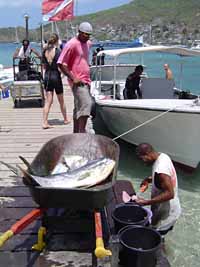 After that we took
a walk down the coast to a nearby beach to relax and swim. Friday morning
we loaded up our gear and walked the short distance to Dive Bequia's boat
dock and headed out for a morning of scuba diving. Scuba diving in Bequia
is strictly drift diving - the boat drops you off, you swim/float with
the current under water, then the boat picks you up down current at the
end of the dive. Although I have over 400 logged dives, I have never intentionally
done a drift dive before, so this was somewhat of a treat for me. I had
always felt a bit of trepidation about the whole idea, but it was really
no big deal. Visibility for the first dive was only fair, but the water
was warm (80°F) and there were lots of sponges and soft corals and
other marine life to see. We moved to a new location with better visibility
for the second dive and had the boat nearly to ourselves as we had dropped
all but one of the other divers off at the dock between dives. After an
enjoyable morning, we arrived onshore in time to shower, change, and catch
the 2pm ferry back to St. Vincent.
After that we took
a walk down the coast to a nearby beach to relax and swim. Friday morning
we loaded up our gear and walked the short distance to Dive Bequia's boat
dock and headed out for a morning of scuba diving. Scuba diving in Bequia
is strictly drift diving - the boat drops you off, you swim/float with
the current under water, then the boat picks you up down current at the
end of the dive. Although I have over 400 logged dives, I have never intentionally
done a drift dive before, so this was somewhat of a treat for me. I had
always felt a bit of trepidation about the whole idea, but it was really
no big deal. Visibility for the first dive was only fair, but the water
was warm (80°F) and there were lots of sponges and soft corals and
other marine life to see. We moved to a new location with better visibility
for the second dive and had the boat nearly to ourselves as we had dropped
all but one of the other divers off at the dock between dives. After an
enjoyable morning, we arrived onshore in time to shower, change, and catch
the 2pm ferry back to St. Vincent.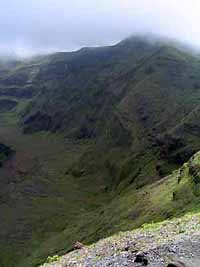 Saturday,
Amber, George, and I got up early (Brian had a prior commitment as an
extra in the filming of the Pirates of the Caribbean sequel!) to hike
the Soufriere volcano on the north end of the island. We met Gary, a friend
of Brian and Amber's and our guide for the hike, and 5 young boy scouts
who would be our companions for the trip, and then hopped in the back
of a flat bed truck that Gary had arranged to take us all to the trail
head at the northern end of the leeward road. We began the trail on the
beach, first crossing barefoot through the stone-filled streams that flowed
down from the mountains, then walking along one of the black sand beaches
that surround the island. Near the end of the beach we headed inland and
started the ascent that would take us approximately 2½ hours until
we reached the top. We had cloud or tree cover most of the way so the
heat wasn't bad, but the humidity was quite high and we were all drenched
in sweat. Not long after we started the climb I wondered why it had not
occurred to me to train for this hike. We had been planning to hike the
volcano ever since Brian mentioned it as a possibility in an email over
a month ago. Well, I would pay for that mistake. We started at sea level
and the rim of the volcano is almost 4000 feet high. On that day and the
two days following, I would learn just how out of shape I really am.
Saturday,
Amber, George, and I got up early (Brian had a prior commitment as an
extra in the filming of the Pirates of the Caribbean sequel!) to hike
the Soufriere volcano on the north end of the island. We met Gary, a friend
of Brian and Amber's and our guide for the hike, and 5 young boy scouts
who would be our companions for the trip, and then hopped in the back
of a flat bed truck that Gary had arranged to take us all to the trail
head at the northern end of the leeward road. We began the trail on the
beach, first crossing barefoot through the stone-filled streams that flowed
down from the mountains, then walking along one of the black sand beaches
that surround the island. Near the end of the beach we headed inland and
started the ascent that would take us approximately 2½ hours until
we reached the top. We had cloud or tree cover most of the way so the
heat wasn't bad, but the humidity was quite high and we were all drenched
in sweat. Not long after we started the climb I wondered why it had not
occurred to me to train for this hike. We had been planning to hike the
volcano ever since Brian mentioned it as a possibility in an email over
a month ago. Well, I would pay for that mistake. We started at sea level
and the rim of the volcano is almost 4000 feet high. On that day and the
two days following, I would learn just how out of shape I really am.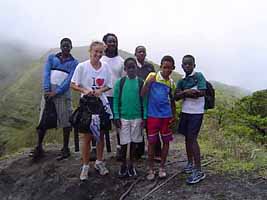 Nearing
the top, we began to lose the shelter of the lush forest that had lined
the trail most of the way, and simultaneously lost our windbreak. The
wind at the top was fierce - so much so that it was difficult to walk
upright - and cold and I was dressed for heat. As we reached the summit,
we were awestruck by the enormity and beauty of the crater as we watched
the fog rolling in over the windward edge. Gary thought it was best to
wait a bit before attempting the descent into the crater, so we stopped
for lunch at the top. I was so cold I was having trouble functioning.
I huddled in a tight ball with my back pack drawn close into my chest
to try to maintain a little bit of body heat, but I couldn't stay like
that for long. The crater was a long, steep way down, but I needed to
get off of the rim just to get out of the wind, so when Amber started
towards the trail that would take us there, I quickly followed.
Nearing
the top, we began to lose the shelter of the lush forest that had lined
the trail most of the way, and simultaneously lost our windbreak. The
wind at the top was fierce - so much so that it was difficult to walk
upright - and cold and I was dressed for heat. As we reached the summit,
we were awestruck by the enormity and beauty of the crater as we watched
the fog rolling in over the windward edge. Gary thought it was best to
wait a bit before attempting the descent into the crater, so we stopped
for lunch at the top. I was so cold I was having trouble functioning.
I huddled in a tight ball with my back pack drawn close into my chest
to try to maintain a little bit of body heat, but I couldn't stay like
that for long. The crater was a long, steep way down, but I needed to
get off of the rim just to get out of the wind, so when Amber started
towards the trail that would take us there, I quickly followed.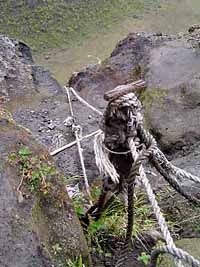 The
path down into the crater was via a long, shallow crevice in the steep
inner wall of the volcano. Running through the crevice were several ropes
in varying states of decay, tied to rusted stakes of dubious holding power.
These were to be our lifelines. The walls of the crevice were lined alternately
with sharp, jagged lava rock and fragile, crumbly dirt so that stepping
on the latter often resulted in a loss of footing and a painful encounter
with the former. It was frightening and exhilarating at the same time,
but I wasn't cold anymore! Finally down at the bottom, we made our way
over to an area where there was still steam rising up from the rocks (St.
Vincent's volcano last erupted in 1979), where we each found a spot to
relax. When the boys decided to hike the perimeter of the crater, the
rest of us decided it was a good idea to get a head start back up to the
rim. As it turned out, as I stepped up over the edge, the first boy was
on my heels and stepped up right behind me!
The
path down into the crater was via a long, shallow crevice in the steep
inner wall of the volcano. Running through the crevice were several ropes
in varying states of decay, tied to rusted stakes of dubious holding power.
These were to be our lifelines. The walls of the crevice were lined alternately
with sharp, jagged lava rock and fragile, crumbly dirt so that stepping
on the latter often resulted in a loss of footing and a painful encounter
with the former. It was frightening and exhilarating at the same time,
but I wasn't cold anymore! Finally down at the bottom, we made our way
over to an area where there was still steam rising up from the rocks (St.
Vincent's volcano last erupted in 1979), where we each found a spot to
relax. When the boys decided to hike the perimeter of the crater, the
rest of us decided it was a good idea to get a head start back up to the
rim. As it turned out, as I stepped up over the edge, the first boy was
on my heels and stepped up right behind me!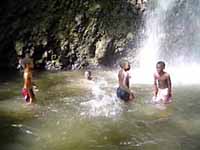 I was quite glad that it had remained hidden for the climb up.
The truck was waiting to pick us up right where it had dropped us off
earlier that morning, then whisked us away to nearby Dark View Falls.
Thinking it was inappropriate to strip down to our underwear with young
boys around, Amber and I limited ourselves to getting only our legs and
feet wet, but George and the boys jumped right in for a dip in the pond
below the waterfall. Tired and refreshed, we headed back down the road
to Brian and Amber's house on the beach and our last evening on beautiful
St. Vincent.
I was quite glad that it had remained hidden for the climb up.
The truck was waiting to pick us up right where it had dropped us off
earlier that morning, then whisked us away to nearby Dark View Falls.
Thinking it was inappropriate to strip down to our underwear with young
boys around, Amber and I limited ourselves to getting only our legs and
feet wet, but George and the boys jumped right in for a dip in the pond
below the waterfall. Tired and refreshed, we headed back down the road
to Brian and Amber's house on the beach and our last evening on beautiful
St. Vincent.