|
|
 |
 |
 |
 | ||||||||||
|
||||||||||||||
 |
|
April 2004 |
||
| Info about Antigua (an-tee-ga) | ||||
| Thursday April 1 |
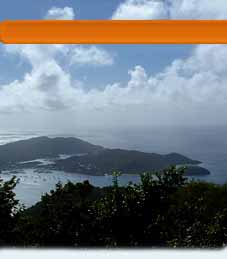
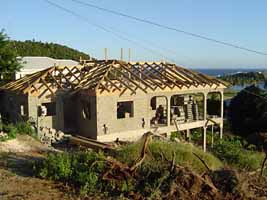
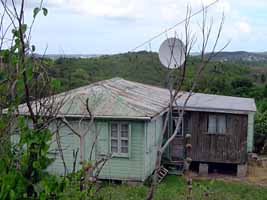
A little bit about where I live – the country is made up of two neighboring islands in the Eastern Caribbean, Antigua and Barbuda. Antigua is approximately 11 by 14 miles and there are roughly 65,000 or so people living here; many are descendants of African slaves who were brought here to work on the sugar plantations. Although sugar is no longer grown here as an industry, the land is still dotted with old mills as well as the ruins of a number of British forts. Antigua boasts 365 beaches, but the people who’ve attempted to count them say that the actual number is probably closer to 100. There are around 40 resorts and hotels scattered around the island, some quite extravagant, with rooms up to US$1000 per night (all inclusive). I haven’t been to most, but all beaches on the island are public, so you could go swimming at any of their beaches if you wanted, you just couldn’t use their facilities if you weren’t a guest. There is really only one town in Antigua – St. John’s, which is located on the northwest shore of the island, and it is the hub of all activity. Bus routes and roads extend outward from it like bicycle spokes. The cruise ship docks and deep-water harbor are here, as well as shops, grocery stores, the public markets, and government center. Elsewhere on the island are villages, which vary in size – many have schools, the larger ones have some businesses and small groceries. Others, like my village, have very few services. There’s a lady at the far end of town who has a fruit and vegetable stand, but her prices aren’t as good as one might think because she caters to the tourists passing by in rental cars on their way up Fig Tree Drive. There are a couple of small shops that are really more like wooden shacks with a door, counter, and some shelves on the wall where you could pick up a loaf of bread or pound of sugar in a pinch, but could not possibly stock your kitchen from them. The two primary construction techniques for homes are frame (wooden) or walled (cement block). In the same village, you’ll see people living in some extremely modest homes that appear to have had very little done to repair them since the last hurricane, as well as some nice, modern homes. Some of the outhouses behind the homes are still in use. There are a lot of buildings all over the island that are under construction but have not been touched in I don’t know how long. Perhaps the money ran out? I’m sure each has it’s own story. The walled homes are often built a floor at a time – once the first floor is completed, the family will move in and then work on the second and possibly third floors as money and time allows – or not. Some stay in that partially completed state indefinitely.
|
|||
|
Roofs are designed to catch the rainwater into tanks or cisterns. Many homes are hooked up to the government pipes (which, based on my 6 weeks in Sea View Farm and what I observe in town, is turned off for several hours a day up to several days at a time), but many as well, like mine, are not connected to city water at all and rely solely on the tanks. More people don’t have hot water than do. Many wash their clothes by hand, although it’s not uncommon to see a nice new washing machine sitting on the front porch of a rather dilapidated frame house. Almost no one has clothes dryers. I boil all of my drinking water, partly to save money, but mostly to avoid having to haul water home on the bus and up my hill. Power outages are common. For the first few months that I was here, I never had to worry about defrosting my refrigerator because the power went out so often, and for so long, that all I had to do was wipe up the water at the bottom. Lately however, the power has been pretty consistent, or the outages so short in duration that I will probably have to manually defrost it soon!
Dominoes are big here. There’s usually a group of men sitting at the bus station, slamming their pieces down onto the table. It’s a frequent sight, repeated on street corners in villages all around the island. The big sports are cricket and football (soccer, not American football). The Recreation Grounds in town is host to several professional level tournaments during the year; the cricket World Cup is scheduled to come here in 2007, I believe. New basketball courts were recently built in several locations and those get a lot of use from the local kids as well as the older teens and young men. Antigua is also a world class sailing destination and hosts the annual Antigua Sailing Week during the last week of April, as well as many other smaller races and regattas throughout the year. Carnival is a Mardi-Gras type of celebration held throughout the summer in the Caribbean. There is historical significance to the celebrations (end of harvest, stuff like that), and as I understand it, many once took place at the same time, but the dates have since changed so that the different islands don’t compete against each other for attendance. Antigua’s is held during the last week of July through the first week in August. Our arrival on the island last summer was strategically planned to miss Carnival (for some reason they don’t want the volunteers’ first impression to be a week-long party), so this year’s event will be my first. |
||||
| Expectations | ||||
| Friday April 2 |
Expectations are a strange thing; they always a funny way of disappointing you. |
|||
| Cricket | ||||
| Monday April 12 |
Saturday, PCVs Lorena and Angel were visiting from Dominica, so we met them downtown for lunch and shopping. Lorena was blown away by the shopping we have here, which apparently is about non-existent where she lives. Like the rest of us, she started in St. Lucia, and now lives in Dominica, has traveled to Barbados and St. Vincent and the Grenadines, and says she likes Antigua best because of what the island offers. She wants to settle here after her service is completed and own and run several beach cottages.
|
|||
| Goodbye to winter | ||||
| Wednesday April 14 |
Winter is over. It doesn’t blast in with freezing temperatures and a blanket of snow; the trees don’t even lose their leaves. No, winter here is much more subtle. If you weren’t paying attention, you could have missed it, but there were a few short months when you stood a good chance of arriving at your destination without being soaked in sweat. How did Lansana put it the other day – “Is it just me, or is it so hot out that is seems like God is mad at us?” And it’s only April. |
|||
| Sailing week begins | ||||
| Wednesday April 28 |
Lorena must have gone back and really talked the place up because 7 more volunteers from Dominica are coming to Antigua to visit this weekend! Two of the ladies will be staying with me; I’m looking forward to having visitors since no one else comes to visit me (BIG hint!). This is sailing week in Antigua and I have been very “fortunate” to sail in it on the Huey Too. There are something like 200 boats entered from all over the world with many world-class sailors competing. I missed Monday’s racing because I had to teach, but today (Wednesday) is a layday, and my classes on Tuesday and Thursday were combined with my Mon/Wed class due to a scheduling conflict with the room, so I’m sailing the rest of the week. That’s 5 days total – a training day on Saturday and races on Sunday, Tuesday, Thursday, and Friday. Yesterday was a real challenge – the wind was strong and the seas were rough and we had to beat upwind for nearly 4 hours. That’s 4 hours of tacking back and forth, climbing over the boat, ducking beneath the boom, getting kicked in the head, scraped up and bruised the whole time. As well as soaked – I wore my rain jacket all day, not because it was raining, but because every time we hit a swell, a wave of water splashed over the bow and on top of us. I couldn’t have been wetter if I had dove in. And tomorrow I go back for more. Tomorrow’s course is several laps back and forth, so there should be more variety with some spinnaker legs as well. I don’t do a lot when we race because most of the crew is more experienced than me, but I do have some specific tasks when we run with the spinnaker, so that makes it more interesting.
|
|||
| A wild day of sailing | ||||
| Thursday April 29 |
Wow, what a day. 30-knot winds and swells up to 6-8 feet. The first race
began with a protest as another boat hit us crossing the starting line.
Then we hit one of the marker buoys and had to do a penalty 360 around
the mark. Then we got squeezed between 2 boats and sliced one of their
spinnakers with our mast. In the second race the seas and winds picked
up and it was brutal. We got up to a speed of 12.3 knots on the first
run, apparently a new record for this boat. On the second run, the spinnaker
sheet came undone twice and the spinnaker was flapping in the wind. When
we finally got it secured, a gust of wind pulled it over and snapped the
pole. |
|||
| << back next >> |

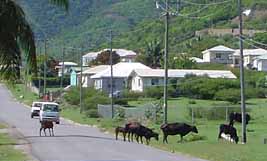 Livestock
is mostly left to wander and graze where they may. Sometimes animals are
tied to a tree or stake in a field, but many just roam. It’s a daily
occurrence to have to stop or drive around cows, goats or sheep on the
roads. Donkeys and horses are more likely to be tied somewhere because
people ride them and I guess their owners want to keep closer tabs on
them. Very few animals are fed purchased food, even the dogs. Dogs tied
in the yards get scraps and the others are left to scrounge. Occasionally
I’ll see someone buy a bag of dog food and it makes me smile inside
when I do. It’s a pretty effective deterrent to have a dog in your
yard because most locals won’t go near them; they’ll stand on
the road and yell for you to come out rather than enter a yard with a
dog in it. George’s neighbors have 2 dogs that rush to the fence
and jump up and down whenever they see me because I think I’m the
only one who ever pets them and pays them any attention. Anyone else goes
by and they bark their fool heads off.
Livestock
is mostly left to wander and graze where they may. Sometimes animals are
tied to a tree or stake in a field, but many just roam. It’s a daily
occurrence to have to stop or drive around cows, goats or sheep on the
roads. Donkeys and horses are more likely to be tied somewhere because
people ride them and I guess their owners want to keep closer tabs on
them. Very few animals are fed purchased food, even the dogs. Dogs tied
in the yards get scraps and the others are left to scrounge. Occasionally
I’ll see someone buy a bag of dog food and it makes me smile inside
when I do. It’s a pretty effective deterrent to have a dog in your
yard because most locals won’t go near them; they’ll stand on
the road and yell for you to come out rather than enter a yard with a
dog in it. George’s neighbors have 2 dogs that rush to the fence
and jump up and down whenever they see me because I think I’m the
only one who ever pets them and pays them any attention. Anyone else goes
by and they bark their fool heads off. 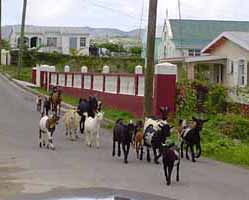 Roads
are only 2 lanes and many are too narrow to park on, but people do anyway.
That causes traffic in one direction to be stopped, but the cars just
work it out, pulling over to let the opposite lane pass, then moving on
when it’s clear. No one gets upset – unless both lanes are blocked
for more than a few moments, after all there really is nothing else to
do. The main roads are good in some places, terrible in others. The story
was that the bad roads were in the areas where the representative was
from the opposition party. I suppose if that’s true, many of those
roads should get fixed soon.
Roads
are only 2 lanes and many are too narrow to park on, but people do anyway.
That causes traffic in one direction to be stopped, but the cars just
work it out, pulling over to let the opposite lane pass, then moving on
when it’s clear. No one gets upset – unless both lanes are blocked
for more than a few moments, after all there really is nothing else to
do. The main roads are good in some places, terrible in others. The story
was that the bad roads were in the areas where the representative was
from the opposition party. I suppose if that’s true, many of those
roads should get fixed soon. 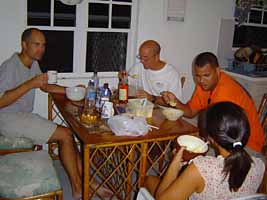 Friday
night several of us got together for a cooking lesson by Joanne at Jim’s
house. The guys had been complaining about not really knowing how to cook
since we got our own places, so Joanne offered to teach some pointers.
We made fried rice and a curry dish. Finished it off with ice cream with
chocolate and rum on top! It was excellent. Played Yahtzee afterwards
and Alan (beginner's luck) won.
Friday
night several of us got together for a cooking lesson by Joanne at Jim’s
house. The guys had been complaining about not really knowing how to cook
since we got our own places, so Joanne offered to teach some pointers.
We made fried rice and a curry dish. Finished it off with ice cream with
chocolate and rum on top! It was excellent. Played Yahtzee afterwards
and Alan (beginner's luck) won.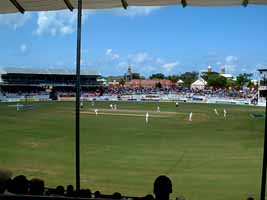 Sunday, while San Diegans were enjoying the opening series in the new
ballpark, I was attending my first cricket match at the Antigua Recreation
Grounds. It was match 4 of the West Indies vs. England Cable & Wireless
Test Match series. A test match lasts 5 days, from 10am to 6pm each day,
with lunch and tea breaks. We got a brief introduction from Alan Friday
night and had a rules book from the library so I had a vague idea what
was going on, but the subtleties of the game were lost on me. I attended
day 2 of 5, so there was no winner or loser – that, I guess, is not
determined until the end. In fact, the entire day was only 1 inning played
– West Indies batted, and England bowled and fielded. From the scoreboard,
I couldn’t even tell who was winning because they only posted the
score of the batting team. Eight hours is really a long time to sit and
watch a cricket game. There were long periods of time when not much was
happening. Probably the best way to do it is go with a large group of
friends and keep yourselves entertained, and there were some areas in
the stands where exactly that appeared to be happening. I wanted to go
at least once just to see what it is all about, and now I can say that
I have, but I’m guessing there was a lot more fun being had at Petco
Park yesterday! (I did get to watch part of the baseball game on ESPN
after I got home last night - I really enjoyed the skycam shots of the
city the best!)
Sunday, while San Diegans were enjoying the opening series in the new
ballpark, I was attending my first cricket match at the Antigua Recreation
Grounds. It was match 4 of the West Indies vs. England Cable & Wireless
Test Match series. A test match lasts 5 days, from 10am to 6pm each day,
with lunch and tea breaks. We got a brief introduction from Alan Friday
night and had a rules book from the library so I had a vague idea what
was going on, but the subtleties of the game were lost on me. I attended
day 2 of 5, so there was no winner or loser – that, I guess, is not
determined until the end. In fact, the entire day was only 1 inning played
– West Indies batted, and England bowled and fielded. From the scoreboard,
I couldn’t even tell who was winning because they only posted the
score of the batting team. Eight hours is really a long time to sit and
watch a cricket game. There were long periods of time when not much was
happening. Probably the best way to do it is go with a large group of
friends and keep yourselves entertained, and there were some areas in
the stands where exactly that appeared to be happening. I wanted to go
at least once just to see what it is all about, and now I can say that
I have, but I’m guessing there was a lot more fun being had at Petco
Park yesterday! (I did get to watch part of the baseball game on ESPN
after I got home last night - I really enjoyed the skycam shots of the
city the best!)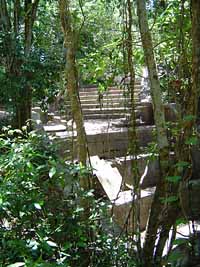
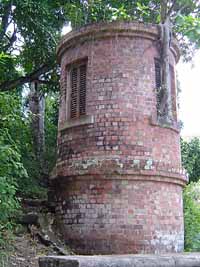 Today
is a holiday (Easter Monday) so we went for a hike up to Wallings Dam.
The dam is just a short walk off of Fig Tree Drive and it was quite a
surprising sight to see when we arrived. There’s a large stepped
concrete overflow structure on one side with a cylindrical brick tower
at the top containing several wheels and gears that appeared to, at one
time, control the flow from the dam. Behind the tower there is a trail
that we followed around the lake and up the hill for quite a ways, until
it forked in several directions. Not knowing where any of the trails led,
we decided to turn around. Back at the dam, there is a nicely maintained
picnic area with tables and a gazebo, so we stopped to cool down and have
a snack before heading home.
Today
is a holiday (Easter Monday) so we went for a hike up to Wallings Dam.
The dam is just a short walk off of Fig Tree Drive and it was quite a
surprising sight to see when we arrived. There’s a large stepped
concrete overflow structure on one side with a cylindrical brick tower
at the top containing several wheels and gears that appeared to, at one
time, control the flow from the dam. Behind the tower there is a trail
that we followed around the lake and up the hill for quite a ways, until
it forked in several directions. Not knowing where any of the trails led,
we decided to turn around. Back at the dam, there is a nicely maintained
picnic area with tables and a gazebo, so we stopped to cool down and have
a snack before heading home.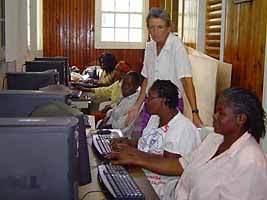 Jim
and I are back teaching in the Cultural Division. The courses have been
restructured and opened up to anyone working under the Ministry of Education,
Human Development, and Culture, and they eliminated the fee that they
were proposing, so we actually have had very good response – so much
so that some of the classes have more students than computers. Anyhow,
had a fun day today – I was trying to make the word processing lesson
applicable to the students, so I had the ladies dictate to me how to make
an Antiguan doll and then had them edit and format it, and we added pictures
from my digital camera. It really created a lot of interest - some of
the other staff members were complaining to Jim that they wanted to take
my class instead because they weren’t doing anything like that in
his!
Jim
and I are back teaching in the Cultural Division. The courses have been
restructured and opened up to anyone working under the Ministry of Education,
Human Development, and Culture, and they eliminated the fee that they
were proposing, so we actually have had very good response – so much
so that some of the classes have more students than computers. Anyhow,
had a fun day today – I was trying to make the word processing lesson
applicable to the students, so I had the ladies dictate to me how to make
an Antiguan doll and then had them edit and format it, and we added pictures
from my digital camera. It really created a lot of interest - some of
the other staff members were complaining to Jim that they wanted to take
my class instead because they weren’t doing anything like that in
his!  In
my class at the Ministry, most of my students are school teachers or principals
or Ministry staff. Today we were finishing Excel and I had them complete
an assignment on their own in class without my direction. I expected to
have to walk them through a lot of it anyway, but they mostly either figured
it out themselves, or helped each other. I was quite pleased – I
felt like they were really getting it. Monday morning I was so tired and
worn out from a weekend of sailing that I was very close to calling in
sick, but then it occurred to me that these people are all doing this
because they want to learn and are depending on me to do my best. It really
was a breakthrough. I was feeling so discouraged at the end of last term
with the cheating amongst my college students and the poor attendance
in the other classes – it feels like it’s all coming together
now.
In
my class at the Ministry, most of my students are school teachers or principals
or Ministry staff. Today we were finishing Excel and I had them complete
an assignment on their own in class without my direction. I expected to
have to walk them through a lot of it anyway, but they mostly either figured
it out themselves, or helped each other. I was quite pleased – I
felt like they were really getting it. Monday morning I was so tired and
worn out from a weekend of sailing that I was very close to calling in
sick, but then it occurred to me that these people are all doing this
because they want to learn and are depending on me to do my best. It really
was a breakthrough. I was feeling so discouraged at the end of last term
with the cheating amongst my college students and the poor attendance
in the other classes – it feels like it’s all coming together
now.  The spinnaker and pole went in the water and the boat heeled over
to near 90 degrees. Poor Louie looked like a flag blowing in the wind
as he hung vertically from one of the stays to keep from going over the
side. On the bright side, I finally figured out how to get over the boat
during a tack with the least amount of pain and without getting kicked
in the head. It wasn’t completely painless though, because on one
trip across I caught my knee on the boomvang pulleys and got a nasty bruise
that’s swelling up and making it hard to walk. If the winds stay
like this tomorrow, it will be hard to find anywhere on my body that doesn’t
have a bruise or a bump on it!
The spinnaker and pole went in the water and the boat heeled over
to near 90 degrees. Poor Louie looked like a flag blowing in the wind
as he hung vertically from one of the stays to keep from going over the
side. On the bright side, I finally figured out how to get over the boat
during a tack with the least amount of pain and without getting kicked
in the head. It wasn’t completely painless though, because on one
trip across I caught my knee on the boomvang pulleys and got a nasty bruise
that’s swelling up and making it hard to walk. If the winds stay
like this tomorrow, it will be hard to find anywhere on my body that doesn’t
have a bruise or a bump on it!