 |
search engine here |
||
|
|||
| USEFUL MARKET SURVEYS |
The African Demand For Satellite Equipment Dubai-based traders focus attention on African markets as demand for satellite equipment registers unprecedented rise |
|||
|
The United Arab Emirates is the undoubted leader in terms of offering the most technologically-advanced satellite systems in the Middle East. Dubai alone has more than 300 companies engaged in the installation of satellite systems, and around 150 companies involved in direct selling of satellite products. As a result, Dubai offers a wide range of products and services geared to provide excellent television reception. For African customers this translates into the convenience of finding a comprehensive range of products at competitive prices. "Dubai has become a major of supplier
of dish antennas, LNBs, satellite receivers and other related equipment
for East Africa," said Nazim Karmali of Uganda-based Bai Enterprises. "Africa has the potential to emerge as the next big market for satellite equipment and services," notes Hussain Naqvi, general manager of MediaCom in Dubai. "Demand from East African countries has been growing for the last couple of years," he said. The total turnover of the satellite market in 1997 is estimated to have been almost Dhs 1 billion. Most of the demand for satellite equipment is from outside the domestic market, namely re-exports, tourists and travellers, as UAE has established itself as a major retail and wholesale supplier of all types of electronic goods. Over the last year, television viewing in Africa has undergone a paradigm shift. From a limited selection of national broadcasters with restricted transmission coverage, or very expensive satellite options, African TV viewers now have a selection of 39 DS TV channels available through direct-to-home (DTH)satellite television. The DS TV option is currently made up of 20 TV, 17 audio and two optional TV channels. Orbicom, the signal distributor for MultiChoice, provides the technology behind this revolution. Orbicom has set up the systems to allow C-band transmissions from the PAS-4 satellite to cover almost the entire continent of Africa. With C-band, satellite TV viewers can use a satellite dish as small as 1,8m. Central to DS TV's success is the correct installation of satellite dishes. Orbicom has a field services satellite receiving team who have spent the last one year advising and travelling through Africa, resolving problems typical of such new ventures. As a result of these developments, the satellite television market in Africa is abuzz with activity as new opportunities offer themselves in the vast continent. Canadian/Ugandan television company, Home Vision is planning six new channels for Uganda, which is already home to four free-to-air services. Home vision intends to operate four pay-TV and two free-to-air channels, and is looking at establishing satellite distribution in East Africa. Home Vision is a technology supplier to 29 television stations, mainly in developing countries. and is currently planning to expand on their operations in Africa. One of the large satellite TV companies in Africa, Home Vision is associated with a number of Canadian broadcast technology firms. Privately owned satellite operators such as PanAmSat have in recent years gained a large chunk of the independent television distribution business in Africa, in large part due to their flexible operational style. PanAmSatís PAS 4 introduced multichannel satellite TV to Africa recently. PanAmSat also launchend a second satellite to serve sub-saharan Africa last year. MMDS (microwave) transmitters have become a popular way of broadcasting to capital cities in West Africa. But, in South Africa, the MMDS network is making way to DTH satellite broadcasting. Since the introduction of Ku-band
satellite transmissions in South Africa in 1995, Orbicom has dismantled
35 of its 70 MMDS transmitters. These transmitters were part of a satellite
network providing business and educational TV services. With the imminent introduction of
cable television by UAEís telecon company Etisalat, dealers in Dubai are
looking to develop new markets for re-export and Africa is certainly one
of the most attractive proposition under the current scenario. Long range
telephones, security systems and other telecommunication products like
satellite phones and wireless sets displayed by Dubai-based companies like
MAF Telecom and Samraa Trading Est. at the Afro
Business Trade Fair in Uganda generated a lot of interest. ìDubai companies
can reap rich dividends by introducing new products and technologies in
the emerging markets of East Africa,î says Sadat Hocine, a Dubai-based
trader.
Huge Profits
Satellite equipment in certain African countries costs as much as three times the price that its being sold in Dubai. This huge price difference has given rise to the ëcarrierí business from African countries whereby individuals from these countries travel to Dubai specifically for purchasing these goods and selling them at a premium in their own countries. Satellite dishes, receivers, LNBs, cables and other related equipment is being bought in increasing quantities by African customers visiting Dubai. The satellite market in Dubai - a beehive of activity because of its re-export business - has been registering an increase in the number of visitors from Africa. Traders in Dubai are happy with this new trend as they are paid in cash and the responsibility of shipping the goods and clearing them through customs is also not their headache. ìCash customers who buy in bulk are always welcome,î says Akbar Ali of Globatronics, one the leading suppliers of satellite equipment in Dubaiís satellite market. Business Contacts
Business Advise
There are a few easy ways for dealers and manufacturers of satellite equipment to make their presence felt in the markets of Africa. For traders of of satellite receivers, LNBs and dish antennas, Africa is indeed a very lucrative market. Those dealing in products manufactured in the Far East (China, Korea, Thailand, Malaysia etc) will find a ready market for their products as Africa is by and large a very price-sensitive market. It is a well known fact that African customers prefer cheaply priced goods from the Far East rather than the expensive ones from Europe and America. You can promote your products and/or services in Africa through many mediums: |
|||
courtesy of Africa Business Pages |
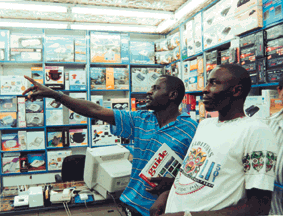 "Satellite television is still a relatively new concept in the East African
region and there is a great demand for quality satellite systems which
is being sourced from Dubai,î he said. As more and more countries in Africa
join the bandwagon of satellite television, the demand for satellite receiving
equipment is bound to grow in the future. Prices of dish antennas and LNBs
in countries like Uganda, Congo, Rwanda and Tanzania are almost double
of what they are in Dubai. As a result, a large number of African traders
are buying these goods from Dubai in large quantities and selling them
in their countries at a high premium.
"Satellite television is still a relatively new concept in the East African
region and there is a great demand for quality satellite systems which
is being sourced from Dubai,î he said. As more and more countries in Africa
join the bandwagon of satellite television, the demand for satellite receiving
equipment is bound to grow in the future. Prices of dish antennas and LNBs
in countries like Uganda, Congo, Rwanda and Tanzania are almost double
of what they are in Dubai. As a result, a large number of African traders
are buying these goods from Dubai in large quantities and selling them
in their countries at a high premium.
 The new PAS 4 Ku-band satellite also carries these channels and, since
the service requires only cheap, 90cm satellite dishes, customers are using
dishes for direct reception of these nich* market channels. Some decommissioned
transmitters are being redeployed to high density areas of South Africa.
Predominantly, MMDS is used to broadcast to capital cities in Africa, where
television frequencies may not be available, and the role of MMDS is far
from over. MMDS requires a ìset-topî or a headend converter for reception,
which makes it a little more expensive than reception of ìnormalî TV frequencies.
The cost of the converter is still much lower than a satellite reception
kit, and, especially in highly populated areas, will remain a useful method
of transmission.
The new PAS 4 Ku-band satellite also carries these channels and, since
the service requires only cheap, 90cm satellite dishes, customers are using
dishes for direct reception of these nich* market channels. Some decommissioned
transmitters are being redeployed to high density areas of South Africa.
Predominantly, MMDS is used to broadcast to capital cities in Africa, where
television frequencies may not be available, and the role of MMDS is far
from over. MMDS requires a ìset-topî or a headend converter for reception,
which makes it a little more expensive than reception of ìnormalî TV frequencies.
The cost of the converter is still much lower than a satellite reception
kit, and, especially in highly populated areas, will remain a useful method
of transmission.
A Personal initiative of the author Engr.Jolan P. Formalejo.