|
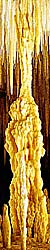
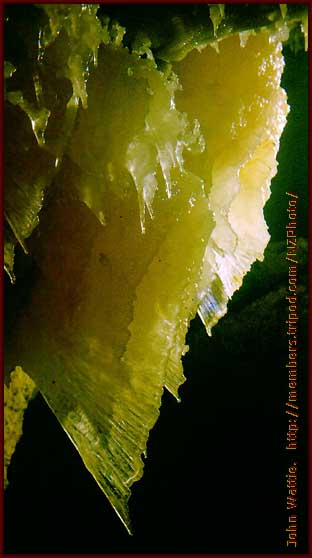
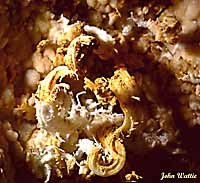
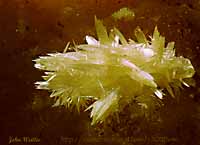
Gypsum flowers "grow" in
profusion on the wall of the Puketiti Flower Cave in New Zealand. They are rocks, not
living plants, despite the flower-like shape. They seem to grow and curve out of the wall,
like toothpaste forced out of a tube. Some say they come out of cracks in the wall, but it
would be vandalism to break them off to search for any cracks and so I cannot confirm this
theory. Usually gypsum flowers are white. In this passage the
tips of the flowers are brown. Probably water flowed through the cave at some stage
depositing mud from a flood. The flowers continued to grow and the base of the flower once
again showed the normal white colour.
Photograph by John Wattie.
Press on the thumbnail image to see a bigger version.
The blue border means the image is a link to another place. |
|
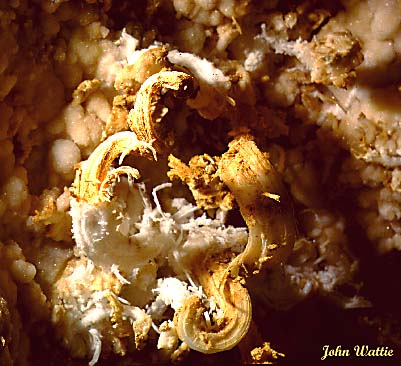
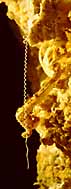
This extraordinary spiral has 57 turns
and is another gypsum formation in the lovely Puketiti flower cave. This is the only
long cork-screw formation known to the author. The "wood shaving", described later, has a spiral shape
reminiscent of this. The shaving has crystallised in mud , which suggests this spiral has
crystallised in a similar way from the cave wall.
Photography: John Wattie Press
on the image to see a bigger version |
|
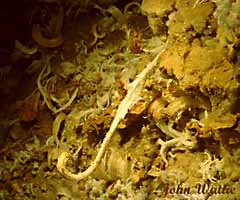
A gypsum "walking stick" on the flower cave's
wall. All sorts of shapes develop and we choose certain ones
to photograph because they look like familiar objects.
Gypsum is hydrated calcium sulphate. It is often associated with
sedimentary rocks, like limestone, because it is one of the first crystals to form when
salt water evaporates. If gypsum is ground up and then heated to drive off the water, it
becomes Plater of Paris.
Photography: John Wattie
No blue border means: no bigger version is available. |
|
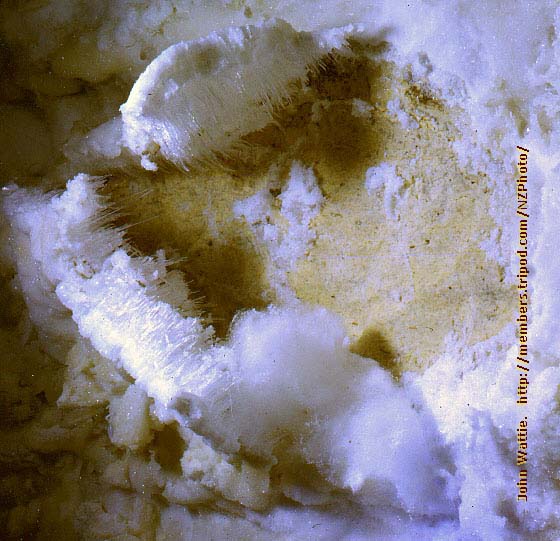
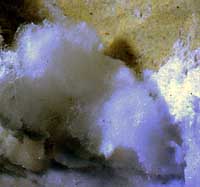
This cave wall is lined by gypsum, but for some reason
it has peeled off here, to reveal gypsum "needles". The
gypsum "cotton wool" is a rare phenomenon and I have only seen it once. The
fibrous form of gypsum is called Anhydrite, meaning gypsum without water.
It is possible this is Epsomite, which is epsom salts
(hydrated magnesium sulphate). It forms delicate fibrous masses in mines and caves. It was
first found in Epsom, England. Epsomite is "diagnosed" by tasting very bitter
when the tongue is applied to it (but this piece has not been tested by taste!)
(Peter Roberts, personal communication).

|
|
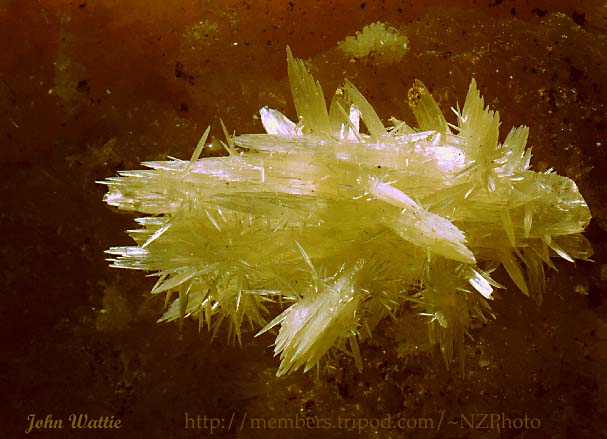
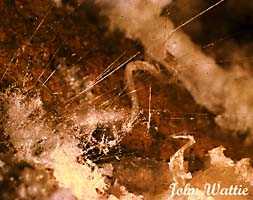
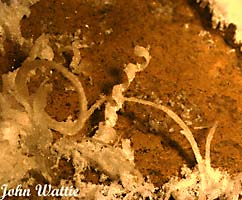
Selenite
"needles" seem to grow out of mud on this cave floor.
Nearby the mud produces a selenite
"wood shaving" and other "antlers" of varying shapes.
Mud is found everywhere in caves, but
selenite growing from it is rare.
Selenite is a form of gypsum
Photography in Fred
Cave: John Wattie
|
|
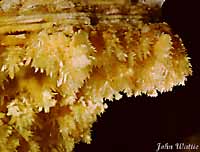
Calcite crystals have precipitated
under water. The water has long gone, but we can see the old
surface of the pool, clearly marked by the flat top to the crystal formation.
This is only a portion of the "jewel box" in the depths of
the Puketiti flower cave. The chamber is big enough for two people at a time and is lined
by the jewel-like crystals |
|
Calcite is the crystalline form of
limestone (calcium carbonate). Large cave formations are all
made of calcite. It often contains impurities which can colour it and determine its
various forms, ranging from soft chalk to hard marble, or large crystals, as here. Iceland
spar is made of large, very pure calcite crystals, used in optical instruments and Nicol
prisms, which polarise light.
The rate of formation
of calcite crystals is known from a New Zealand gold mine investigated by Peter
Roberts.
Puketiti cave photography by John Wattie. |
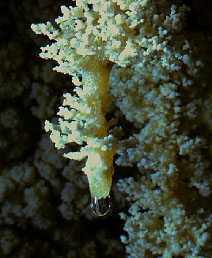
On rare occasions, crystals form and
project horizontally from the surface of a straw. These crystals are called helectites.
In this grotto, helectites are also growing on the wall. The helectites were found only in
a small part of this large cave. Presumably the dissolved minerals have different
impurities here, causing helectites to grow?
|
Stalactites hang down from the roof and
stalagmites grow up from the floor. "When the mites crawl up, the
tights come down."
Stalactites start as a hollow straw,
formed by limestone crystallising around the outside of a water drop. Straws slowly
elongate as new drops follow and make their contribution. You can see a water drop
dangling from the tip of a straw (and several more in the enlarged version of the
picture).
Rain fell on the earth and became acidic while
trickling in the soil layer above the cave roof Carbon dioxide is absorbed from decaying
humus to form carbonic acid.
Dissolved carbon dioxide is here diffusing from the
drop, to enter the cave atmosphere. The water was acidic (carbonic acid) as it
penetrated cracks in the cave roof, enabling it to dissolve the limestone. Now the
carbon dioxide is leaving, the drop loses acidity and the dissolved calcium carbonate
precipitates. The calcium carbonate forms as a ring around the drop, elongating the straw,
but preserving its central hole.
Straws are smooth on the outside. They slowly
thicken as water runs down on the outer surface, depositing calcium carbonate.
Eventually the straw's hole is blocked. It is
then a stalactite and continues to grow in diameter and length from the lime water
trickling on its surface.
Helectites are said to contain a
central canal along which lime water is forced hydrostatically or by capillarity. A drop
forms at the tip of the channel, droops and crystallises at an unpredictable angle. Rarely
helectites all point the same way, due to a draft in a cave. They can even grow upwards,
defying gravity.
Photographs copyright: all by John Wattie. |