 Press to return to the cave
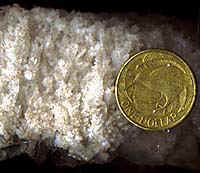
Calcite sample, viewed from the side to show thickness.
Peter J Roberts found this calcite in underground workings of the Carrick Goldfield in Central Otago, New Zealand. These old workings are on the eastern flank of the Carrick Range, a few km south of Cromwell.
Mining commenced here around 1870 and ended around 1910, although there was minor intermittent activity in later years.
This calcite was formed from lime-rich mine water percolating along the floor. When found in 1982, by an Amoco prospecting party, the white calcite covered several square meters of the floor of an old adit. Fragments of crushed schist are incorporated in the base of the sample (the grey stones), which proves the calcite formed after mining commenced. The calcite is very delicate and would have been readily destroyed by foot traffic, so it must post date mining activity.
This gives a maximum age of 129 years, and probably 1980-1910 = 70 years.
The New Zealand dollar is 23mm diameter.
The growth rate for the calcite is about 42mm/70 years = 0.6mm/year.
Rate of growth depends on rain-fall, thickness of the soil (which decides if the water becomes saturated with carbon dioxide) and rate at which the lime water trickles into the mine...
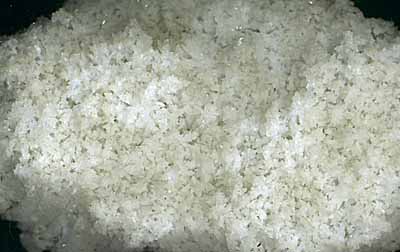
Calcite sample seen from the top surface