Page 1
|
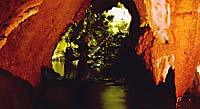
Only a few caves are as easy to walk into as White's
cave. Most New Zealand caves are entered down vertical shafts. Walking in water is usual and wet boots are inevitable. In New Zealand, a shaft in limestone country is called a tomo. "WAITOMO" is a Maori place name meaning water (wai) shaft (tomo). Pronounced: Why-Toe-Mow Lighting: John Pybus |
|
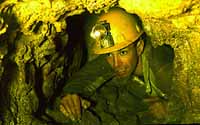
Crawling through holes is common,
dragging a small water-proof pack containing the camera, collapsed tripod and an
electronic flash-gun. Calcium carbide helmet lamps produce acetylene as water drips onto
the carbide. Acetylene flames give a good light, although it is yellow. Often the true
colours of caves are only appreciated when the photographs are processed. Mud has spoiled
the caver's lovely white overalls, but at least mud lubricates the drag of clothes on
limestone rocks. Photography:
John Wattie |
|
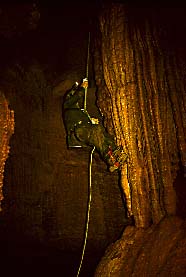
Frequently caves must be entered by dropping down a
vertical shaft on a rope, or a wire ladder. Since the shaft can be several hundred feet
deep, it is necessary to use a brake bar to slow the descent. The rope has a
non-stretch core and is not twisted, since a rotating rope would be a great nuisance. It
is not the standard climbing rope, which is elastic so as to absorb shocks. An extra belay
line is often used, especially for beginners, but this expert is climbing without any
belay. The speleologist is climbing back up the rope, using jumars. These are Swiss rope gripping devices which are much safer than prussic loops. He has a jumar in each hand. Each jumar is connected to one foot by a rope sling. He slides a jumar up the climbing rope, locks it on, then pushes himself up with the appropriate leg. Alternating this way, he climbs the rope rather like a ladder. Note that the rope passes through a karabiner attached to his chest loop. This stops him falling away from the rope, with the risk of turning upside down and crashing out of the foot loops. The karabiner also has the top Jumar/foot sling running through it. It is not a good idea to get the carbide helmet lamp too close to the rope! Calcium carbide releases acetylene gas when water drips onto it and the gas is ignited to give a fairly bright, yellow light. The naked flame is safe, as there are no explosive gases in caves, unlike coal mines, However, the flame is very hot! Speleologists take more than one light source into a cave, including a torch or two, often a candle and spare batteries and calcium carbide. A wire pricker is essential, to keep the carbide lamp jet clear Alabama, USA. Photography: John Wattie |
|
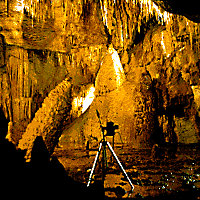
"Painting with light"
technique is used for cave photographs. The camera is on a firm tripod. The shutter is locked open in the dark, using a locking cable release and B setting in the case of this Nikon, which does not have a T shutter option. The photographer wanders through the cave in the dark, firing his electronic flash from pre-determined sites. As many as 20 flashes may be integrated on the film in a big cavern and this may take 20 minutes or more to finally build the picture up on the film. Transparency, positive film is used since negative colour film causes difficulty in deciding on the correct colours when it is printed. Waipuna Cave Photography: John Wattie |
|
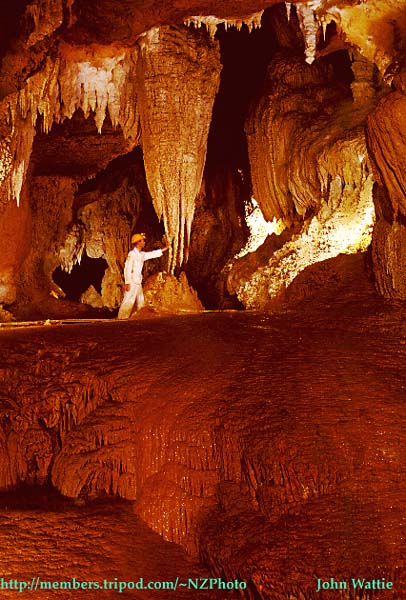
Flow stone is like a frozen
waterfall, except it is made of limestone. The red colour is due to iron compounds (rust).
The painting with light technique takes so long that the model has difficulty keeping still. Touching cave formations is not "good form" but was done here to keep him still during the long exposure time. This is White's cave, which is very clean and the speleologist still has white overalls. Overalls soon turn wet and brown in the commoner muddy caves. He walked along the stream, shown on the top picture and his boots were clean. So were those of the photographer, who clambered over the flow stone in the dark, carrying the flash gun. Similar flow formations occur in hydrothermal waterfalls, but made of silica instead of limestone. Lighting: John Pybus, Camera: John Wattie |
|
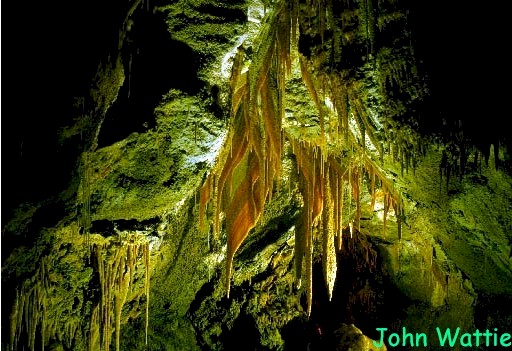
Konrad cave
is famous for shawls. As water runs down the sloping roof of the cave, it meanders, just
as a stream follows a wriggling path over the surface of the land. In the cave
atmosphere, limestone is deposited as it comes out of solution. Gradually, the shawls are
built up by the meandering trickle on the roof. Photography: John Wattie |
| Go to page 2: Small cave structures, crystals. |