Press the shell
for table of contents
Press the shell
for table of contentsPage 3
Press the shell
for table of contents
Climbing in caves is scary: it is so dark you imagine dangers, worse than reality!

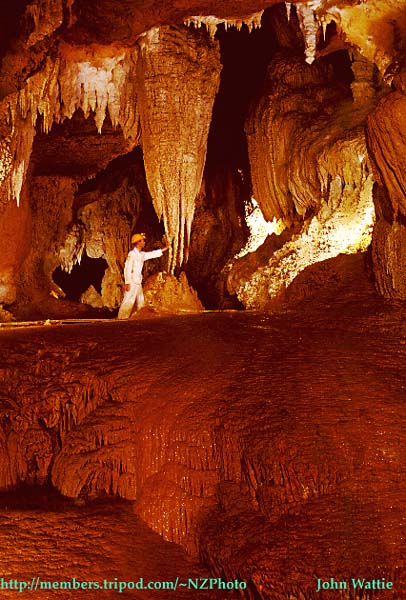
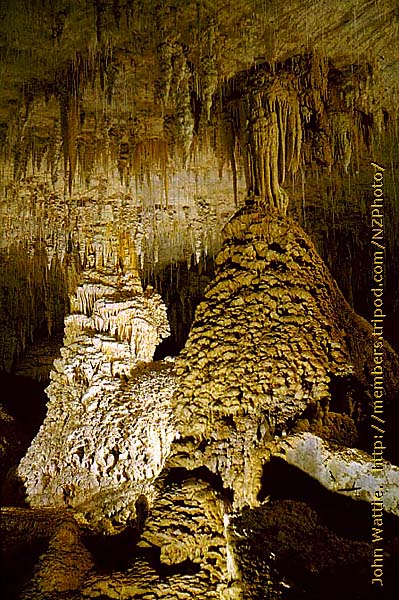
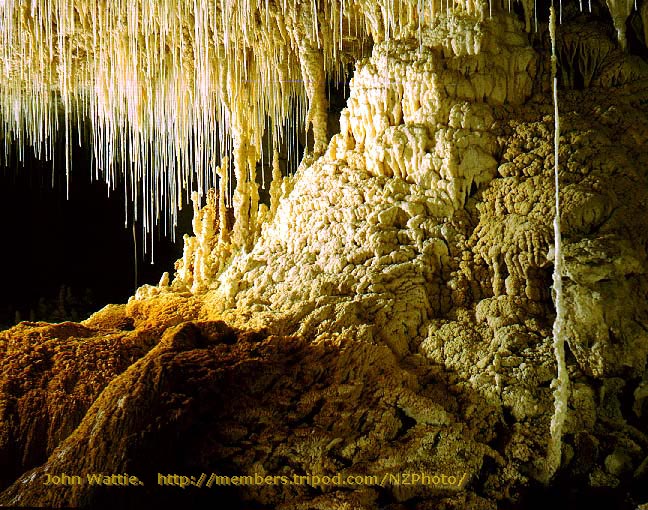
This page shows BIG cave formations. Press to view |
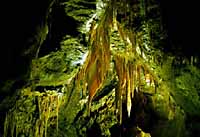
Hollow Hill cave has huge columns with strange "blade formations" |
|
The Peter Lambert Level of Gardner's Gut has a big column, coloured red by rust. |
|
Splattered mud versus splattered lime water. (Hollow Hill cave)
|
|
Light suction
in caves: phosphorescence and photography
|
|
Page
4: more caves.
|
Light suction in caves |
Sign on a darkroom door |
"You
can never use too much electronic flash in a cave" |
"Do not open: all the dark will leak out" |
| Photographers believe caves "suck
up light". Electronic flash exposures are computed from the guide number. Slides of caverns come back too dark, unless compensation is made for caves losing photons. |
Guide numbers are generally
quoted for flash fired in a room, where the ceiling and walls are usually pale and reflect
light. When a flash is used outside, or in a large cavern, there is no reflection.
|
| . | . |
Cave phosphorescence |
Caves do suck up some light, it is not just a charming metaphor! |
| If you shut your eyes to avoid the glare
while the electronic flash fires, then immediately open them, the cave formations glow
with an eerie light, which quickly fades
|
Electronic flash guns emit some
ultraviolet light, especially an unfiltered, naked flash tube in a reflector. Some cave minerals absorb UV and far blue light. Phosphorescence fades exponentially after
the flash. |