HOME

   JIN KEI DO

   THE SPECIAL TEACHER

   Q's and A's

   TEACHER

   LINEAGE TREE

   TRAINING

   MEDITATION

   SPIRITUAL IDEALS

   VENUE

   PRACTICE TIMES

   THERAPIES

   EMAIL

   LINKS

   BOOKS

  QUESTIONS REIKI SYMBOL
COMMONLY ASKED ABOUT ...
REIKI

"What is Reiki?"

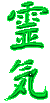
The word REIKI is a Japanese term.

In Japan, "REI" means something mysterious, miraculous, and sacred, whilst "KI" means the atmosphere or something unseen, or the energy of the universe. The Japanese words REI and KI can be defined as the miraculous and sacred energy of the universe which sustains all life. Reiki has no connection with any religion or belief system. It is the essence of compassion - the cornerstone of the practice.

Reiki is a spiritual healing practice that can help return us to a state of functioning balance on all levels physical, mental, emotional and spiritual. It is a gentle 'hands-on' practice with very ancient origins emanating from the cultures of Tibet, Nepal and northern India. The practice involves a form of subtle energy transference in which the practitioner places his or her hands over the head, trunk and limbs of the client to allow the flow of Reiki energy. It is a form of vibrational healing or biofield therapy.

Reiki is not a form of massage, as the contact is entirely passive, each hand placement being maintained for around two to four minutes on average. Contact is very gentle, and, in the Jin Kei Do lineage, the body's surrounding energy field is also treated.

The current lineage bearer, Dr Ranga Premaratna, Ph.D, has given this form of Reiki the name "Jin Kei Do". These are Japanese words which translate as follows: Jin = compassion; Kei = wisdom; and Do = a path, or way of life. Reiki is essentially a practice which offers compassion and care to the receiver through the medium of gentle touch. It is not a substitute for any other form of treatment, and it does not interfere in any way with that chosen treatment.

Typically, a Reiki session may bring rapid stress reduction and relief from pain or physical discomfort, and anxiety. Reiki does not treat disease, but it may assist in relieving side effects of medication, radiation or chemotherapy, but results will vary according to individual situations. Essentially, it supports wellbeing and may stimulate the healing process, even when that has been stalled for a lengthy period. Contraindications are unknown.

"What is the energy that is used?"

    The energy that is used is not the personal energy of the practitioner. Rather, it is described as the "Universal Life Force" without which nothing would in fact exist. This limitless energy emanates from an outside source, and the practitioner is merely a facilitator.

"Does Reiki involve any belief system?"

    No. Reiki has no belief system, and no connection with any religion. However, as is the case in any healing process, that healing process will always be more active if the patient has an open mind and a positive attitude towards the treatment outcome.

"Is removal of clothing required?"

    No. Since the energy will pass through any substance, including cloth, plastic, rubber, metal and plaster casts, the person being treated remains fully clothed. Treatment may be received either seated or lying on a bed or couch

"Does Reiki offer a cure?"

    No. Reiki can offer healing and nourishment on all levels - physical, such as to relieve pain or discomfort; emotional or mental, such as to cope with stress or emotional situations; and finally, the spiritual level, by helping to restore peace of mind, the addressing of anger or grief, or to feel more positive about life. Reiki does not cure anything, though a cure sometimes does occur as part of healing. Healing and curing are, however, quite different processes.

"What is the experience of Reiki?"

    Experiences vary from person to person, and from situation to situation. However, it is common for the receiver to experience relaxation which may sometimes be profound. A person may also experience a rise in physical and mental energy after a treatment. The energy is often experienced as warmth from the practitioner's hands. All experiences are individual, and the practitioner does not offer an interpretation or explanation of these experiences.

"Can anyone practise Reiki?"
"Does it require any special ability?"

    No. No special ability is necessary, and no special prior knowledge is required. The majority of people who learn the practice are lay people whose only desire is to use Reiki as a self-treatment on themselves, in family situations, and with friends in need. Animals and plants also readily respond to treatment with Reiki.

    The practice is also administered in medical and hospital situations by health professionals, including medical doctors, nurses, and psychologists. Naturopaths and body workers, such as masseurs, physiotherapists, reflexologists and shiatsu practitioners, find that the practice of Reiki enhances the quality of their principal modality.

Hosted by www.Geocities.ws

1
