















2003 NMUN Conference
The 2003 NMUN conference was sponsored by the National Collegiate Conference Association. The conference which took place in the Hilton New York from April 15th to April 19th 2003 was a fascinating experience for John Jay College students who were assigned to represent the Republic of Peru in twelve (12) committees. Prior to the conference, participating students were required to prepare papers summarizing Peru's position in regards to the three (3) issues that were discussed in each committee. The position papers required immense research, staying at school till 2 AM, translating websites and newspaper articles from Peru�s national language Spanish into English, digging out grassroots research from Peruvian newspapers, and Peruvian Ministries of Economy, Education, Health, etc. After hours spent at researching and translating, students were often dispirited to learn that their research was not relevant to the issues of position paper. But the overall experience of researching about a country of a different culture, language, and society than their's, about issues to which they had never heard about, was a great and significant experience of their lives; opening up many new possibilities and a unique and diplomatic understanding.
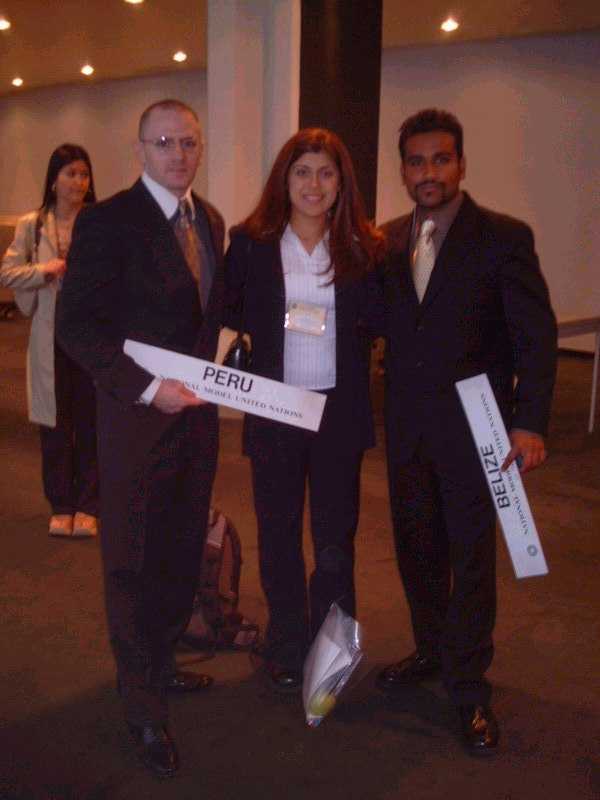
Jason Roderiques (left) along with delegates from other colleges at the NMUN Conference
Representing Peru at the Conference meant that students had to put aside their own personal prejudices and attitudes and advance Peru�s interests unconditionally. It required immense patience, understanding, and a perceptive attitude to advocate something even if it runs afoul of your personal beliefs. The conference allowed students to scrutinize issues such as globalization, world poverty, health issues, sustainable development and free trade, non-proliferation, education, etc, from Peruvian perspective, steering them to understand the aforementioned issues from the perspective of a developing state. Such an experience gave a diplomatic understanding to the students personal perspective.
In the next few days, the position papers that were prepared prior to the conference by John Jay College students will be added to this site. In addition, a few reviews of the the NMUN conference will also be added to this site.
Position Papers from the 2003 NMUN Conference
Position paper for the United Nations Special Session on Children
The issues before the United Nations Special Session on Children are: Children and the Environment, Child Labor: The Plight of Children Living in Poverty, and The Effect of Sanctions on the Well-being of the Child.
I. Children and the Environment
Peru has a solid legal framework, which provides adequate standards with respect to the rights of the child. The Peruvian Government has set up a special commission to deal with environmental problems. Article 19 the American Convention on Human Rights, ratified by Peru in 1978, establishes the right of member - states to take necessary measures to protect their children. Furthermore, the Republic of Peru, one of the first to ratify the Convention on the Rights of the Child, is deeply committed to the protection of children�s rights.
However, Peru ascribes particular attention to poverty, the unequal distribution of incomes and social exclusion, which is one of the main environmental problems with a great impact on children. Therefore, the Government has implemented Project Hauscarfin, which will connect schools and improve the quality of education of children in areas with high poverty levels. In addition, the 20% reduction of military expenses has been redirected to investment in nutrition, health, and justice for people living in poverty. Peru has already presented the National Plan of Action for Children 2002-2010, which contains strategies, programs and actions with strong emphasis on the reduction of infant mortality, poverty and malnutrition, and access to basic services and education. In fact, infant mortality for children of age has already decreased from 43 to 33 per 1000 live births between 1996 and 2000. Also the government of Peru in collaboration with USAID and other non-governmental agencies has been working on improving the national environmental policy and institutional framework, increasing local environmental management capacity, and increasing environmental awareness, understanding and demand. Since 50,000 Peruvian children are involved and work in mining, these children are being exposed to mercury, poor sewer systems, and lack of clean water, which lead to health risks. Thus, governmental and non-governmental agencies are working with the International Labor Organization (ILO) to eradicate child labor in mining, in order to reduce environmental hazards. Mining is a big issue in Peru. Not only does it pollute the air, but often also its waste filters into the water that people drink. The Environmental Health (DIGESA), the National Environmental Council (CONAM), the Ministries of Industry, Transportation and Presidency, local authorities, NGOs, and firms are principal partners of the government in its environmental health area efforts.
The Peruvian government strongly recognizes the rights of the child and it is taking necessary steps to enforce them. Thus, the government has provided strategies to guarantee the successful accomplishment of these rights.
II. Child Labor: The Plight of Children Living in Poverty
Poverty is a major cause of child labor. Children, who work, tend not go to school and even if they go, working prevents them from pursuing the proper education. Children in Peru work in different fields: agriculture, fishing, manufacturing, mining and quarrying, services, domestic workers, and commercials workers among others. Even though, children as young as 12 years old are permitted to work the minimum age vary in accordance with different occupations. For instance, a minimum age of 14 applies to children working in agriculture, 15 years old for industrial, commercial and mining activities, and 16 for commercial fishing. In addition, Peru�s child labor laws do not permit children between the ages of 12 and 14 to work more than 24 hours per week. Also, Peruvian laws prohibit youth below a certain age from working at night. In Peru, the Ministry of Labor authorizes the work of adolescents working for third parties or in dependent situations. In order to receive authorization the work must not interfere with the regular school attendance and the adolescent must have a medical certificate which is provided free of charge by the Ministry of Health. The Ministry of Labor also requires proof of identity and proof that the child is enrolled in school. However, employers, parents, and relatives must guarantee their regular school attendance. Special judges dealing with children�s issues are to oversee the enforcement of all issues related to domestic workers. One of the most problematic forms of child labor in Peru is children working in small-scale mining, who are not only exposed to immediate risk but they are jeopardizing their long-term development both physical and socioeconomic. The hazards faced by children are different: inundation, cave-in, asphyxiation, overexertion, malnutrition, TB, malaria, diarrhea, trips and falls, lack of hygiene, dust, noise, vibration, mercury, and other chemicals. In order to eliminate child labor in mining, Peru has and is collaborating with many agencies and international organizations, especially ILO through the International Programme on the Elimination on Child Labor (IPEC). In addition Peru ratified the Worst Forms of Child Labor Convention 182 on 10/01/2002. By ratifying this Convention Peru has made a commitment to stop the suffering of those children who were working and at the same time to end the commercial exploitation of children. The Peruvian government respects and adheres to existing laws and conventions including the UN Convention on the Rights of the Child, which Peru has signed and ratified. Peru is committed to strengthening control and inspection mechanisms for all issues concerning child labor.
III. The Effect of Sanctions on the Wellbeing of the Child
The Republic of Peru feels that general sanctions, when used against a nation, threaten the wellbeing of children. In 1973, when Peru�s credits were withdrawn, the economy nose-dived and poverty increased dramatically. As a result, Peru�s inability to actively trade created extensive unemployment and malnutrition, which affected the most vulnerable Peruvian citizens, especially the children. The Republic of Peru feels that sanctions need to allow for continued foreign investment and the acceptance of trade credits. According to the United Nations Children�s Emergency Fund (UNICEF), currently 200 children in Iraq are dying everyday as a direct result of general sanctions implemented through S/RES/661and S/RES/667, which do not make the distinction between dual use, military and civilian, goods. In the case of the Republic of Haiti, under S/RES/917, sanctions were applied on all commodities and goods except for specified medical supplies. As a result of these general sanctions, civilians cannot utilize many necessary medical goods and other products, which can provide humanitarian aid and stabilize the economy. However, if targeted sanctions were applied in Iraq, there would have been 500,000 fewer deaths of children under the age of five. The government of Peru believes that smart sanctions, which still constrains specific areas, such as military technology and visa restrictions, but that do not disrupt the overall structure of a states economy, should be utilized.
Peru also shares the belief of the Office for the Coordination of Humanitarian Affairs (OCHA) that a new regime monitoring the impact of sanctions should be established in order to insure true humanitarian objectives. In recent history, targeted sanctions have proved their effectiveness. The success of those sanctions is evident in the cases of the former Yugoslavia under S/RES/988 and S/RES943, in Haiti with S/RES/841, and in Sierra Leone with S/RES/1132 and S/RES/1156. Indiscriminate sanctions are blunt instruments that victimized those least capable of protecting themselves and least responsible for the course of action that led to the adoption of sanctions in the first place. Also, Peru shares a similar approach as the Committee on the Rights of the Child, pointing out that general sanctions can act as an obstacle to the implementation of the Convention on the Right of the Child, which Peru was one of the first states to ratify. Therefore, Peru strongly believes that general sanctions would violate and negatively influence the well being of the child.
Position Paper for the United Nations Educational, Scientific, and Cultural
Organization.
The issues before the UNESCO are: Consideration of Democratic Governance Programs Deliberated at the 2002 World Social Forum; UNESCO�s Role in Post-Conflict Reconstruction; HIV/AIDS in Africa: A Cultural Approach.
I. Consideration of Democratic Governance Programs Deliberated at the 2002 World Social Forum
The Republic of Peru is a newly developing democratic nation and is experiencing a dramatic political, economic, and social transition that began in the year 2000. The Government of Peru had made commitments to reinvigorate the country's democracy and promote a market-based economy that will provide benefits to all Peruvians. However, the internal economic and political situation remains unstable, especially in light of the current problems in the global economy. Nevertheless, there are five key areas that the government of Peru is focusing on: decentralization and local government strengthening, congressional reform (OEA/Ser.P AG/RES. 1753 XXX-O/00,) civil-military relations, support for a Truth Commission to address human rights abuses committed over the past decade, and anti-corruption in politics and economics.
The Peruvian Government strongly believes in reforming the electoral process (2AG/RES.1837 XXXI-O/01), strengthening freedom of the press, and improving the judicial system. With the great support of the United Nations and its agencies, such as UNESCO, Peru is steadily evolving into a more open society.
Furthermore, the Government of Peru is working closely with the IDEA and is building up solid partnership, respect, and developing political reforms, promoting political participation of women and other under-represented groups, and preparing the ground for work on political parties. The Republic of Peru is fully committed to reform the electoral process, ensure an independent judiciary, an independent constitutional tribunal, protect freedom of the press, and is working closely on these and related issues with the Organization of American States (OAS).
II. UNESCO�s Role in Post-Conflict Reconstruction
Even though violence still remains a major issue in Peru, the Republic of Peru is fully committed to the promotion and protection of internationally recognized human rights and norms. Working closely with UNESCO and other NGOs the Republic of Peru strongly believes in promoting an International Forum on Education for Non-Violence. Thus supporting the long-term continuing process of developing a culture of non-violence and cooperative learning in schools and other educational institutions as an important contribution to a global movement for a culture of peace. The Republic of Peru is focusing largely on promoting the Culture of Peace by eliminating war and conflict on the local as well as international levels, and by contributing its efforts to the International Decade for a Culture of Peace and Non-Violence for the Children of the World. Furthermore, working closely with UNESCO, the Republic of Peru is working towards post-conflict peace building and is developing various policies on education, science, culture and communication.
The Republic of Peru is convinced that education plays a key role in legitimizing human rights and democracy. Educating people about their rights helps them become active defenders of their rights. The Government of Peru is in the process of developing different projects to train teachers and citizens on human rights education. In addition, the Peruvian Scientific Network (RCP) created public Internet booths, and has signed an agreement with El Salvador to install the system that supplies the entire Central American region with Internet access. This newly developing project provides an opportunity to many Peruvians to get online and be connected with the world.
Reconstruction in the Republic of Peru provides opportunities for women to help shape emerging political, economic, and social structures, and to benefit from the large amount of funds provided by international donors. The Republic of Peru is working closely with the United Nations Development Fund for Women (UNIFEM) to enhance women�s perspectives and participation in electoral, constitutional, legal, and judicial reform processes. The Government of Peru encourages women to build their skills in networking, and in bolstering the visibility and mainstreaming of gender equality in public policy agendas. Concerned with the situation of women into conflict and post-conflict situations, both Peru and UNIFEM, conducted country specific consultations with noted women leaders, peace activists, and experts from the region. Working closely with UNIFEM, the Government of Peru is conducting national consultations to ensure a participatory approach to developing strategies for women peace activists. Since the adoption of Security Council Resolution 1325, UNIFEM has been working to assess women�s participation in enhancing democratic processes in Peru. As a result of the above mentioned Resolution, the Government of Peru has passed several laws to insure the safety of women: Law 26260 on Domestic Violence and the Rules and Regulations approved by the Supreme Decree 002-98-JUS, General Health Law N.26842, and Law 26872.
The Republic of Peru is focusing primarily on eliminating extreme poverty. The country now spends $250 million on food security programs such as the National Food Program. Peru is also working closely with the World Education Forum in order to achieve the education for all Peruvians. In addition, the Government of Peru is working closely with the International Bureau of Education (IBE), in partnership with the Education Sector's Division of Secondary, Technical and Vocational Education (development of the secondary education curriculum).
The Government of Peru is a proud sponsor of a Resolution [GA/3458] on human rights and terrorism, adopted by the General Assembly. Peru fully supports international cooperation in fighting terrorism and condemns incitement to ethnic hatred and violence.
III. HIV/AIDS in Africa: A Cultural Approach
It has been estimated that out of 28 million people living in the Republic of Peru, the HIV/AIDS adult prevalence rate is 0.35 percent, one of the lowest in the hemisphere. Our government is working towards achieving the primary goal of limiting the spread of the disease. The Ministry of Labor and Social Promotion, launched in 1998, has launched a training program on sexual and reproductive health with the central objective of disseminating information that will promote and foster responsible behavior in the area of sexuality and contribute to the prevention of HIV/AIDS. Bearing this in mind, it is Peru�s belief that the best means of prevention is through education and must be the mainstay of our global response [A/RES/S-26/2]. Our HIV/AIDS strategy is oriented toward reinforcing early diagnosis and treatment of HIV/AIDS, implementing behavior change interventions; supplying free antiretroviral treatments for pregnant women and newborns to reduce vertical transmission and risk of infection through artificial lactation; ensuring the safety of the blood supply and promotion of proper bio-safety practices; offering quality services for people living with HIV/AIDS; and promoting and protecting the human rights of persons affected by the epidemic.
In accordance with Security Council Resolution 1308 (2000), Peru reaffirms the importance of a coordinated international response to the HIV/AIDS pandemic, especially in emergency situations like that occurring on the African continent. The catastrophic effect that HIV/AIDS has on the population of Africa is an immediate concern for the world community: the virus of HIV/AIDS knows no borders. Approximately 20 million Africans are infected with the AIDS virus and each day in Africa 11,000 more men, women and children become HIV-positive, more than half of them under the age of 25.
Of great concern are the words of Secretary General Kofi Annan in addressing the Security Council at its 4087th meeting January 2000 that �AIDS killed about 10 times more people in Africa than did armed conflict.� Peru echoes the concern of the international community and encourages all interested Member States which have not already done so to consider developing, with international help where possible, effective long term strategies for HIV/AIDS education, as well as preventive measures to help stop the spread of the virus. Moreover, Peru emphasizes the importance of taking into account these measures in concert with the critical role that culture; family, ethical and religious factors play in prevention of HIV/AIDS. Peru faced a Tuberculosis (TB) outbreak of epidemic proportions during the 1980�s. The Government of Peru, newly committed to TB control, worked with the World Health Organization on a plan of action. Today, the successful treatment rate is 91 % and the overall number of new cases has begun to decline. Using this as a model and with the support of various non-governmental organizations and United Nation bodies, such as but not limited to UNAIDS, inroads can be forged and programs developed to combat HIV/AIDS much in the same manner as the TB outbreak in Peru.
Position Paper for the Group of 77
The issues concerning the Group of 77 are: Access to Fresh Water, the Terrorist Threat in the Developing World, and South-South Cooperation.
I. Access to Fresh Water
Peru recommends that all states take immediate action and start to make amends by methods of conservation and to work together in order to find a way for LDC�s, developing and developed countries to produce and at the same time not pollute the fresh water which is essential for the survival of all men and essential for the planet to remain habitable. Peru is committed to bettering and eliminating water stress in which it hopes other nations will join her by adapting various methods in order to combat this problem, Peru in order to better deal with water stress has coordinated with many different organizations and has been aided by many others, all concerned with aiding those suffering from the lack of fresh water. Peru prides itself in dealing with purification and storage/distribution equipment, which includes filtration and on-site generation of chlorine for disinfection in villages and these systems, can also be powered with electricity generated by photovoltaic solar panels. Peru is involved with the use of fog collectors, at the First International Conference on Fog & Fog Collection in Vancouver, Canada. More than 160 scientists and water managers attended the event to share their research on fog collection in places ranging from the Sultanate of Oman to Hawaii, South Africa, the Canary Islands, Croatia, and Peru.
Regarding rural areas in Peru, the water and sanitation program (WSP) has built significant partnerships with SUM-Canada, CARE and the Swiss Development Cooperation (SDC), the latter two involved in the Water and Sanitation Pilot Project (PROPILAS). WSP has provided technical assistance and the lessons learned have been introduced and replicated in the national program PRONASAR. WSP has assisted the Peruvian government in the preparation and validation of a �Strategy for Rural Sanitation�. A case study on Peru was submitted at the Water Forum held on April 2000 to discuss the experience of the NGO KALLPA and its successful project in educating the community �Promoting Health and Hygiene through the School System�. Peru submitted a diagnosis of the subject and the lessons learned from the activities of the NGO KALLPA. The organization Food for the Hungry first starting working in Peru in 1984, their programs are designed to help people pull themselves out of poverty as well as helping with the needs of malnourished children. They help people gain access to clean water, food, clothing, health care, and education. They have helped Shipibo Indians repair broken wells and install new ones. The International Finance Corporation (IFC) of the World Bank Group has given loans totaling US$150 million for the development of the Yanacocha mine as well as other mines. IFC says that their involvement also ensures adherence to the highest social and environmental standards.
The Republic of Peru also recognizes the problems that arise with fighting amongst groups over water sources in regions where water is scarce. Water has also been associated with conflicts between several neighboring countries. In Africa, Central Asia, West Asia and the Americas, some countries are arguing fiercely over access to rivers and inland seas, and confrontations could arise as water shortages grow. Countries currently or potentially involved in international disputes over access to river water and aquifers include: Turkey, Syria and Iraq, the Tigris and Euphrates rivers; Israel, Jordan, Syria and Palestine, the Jordan River and the aquifers of the Golan Heights; India and Pakistan, the Punjab rivers; India and Bangladesh, the Ganges and Brahmaputra river; China, Indochina and Thailand, the Mekong River; Tajikistan, Kyrghyzstan and Uzbekistan, the Oxus and Jaxartes rivers; Ethiopia, Sudan and East African riparian countries.
II. The Terrorist Threat in the Developing World
The Republic of Peru believes that terrorism is an urgent matter that requires as much effort as physically possible to be put into combating it. The republic of Peru acknowledges the heightened awareness caused by Sept. 11th and the effects globally however it would like to draw particular attention to the devastating affects terrorism can have on developing countries. But, Peru would also like at the same time not to undermine the horrors caused by terrorism on Sept 11th and indeed of the effects on the developed world, as well as recognizing that terrorism does indeed affect the international community. Having said that, the Republic of Peru maintains that terrorism has especially devastating effects on the developing world more so than the developed world as they do not have as many resources to combat or recover from the affects of terrorism. The Complex Political Emergencies (CPE), varying conflicts that cause terror and violence in the developing world, are escalating: these include civil wars, local insurgencies, rise of paramilitary activities, organized crime as well as others that inflict terror on civilian populations. These conflicts have led to an increase in the numbers of refugees and displaced people; often these problems have a knock � on effect on neighboring countries. The state of Peru recognizes that all states have a duty to protect human rights and freedoms of people; eradicating terrorism is necessary in order for one to carry out the duty to the people and the protection of their rights. Peru recognizes that poverty and poor economic conditions are key factors in the existence of terrorism, and also recognizes that these terrorist groups often work together with organized criminal gangs and are involved in a number of highly illegal activities from drug and arms trafficking to kidnapping and extortion. Peru has participated in numerous acts and has signed many declarations in the international community and with her neighboring countries in order to defeat terrorism. The government of Peru urged initiatives condemning the 9/11 terrorist attacks, in the OAS, the UN, APEC and XI Ibero-American Summit, as well as the Peruvian Proposal for the approval of the �Inter-American Convention Against Terrorism�. Also in November 2001 Peru filed an instrument of ratification of the �International Convention for Repression of the Financing of Terrorism� within the United Nations as well as one for attachment to the �Convention for the Suppression of Terrorist Attempts Committed with Bombs�. The Republic of Peru is a party to all international treaties on this subject.
Peru both relates and recognizes the problems that terrorist and criminal activities cause. Peru has had a long history of terrorist activities and has been in conflict with the Sendero Luminoso (Shining Path) since the 1960�s, drug trafficking also funds this group. Peru also recognizes that conflict and terror also turns away investment, all of which is highly damaging to a developing country and is in fact a downward spiral that can lead to ineffective governance, social warfare, humanitarian concerns and in the end a very negative and backward effect on development. The World Bank estimates that in Africa conflicts cause a 2% decrease annually across the continent. With an ineffective government in place there is also a chance of the increase in highly illegal and corrupt activities. The Republic of Peru is making many attempts with the aid of different organizations in order to combat terrorism and their funding. It stresses how important it is for all states to act in as many ways as they can to aid in the fight against terrorism, as it impedes the development of nations. President Toledo is dedicated to necessary and quick actions. He has recently asked congress to urgently delegate extraordinary legislative powers in order to stop the release of anyone associated with terrorist activities. President Toledo has also reached an agreement with the U.S, who offered $195 million in assistance to Peru last year to aid in the fight against drugs and terrorism.
III. South �South Cooperation
The republic of Peru recognizes the need for South � South cooperation in order to better represent and address the needs and interests of the developing world. South �South collaboration will be beneficial with trade negotiations and could aid in the reduction of the ever-increasing marginalization of the South. Peru also recognizes that certain commonalties and challenges that face the developing South can only benefit from cooperation. Some of the commonalities that desperately need to be addressed are AIDS, desertification and human and drug trafficking. Peru understands the benefits of cooperation and is proud to be a member of the highly successful G24 whose main objectives are to highlight the positions of developing countries on monetary and development finance issues as well as addressing debt relief through the HIPC initiative. Peru is highly committed to bridging the gap of the digital divide, the ICT is helping to promote local development and provide awareness and information to peasant farmers and local municipalities in rural areas through the installation of information systems (InfoDes) at Cajamarca. Peru prides itself by being one of the pivotal countries in the TCDC, sharing her experiences with the developing world and promoting South � South cooperation. Peru also recognizes the rights of women and rejects all discrimination against women; Peru is dedicated to the equality of its people and has ratified CEDAW. Peru recognizes that there are differences in language, culture and gender issues, but Peru also recognizes the need to work together to ease the suffering of the poor, hungry, sick and those suffering with AIDS is of much greater importance and well worth the breaking down of language and cultural barriers. Peru argues that these differences need not remain barriers, the word barrier implies blockade and inability to interact, Peru argues that our diversities and differences can become our strength and aid in our understanding in order to form a South-South cooperation, one that not only competes with the North on issues that concern the developing world such as trade related areas but also strengthens converging expectations on issues of sustainable development, social justice, and good governance.
Position paper for the General Assembly Plenary
The issues before the General Assembly Plenary are: Preventing and Combating the International Flow of Illicit Funds, Ensuring Civil Rights and Liberties In times of Non conventional Warfare, and Strengthening the Role of Information and Technology for Public Governance.
I. Preventing and Combating the International Flow of Illicit Funds
The Republic of Peru is firmly committed to and believes that fighting corruption on both the national and international level will not only serve to enhance and promote social and economic mobility but also encourage sustainable growth and development. Peru, in it�s recent history, has witnessed the deaths of more than 30,000 citizens and thousands of millions of dollars in material loss due to terrorist movements financed by a network of drug traffickers. The Peruvian government acknowledges that the flow of illicit funds occur from illegal practices such as drug trafficking and the proliferation and circulation of small weapons. Sharing in the belief that each State is responsible in this collective effort to eradicate illicit traffic on small and light arms, Peru, in accordance with the Inter-American Convention against illicit Manufacturing of and Trafficking in Firearms, Ammunition, Explosives and Other Related Material, has adopted and enforced strict measures such as the marking of small and light weapons and their registration for better identification purposes. In addition, respective measures have been tabled characterizing as crimes under domestic law the illicit manufacturing and trade in light arms. Furthermore, it is noted that money laundering is directly linked to the distribution of illegal substances. In compliance with GA/RES. 1655, 1656, 1657, 1658, 1543 and 1544, Peru in cooperation with the OCDDP has established national programs aimed at circumventing the growth, sale and distribution of coca-leaf. In fact, coca production declined dramatically from 1995 onwards, 94,400 hectares in 1996 to approximately 38,000 hectares at the end of 1999. While there has been a 50 percent decrease in Peruvian cocaine on the world market, the implementation of the Peruvian model has led to the creation, diversification and strengthening of traditional and new crops. On the international front, Peru has signed and ratified the Inter-American Convention Against Corruption, the Arusha Declaration and in 1997 hosted the 8th International Anti-Corruption Conference that resulted in the Lima Declaration Against Corruption. Additionally, Peru has adopted several resolutions which include but not limited to AG/RES. 1159, 1294, 1328, 1346, 1395, 1397, 1477, 1552, 1649, 1784, 1785, and 1870. As such, the Peruvian delegation asserts that even though illegal practices are widespread, though certainly diminished, the government of Peru has made tremendous strides in implementing policies geared towards controlling the international flow of illicit funds thus curtailing corruption before it undermines Peru�s democratic development.
II. Ensuring Civil Rights and Liberties In times of Non conventional Warfare
The Republic of Peru contends that promoting, preserving and defending democracy not only contributes to internal social stability and economic growth nationally but also reaffirms the symbiotic relationship between countries where democratic ideals prevail. Bearing in mind the 1977 Protocol II Addition to the Geneva Conventions, the OAS, the American Declaration on Rights of Man, the American Convention of Human Rights, Resolution AG/RES. 1080 (xxx-0/91), the Convention Against Torture and Other Cruel, Inhumane and Degrading Treatment and Punishment and the International Covenant on Civil and Political Rights the Peruvian government recognizes the need to protect human rights, liberty, justice and equality for all. With this in view, national initiatives such as the Truth and Reconciliation Commission, the Ombudsman Office and the Mesa de Dialogo were implemented and have helped to foster respect for human rights. By further instituting a master curriculum within the educational process, and other programs such as one on International Humanitarian Law (Derechos Internacional Humanitario) where the target group is the police, respect for human rights at all levels is taught to and made mandatory for both civilian and military personnel. Additionally, in order to protect and preserve the inherent and basic human rights of all persons during times of both internal and international conflict, the 1993 Constitution and specifically, the Supreme Decree No. 64-91-De/SG, approved Directive No. 023-MD/SGMD, ensure that during a state of emergency and in security zones, the observance and defense of human rights remain intact. Similarly, Memorandum No. 3339-EMFA-DDHH, Memorandum No. 2586-EMFA/DDHH and Training and instruction note, No. 002-C-2/a.05.01 specifically issued for situations of international violence, reiterate the importance of strict observance of international human rights and humanitarian law standards.
III. Strengthening the Role of Information and Technology for Public Governance
The Republic of Peru supports the implementation and coordination of information and communication technologies (ICT) as conduits to better foster cooperation among countries. The ratification of the Declaration of Quito of the Inter-American Telecommunication Commission, General Assembly resolution 56/183, the Millennium Declaration and more recently the Bavora Declaration, are geared towards a plan of action to further implement and promote information, knowledge and technology development. The Peruvian government is particularly interested in ICTs and their potential as a tool to be used to further the democratization process and to promote a self-sufficient population in Peru. Through a partnership between Pontifcia Universidad Catolica of Peru (PUCP) the World Bank and the municipal government of Cajamarca, Ayacuco and Tarapoto, the �Public Window� program has been established. With the development of the �Public Window�, citizens will now have access to information on local government officials and institutions, see how public funds are spent and be better able to access information on the procedures for procuring official documents (i.e. birth certificates). In a continuing effort to improve Peru�s telecommunication infrastructure, the government has taken a proactive role in creating a national Web portal, online customs payment and a national current accounts database and created FITEL, a fund to subsidize rural telephone and internet access. Recognizing the need for public ICTs access, the Red Cientifica Peruana (RCP) introduced public cabins in 1994. As a result, 1,500 public-access points have been established around Lima and other parts of the country. Additionally, with the initiation and implementation of such programs as Plan Huascaran, Peru is determined to rebuild and improve its educational system by networking approximately 5,000 state grade schools nationwide. With the rapid advance of technology, the government of Peru reaffirms its commitment to strengthening democratic ideals, rebuilding the public trust in the government and promoting transparency through the dissemination of information.
Position paper for the Commission on Human Rights
The issues before the Commission on Human Rights are: Human Rights and the Environment, Human Rights Education and The Humanitarian Situation in the Arab-Israeli Territories.
I. Human Rights and the Environment
The Republic of Peru believes that the quality of the environment is an important issue for the well being of its citizens. In article 55 of the 1993 constitution, Peru emphasized its concern for sustainable development by incorporating international treaties as part of national law. In addition, Peru�s concerns about the environment are reflected in the measures taken to allocate resources to its mammal, bird and reptile biodiversity and to prevent deforestation due to illegal logging, soil erosion, desertification, air pollution in the capital and water pollution resulting from uncontrolled industrial and mining discharges. Between 1990 and 1994 the Government adopted the Environment and Natural Resource Code. In addition, the Government strengthened its environmental policy and established by Law No. 26410 the National Environmental Council (CONAM). CONAM, which was instituted in June 1995, has diverse responsibilities such as coordination of other environmental institutions, formulation, and evaluation of national environmental policies, and the authority to initiate criminal or civil proceedings against polluters. With its creation, CONAM has developed the National Environmental System, designed and implemented the National Environmental Action Plan, applied the National Environmental Information System, established a National Environmental Trust Fund, put into action the Transectoral Environmental Impact Assessment, developed technical, scientific and educational capacity and developed public and political support and international cooperation.
In terms of coordination, CONAM is responsible for all biodiversity aspects such as application of the Convention of Biological Diversity (CBD), and the Convention on Climate Change (CCC). Henceforth, it has created a project called the Sustainable Environmental and Natural Resources Management Project (SENREN) in order to strengthen the capacity of public and private institutions to recognize and to solve environmental problems, improve the framework of policy and environmental regulation, and to provide reliable environmental information. This project created environmental legislation for manufacturing and fisheries, improved practices and technologies for the fishery industry, introduced solid waste management in urban areas, created a Structural Framework for Environmental Management (MEGA), enacted the Framework Law for Natural Resource Use and established the First Five Regional Environmental Commissions.
Peru also established an institution called the National Institute of Natural Resources responsible for the implementation of other international agreements such as the Convention on Wetlands of International Importance Especially as Waterfowl Habitat (RAMSAR), the Convention on International Trade in Endangered Species of Wild Fauna and Flora (CITES), and the Convention to Combat Desertification (CCD). Peru�s continuing commitment to environmental issues led to the recent ratification of the Kyoto Protocol.
II. Human Rights Education
The Republic of Peru has been firmly committed to human rights education. In response to the rise in family violence due to economic decline and terrorism in the early 1980�s and 1990�s, the Peruvian Government has taken the initiative in the establishment of the Andean Commission of Jurists (ACJ) in 1982, the Human Rights Association (APRODEH), the Legal Defense Institute (IDL) and the Peruvian Institute for Education in Human Rights (IPEDEHP) in 1983.
The ACJ, an international nonprofit organization, provides the region (Bolivia, Colombia, Chile, Ecuador, Peru and Venezuela) with public interest legal services. It has contributed to the strengthening of the rule of law and democratic institutions to assure respect for human rights. The APRODEH was instituted in order to support the Government in terms of preserving and protecting the civil rights of Peruvian citizens. Since its existence, it has broadened its role by exposing human rights violations affecting low-income families, discussing and proposing alternatives in order to eliminate violence, and collecting, analyzing information and making it accessible to the public. The IDL, a non-governmental organization, is devoted to the defense and promotion of human rights and to the consolidation of democratic institutions. It has provided training activities for leaders, participated in the Peruvian Network in Human Rights, and launched a weekly radio program (since 1994) geared towards the promotion of human rights. IPEDEHP, since its creation has focused on training teachers who have been affected by violence. This program focused on the importance of respect for human dignity and for the basic principle of democracy. In 1996, with the assistance of USAID, it has expanded its role by training community leaders on the relevance of human rights, democracy and citizen participation.
In addition to IPEDEHP, in 1992, two UNESCO projects in Peru have also promoted human rights education. These programs aim to bring literacy in Quechua and Spanish and civic education to indigenous and rural women, and integrate children with disabilities into regular classrooms. The first part of the project was successful in terms of increasing self-esteem and self-reliance among women. The second part of the project, which is the integration of children with disabilities, has been the most effective one. An increasing number of children with special needs have been accepted into regular classrooms. A number of schools are participating in this project. The Ministry of Education has been receiving requests from other schools, educational authorities, teachers and psychologists suggestions concerning integration. The Peruvian Government continues to show interest in human rights education by promulgating in May 2002 law No. 27741 which provides for compulsory teaching of Peru's Constitution, of human rights and international humanitarian law, at all levels of civilian and military education. In this context, the ICRC has taken the responsibility of integrating international humanitarian law into university courses and running human rights training courses for the national police.
III. The Humanitarian Situation in the Arab-Israeli territories
The Government of Peru acknowledges that the humanitarian situation in the Israeli occupied Arab territories is not only a pressing concern of the Middle East region but also for the international community. In this regard, the Government of Peru strongly believes that the Fourth Geneva Convention of 1949 that ensures protection of civilians in armed conflict along with forbidding the construction of settlements on occupied land, unilateral annexation, willful killing of civilians, collective punishment, torture, and the destruction of property without a compelling military reason must be applied to the territories occupied by Israel. Peru believes that Israel must abide by the legal obligations under the Fourth Geneva Convention and urges Israel to dismantle settlements, refrain from attacks against civilians, end its policies of collective punishment, and ensure judicial accountability for suspected war criminals.
Peru also supports UN Security Council Resolution 181 declaring the establishment of two states of Israel and Palestine, General Assembly Resolution 194 granting dispossessed Palestinians the right to return to their homes in Israel and encouraging both sides to enhance negotiations, Security Council Resolution 242 declaring Israel�s occupation of Arab land occupied in 1967 illegal and urging both sides to work for just and lasting peace in which every State in the region can live in peace with secure and recognized boundaries, Security Council Resolution 446 declaring Israeli settlement activity in occupied Palestinian land illegal and deplores the failure of Israel to abide by Security Council Resolutions 237, 252, 298, and General Assembly Resolutions 2253 (ES-V), 2254 (ES-V), 32/5, 33/113, General Assembly Resolution 3236 assuring Palestinian right to self-determination, and most recently Security Council Resolution 1397 reaffirming the prospects and rights of a Palestinian state and Israel�s right of existence. Peru supports the Commission of Human Rights resolutions such as E/CN.4/RES/2002/90 that expressed concern about the critical humanitarian situation of the Palestinian civilian population and condemned the continuing gross, widespread and flagrant violations of human rights of the Palestinian people by Israel, E/CN.4/RES/2002/3 that reaffirmed the inalienable, permanent, and unqualified rights of the Palestinian people to self-determination; and E/CN.4/RES/2002/7 that strongly condemned all acts of violence and terror, provocation, incitement, destruction, and the killing and injuring of civilians on both sides of the conflict and urged Israel to follow humanitarian law in regards to settlement policy in the occupied territories and implement the principles of Geneva Conventions in regards to respecting Palestinian human rights.
Peru, along with the Andean countries and the rest of the international community, believes that both sides of the conflict must recognize each other�s sovereign right of existence and must respect the human rights of civilians of that region. Peru has a staunch record of supporting UN resolutions that call on all parties in the region to follow the principles of and abide by humanitarian law.
Position paper for the Commission on Social Development
The issues before the Commission on Social Development are: Role of Volunteerism in Social Development, Social Responsibility of the Private Sector and Promotion of Equalization of Opportunities by, for, and with Persons with Disabilities and Protection of their Human Rights.
I. Role of Volunteerism in Social Development
The Republic of Peru supports the increased role of volunteerism in social development. Having adopted United Nations General Assembly Resolutions 56/38 on Recommendation on Support for Volunteering, 55/57 affirming 2001 as the International Year of the Volunteer, and Commission for Social Development Resolution E/Can./2001/L4 on Volunteering and Social Development, Peru remains committed to promoting and encouraging the expansion of various volunteer organizations throughout the world. Peru endorses the effort that non-governmental volunteer organizations such as �Care�, �Red Cross, Red Crescent�, �Peace Corps�, �United Nations Volunteers�, and �Medicines Sans Frontiers International� put forward during the catastrophic aftermath of the June 2001 earthquake. Moreover Peru would like to acknowledge its partnership with CARE, that resulted in eighteen successful development programs designed to improve the social conditions in less developed sectors of the country. Some of these projects are: Community Water and Health that works to improve the health of 54,000 poor people in 180 rural communities of Cajamarca and La Liberated Departments by helping them construct gravity-fed water systems and latrines and training them in health and environmental sanitation; Strengthening Local and Regional Institutions for Decentralization and Development aiming to strengthen the capacity of civil society organizations in 64 municipal districts in the regions of Ancash, Ayacucho, Cajamarca and Puno to express and defend their economic, political, social and cultural rights; Reduction of Illicit Coca Production In Target Areas of Peru designed to bring about a sustainable increase in income and occupation levels of family units in the ADP target areas, in order to produce behavioral changes that lead to voluntary commitment to reduce illicit coca production.
Furthermore, the Republic of Peru would like to commend the effort that the Peace Corps have put in implementing the following projects in the country: Small Business Development that focuses on two components: small business promotion and agribusiness extension. Small Business Development Volunteers generally work in a central rural community or mid-sized towns, where they provide direct technical assistance to small-scale businesspersons and agricultural producers. Community Health Promotion Peace Corps/Peru's health project addresses the multiple health needs of the country's rural communities, particularly high-risk groups like indigenous communities, and women and children. Volunteers work with community groups, local health posts, nongovernmental organizations, and local educational institutions to strengthen family health, nutritional and hygiene practices, and to reduce infant mortality. With that, Peru reaffirms its belief that strengthening the role of volunteerism is extremely important in reaching our goal of sustainable development.
II. Social Responsibility of the Private Sector
As evidenced by the Organization of American States AG/Resolution 1871 - Promotion of Corporate Social Responsibility in the Hemisphere, which was ratified on June 4th 2002, and by Peruvian participation in the Americas Conference on Corporate Social Responsibility, which took place on September 22-24th in Miami, Florida, the Republic of Peru demonstrated its commitment to promoting social responsibility of the private sector. Also, the first Latin American Summit on Local and Regional Development and Decentralization, sponsored by the Inter-American Foundation, will be held at St. Augustine University in Arequipa, Peru from June 9-12, 2003, further solidifying the commitment of the Peruvian government to the promotion of social responsibility of the private sector.
Even though Peru has only recently emerged from a severe economic crisis, the Peruvian government is committed to private sector development. A $230 million a year loan from the World Bank for the 2002-2006 period, designed to help Peru improve access of the poor to critical social programs, shows that the world community is aware of the progress that the Republic of Peru is making. Furthermore, on September 23, 1998 the Multilateral Investment Fund approved a Technical Support for the Development of Private Sector Health Care Providers project in the amount of $3,400,000, designed to support the government of Peru in the creation of a policy and regulatory environment that enables the participation of the private sector in the social security health system.
Moreover, the Republic of Peru fully supports organization PERU 2021, founded in 1994, which is a member of the World Business Council for Sustainable Development. Its goals are: to promote the adoption of sustainable development within the businesses, and to secure the involvement of the business community in the development of projects aimed at promoting such development. Some of its activities are: Cadena Productiva Sostenible (Sustainable Productive Chain Project), which is a way of improving the environmental and economic performance of Peruvian companies. The project, began in April 19th, 1999, will last for 5 years. In addition, the Decentralized Education Project, started in February 2001, has the support of AVINA, UNICEF and the Peruvian Ministry of Education. Its objective is to support a nationwide effort launched by the Ministry of Education to develop mechanisms for broad participation in the management and implementation of educational reforms. The Program of Corporate Social Responsibility seeks to motivate Peruvian businessmen to integrate corporate social responsibility initiatives into their corporate strategies. From the above information, it is clear that the Republic of Peru is committed to encouraging its private sector to promote social responsibility.
III. Promotion of Equalization of Opportunities by, for, and with Persons with Disabilities and Protection of their Human Rights
Of the approximately 24 million people of the Republic of Peru, an estimated 3.5 to 5 million are disabled. Having endorsed the United Nations General Assembly resolutions 37/52 (adoption of the World Program of Action concerning Disabled Persons), 48/96 (adoption of the Standard Rules on the Equalization of Opportunities for Persons with Disabilities), 56/168. (Comprehensive and integral international convention to promote and protect the rights and dignity of persons with disabilities), Peru is dedicated to the promotion of the rights of the disabled. LAW No. 27050 for people with disabilities went into effect on July 25, 1999. At the same time, Peru has ratified the Inter-American Convention on the elimination of all forms of discrimination against people with disabilities.
APRODDIS is the Association Pro Developments of the Persons with Disabilities in Peru. APRODDIS has developed numerous projects and activities related to the Elimination of Architectonic Barriers, Communications, Citizen Participation and Independent Life for the people with disabilities. Such programs include the Right to Suffrage of the People with Disabilities, (since voting is compulsory in Peru, this is an issue of paramount importance) which is in continuous implementation and execution thanks to an agreement with the National Office of Electoral Processes; the Bellavista Project, an urban planning project which focuses on redesigning infrastructures promoting an atmosphere free of barriers for the disabled; the Program of Free Speech for the People with Visual Disabilities, which concentrates on implementing a method of verified effective learning which is low-cost and alternative to the system of Braille, as well as increasing the number of blind people and those with low vision who accede to the information in the public libraries; and Project V.I.D.A. (Independent Life for the Disabled in Action), whose main objective is the opening of a Center that will provide the disabled with a plethora of information involving legal aid, public programming, events, clubs for parents, and information on accessible designs.
Position Paper for the Free Trade Areas of the Americas
The issues before the Free Trade Areas of the Americas are: Trade Liberalization in the Americas, FTAA & Sustainable Development, and the FTAA and its Effects on Labor & Investment.
I. Trade Liberalization in the Americas
The Republic of Peru strongly believes in liberalizing trade between the democracies of the Western Hemisphere. Peru believes that trade liberalization in the Americas is critical to the future political, social, and economic development of the Western Hemisphere and will increase efficiency in the region's economies through import competition, provide access to efficient, improved, and advanced inputs and technology, strengthen participatory economies and democracies, and most importantly, help overcome poverty in the Western Hemisphere. Peru is a proud signatory to many trade liberalization treaties such as the World Trade Organization (WTO) agreement; partner in regional trade agreements such as the Latin American Integration (ALADI), and the Andean Community. Peru has also signed bilateral investment and liberalization treaties with Argentina, Bolivia, Colombia, El Salvador, Paraguay, and Venezuela. To liberalize trade relations, Peru has signed an Economic Complementation treaty with Chile and has signed a Partial Scope Economic Complementation Agreement with Colombia, Ecuador, Venezuela, and Brazil. To strengthen our commitment to trade liberalization, Peru has also compelled the Andean Community to liberalize trade with the MERCOSUR parties. Peru has also been making many structural reforms to align its economic infrastructure to the Free Trade Areas of the Americas (FTAA). In the 1990's, Peru successfully moved towards privatizing many of its national industries and with the help of the WTO, IMF, and strong foreign investment, Peru's twelve-month rate of inflation declined to 3.7 percent by the end of 2000. Economic growth in the year 2003 is projected to be 3.5 to 4 percent. Provisional data from 2000 indicate that Peru�s exports increased by 14 percent and its imports by 10 percent for the same period in1999. These are only some of the positive effects of trade liberalization. Peru plans to lay the foundations for sustainable growth through implementation of sound macroeconomic policies and will grant operating concessions to the private sector in the industries of energy, seaports and airports, and highway projects. The Declaration of Andean Business Advisory Council held at Santa Cruz de la Sierra on January 27, 2002 that was signed by Peru, stresses that all Andean countries participating in the FTAA should eliminate all local laws and practices that will hinder the process of trade liberalization.
Peru feels that successful trade negotiations in the FTAA process can produce economic and social benefits for the participating countries. Sustainable development, education, health, gender equality, labor and indigenous rights should be the top priorities of negotiations and summits aiming at further trade liberalization. At the Machu Picchu Declaration on Democracy, the Rights of Indigenous and the War against Poverty, that was attended by the presidents of the Andean countries along with the presidents of Argentina, Chile, Brazil, Costa Rica, Dominican Republic, Panama, Paraguay, and Uruguay, President Toledo emphasized that fighting poverty and protecting indigenous rights should be a top priority of trade liberalization in the Americas. Peru maintains that developed countries in the region should not be allowed to use trade sanctions to address non trade issues such as labor or environmental concerns. The developed countries in the region also provide large subsidies to the agricultural sector of their economy and also persist on maintaining their anti-dumping laws. Domestic access quotas should be lifted on sensitive products that can be easily imported from other participating economies. The Andean Charter for the Promotion and Protection of Human Rights signed by President Alejandro Toledo emphasizes that all countries should work together to promote the elimination of dumping and subsidizing practices that may hinder trade liberalization. Peru feels that the domestic policies and national interests of any country should not be allowed to derail the trade liberalization process. However, trade liberalization negotiations must take economic disparities and the sizes of the participating economies into consideration.
II. FTAA & Sustainable Development
The Republic of Peru believes that the Free Trade Areas of the Americas must live up to the commitment and promise of sustainable development that was adopted in the First Summit of the Americas in Miami in 1994. Peru has been working rigorously to promote sustainable development in the region and in the Eleventh Andean Presidential Council, in Cartagena in 1999, the Andean Community (CAN) leaders instructed the Council of Foreign Ministers to draw up and present a strategy on sustainable development that would serve as a top priority. Peru has taken the five mandates of the Santa Cruz Summit in Bolivia into deep consideration and has implemented domestic and regional policies to promote the issues of environmental health, emerging and infectious/contagious diseases, and education for sustainable development. Peru proudly signed and ratified the Kyoto Protocol in September 2002, the United Nations Framework Convention on Climate Change, and expects other countries to do the same and show their commitment to trade liberalization with respect to the environment.
In regards to sustainable agriculture and forestry, Peru agrees with the assumption of the Santa Cruz Summit that unsustainability of the agricultural process is a serious problem. To encounter that problem, Peru has taken many measures; the most noteworthy one is to provide small farmers with access to fertilizer and certified seed for their primary crops. Peru, along with other Andean countries, is working to develop a favorable position towards the World Sustainable Development Summit (Johannesburg, 2002), the Convention on Biological Diversity, and the United Nations Forum on Forests, and encourages other countries interested in trade liberalization in the Western Hemisphere to do the same. Peru, along with other countries of the region, has stated its favorable position to the above summits, conventions, and forums in �Contributions from the Preparatory Meeting of the Andean Region for the World Summit on Sustainable Development to the Regional Platform of Latin America and the Caribbean.� Peru also has a firm record of protecting its forests and showed it when it expelled illegal loggers who posed a threat to uncontacted indigenous tribes of Mascho-Piro, Amahuaca, and Nahua in the Amazon. Peru promotes the conservation and sustainable use of biodiversity and summons the adoption of Regional Biodiversity Strategy for the countries in Andean Tropics and the implementation of Decisions 391 and 345 that promote access to the genetic resources and encourage the valuation of native forests and ecosystems, among other things. Peru has also proudly ratified the Cartagena Protocol on Biosafety.
Peru believes that the promise of the Santa Cruz Summit regarding sustainable cities and communities must be respected and implemented by the FTAA. Cities must be economically developed, housing must be adequate, pollution must be prevented and controlled, environment protected, and transportation systems of the cities must be adequate. The Twelfth Andean Presidential Council, meeting in Lima in June 2002, set up the Advisory Council of Labor Ministers that was given the task of promoting job training in accordance with production sector requirements among other things. Peru also has a strong record of enforcing its environmental policies and fined Argentina's third biggest gas producer and Peru's largest oil company Pluspetrol $460,000 for an oil spill of 5,000 barrels that put the lives, health, and property of Peruvians in danger. To secure Peru's environment while encouraging development, Peru has enacted laws giving economic and fiscal incentives to those companies that adhere to environmental regulations firmly. The FTAA must respect the declarations regarding sustainable cities and communities made during the Santa Cruz Summit. The government of Peru is deeply committed to their implementation.
III. FTAA and its Effects on Labor & Investment
Peru believes that the FTAA should resemble the structure of the newly formed European Union (EU), with whom Peru�s business relations have been successful and prosperous. About 20 percent of Peru�s exports are directed to the EU while 19 percent of its imports originate from it. Peru exports mainly primary products (copper, coffee, gold), and receives mainly manufactured products like machinery and chemicals from EU. Since 1991, Peru has provided a legal framework that promotes private investment based on the Law for Growth of Private Investment (D.L.662), Framework Law for Growth of Private Investment (D.L.7575), and the Law for Promotion of Private Investment in State Companies (D.L. 675). According to ProInversion, foreign investment in Peru was $18 billion and commitments for investment were more than $10 billion in the past 10 years. During this period, private investment has generated an increase in the employment in the telecommunication industry by 248 percent, in mining by 51 percent and in the financial section by 5 percent. Employment creation as a result of privatization is estimated at more than 500,000 new jobs. Peru believes that to improve the general welfare of the country, it is necessary to create conditions that attract more investment, both national and foreign. According to the Peruvian Institute of Economy, the State would have needed more that 80 years to achieve the results and match the amount invested by private businesses.
In the United States and Canada, Andean exports benefit from preferential treatment either through the Generalized System of Preferences (GSP) or the Andean Trade Preferences Act (ATPA). Peru receives 19 percent ($195 billion) of the total investment from the United States. These investments are oriented towards: 28 percent to the energy sector; 26 percent to mining; 14 percent towards finances; and 14 percent towards industry. Therefore, Peru believes that investment from developed countries in the region, such as the United States, can help Peru and other developing countries. An investment stability system has been created in order to guarantee the investors rights in Peru. The legislative decrees 662 and 757, Foreign Investment Promotion Law for the Private Investment Growth, include basic provisions for the growth of the economic activity. Foreign Investment and transfer of technology are essential to boost Peru�s economic development to complement national investment, as provided in Article 137 of the political Constitution of Peru. Peru�s objective is to remove obstacles and restrictions on foreign investment in order to guarantee equal rights and obligations to foreign and national investors. Peru provides legal stability to them by recognizing certain guarantees to assure the continuity of the existing rules stated in the Foreign Investment Promotion Law established by Legislative Decree 662. In conformity with the provisions set forth in item 10 of Article 211 of Peru�s Constitution, Peru adopted Legislative Decree 757. The object of this law is to guarantee free initiative and private investments, now and hereafter existing, in all economic activities and under any corporate or contract form as authorized by the Constitution and the laws. The Law creates rights, guarantees, and obligations applicable to all national and foreign individuals or enterprises, and is binding upon all central, regional, or local entities. In order for the FTAA to be successful, other countries in the hemisphere, especially the developed ones, must take the same steps as Peru to ensure investor accountability regarding investment and labor.