




















Willkommen Experten.
I was told that I needed to write up a section on Jagdgeschwader 26 for this website, the reason for which definately not my writing skills, but my knowledge of the historical unit which fought and flew in WWII.
Please forgive any grammar errors or misspellings in what I hope will be a successful attempt at recreating the JG 26 of WW II, and putting that experience into words.
The skies were filled with propeller driven aircraft and a few jets in World War II, alot of people claimed the war was won or lost based on the air campaign. The story of JG 26 basically tells the story of the Luftwaffe as a whole, from the rise to the fall.
Jagdeschwader 26 actually found it's birth place in the Third Gruppen of Jagdgeschwader (JG) 134, one of the very first JG's in the Luftwaffe. The first documented mission of the Third Gruppen was to reoccupy an airfield in the Rhineland. Shortly after that, the Gruppenkommodore of the Third Gruppen, a Hptm. Oskar Dinort, was informed he was going to Spain and he took two fellow pilots with him in what would become the 2nd test for the new Luftwaffe.
The Spanish campaign had ended and the soon to be JG 26 became JG 234, which was later renamed to JG 132 and given the Honor Title of "Schlageter". On 1 May 1939, JG 132 was renamed for the final time to Jagdgeschwader 26 "Schlageter", and being a named unit wasn't just for show. The Luftwaffe would use the named units as propaganda and JG 26 would be one of the first units for the remainder of the war getting the newest machines.
The Polish campaign started and JG 26, as it would for most of the war, remained on the western borders of Germany, with the simple mission of defending her against suspected attacks from the Allies. They never came and JG 26 saw little combat until the campaign against France and the Low Countries. The Battle of France was completly different than that of Poland, JG 26 was dead center of most of the action. As the Wehrmacht smashed through France, JG 26 had little oppostion but did learn valued lessons on escorting, strafing and fighter screening missions.
They would turn out to become very useful in the battle to come.
THE BATTLE OF BRITIAN
The first real test of JG 26 was in fact the two month battle for Britian. Their missions mostly consisted of bomber protection, fighter sweeps, and a new ordeal for fighter pilots, dive-bombing raids. JG 26 very early on separated themselves from other JG's in the Channel with their high percentages of success in protecting the Stuka's that were bombing the shipping lanes in the Channel. They later proved their worth doing it as far inland as London. Galland was one of the inspirations of the Battle of Britian, first leading the Third Gruppen then leading the entire Geschwader. When the Battle of Britian slowed down and the Russian battle grew bigger, JG 26 shined above all with successful misssions, their ratio of planes shot down and their own survival rate. They were slowly being considered elite, not only by the Luftwaffe but by the RAF as well.
SITZKRIEG
The sitting war was the begining of tactics and situations that would last the rest of the war. The RAF slowly started sending bombers and fighters over the coast of France, and as the German Radar and Radio improved the more accurate the JG's got. JG 26 would usually fly in Gruppen strength and take off at the last moment. Climb over the enemies get into the sun and dive in.
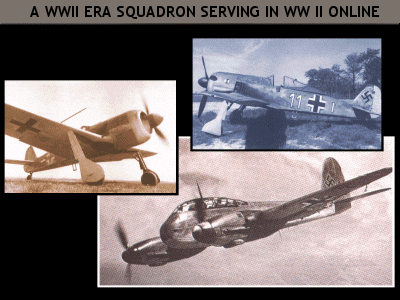
The FW 190 was introduced in 1941, and was considered the best prop plane in the world at the time. Fifth Staffel of II./JG26 was in fact the first operational unit equipped with the FW190 in the late autumn of 1941, the first operational Geschwader so equipped with the new aircraft. The first airfield that flew the new FW190 aircraft was at Moorseele, Belgium.
The RAF got their first look at the new aircraft later in 1942, when a FW109A3 piloted by Oberleutnant Armin Faber, Stab. III./JG2 mistakenly landed the aircraft at RAF Pembry in Southern Wales due to an error of dead reckoning navigation after a knife fight over the Channel on 13 June.
For the RAF, who had planned an SAS commando raid to steal one of the new fighter aircraft, the mistake was a gift. Extensive tests and evaluation revealed several critical shortcomings, including it's poor performance at high altitude. Based upon this information, the RAF established squadron countermeasures against the A3 series.
The blow for JG26 was very real. JG2 had been considered a close rival of JG26 in the Luftwaffe, both premier units deployed to Northern France and seeing almost daily combat over the Channel and South Wales. JG2 would never recover from the mistake, and JG26 benefitted from it.
However, now JG26 would have to fight on uneven ground in the A3 as a result of JG2's mistake. They knew how well the aircraft performed and after flying the aircraft successfully, fixed some major design flaws inherent in the A3. Operating primarily out of Abbeville, the unit became known as the "Abbeville Boys", their brightly painted yellow noses visible in close combat.
JG26 was likewise the first Geschwader equipped with subsequent variants of the FW190. A4's, A5's, and A6's came and went with blinding regularity as the team at Focke Wulf tried and failed to produce a war winner. It became extremely difficult for the Geschwader pilots, who were yearly learning to fly new aircraft, with new handling and performance characteristics. A7's pictured leaving their airfields in northern France, became the primary weapon of Jagdgeschwader 26 in the months of April, May and June 1942. But only 80 were every produced and soon the pilots were flying the new A8 series.
Even the A8 didn't last. Very few were produced and the pressure on the German industrial complex was growing. In the last months of the war, the unit would fly the brand new F series Wulfs early in 1943. Considered the most lethal FW190 variant ever produced. Very few F-series FW190s were built when the RLM ordered the production priorities shifted away from the expensive and maintenance intensive F series Wulfs in March 1944. The priority returned to building the A8, considered by many Luftwaffe pilots to be a better, more reliable aircraft. On paper the F series Wulfs were far more impressive, however, without the time to shake out the bugs, the nearly experimental aircraft was troublesome.
The last production model of the A series was also flown first by Jg26 beginning in autumn 1944. The FW190-A10 series prototype never left the plant floor and it's sisters, the FW190-F8, 9, and 10 series aircraft likewise were never produced. The FW190-F8 however, represented fully 60 per cent of all fighter bombers produced during WWII. Ironically, the powerful FW190-F series had planned prototype models for the FW190-F9 through the FW190-F16. The F-16 was a marvel, and although a production model was assembled for testing, it never left the ground.
After spring, 1943, JG26 was diced up and split apart. 2./JG26 and 6./JG26 were stationed in northern France for the majority of the war, flying out of Cambrai, Abbeville and Caen. 7./JG26 was sent east in the spring of 1943 and Gruppen I and III were sent east to relieve the beleagered JG52 now fighting desperately in the deadlock of Soviet winter. Units from JG54 "Greunherz", tired and depleted from the fighting in the East were spun out to France to recover. That unit (JG54) was later absorbed by JG26 in the autumn of 1944, as JG26 became the primary weapon the Luftwaffe had available in the West.
The unit was splintered, the elite units of Jagdgeschwader 26 sent to hot spots throughout the European and North African theatres. The 7th Staffel, JG26 "Rot Herz" went to Africa, Gruppen I and III went to the eastern front in exchange for Gruppen's from JG 54.
Eventually JG 26 came back to the West and at around the same time, Adolf Galland was promoted to General of Fighters and got a desk job in Berlin. Other than that, JG 26 would take off where it was needed and defend factories and military installations in France.
It's last commander was Major Josef 'Pips' Priller, who retired the war one if it's highest scoring surviving aces. Galland lived to, surrendering along with his unit, Jagdverband 44, at Nijmegen, in February, 1945.
Jagdgeschwader 26 retired the war as the single highest scoring unit of it's type, and the most respected. It not only surpassed it's fellow Geschwaders in kill tallies, it's own aces retired with kill records that surpassed that of the aces of the entire Royal Air Forces of Britain, Canada and Australia and that of the USAAF combined.
Fair Skies.
Navigate this site.
Jagdgeschwader 26 - A WWII era Luftwaffe squadron serving in WWIIOL.
