Discover
Thailand
A place unlike any other
From South to North, each exhibit merits close study. Before long
the visitor will see how they all fit together
Jarunee Taemsamran
 The
faster we move toward the new era, when technology and money influencing
modern live, the farther behind we are leaving the simplicity
of a life strongly rooted in Eastern traditions.
The
faster we move toward the new era, when technology and money influencing
modern live, the farther behind we are leaving the simplicity
of a life strongly rooted in Eastern traditions.
We live in condominiums or high-rises, keep the tropical heat
at bay with air-conditioning, socialise very little with our neighbours
and pay less attention to local culture and folkways.
Fewer people appreciate the value of what our ancestors strove
to create, and among those who do appreciate the past, many lack
the power and energy to conserve it.
But the founder of Ancient City-Lek Viriyahbhan or Sia Lek-has
raised appreciation of Thai culture to an art form at a park unlike
any other. It is fitting that "Viriyahbhan" means "family
of perseverance".
Sia Lek has spent his lifetime studying, collecting and researching
ancient ruins throughout the Kingdom and representing them with
loving care at the site in Samut Prakan. At 82, he still has a
clear vision for Muang Boran, as most local people know it.
The largest privately-owned open-air museum in the world, the
320-acre site is laid out in the shape of a map of Thailand. It
gathers together examples of artistic works related to Thai history,
culture, literature and architecture from all regions. It is a
must-see for anyone who wants to get a feel for Thailand as a
unified whole.
Established almost 30 years ago, the Ancient City is the only
place where visitors can see famous symbols from each province,
be they Bangkok's Grand Palace, Ayutthaya's Sanphet Prasat Palace,
Saraburi's Buddha Footprint or Sukhothai's main chedi of Wat Mahathat,
to name but a few.
The open-air museum also showcases regional lifestyles in re-creations
such as a northern village in Chiang Mai, and a floating market.
A Chinese-descended businessman who was highly successful as a
Mercedes Benz dealer, Sia Lek was said to have developed his interest
in Thai arts as part of a highly personal search for values in
life. Rather than put his considerable wealth into the pursuit
of more material gains, he resolved to give something back to
society.
He has never given a press interview, and visitors instead are
directed to the mission statement he wrote when he built Muang
Boran:
 "Only art has bestowed the refreshing spirit on human beings
up to the present day. Therefore, we should give more thought
and interest to art. ... Under the circumstances, I would like
to draw the attention of the world population to come to witness
our art, customs and culture.
"Only art has bestowed the refreshing spirit on human beings
up to the present day. Therefore, we should give more thought
and interest to art. ... Under the circumstances, I would like
to draw the attention of the world population to come to witness
our art, customs and culture.
"I am certain that at some time or another, they will benefit
the noble spirit and will be a good reminder to those who are
drawn to materialism. Thus, Muang Boran has been created."
When the Ancient City was being built, Sia Lek gave little thought
to the potential material benefits from tourism.
The founder did not see his creation as a way to make money; it
continues to be run as a non-profit organisation. It has never
been promoted, advertised or marketed commercially. People get
to know it only by word of mouth. The entrance fee has never been
increased from the original 50 baht.
Development continues to this day, but it has nothing to do with
modernisation or technology. The goal is to expand the space to
support the creation of more artistic works.
More recent developments have focused less on reproductions of
historical or archaeological sites, and more on representing the
beliefs and philosophy of the founder.
Admirers of Muang Boran have said that the newer works showed
the profound insights that Sia Lek had achieved through his lifelong
study of art and the way it represented life.
Among the new works is a large statue of Kuan Ying, the Goddess
of Mercy, carved from a single huge block of wood. There are also
representations of a Royal Barge Procession, and a botanical garden
of Thai literature.
As the brochure notes, the Ancient City "... was conceived
as a never-ending process that requires time for constant improvement.
"This is why Muang Boran has never had a fixed long-term
view of the project as a whole, and the reason why it is constantly
being developed and improved on."
 More
than 10 billion baht are said to have been invested in the faultlessly
accurate reproductions and other works at the Ancient City. The
owner's investment of time, mental, physical and spiritual strength
is incalculable. More
than 10 billion baht are said to have been invested in the faultlessly
accurate reproductions and other works at the Ancient City. The
owner's investment of time, mental, physical and spiritual strength
is incalculable.
The lack of promotion means that only a thousand or so people
visit the Ancient City in an average month. Continuing maintenance
costs are borne by the Viriyahbhan family.
However, the financial burden could one day prove to be too great,
says a worried Assoc Prof Srisakra Vallibhotama, a well-known
historian and an adviser to Sia Lek.
Realising that the Ancient City is a valuable tool for educating
people and instilling the love in Thai arts, history and culture,
the family members are now thinking of projects to draw more visitors,
especially young people.
For anyone with a love of the country, the Ancient City will elevate
your spirit and fill you with amazement at the perseverance of
a man who set out to bring value to his life.
And soon, you will understand the motto of the Ancient City and
the philosophy of its founder: "Effort belongs to man, the
results belong to heaven [to ordain]."
TOURING
THE SITE
Savour the details, but keep big picture in mind
The Ancient City showcases historical sites in various forms.
Some are replicas of real sites, some have been requisitioned
from old temples, some are the products of imagination from local
literature.
What all the displays have in common is that they are genuinely
Thai without any pretence. And they were created with scrupulous
attention to detail in terms of what was the custom at a particular
point in the history.
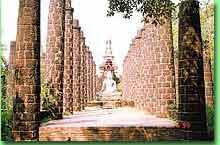 Visitors
enter the area, shaped like a map of Thailand, by the country's
southern tip. The entrance is in the form of a traditional city
wall and gate. Visitors
enter the area, shaped like a map of Thailand, by the country's
southern tip. The entrance is in the form of a traditional city
wall and gate.
The very first archaeological site is the stupa of Phra Maha That,
from Nakhon Si Thammarat. Not far away is the stupa of Phra Maha
That Chaiya, a notable Surat Thani site.
Dozens more interesting sites await. Among them:
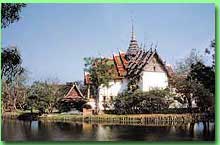
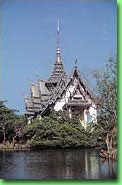
The Sanphet Prasat Palace: Once the symbol of the old capital
of Ayutthaya, it is now also the symbol of the Ancient City. The
replica was created after research of old documents, as well as
from other archaeological and historical sources in Thailand and
abroad.
The interior is richly and appropriately decorated with giltwork
and glass inlay patterns. The murals, depicting the story of Narai
in 10 different reincarnations, have been superbly executed.
- The Dusit Mahaprasat Palace or the Grand Palace: Known as the
oldest palace in Bangkok, it is still used for important royal
functions. The version at the Ancient City is meticulously based
on the principal structure which is believed to be in the original
decorative style. For example, the hand-painted decorative motifs
on the pillars and posts of the interior are taken from detailed
studies of the base of the Reclining Buddha at Wat Phra Chetupon
in Bangkok; the ceiling and woodwork from some private museums;
and the giltwork between the windows, depicting the 12-month royal
ceremony, from Wat Nang Nong in Thon Buri.
- The Floating Market: Most people are familiar with the floating
markets, widely advertised in brochures, at Ratchaburi or Taling
Chan district in Bangkok, but these are quite "touristy".
The Ancient City has taken a different approach,creating a genuinely
Thai atmosphere. The houses and shops on both banks, and the houseboats
floating peacefully, form the typical elements of a Thai community
settled along the banks of the Chao Phraya River.
- Ho Kham, Lampang: This timber house, built entirely without
nails, once belonged to the governor of Lampang province during
the Ratanakosin period. It stands high off the ground in the manner
of houses belonging to the northern Thai aristocracy. Currently,
Ho Kham houses an art collection that contains a number of rare
examples of classical Buddhist art. Be sure to go inside for a
closer look.
- The Anthropological Museum: A very carefully researched and
assembled collection of cultural exhibits, including native artifacts
drawn from every region. It is the largest collection of its kind
in the country.
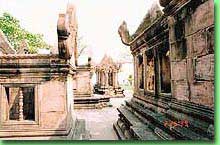
- Khao Phra Wihan (Preah Vihere): The original site is in Si Saket
province. The Ancient City version was constructed, appropriately
enough, on a hill, complete with a stone mount and stone sanctuary.
Only the size and scale have been reduced to blend in with both
the natural and man-made elements in the environment.
Climbing to the vantage point on top of the Wihan at the Ancient
City, you can enjoy a panoramic view of the entire area.
There are 109 sites in total, including more recent creations
that are just as faithful to the founder's spirit as the older
exhibits are.
The visitor can marvel at the detail and craftsmanship, but the
ultimate goal of Sia Lek is that we also learn from our encounter
with the Ancient City. He once wrote:
"In order to grasp the significance of Muang Boran, one must
acquire a broad knowledge of Thai history and culture, not by
viewing each separate manifestation in isolation, but by approaching
it as an integral part of a unified whole.
"But one should realise that each structure, reflecting as
it does the great splendour of the past, was not constructed in
isolation from the next. Each one relates to another in such a
way that it conveys a certain meaning in terms of our historical,
social and cultural achievements. Therefore, visitors to Muang
Boran should not limit themselves to viewing each thing in isolation."
Getting there by car: Take the expressway to the Samrong-Samut
Prakan exit. From the Samut Prakan intersection, turn left along
the old Sukhumvit road and drive to Km 33. The Ancient City is
on the left.
By bus: Take air-conditioned bus No.11 (Pin Klao-Paknam) to the
end of the line. From there, the No 36 minibus (four baht) passes
the site entrance.
There is also an eight-seat air-conditioned shuttle bus from the
Bangkok office (near Democracy Monument on Rajadamnoen Avenue)
every Monday to Saturday, leaving around 9:30 a.m. and returning
at 4 p.m. The fare of 180 baht per person includes two soft drinks
and the entrance fee. Reservations must be made at least two days
in advance. Call 226-1227, 226-1936-7.
Hours: 9 a.m. to 5 p.m., seven days a week. A brochure is available
in Thai and English.
Admission: 50 baht per person, plus 50 baht per car.
Bangkok Post March 18, 1999
|