Discover
Thailand
Harvest of delights
Famed for fruit of all kinds,
Chanthaburi and Rayong are now showing off their bountiful orchards
to tourists
Story And
Pictures: Jarunee Taemsamran
 Thailand
abounds in a rich variety of fruits, but at this time of year
enthusiasts seek out the special pleasures of the king and queen
of fruits-durian and mangosteens. Thailand
abounds in a rich variety of fruits, but at this time of year
enthusiasts seek out the special pleasures of the king and queen
of fruits-durian and mangosteens.
For connoisseurs, there is no better place to work up an appetite
than in the orchards of Chanthaburi and Rayong.
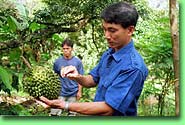
The mouth-watering taste and exotic smell of durian has impressed
foreign visitors, especially those from Hong Kong, Taiwan, Malaysia
and Singapore among others.
Durian has become so popular that in the last two years, Chanthaburi
has drawn sizeable crowds to its World Durian Fair.
"It used to be a headache for provincial governors to sell
all this durian before it turned rotten," an official of
the Tourism Authority of Thailand joked recently.
Chanthaburi and neighbouring Rayong boast soil and growing conditions
ideal for durian. But the two eastern provinces are also known
for their bounty of rambutan, lychee, longong, papaya and mangoes-all
are abundant at this time of year.
The best place to go is straight to the source: Some orchards
are now open to tourists who can pick and sample fresh fruit.
The Tourism Authority of Thailand is encouraging more orchards
to open their gates as part of a growing trend toward agricultural
tourism, said Chawaikit Rattanakup, director of the regional TAT
office.
The idea is not completely new. Some orchard owners used to welcome
visitors but they found that many tourists lacked understanding
and sensitivity. They picked immature fruit from trees and damaged
overall production.
"We have to educate [tourists] and create a better understanding
about the idea of agricultural tourism. Now it is more clearly
understood," Mr Chawaikit said.
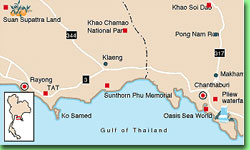
In Chanthaburi, three orchards that are open for visitors: Suan
Pai Thong, Suan Wong Wit and Suan Sadetyad. The owners are younger
farmers with some novel ideas and a good understanding of the
agricultural tourism idea.
 At
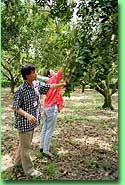
Suan Wong Wit, for example, owner Kris Wongwit encourages visitors
to take leisurely walks in the orchards. There are also demonstrations
of fruit picking as well as processing. At
Suan Wong Wit, for example, owner Kris Wongwit encourages visitors
to take leisurely walks in the orchards. There are also demonstrations
of fruit picking as well as processing.
Another mouth-watering attraction is the chance to consume an
unlimited amount of fr At Suan Supattra Land in Rayong, the owners
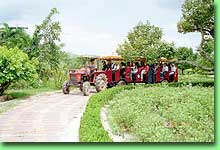
began taking steps to accommodate tourism three years ago. Visitors
to the 700-rai site can take a sightseeing trailer (for an average
of 20 baht per person) or rent a golf cart (200 baht an hour)
to see the entire spread.
The orchard is clearly divided into separate cultivation areas
for durian, rambutans, mangosteens and so on. There is also a
park with a pool and artificial waterfall for visitors. A bird
park is on the drawing board as an added attraction, a guide said.
Some travel agents in Taiwan, Hong Kong and Malaysia have already
added visits to the farm to their clients' itineraries.
To take advantage of growing tourist interest, the eastern provinces
have been expanding their annual fruit fairs to include a variety
of activities plus the sale of handicrafts and other products.
On the wilder side
The first half of the year is the best time to visit Chanthaburi
and Rayong when the supply of fruits is abundant, but efforts
have increased to promote the provinces as all-season destinations
for people interested in nature tourism.
Pong Nam Ron district in Chanthaburi is seen as a potential showpiece.
 Twenty
years ago, the district near the Cambodian border was known, if
not feared, as an enclave of communist insurgents. Today it is
seen as an attractive destination blessed with cool weather and
good rafting streams. Twenty
years ago, the district near the Cambodian border was known, if
not feared, as an enclave of communist insurgents. Today it is
seen as an attractive destination blessed with cool weather and
good rafting streams.
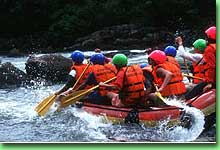
Two tour operators pioneered rafting trips in the area last year,
and the Tourism Authority of Thailand believes local people need
to become more involved if the district is to fulfill its promise
as an eco-tourism site.
Wang Khon Chalet is one of the local operators.
"I have lived here since I was born. I swam in this klong
when I was young so I knew its beauty, especially when I discovered
the rafting route," said owner Poonpongsak Rungpracha.
"This can be an ideal rafting spot. Both adults and youngsters
can enjoy the activity together."
The seven-kilometre Klong Pong Nam Ron is graded level 2-3, making
it accessible to rafters without a great deal of experience. It
now attracts as many as 1,000 visitors a day during the peak season.
The TAT is also developing the Khao Chamao-Khao Wong national
park for ecotourism, with the recently discovered Klong Pla Kang
waterfall as a magnet.
Covering 52,300 rai and straddling Rayong and Chanthaburi provinces,
the park boasts fertile, pristine forests and a good selection
of wildlife. Besides the Khao Chamao waterfalls, Morakot cave
is a highlight.
The 33-year-old park attracts about 300,000 tourists a year, mainly
local people.
The Klong Pla Kang waterfall has been an exciting find, and the
Forestry Department is working with the TAT on ways to ensure
that it can thrive as a sustainable tourism development. There
are strict controls, for example, on bringing non-biodegradable
materials into the park.
Khao Chamao sub-district in Rayong, just 170 kilometres from Bangkok,
is home to the Chamao Ranges and the last undisturbed forest in
the province. The population of about 20,000 makes its living
from hillside orchards of durian, rambutan and mangosteen. The
area's relative remoteness has helped preserve its natural beauty.
Formally established as a sub-district six years ago, Khao Chamao
will stage anniversary celebrations from May 29-31. On the schedule
will be a reforestation exercise focusing on the planting of rare
trees associated with local legends, as well as herbs.
As well, a cross-country mountain bike rally is planned along
a hillside route that passes the Khlong Plakang and Khao Chamao
waterfalls, the Khao Chook reservoir, fruit orchards and rubber
plantations.
 Participants
can choose routes of 15, 25 or 40 kilometres. The event will begin
with an early-morning offering of alms to monks. Participants
can choose routes of 15, 25 or 40 kilometres. The event will begin
with an early-morning offering of alms to monks.
For more information, contact the sub-district office at (038)
969238-9.
GETTING THERE
By car: Take Sukhumvit road No 3 from Bangkok via Pattaya, Ban
Chang, Rayong and Chanthaburi (291 km); or Highway 36 through
Chon Buri, Si Racha and Rayong (254 km); or Highway 344 via Chon
Buri and Klaeng to Chanthaburi (245 km).
By Bus: Both air-conditioned and regular buses leave the Eastern
(Ekamai) bus terminal (391-4164) every day starting from 5 a.m.,
with the last buses returning at 11 p.m.
ACTIVITIES
Fruit farms:The best time to visit fruit farms is in the first
half of the year with the peak harvest season in May.
*Suan Wong Wit in Chanthaburi, (01) 861-6258.
*Suan Supattra Land in Rayong, (038) 892048-9. Reservations must
be made in advance.
Rafting: The best time to go rafting in Chanthaburi is during
the rainy season from June to November. To arrange outings, contact
Wang Khon Chalet (01) 663-7089; or Yiwa Tour (039) 322904, 312964.
ACCOMMODATION
* Maneechan Resort and Sports Club, (039) 343777.
* Wang Khon Chalet, (01) 663-7089.
For more information on Chanthaburi and Rayong attractions, contact
the TAT regional office, (038) 655420-1, 664585; or the Chanthaburi
Tourist Business Association, (039) 663708-9.
|